

Growers of African violets believe in the 1/3 pot rule, which says that they should be planted in a pot no bigger than 1/3 the diameter of the plant. For example, if your plant is 9″ in diameter, you should use a pot no bigger than 2″ in diameter.
There are two main claims:
- Larger pots are too wet, which leads to root rot and the death of the plant.
- Plants in large pots won’t flower until the root ball fills the pot, so large pots delay flowering.
I didn’t buy it! Here’s why.
- Plants have no intelligence and don’t know what size pot they have. They don’t even know they are in a pot.
- Smaller pots are actually wetter than large pots. To understand this, see: Are Small Pots Wetter?
- What about a seedling 1/2″ in diameter? Does it need a 1/6″ pot? They don’t exist.
- Community pots (several plants in one pot) are routinely used for seedlings and small leaf propagations. They grow fine in pots that don’t follow the 1/3 rule.
Based on over 50 years of plant experience and my knowledge of basic plant biology, the 1/3 rule makes no sense, so I decided to test it. Here is what I found.
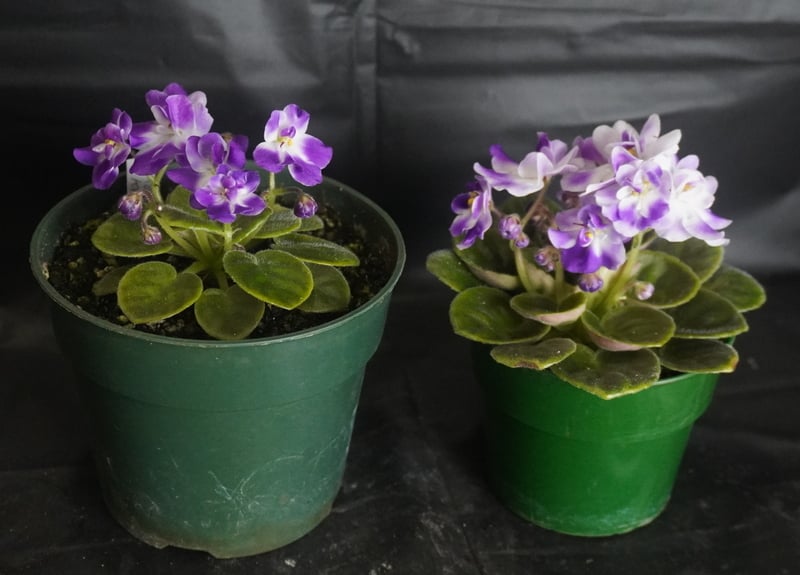
Key Takeaways
- The 1/3 pot rule is a myth!
- Large pots do not prevent flowering.
The Ultimate Big Pot Test
We were having a discussion about pot size in an African violet Facebook Group, and I was challenged to try and grow one in a big pot. I accepted!
The test plant was a leaf propagation from Guelph’s Christmas that had been growing in a 2″ pot for 4-6 weeks. It had a 3″ diameter. Even though this pot breaks the 1/3 rule for being too large, the plant is doing fine. I moved the plant into an 8″ pot that holds about 1.5 gallons of soil. It is 8 times the recommended size based on the 1/3 rule.
The media is my standard mix for African violets and streptocarpus: 50% Promix HP + 50% perlite. It is top-watered with 100 ppm nitrogen fertilizer (NPK ratio 3-1-2) and grown under LED grow lights at a DLI of 6, in a grow tent right beside my indoor tomatoes. The tent and LED light are from Spider Farmer. Some may believe that a DLI of 6 (10 hours) will stress the plant, but 1) the science says it won’t, and 2) I didn’t have another large spot to put it 
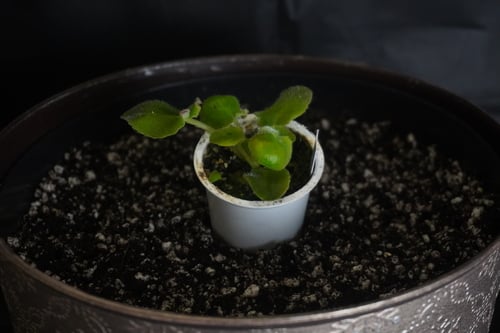
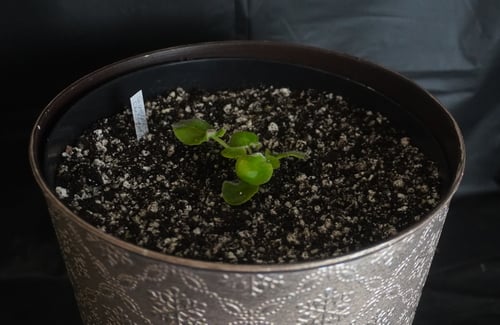
The left image shows the plant in the original 2″ pot, and the right image shows the same plant right after potting up (October 13) in a pot that is 8 times too large. It is in a standard green plastic pot. The silver pot is just a decorative cover pot.

Will it survive? Will it bloom as a normal-sized plant, or does it need to fill the pot before it blooms?
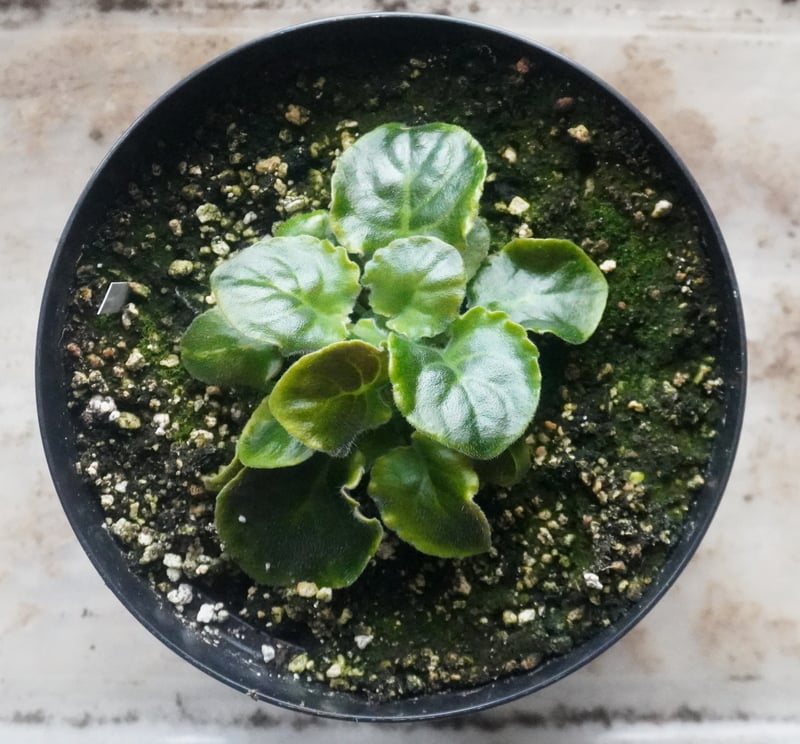
Nov 19 Update. The plant is growing well. No sign of root rot or a dying plant! Growth is tighter under the high light, and leaves are a bit more yellow, but the high light does not seem to be harming the plant. No buds yet.
I’ll update this image in a couple of months.
Small vs. Large Pot Test: Standard-Sized AV
This test compares growth in two different-sized pots to see the effect on both growth and flowering for a standard-to-large size African violet called Guelph’s Christmas.
I selected two leaf propagations and tried to match their size as closely as possible. Both were 2″ in diameter at the start of the experiment, and both had a good root system. The 1/3 rule recommends a 2/3″ pot for growing them. I did not have a pot that small, so I used a 2″ pot and a 4″ pot.
The media is my standard mix for African violets and streptocarpus: 50% Promix HP + 50% perlite. They are top-watered with 100 ppm nitrogen fertilizer (NPK ratio 3-1-2) and grown under LED grow lights at a DLI of 1.7 (13 hrs, 2400 lux).
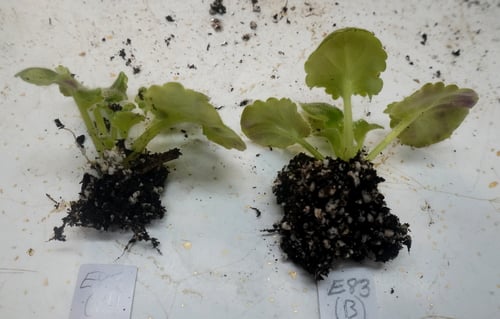
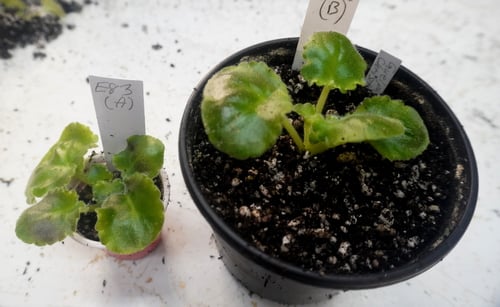
Plants used, showing them before potting up (left one for small pot (A)) and right after potting up (Aug 23).
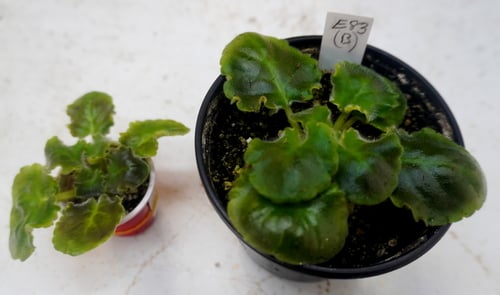
Sept 17 Update: Three weeks into the experiment, both plants are growing well. Clearly, the large pot did not “kill” the plant, as so many claim. The plant in the large pot is now slightly larger than the one in the small pot.
Oct 15 Update: Both are growing well. The one in the smaller pot has finally reached a size that is suitable for the small pot – according to the 1/3 rule. The one in the larger pot is now bigger than the one in the smaller pot. Neither plant has buds.
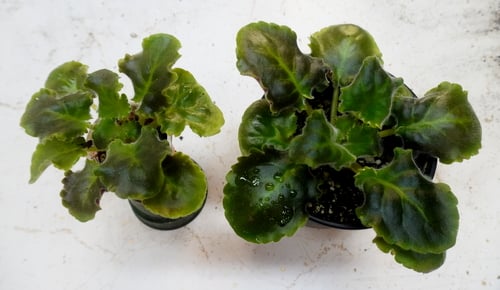
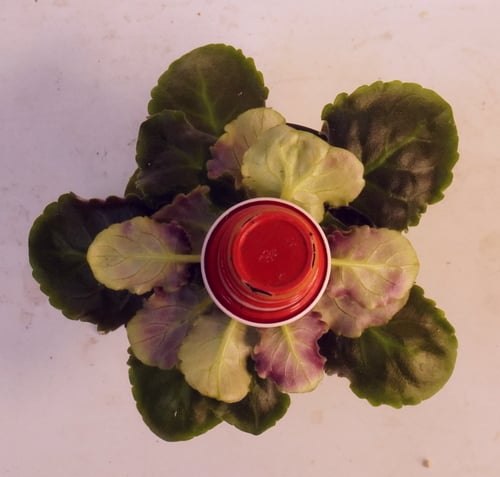
Nov 18 Update: Both plants are growing well. The one in the large pot has two flower buds developing. The one in the smaller pot has none.
Conclusion:
- The plant in the large pot showed no signs of root rot and grew better than the one in the small pot.
- The plant in the large pot also produced flowers first.
Small vs. Large Pot Test: Semi-Miniature AV
This test compares growth in two different-sized pots to see the effect on both growth and flowering for a semi-miniature African violet called Munchkin Kisses.
I selected two leaf propagations. The larger one had a couple of roots starting and was potted up in a small 2.5″ square pot. The smaller plant had no roots and was potted in a larger 4″ square pot. Both were bagged for two weeks to allow roots to form.

The media is my standard mix for African violets and streptocarpus: 50% Promix HP + 50% perlite. They are top-watered with 100 ppm nitrogen fertilizer (NPK ratio 3-1-2) and grown under LED grow lights at a DLI of 1.7 (13 hrs, 2400 lux).
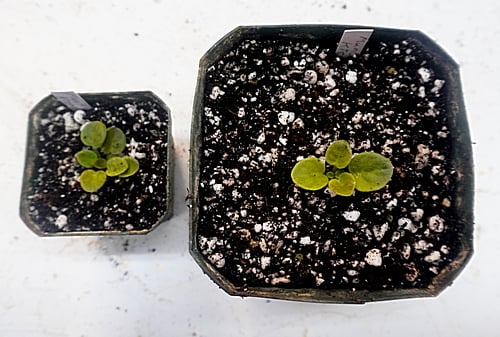
Nov 18 Update: Both plants are doing well. The plant in the large pot has the largest leaves. The small pot has more leaves. Both plants are starting to make suckers, which is common for this clone. The suckers will be left on the plant for this experiment.
Buds have just started to form on both plants.
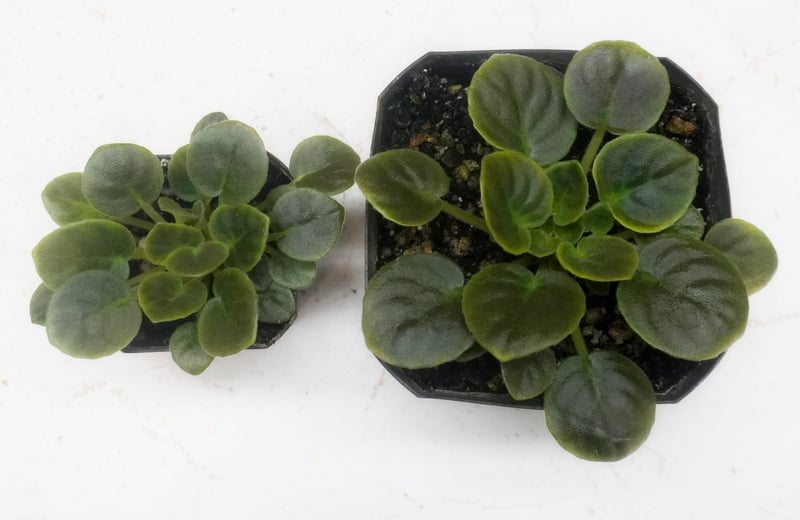
Conclusion:
- The plant in the large pot showed no signs of root rot and is growing as well as the one in the smaller pot.
- Both plants are forming their first flower buds at the same time. Pot size has nothing to do with the rate of flowering.
Large Pot Test For a Trailing African Violet
What happens when you grow a tiny Pixie Runaround Sport in a big pot?
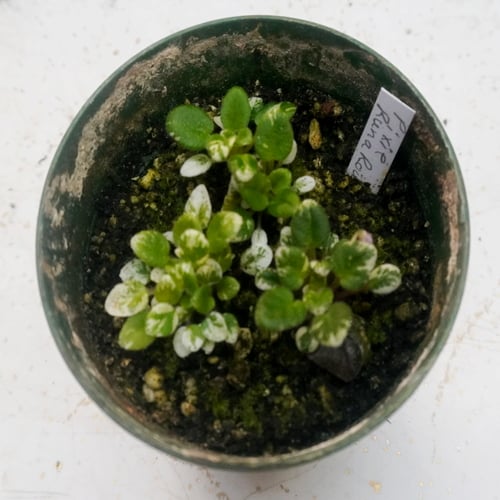
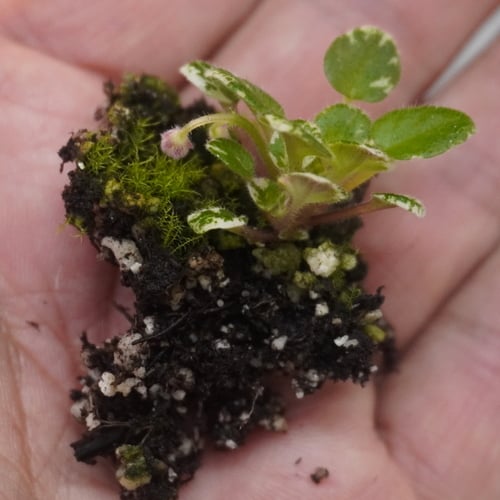
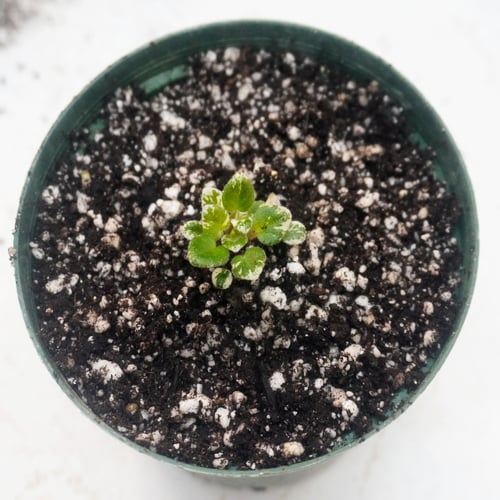
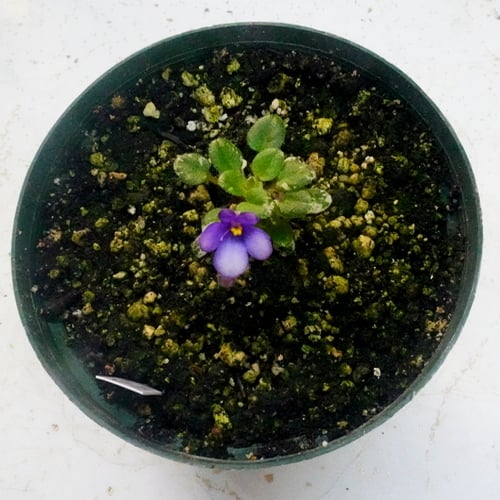
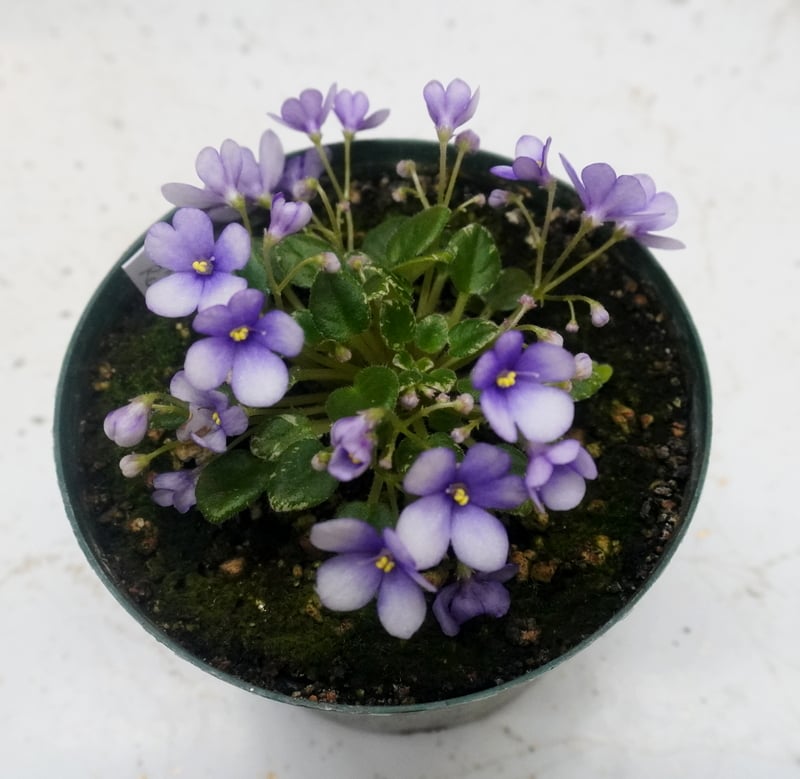
The plant was grown in a community pot that was way too big, according to the1/3 rule, but all three plantlets grew well. At the time of transplant, it was about 1″ in diameter. According to the 1/3 rule, it should not grow well in anything larger than a 1/3″ pot! It was planted in a 4.5″ pot, which is 13 times too big.
Conclusion:
- The plant grew just fine with no evidence of root rot.
- It started flowering soon after transplant and has continued to flower. The large pot did not stop flowering.
The media is my standard mix for African violets and streptocarpus: 50% Promix HP + 50% perlite. They are top-watered with 100 ppm nitrogen fertilizer (NPK ratio 3-1-2) and grown under LED grow lights at a DLI of 1.7 (13 hrs, 2400 lux).
Tiny Starters In Big Pots
What about very small starters from leaf propagation? Can they be grown in an oversized pot?
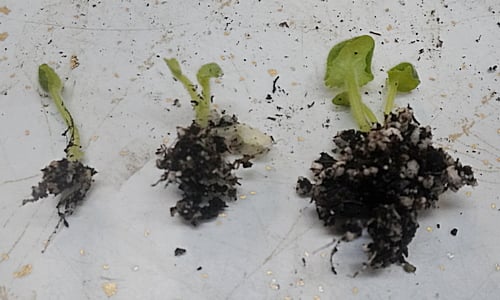
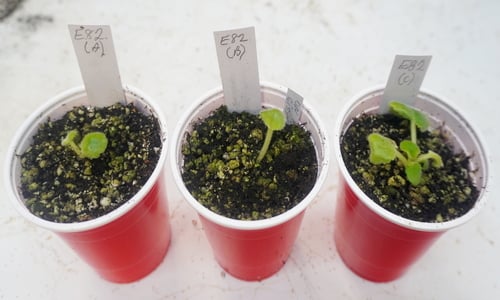
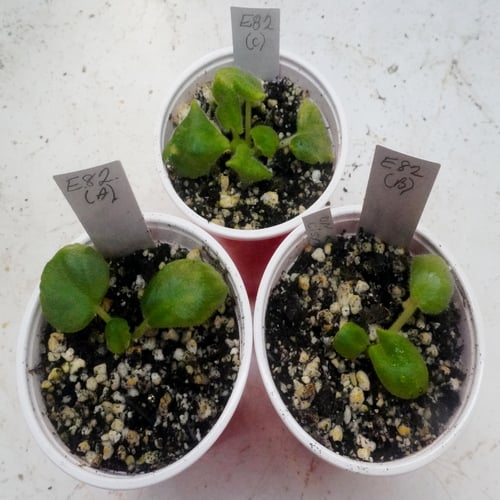
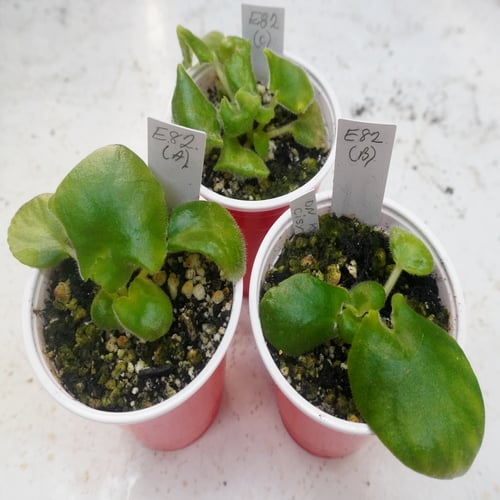
A large African violet (NOID) was used to make leaf propagations. Three of the smallest ones were selected and potted in 3″ pots and grown in my standard mix for African violets and streptocarpus: 50% Promix HP + 50% perlite. They are top-watered with 100 ppm nitrogen fertilizer (NPK ratio 3-1-2) and grown under LED grow lights at a DLI of 1.7 (13 hrs, 2400 lux).
According to the 1/3 rule, these plants should have developed rotten roots and died.
Conclusion:
Many growers of African violets believe in the 1/3 pot rule, which says plants should be planted in a pot no bigger than 1/3 the diameter of the plant. For example, if your plant is 9″ in diameter, you should use a pot no bigger than 2″ in diameter.
Each of the above experiments demonstrated:
- Plants have no trouble growing in larger pots.
- There is no evidence that large pots cause root rot or slow plant growth. Small pots are not wetter, as frequently claimed.
- Large pots do not inhibit flowering. They flower as quickly in larger pots as in smaller pots. Plants flower when they reach a mature size, which has nothing to do with pot size.
The 1/3 rule is a common show rule. The African Violet Society of America says, “A general rule is that the pot should be one-third the diameter of the leaf span”. Many have taken this show rule and assumed it is a cultural rule. This is NOT a culture rule; it is a show rule.
The 1/3 pot size rule is a complete myth.


