Propagating African violets from leaves is both easy and a lot of fun. If you have never tried it, you really should. It is one of the coolest things in nature.
If you research the topic a bit, you will find several ways to propagate African violets from leaves, with no evidence as to which way is best. I decided to try several methods and compare the results to determine “the best way”. Here is what I found.
To watch the video version of this post, click: https://youtu.be/czuPJQI9RXQ
Key Takeaways
- All the methods produce babies, but they are not all equal.
- The water method was fastest.
- A split leaf produces the most babies.
Different Methods of Propagation
These are the methods that are tested:
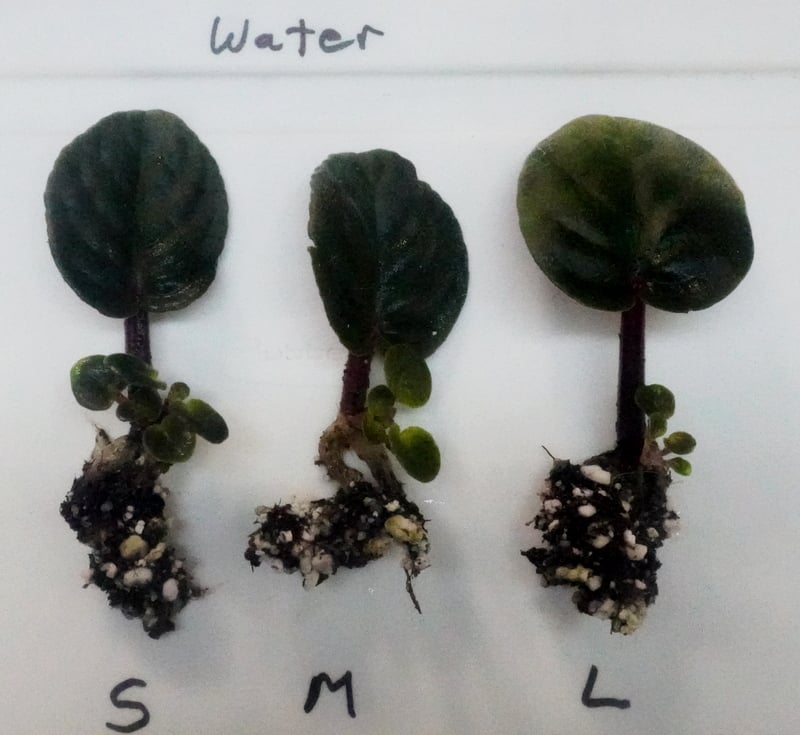
- Rooting in Water: Insert whole leaves into water so the bottom of the petiole is submerged and the leaf blade stays above the water. Once roots form, move the leaf to soil for further propagation.
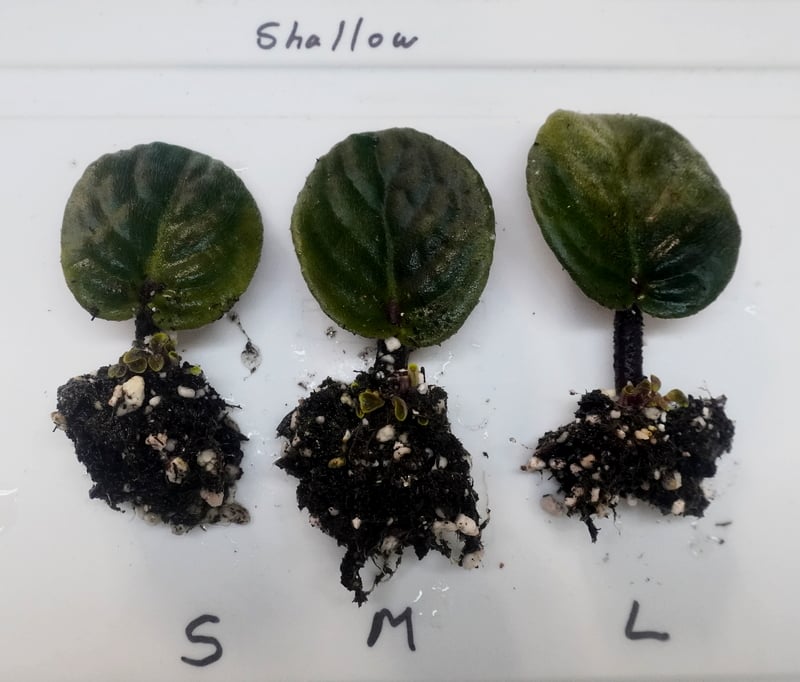
- Shallow in Soil: Cut the petiole to about an inch long and insert it into potting soil so the petiole is just below the soil surface. It is situated at about 45 degrees to the surface of the soil.
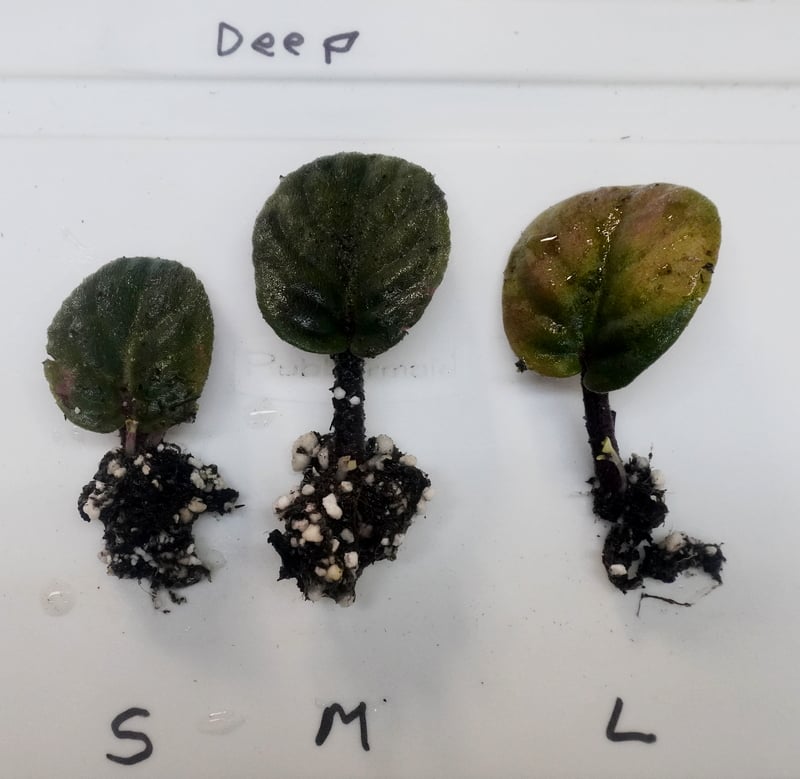
- Deep in Soil: The petiole is cut to about an inch in length and inserted in potting soil so that the leaf is vertical and the tip of the petiole is deep in the soil.
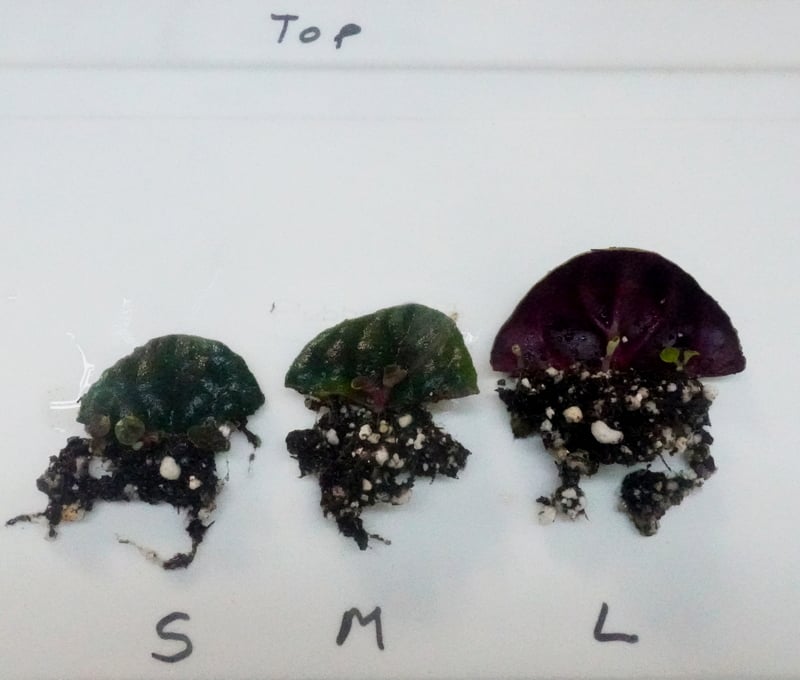
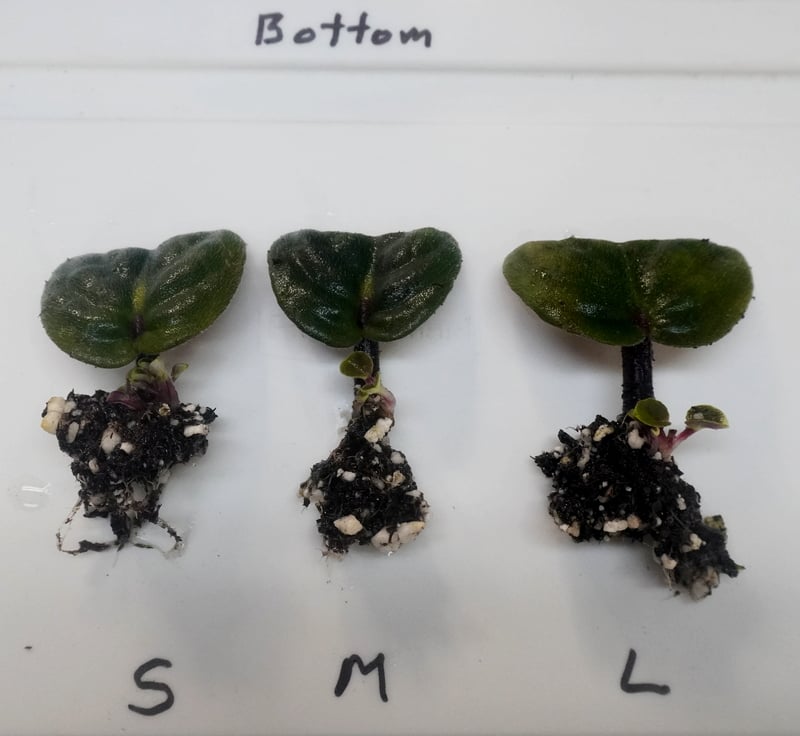
- Bottom of the Leaf: A leaf is cut horizontally across the blade, forming two halves. The lower section with the attached petiole is inserted in the soil using the shallow method.
- Top of the Leaf: The top part of the leaf from the above cut is used. It is inserted so the bottom of the leaf is partially below soil level.
Each of these methods is demonstrated in this video: https://youtu.be/czuPJQI9RXQ
Lots of new gardeners like to root things in water. For some reason, they think it is easier than rooting in soil. The problem with this method is that roots developing in water do not grow well once the cutting is moved to soil because it then has to regrow a new type of root. In theory, this is a poor choice for rooting African violets or any other plant.
To be honest, the only reason I included the water method in the experiment is that it is popular. I would “never” use this method, but …… see the results below.
The method that places the leaves in a shallow orientation seems to be the most popular one for propagation in soil, and therefore it should perform the best – we’ll see.
The bottom and top of leaf methods are not commonly used for African violets, but I have been using them regularly for streptocarpus, and since the two plant groups are very closely related, I figured the method should be tested.

The Experiment Design
I purchased a flowering NOID (no ID) from a local nursery. It is a fairly common type and has normal leaf structure. It will form a medium to large plant. I removed the flowers, kept it debudded, and grew it for about 2 months to increase the leaf count.
The propagation experiment started on day 0 (July 29). Leaves grown in water were transferred to soil on day 46, and final results were determined on day 57.
Most of the leaves were removed from the plant and organized into three types. Large leaves were taken from the outer row of leaves. The small leaves were taken from an inner row, and the medium leaves were taken halfway between small and large. An effort was made to make the final selected leaves in each group as similar as possible. Then they were randomly selected for each propagation test.
Each of the petioles was cut about 1″ below the blade, at a 45-degree angle.
The leaves in water were placed in a small jar covered with clear plastic wrap. Three holes were made, one for each leaf. Water was topped up as needed so that the tip of each leaf was always in water.
My standard potting media was used for soil rooting. It is 50% Pro-mix HP plus 50% perlite. Soil was put in a plastic tray that had a lid. Holes were punched in the bottom of the tray.
The tray was kept closed most of the time, but during the first week, water droplets formed inside. The tray was opened, and the excess water was removed. If the soil is too wet, the leaves will rot.
All the leaves were placed under an LED grow light, with a lux of 4,300 and a DLI of 2.9. The soil tray was rotated every few days to make sure all leaves received the same light.
As soon as most of the leaves rooted, the lid was removed from the soil test. The leaves in water rooted very quickly, and on day 46 were transferred to a single plastic pot. The uncovered leaves were top watered with my usual fertilizer solution (100 ppm nitrogen).
Which Method is Best for Propagating African Violets
Which Method Worked: All of the methods worked.
Speed: Babies developed most quickly in the water method. This might be due to the fact that they are more visible in water than in soil, but even at the end of the experiment, the babies that started in water were the largest, supporting the observation that they formed the quickest.
The second-largest babies were found on the bottom leaf propagations.
Best Root System: The largest root system was produced by shallow planting. This might indicate that these babies will grow the best long term.

Water culture had a small root system, but this is probably due to the fact that they had not been growing in soil for very long.
Individual Babies: All babies that rooted on the petiole produced one cluster of babies. This might be a single crown or several crowns growing on top of one another. As they grow, these will be more difficult to separate from one another. On the other hand, the babies growing on the top of the leaf grew at various points along the leaf edge since they tended to grow at the base of leaf veins. That means the babies are naturally separated from one another, which makes it easier to separate them once they get bigger. Separation will also be less stressful and produce less root damage on the babies.
Smallest Root System: The least developed root system and the least developed babies were found with deep planting. Of all the methods, this is probably the worst option.
Best Leaf to Use: The common advice is to use a relatively new leaf that is fully formed. In this experiment, that would correspond to the medium leaf. Users are told not to use older leaves (our large), and nobody really uses the new small ones.
All three leaves, small, medium, and large, performed well. I see no reason not to use the older leaves since you usually remove them anyway when a plant is pruned.
The medium-sized leaf performed the best in all methods, but small and large were close seconds, and in several cases they were just as good. The one exception was the top leaf method, where the small leaf actually performed better than the medium one.
Final Words
Each tested method produces babies. The water method may be the fastest, but starting them in water is more tedious than just sticking them into a pot of soil. I’ll stick to the soil method.
The myth that old leaves are not suitable for propagation is false. Any green leaf can be used.
I did this test with one clone. Results may be different for other types of African violets, but I don’t expect them to be drastically different.
How To Maximize Production
There are two ways to increase the number of babies you get from a leaf: cutting the leaf in half and removing babies early.
By cutting a leaf in half, both halves produce babies. This produces more babies from a leaf, and it gives you a better chance of success if one half fails.
A second way to increase the number of propagations is to harvest them as smaller plants. This is fully explained in this video:

Results
The following are images of the final results.
Water Method
Shallow Planting
Deep Planting
Bottom of Leaf
Top of Leaf