

Growing African violets under lights allows you to control the amount of light the plants receive by changing the type of light, the distance between the plant and the light, and even the duration of light used. But how much is the best amount of light for growing and flowering African violets?
I decided to dive into the research to see what the experts say.
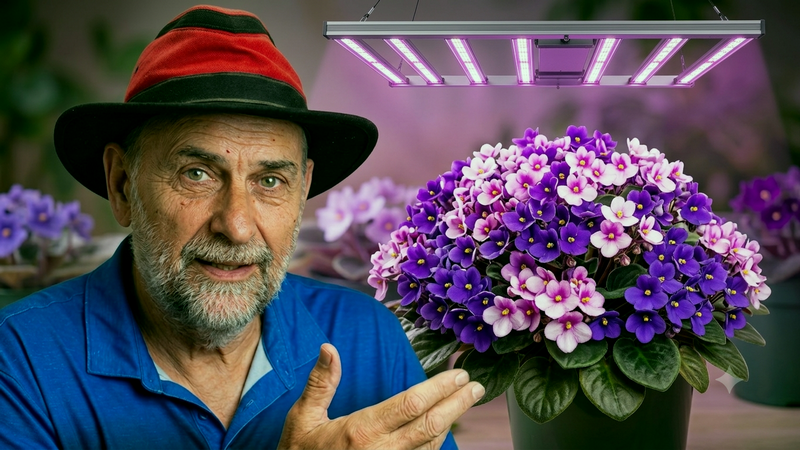
Key Takeaways
- The best light level for African violets is 10,000 lux with a DLI of 8.
Best Light Level for African Violets
To determine this, I have gathered together a list of research papers and collated their recommendations. See the next section for the details of the research reports.
Light levels are reported in a number of different ways, including foot-candles, lux, PPFD, and DLI. A detailed explanation of these, along with formulas to convert one to another, can be found in What is DLI – the Daily Light Integral.
The conversion of these units is approximate and depends on the type of light, but the numbers used here are accurate enough for home use. The best light unit for home growers to use is the DLI. It not only takes into account the intensity of light, but also the duration. DLI measures the total amount of light a plant gets.
The following table lists the “best” light levels from the research reported below. If a duration is not listed, I have assumed a value of 12 hours to calculate the DLI.
| Research | Light Intensity (lux) | DLI |
|---|---|---|
| Seed germination was affected by both high and low light | 2,500 – 10,000 | 1.6 – 6.5 |
| Behnaz Ghalecahi et al | 8,000 | 6.9 |
| 1956, by Louisiana State University | 6,500 | 5.3 |
| plug production in greenhouses | 10-15 | |
| number of flowers | 3.1 to 9.3 | |
| Reducing the light intensity of full sunlight | 16,000 | 10.4 |
| best condition for growth | 5,000 – 10,000 | 3.2 – 6.5 |
| University of Florida/IFAS | 11,000 – 13,000 | 7.1 – 8.4 |
| Average (not including seeds) | 10,000 | 7.7 |
I had previously published a table of houseplants and best DLI values. For African violets, it suggested a range of 4 – 12, with an average of 8. That is close to the average from the above table. According to research, the best light level for African violets is 10,000 lux with a DLI of 8. You can grow at lower light but keep it above 5,000 lux and a DLI of 4.

Light Levels Used by Home Growers
I measured the light I use for African violets. 5,000 lux for 13 hours is a DLI of 3.5. That is less than half the recommended amount. The plants grow with flat leaves, indicating they are getting enough light, and they flower well. But the science says I could be producing even more flowers with more light.
What does the American African Violet Society recommend? On their website, they give examples of several respected growers and their setups. Only a couple provide the data needed to calculate DLI values.
Dr. Minh Bui uses fluorescent light producing 3000-3500 Lux for standards, and 4500-5000 Lux for minis and semi-minis. They are on for 7 hours a day, producing an average DLI of 1.2 for standards and 1.8 for minis.
Karin Peters uses 3000 lux for 10 hours, producing a DLI of 1.6.
The African Violet Magazine, in July 2021, reported on some testing for a new T8 type LED with IR in the light. Out of the 4 comparisons, only one used a proper control and provided enough details to make the results meaningful. The new light had a PPFD of 50 with a DLI of 1.4. The old light had a PPFD of 31 and a DLI of 0.9. The new light improved growth rate and bloom number, showing the value of more light. The testing never tested the benefit of the IR because proper controls were not used.
These values are about 25% lower than those recommended by research.
What Do Home Growers Use?
I had a look online. One post recommended a DLI between 0.5 and 2. A recent post on Facebook showing readings taken with the Photone App with a homemade paper diffuser showed a DLI of 2.3. Most home growers use a DLI that is well below the level research recommends.
Best Light Level for Flowering
The scientific studies examined above were looking mostly at plant quality, answering the question, what light level is best for producing plants. A different question can be asked. What is the best light level for producing an abundance of flowers?
A study from 1994 looked at that precise question and concluded the number of bloom stocks per leaf increases up to a DLI value of 4. When a value of 8 was tested, they found no significant increase. They did not test values between 4 and 8 to determine a more precise value.
So far, the discussion is about flowers per leaf. But what about producing more leaves, which would in turn produce more flowers?
The same group also studied this question and concluded that the maximum number of leaves is produced with a DLI of 7. Increasing the DLI above 7 did not increase the number of leaves.
An earlier research group determined that a DLI of 0.8 produced a very low level of flowering while a level of 1.6 produced good flowering.

What does this mean for homeowners?
Homeowners should strive for a DLI = 7, for both maximum leaf growth and maximum flowering. A minimum amount should be a DLI = 4.
How Does Day Length Affect Flowering?
African violets are day-neutral plants. Day length does not impact flowering. What is important is that the plant gets enough light to produce flowers at a maximum rate, and that is determined by the DLI.
Light Level Research for African Violets
Since African violets have been grown for quite a while, the research on the topic is mostly old. The following are the studies and reports I found.
Seed germination was affected by both high and low light (fluorescent), as reported by Ronn Nadeau in African Violet Magazine, 2009. Below 2,500 lux, seeds germinated more slowly, with a germination rate of 30% vs the control value of 50%. At 14,000 lux, seeds germinated more slowly, with a germination rate of 16% vs the control value of 50%. Germination was consistent between 2,500 and 10,000 lux.
Behnaz Ghalecahi et al. tested various plant parameters at 4,000, 8,000, and 11,000 lux, using fluorescent lamps and a day length of 16 hours. They found that both plant growth and flowering increased with increasing light intensity. At 11,000 lux, plants had a dense leaf form and flowered sooner, but flowers did not last as long. A level of 8,000 lux produced good growth and flowering.
An old report from 1956, by Louisiana State University. An intensity of 100 foot-candles ( 1,076 lux) of light for a 12-hour duration is sufficient to produce a healthy plant of good form and foliage color but insufficient for any appreciable flower production. A value of 600 foot-candles (6,500 lux) for 12 to 18 hours per day produced good plants with lots of flowers.
A 2016 review of numerous studies for African violet production found the following results:
- African violets are day-neutral. Day length does not affect flowering.
- During plug production in greenhouses, the DLI is 10-15 (mol/m 2 /day) but can be as low as < 2 in winter.
- Increasing the DLI from 0.31 to 1.9 doubles the number of leaves from 22 to 44.
- The number of flowers, buds, and inflorescences per plant increased as DLI increased from 3.1 to 9.3.
- Reducing the light intensity of full sunlight (7,500 foot-candles, 81,000 lux) to half sunlight (1500 foot-candles, 16,000 lux) increased leaf area while also reducing problems such as sunscald (solarization), chlorosis, and backward leaf curling.
- A light intensity of 5,000 to 10,000 lux was the best condition for growth and ornamental value, i.e., photosynthesis, flowering percentage, number of peduncles, number of florets/peduncle, petiole length, and leaf area.
- The intensity of light is the primary factor influencing flower initiation, while average daily temperature is the primary factor influencing the rate of inflorescence development.
An African violet Production guide from the University of Florida/IFAS says that listing a specific light level for African violets is difficult because of variation between cultivars, but a range of 1000 to 1200 foot-candles (11,000 – 13,000 lux) is satisfactory for most cultivars. Cultivars that produce dark green leaves with long petioles may require higher light levels, especially if few flowers are produced, while plants with light green foliage may require lower levels.
As an aside, they agree with my recommendation for fertilizer: an NPK ratio of 3-1-2.
Another review from 2023 reports that pot-grown plantlets exhibited maximum net photosynthesis at
a moderate light intensity (PPFD) of 70 µmol m-2 s. Values of 35 were too low and 100 did not increase photosynthesis. A PPFD value of 70 is about 5,200 lux for cool white fluorescent and 5,400 for white LED.
Temperature is Also Important
The number of flowers, buds, and inflorescences per plant, and the number of flowers and buds per inflorescence, increase as DLI increases from 3 to 9. This treatment induced a maximum of 6.8 flower stalks/plant at 18 °C and 9.1 at 24 °C. A maximum of 42 flowers/plant could be produced when daylight (in a greenhouse) was cut by 75%, and when plants were exposed to 27 °C.
Flower initiation and development were inhibited when plants grown in a greenhouse were exposed to a DLI of less than 2.
Both day and night temperatures must be high to stimulate a greater number of flower stalks.
Should Old Leaves Be Removed?
A lot of hobby growers remove the outer set of leaves, claiming that they suck energy away from the plant and thereby reduce flowering. That is a myth. Testing the photosynthesis rate showed that the older whorl of leaves was approximately 50% of the rate observed in the younger leaves. That is still very beneficial for the plant.
Healthy outer green leaves contribute to the plant’s energy and should be kept on the plant for better flowering.


