

Composting and vermicomposting are two methods that both create decomposed organic matter but there are differences both in the methods that are used to make it and in the final product. It is important for gardeners to understand the differences. This post will discuss both the products and the methods used to make them. This will help you decide which method to use or which product to buy.
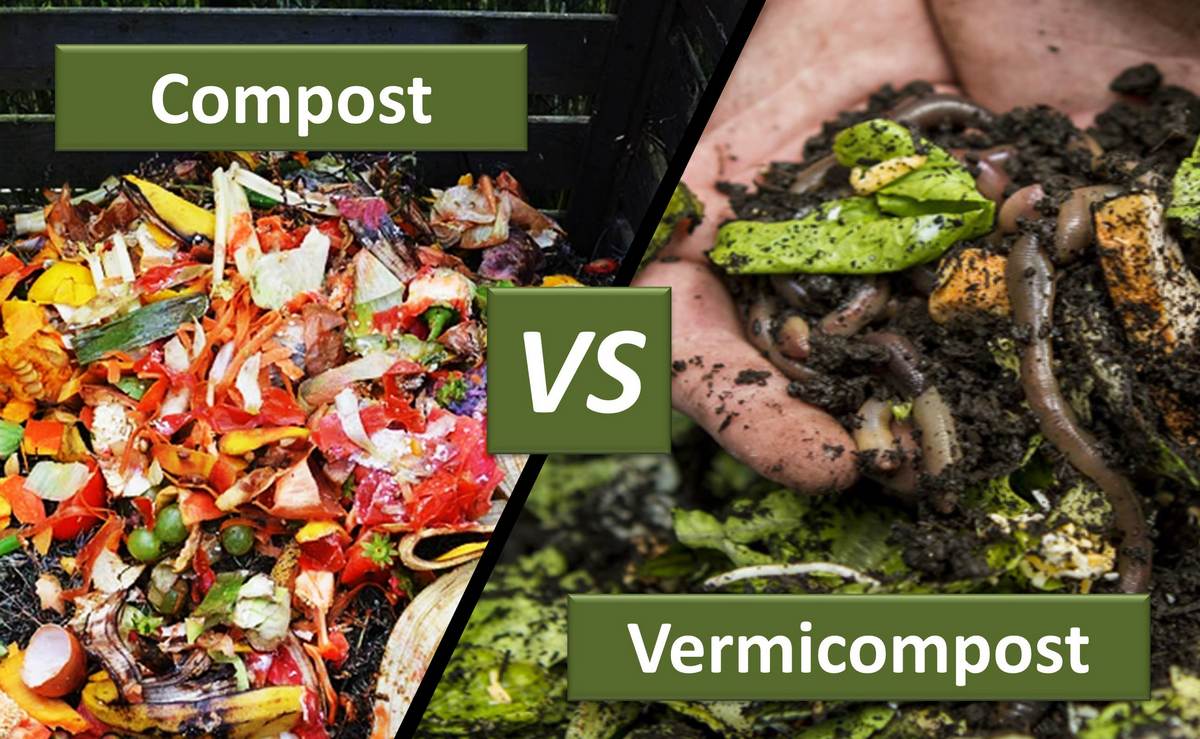
Similarities Between Compost and Vermicompost
Wikipedia defines compost as “a mixture of ingredients used as plant fertilizer and to improve soil’s physical, chemical, and biological properties”. This is also a valid definition of vermicompost, which is just one of many different types of compost.
All composting methods, including composting and vermicomposting, start with large pieces of organic matter such as a rotten banana, orange peel, weeds, manure, straw, grass clippings, etc. During the decomposition process, these materials are broken down into smaller and smaller pieces until plant nutrients are released. This change is carried out by a large number of different organisms, including worms, beetles, bacteria, and fungi, to name a few.
This is a continuous process, and every composting method eventually produces more or less the same material. Plant nutrients are released, and the remaining organic matter is commonly called humus, although humus actually doesn’t exist in soil.
What is Compost?
Compost can be made in a variety of ways using a variety of starting materials, but for this discussion I will use the term compost to refer to the material that is made by gardeners using a traditional compost pile, normally called “hot composting”. This produces black crumbly material known as black gold. It is ready for the garden when it is “finished compost,” which means that most of the starting material is no longer visible to the naked eye. It might look finished to you and I, but it is far from being completely decomposed. Once added to soil, it will continue to decompose and release nutrients for about 5 years.
What is Vermicompost?
Vermicomposting or “worm composting” is the process of creating vermicompost with epigeic earthworms, while vermiculture (literally ‘worm culture’) is the practice of raising worms.

Vermicompost is essentially worm poop (worm manure, worm compost), something we affectionately call “worm casts” or “vermicasts”. Kitchen scraps and yard waste are fed to worms, and the material they produce is called vermicompost. It is important to understand that this material sits around for quite some time before being harvested, and in fact, worms in a worm bin tend to eat and reprocess the material up to 5 times. So vermicompost is actually a combination of the decomposition that takes place inside specialized earthworms and microbial decomposition that takes place both inside and outside of the worm.
Much like compost, it is not really finished when harvested. It will continue to decompose for several years after you add it to soil.
Vermicompost vs Vermicompost Fertilizer
These two terms are mostly interchangeable. It is an organic fertilizer but a lot of the commercial products are not called “fertilizer. In the US a product needs to state the NPK value on the package before it can be called a fertilizer and few vermicompost products provide that information. From a gardener’s perspective, it should be considered to be a slow-release organic fertilizer, which is similar to any other compost product.
What About Composting with Earthworms?
If you have composted, you probably noticed that it has earthworms in it, and some people think they are important for the composting process, but that is incorrect. Composting in a pile happens because of microbes, not earthworms. Worms just happen to show up because there are good things to eat in a compost pile. When the pile gets hot, they leave and come back once the pile cools and most of the initial composting is done.
Composting does not require earthworms, and if you add them when the pile is hot, you will kill them.
Comparison of Compost and Vermicompost
What are the advantages and disadvantages of these two products? They look very similar. They tend to be black, crumbly material. Vermicompost may be a bit more granular, but both have an earthy smell. They can be dry or moist since they hold a fair amount of water. Both can be purchased commercially, although compost is more readily available.
Value as a Soil Amendment
Both products contain a lot of organic matter that is great for improving soil. The microbes in the material, as well as those in soil, use the organic matter as a food source, and their increased activity helps build soil structure. This process releases plant nutrients slowly over a long period of time, which is perfect for plant growth.
There is a hot debate about which is better, but there really is not much difference between compost and vermicompost, except that NPK nutrient levels are slightly different. Remember that the nutrients in the finished product come from the starting organic matter. A banana peel that goes through either process produces the exact same nutrients and organic matter – that is basic chemistry.
NPK Nutrient Levels
I had a detailed look at this in Vermicompost – Is It Really That Great? . The NPK value of the finished product depends very much on the input organic matter.
Average NPK values:
– bin compost is 1.4-1-1.3
– vermicompost is 1.5-2-1
The main difference in NPK values is that vermicompost has more phosphorus. If your soil is deficient in phosphorus, this is a good thing, but most garden soil is not deficient. In fact, garden soil that has been heavily amended, especially soil in raised beds, contains too much phosphorus, which harms soil microbes and can stunt plant growth.
Plants use these nutrients in a ratio of 3-1-2, so you can see that the NPK of vermicompost does not match what plants need.

To better understand the meaning of NPK, see Fertilizer NPK Ratios – What Do They Really Mean
Calcium Levels
The biology of worms is such that they excrete fairly high levels of calcium, which is a benefit if your soil is low in this nutrient. However, most garden soil contains lots of calcium.
The level of other nutrients is about the same in both compost and vermicompost if they are made from the same input ingredients.
Plant Growth Regulators
Plant growth regulators (PGRs) are chemicals that modify plant growth, such as increasing branching, suppressing shoot growth, increasing blooms, removing excess fruit, or altering fruit maturity. These include phytohormones such as auxins, gibberellins, and cytokinins.
PGRs are found in both compost and vermicompost, and the latter may have higher levels. Aging and exposure to light reduce the activity level of these plant growth regulators (promoters) in the casts.
Price
Vermicompost is fifty times more expensive, in part because it costs more to produce but also because it has a mystique about it that implies it is a far superior product for growing plants (see below). It’s not. Vermicompost is a good compost, but you are much better off buying more traditional compost for the same price.
Biological Content
Both products contain large numbers of microbes, including both fungi and bacteria. Some people claim that the bacteria in compost is thermophilic and those in vermicompost are mesophilic, making the latter more suitable for gardens. That is a myth. Both products contain more or less the same bacteria. Besides, your soil is already full of bacteria, and the real value of adding these materials is to add organic matter – not microbes.
I also see a lot of comments about vermicompost containing “beneficial bacteria” while compost doesn’t. That is also false. Both are full of beneficial bacteria, and so is your soil.
Commercial Production
A scientific study that compared the two products, using a commercial process, found that composting reduced the particle size, had higher organic levels, higher nitrogen levels, and higher levels of other macronutrients, compared to vermicomposting. “Both final products were suitable for horticultural purposes“.
The Process: Vermicomposting vs Composting
Now let’s compare the actual processes. For a more detailed description of these, have a look at these resources:
Vermicompost – Is It Really That Great?
What is Finished Compost? The Answer Will Surprise You.
Vermicompost Leachate – Will it Harm Plants?
The most significant difference between the two processes is that composting is a simple garden technique, while vermicomposting is mostly about caring for pets. You can ignore the compost pile, and it will still make compost, but your earthworm pets need regular attention, or they die.
Vermicomposting is usually done in an enclosed bin. Various types of bins are available, or you can build your own from a plastic tote. Tray-based composting bins are superior because they have layers and allow drainage and air circulation automatically. Start by adding bedding material to the bin, which can be coconut coir, shredded newspaper, or pure peat moss. Add the worms and food scraps. The worms eat the food and produce vermicompost. After a while, the vermicast is separated from the remaining bedding and worms. It is then generally aged for several months before use.
Hot composting is done outside using a bin that is usually 4x4x4 feet in size. Material is layered in the bin and water is added. From time to time, the material is turned to ensure it has enough oxygen. It can be left alone, but close monitoring coupled with appropriate adjustments results in faster compost.
Comparison Between Compost and Vermicompost
| Compost | Vermicompost | |
|---|---|---|
| Definition | Organic matter that is decomposed by microbes | Organic matter that is decomposed by earthworms and microbes |
| Process | Hot or cold piles of organic matter are allowed to sit until decomposition reaches a “finished” stage and is no longer harmful to plants. | Organic matter is added to containers holding bedding and earthworms. Additional material is added at regular intervals as worms consume it. |
| Space | Hot composting needs a minimum 4x4x4 foot space, done outdoors. Smaller bins can be used. | Can be done in small bins |
| Aeration | Turning the pile speeds up the process, but it’s optional. | Worms aerate their own home. |
| Maintenance | Minimal; turning is optional | Need to be fed regularly |
| Time required | Minimal, mostly building the initial pile | More work, mostly feeding and harvesting |
| Cost | Minimal or free | Cost of worms and bin |
| Location | Outdoors | Indoors or outdoors in warm weather |
| Organic matter | Anything can be composted; some people don’t add meat or oil. | Worms eat everything, but meat and dairy are usually avoided. |
| Volume | Works well for large amounts of material | Best for small daily amounts |
Thermophilic vs Mesophilic
Traditional bin composting is a thermophilic process, which means that heat is produced during the decomposition process as shown in this diagram. The initial pile is cool, and decomposition starts mostly with fungi and mesophilic bacteria (ones that like it cooler). This activity produces heat, and soon the pile is taken over by thermophilic bacteria that grow best when it is hot. Near the end of the process, things cool down, and mesophilic bacteria take over again. Thermophilic bacteria are either dead or dormant at the end of the process.
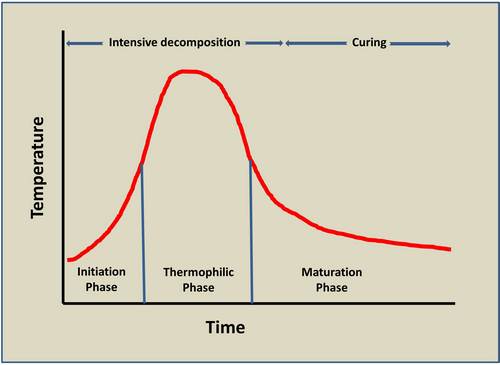
Since vermicomposting is mostly a room temperature process, it only involves mesophilic bacteria. You can see why the end product of both methods contains mostly mesophilic organisms.
Greens and Browns – C:N Ratio
Hot composting only happens when the ratio of carbon to nitrogen (the C:N ratio) is around 30:1. When the value is too high or too low, composting still happens but at a slower pace. This means that gardeners do need to gather different materials and ensure that the pile has the right ratio of ingredients. Gardeners call this the “green and brown ratio”.
Since vermicomposting is not a hot process, the C:N ratio does not matter, making this process a bit easier.
Pathogens and Weed Seeds
Many pathogens are mesophilic bacteria, and the high temperatures in a compost pile kill them off, while room temperatures encourage their growth. There is scientific evidence that the worm digestive system reduces pathogens to some extent.
Hot composting kills weed seeds, while cold composting, such as vermicomposting, does not. However, in most home systems, weed seeds are not introduced as food for the worms, so this may be a moot point.
There are also studies that show vermicasts introduce plant pathogens when mixed with soilless mixes, killing seedlings. It is probably best not to use worm castings on indoor plants.
Production of Greenhouse Gases
Every composting process produces some greenhouse gases, such as CO2. Because vermicomposting happens at least partially inside the worm, it is an anaerobic process which produces both nitrous oxide and methane. Both of these gases are many times more harmful to the environment than CO2.
From a global warming perspective, traditional bin composting may be a more environmentally sound process. I say ‘may be’ because such calculations are very hard to do, and I doubt anyone has done them.
Plant Growth
Which compost results in better plant growth? Some studies show one or the other as superior, but the consensus is that neither compost produces better plant growth than the other. A lot depends on the specific conditions of soil, technologies used, and input ingredients. This study compared the two for growing lettuce in lab conditions and found little difference.
Convenience
Hot composting can only be done outdoors, and it works best if you have enough material all at one time to fill the bin. Colder composting can be done with small amounts of material using a rotary bin or a small plastic composter, but these processes are significantly slower. Hot composting does not work well in winter.

Vermicomposting by homeowners is usually done indoors, but it can be done outside. Worms won’t live through cold winters outside. Some households find indoor composting more convenient and therefore prefer this method.
Speed
How long does each method take? That depends very much on how you manage the process. In commercial settings, both processes can produce a finished product in 2-3 weeks, but that does not happen in home situations.
Hot composting takes 2-4 months when done well, and it can be used earlier before it is fully cured. If the C:N ratio is not right, the pile is not aerated, or the outside temperatures are too low, it takes 6 months.
In theory you could harvest casts every couple of days and use them in the garden, but most gardeners use a much slower process. They leave the bin alone for 2 – 3 months and then harvest. The harvested casts are then allowed to “age” for a couple of months before they are used. Others only harvest every 6 months.
Which method is faster? Either method can be done quickly with more effort. In general, both methods produce a product in about the same time.
Volume
Hot composting can handle any amount of organic material but is not really suited for small amounts. Vermicomposting, on the other hand, is best suited for small regular amounts, like kitchen scraps. If you generate too much material, the excess can be stored in the freezer until needed. Commercially, this technique can handle large amounts, but even then it is not suitable for processing large amounts of waste at one time – worms take time to eat.
FAQs
Q1. Which is superior in terms of nutrients?
If your soil is lacking in phosphorus or calcium, vermicompost is better. Otherwise, the NPK of compost makes it a better option.
Q2. What worms are used for vermicomposting?
Special earthworms should be used, and they can be purchased online. The most popular one is the red wiggler worm (Eisenia foetida). It is the best choice for beginners.
Q3. Which product is best for gardens?
It is a good idea to use lots of organic matter in gardens, and because of price, compost is the best option. Vermicompost can be considered for containers.
Q4 Which method is best?
There is no best method. Any composting method that keeps kitchen scraps and yard waste on your property is good for your soil and the environment. If you like pets and you have a small amount of material, vermicomposting is a great option. If you have a large garden and produce lots of yard waste, you probably want a composting system outside.
Q5. How do you use worm castings?
Use it just like compost. You can layer it on top of soil or pots as a mulch. The nutrients will be slowly released and filter down into the soil. Or you can mix it right into the soil or potting media and plant in that. Add no more than 10% to potting media.
Q6. Is Vermicompost really superior to compost?
A lot of pro-vermicomposting people say this, but there is no scientific evidence that it is true. The reality is that 99.9% of the contents in both products are the same, and they depend mostly on the input ingredients.


