When it comes to adding fertilizer to pots and containers, gardeners talk a lot about fertilizer types and concentrations, but they rarely discuss the elephant in the room. What happens to fertilizer after it’s added to a container?
- Do the salts build up over time?
- How do different watering methods affect the real-time concentration of fertilizer in pots?
- How critical is flushing?
All of these questions will be answered in this post.
Watch the video version of this blog post: https://youtu.be/WcFEgU5cq9A
Key Takeaways
- Top watering is the least likely method to cause salt buildup.
- Bottom watering is the most likely to harm plants.
- Wick watering concentrates salts in the pot.
What Affects Fertilizer Concentration in Containers?
Why does the fertilizer concentration change after you fertilize a plant?
Assume that we have a potted plant and that the fertilizer level in that pot is perfect for plant growth. Why would things change over time?
- Plant Growth: As plants grow, they absorb nutrients from the soil, which decreases the nutrient level in the soil.
- Evaporation: Water at the surface of the soil evaporates, decreasing the amount of water in the pot. As the pot loses water, the concentration of any fertilizer increases. The amount of fertilizer does not change since fertilizer salts do not evaporate, but when the amount of water is reduced, the fertilizer concentration increases. The rate of evaporation depends on humidity.
- Plant Transpiration: Plant roots continually absorb water from the soil and move the water into the leaves where it evaporates into the air. This movement of water is called transpiration. Since it reduces the amount of water in the pot it concentrates the fertilizer in the pot.
- Salt Precipitation: Except for urea, all fertilizer is made up of salts. When the concentration gets too high, they precipitate out into a solid white, orangey powder, which is usually seen at the top of the soil. This white deposit is no longer available for plant use and can in fact harm roots (more about this below).
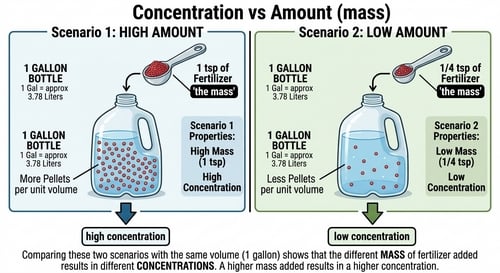
Concentration vs Amount: The amount of fertilizer is the total mass of the fertilizer. The concentration is the amount in a specified amount of water. Mass is measured in units like grams, while concentration is measured in grams/ml.
The amount of fertilizer in a pot is also affected by the watering method. I’ll discuss the following methods: top, bottom, wick (also called mat), and self-watering. A more detailed description of these methods can be found in Best Watering Method for Houseplants: Top, Bottom, Wick, or Self-watering Pots?
Limitations in this Post
To limit the scope and complexity, I will limit the discussion. The following do affect how fertilizer performs, but they add too much complexity for this discussion.
- Soil type or potting medium.
- Individual nutrients. I’ll assume all nutrients behave the same way, which is not strictly true.
These topics are discussed in greater detail in my book, Soil Science for Gardeners, and may be examined in future blog posts or videos.

Fertilizer Levels With Top Watering
The top watering method pours fertilizer solution on the top of the pot until some comes out the bottom. This is normally done when the soil starts getting dry.
After watering, the concentration of fertilizer in the pot is about equal to the concentration in the solution used to water the pot. Then comes a drying process. Evaporation and transpiration remove water from the soil. Plants remove both water and fertilizer. The net effect is that there is a gradual decrease of water in the pot, resulting in an increase in the fertilizer concentration.
At the next watering, the newly added solution pushes the old concentrated solution towards the bottom of the pot. An excess amount pushes it right out of the pot. That is why overwatering the pot is so important
This cycle of drying and fertilizer concentration is repeated with each watering cycle.
The degree of fertilizer concentration depends on the concentration in the watering solution, the rate at which the plant removes nutrients, the rate of evaporation, and the watering frequency.
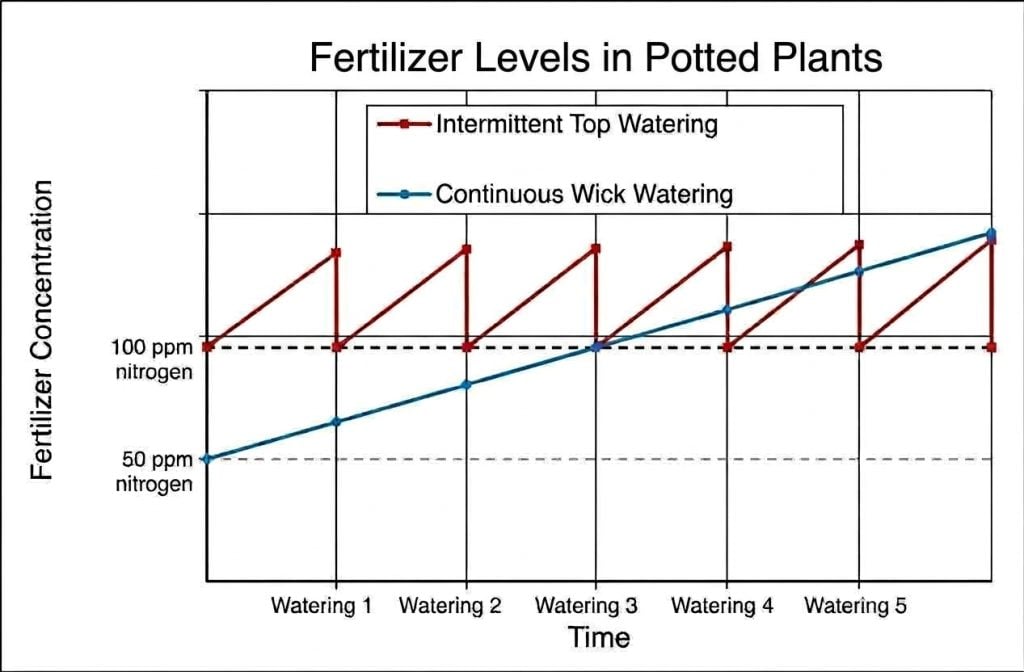
The chart above shows changes in fertilizer concentration in a planted pot. The red line represents top watering with 100 ppm nitrogen fertilizer, the standard recommended amount. Immediately after watering, the level is 100 ppm. Over time, the amount of water in the pot drops and becomes more concentrated. At the next watering event, it drops back to 100 ppm, and the cycle begins again.
The blue line represents wick watering, which normally starts at a lower level. The 50 ppm level used in the chart is the level used by Optimara Violets (confirmed by Reinhold Holtkamp, president, in a direct email). Watering is a continuous process with water loss taking place near the top of the pot. The fertilizer in this region continues to get more concentrated over time.
Salt Precipitation
The process described assumes that the fertilizer concentration never gets high enough to cause some of the nutrients to precipitate out of solution. What happens if the concentration gets higher?
As the fertilizer solution gets more concentrated, some nutrient ions start to precipitate out of solution, forming white salt deposits. These will normally contain calcium, magnesium, carbonate, and phosphate, which tend to be less soluble than other nutrients. Since evaporation is highest at the surface of the soil, that is where you find the salt deposits. In clay pots, you also find them on the outside of the clay pot.
What happens with the next watering? Some of the more soluble salts will dissolve in the fresh water and become available to plants again. Other salts are so insoluble that they remain as a solid.
It is a common myth that these white deposits are harmful to plant roots. That is not really true. The white deposits will not harm plant roots. However, the more soluble salts keep the water around roots in a state of very high salt concentration, and that is harmful to roots. This latter type is easily flushed out with a watering event or a water-only flush.

Fertilizer Levels With Wick Watering and Self-watering Pots
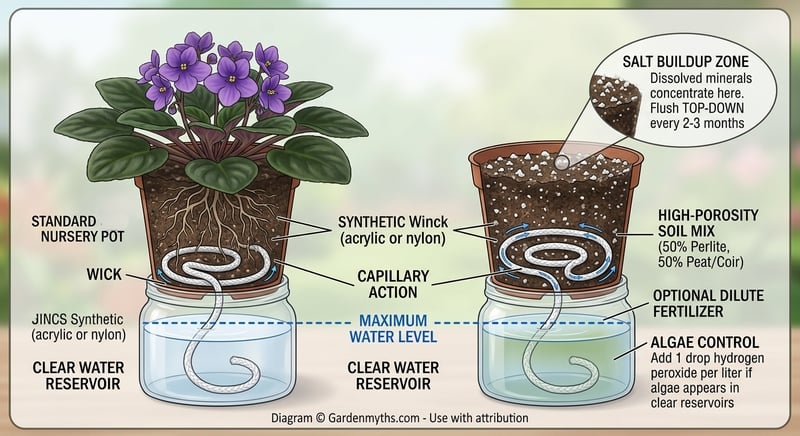
Wick watering, continuous mat watering, and self-watering pots affect the nutrient concentration quite differently than top watering. These methods have a constant supply of fertilizer solution at the bottom of the pot, which is wetter than the top, as discussed in Wick Watering: How It Works & Common Myths. However, the moisture level at any particular point in the pot remains the same all of the time, provided the water in the bottom reservoir does not run out.
Evaporation and transpiration still remove water from the pot, but it’s constantly replaced from the reservoir.
What happens to the nutrients that are not used by the plant?
Fertilizer enters the bottom of the pot using the wicking system. It travels up the pot along with the water and is either used by plant roots or accumulates at the top of the pot. Over time, unused fertilizer gets more and more concentrated at the top of the soil. When it gets too concentrated, some of it precipitates out, as discussed above for top watering.
If the pots are never flushed, fertilizer salts accumulate at the top of the pot. If the same fertilizer concentration is used for both top watering and wick watering, the concentration at the top of the pot would be much worse with wick watering. To prevent this, many people who use wick watering do so with a lower fertilizer concentration than is used for top watering.
Wick watering is described more fully in Wick Watering: How It Works & Common Myths.
Fertilizer Levels With Bottom Watering
Bottom watering is a hybrid between wick watering and top watering. Fertilizer solution moves up the pot, concentrating nutrients at the top of the soil. Unlike wick watering, the soil dries out between watering events, similar to top watering.
The lack of flushing combined with a drying period makes this type of watering a poor choice because it has the highest risk of concentrated fertilizer solution.
Bottom watering is popular for watering seedlings: Watering Seedlings – Bottom or Top Watering?
Why Flushing is Important
Top watering is the least likely to have a fertilizer buildup, provided that some flushing occurs with each watering. If you just add more fertilizer solution without any coming out the bottom, you create a high level of fertilizer in the bottom of the pot.
With wick watering and bottom watering, there is a greater chance of concentrated fertilizer at the top of the pot.
In all cases, the easiest way to reduce this fertilizer concentration is to do a good flush about once a month, as shown in this video: