

Holiday cacti like Thanksgiving cactus (Schlumbergera truncata), Christmas cactus (Schlumbergera bridgesii), and Easter cactus (Schlumbergera gaertneri) are popular houseplants, but some people have a problem getting them to rebloom. One reason is that much of the online information is incomplete and just plain wrong.
I checked reliable sites like US Extension Offices, and even they don’t agree on the best way to get holiday cactus to reflower. Popular gardening sites are even worse.
Part of the reason for the confusion is that these plants have a complicated system for triggering the development of buds that depends on both the duration of darkness and temperature. This blog simplifies the process and discusses some very interesting biology of this plant.
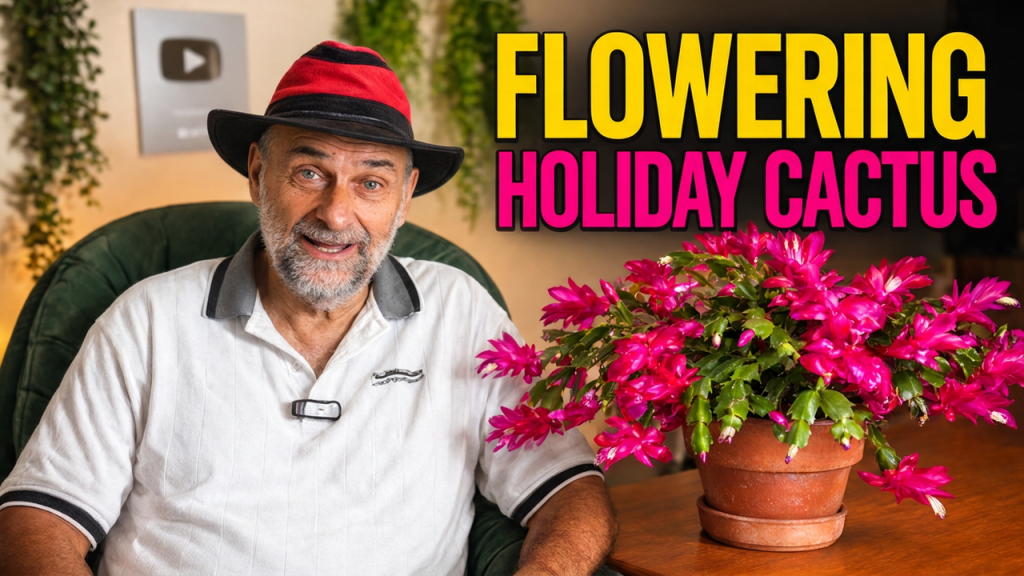
Watch the video version of this blog post: https://youtu.be/4gZvQK312A8
Key Takeaways
- If you have cool temperatures, you don’t need a dark period.
- Much of the information online for flowering holiday cactus is wrong or incomplete.
How Do You Flower Holiday Cactus?
There are three main species of holiday cactus, plus hundreds of hybrids. Each one flowers at a different time, hence the names: Thanksgiving, Christmas, and Easter. Although there is some variation among plants, the trigger for initiating flower buds is the same.
This chart summarizes the triggers for flower bud formation.
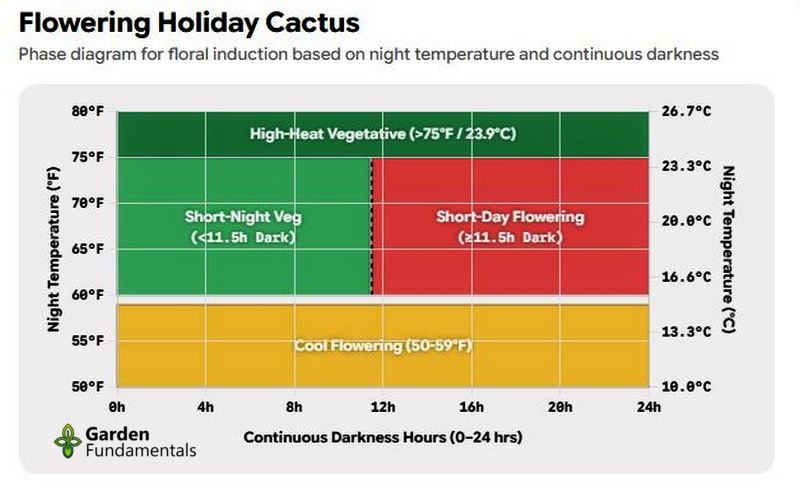
There are three important temperature ranges. Note that these are nighttime temperatures.
50°F to 59°F (yellow area): This range will cause the plant to form flower buds no matter what the duration of darkness is. Temperatures below 50°F can harm the plant.
60°F to 75°F (red area): These plants need to have a long night of at least 12 hours of darkness.

75°F to 80°F (dark green area): Temperatures above 75°F prevent the formation of buds, no matter how long the night is. Temperatures above 80°F are not good for the plant.
Note: Uniform day and night temperatures of 65° to 68°F will produce the highest bud count.
These plants are native to tropical locations where they don’t experience a significant drop in temperature at night, so it seems to have limited effect on blooming. However, a small drop of 5 to 10 degrees Fahrenheit might help.
How to Use The Chart
Determine your nighttime temperature. If possible, keep it below 60°F and the length of darkness won’t matter. Many people keep their plants outdoors in fall, where they automatically get the low temperature at night, making flowering easy.
If you can’t keep the nighttime temperature below 60°F, you need to provide a longer nighttime duration and keep the temperature below 75°F.
Provide this treatment for 6 weeks in the case of Christmas cacti and Thanksgiving cacti and for 8 to 12 weeks for Easter cactus. Once you see flower buds, you can stop the special treatment.
How Accurate is The 75°F Cut-off Point?
I honestly don’t know. Various sources report different values, and it is not always clear whether they are reporting day or night temperatures. One of the more reliable sources is a commercial production document from the University of Massachusetts, which says, “When temperatures are between 60º F and 75º F, plants will initiate flowers under SD”. The Connecticut Greenhouse Newsletter says, “Flower buds do not initiate at night temperatures above 75°F”. However, other sources set the upper range at 70º F.
Scientific studies generally use centigrade values and whole numbers for their testing. Using 20°C and 25°C, which is common, would not allow the study to distinguish between 70º F and 75º F. This might account for some of the disagreement.
Seventy percent of American homes have a night temperature set to 70º F or less. Most homes should be cool enough for germinating holiday cactus.
Thanksgiving and Christmas cacti need approximately 6 weeks, while Easter cacti need 8 to 12 weeks, which is why they bloom in the spring
How Plants Measure Darkness
How does the holiday cactus know that it is exposed to the right amount of darkness? I have used the word “know”, but plants don’t know anything; humans like to pretend they do. All of this “knowing” is explained by chemistry.

The Phytochrome Switch: Pr vs. Pfr
A special chemical, called phytochrome, which is related to proteins and chlorophyll, controls the process. Phytochrome has two forms called Pr and Pfr. When Pr absorbs red light (~667 nm) it is immediately converted to Pfr. Pfr absorbs far-red light (~730 nm) and is quickly converted back to Pr. In the absence of light, Pfr slowly converts to Pr, but it takes hours for a full conversion.
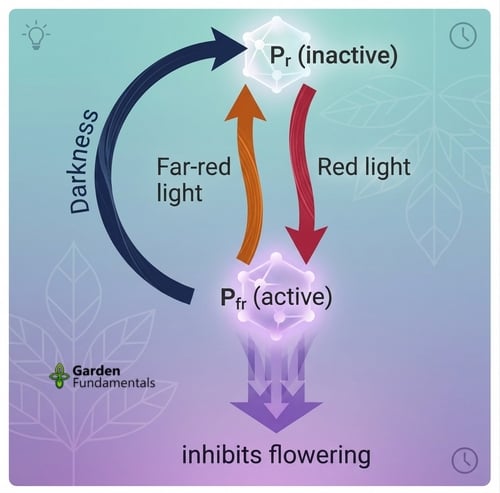
After sitting in a dark room for 6 hours, most of the phytochrome is in the Pr form. If a light is temporarily turned on, all of the Pr is quickly converted back to Pfr, and the process has to start all over again.
Pfr is the active form of the molecule, and it acts as an inhibitor of flowering. High levels of Pfr prevent flower bud formation. To initiate floral buds, the level of Pfr must drop below a specific threshold and remain low for a continuous minimum amount of time.
Blue light can also cause the conversion of phytochrome, but it takes a much higher intensity to cause the effect.
This is just the first step in the production of buds. To understand the rest of the process, have a look at the CONSTANS (CO) / FLOWERING LOCUS T (FT).
What Does Darkness Mean?
The term darkness is poorly defined. Some believe the plant needs total darkness, while others just leave it in a room with the lights off.
Holiday cacti grow in nature, which means they are exposed to some light at night. The moon, for example, gives off about ?? lux of light. Clearly, some light won’t stop flowering.
What about a dark room where someone turns on the light for a few seconds? Does that stop the flowering process?
What about the light from a cell phone? Is it bright enough to stop blooming?
I think one of the reasons nobody defines “darkness” in this case is that it is complicated for several reasons.
Wavelength of Light: The phytochrome switch demonstrates that the wavelength is important. Blue light is not as harmful as red light.
Duration of Light: The plant’s response to light is a chemical response, and all chemical reactions happen over time. Some quickly and some more slowly. Shorter durations are less impactful.
Timing of the Light Event: If the light event happens near the start of the dark period, it may have no lasting effect because there is still a long dark night period ahead. If it happens near the end of the 12 hours, it is more impactful. I think this is why a lot of sites recommend 14 hours. It adds a safety margin to the required 12 hours.
Intensity of Light: Because these are all chemical reactions, the intensity, or amount of light, is critical.
A homeowner does not have the knowledge or tools to measure these things. For this reason, advice for flowering holiday cactus is kept generic and simple.
This amount of variability also explains why some people flower plants with not much regard to the dark period, and others jump through hoops to get the condition just right.
As a general rule, low-intensity light like moonlight is Ok. Higher intensity can also be Ok provided it is a short burst of light, near the beginning of the dark period. To be safe, cover the plant or keep temperatures below 60º F.


