African violets have a reputation for being cool-growing plants, but is that really true?
More importantly, how warm can they get and still grow properly? Let’s have a look at the science.
Watch the YouTube version of this blog: https://youtu.be/IrbHvZmiHFo?list=PLUQee4Qv16_g
Key Takeaways
- African violets are not cool-growing plants.
- They will grow fine in most homes.
Temperature Advice From Popular Sources
What do hobbyist sources say?
Optimara Violets: African violets prefer a temperature of about 70°F (21°C), though many tolerate temperatures between 60-80°F (16-27°C). They perform best when day and night temperatures vary no more than five degrees.
African Violet Society of Canada: Day 70-80°F (21-27°C); Night 60-70°F (16-21°C).
African Society of America: Violets do best between 65-80°F (18-27°C). Violets grown in an enclosure, such as under a dome, often enjoy temperatures 5 degrees warmer than the room temperature (this last comment makes no sense).
Violet Barn: A temperature between 60-80°F (16-27°C), though most will tolerate more extreme temperatures.
There is poor agreement between these groups. They do all seem to agree that 80°F (27°C) is the upper limit, but as you will see, the science does not support that.
The comment “Violets grown in an enclosure, such as under a dome, often enjoy temperatures 5 degrees warmer than the room temperature” by the African Society of America makes no sense.
Temperature Advice From Extension Offices
US extension offices tend to report data from research and are normally a reliable source of information.
Wisconsin Horticulture: African violets prefer 70-75°F (21-24°C) days.
Plant Growers: Suggested air temperatures are between 70-85°F (21-29°C).
Minnesota Extension: Optimal room temperature is between 60-80°F (16-27°C), ideally 70°F (21°C)
.
Georgia: Use a daytime temperature of 70-90°F (21-32°C).
Florida IFAS: Average day temperature of 77°F (25°C) provides the highest rate of vegetative growth. Growth stops when the day temperature exceeds 85°F (30°C).
I am even more shocked that these groups can’t agree on the best temperature. This group does NOT agree with the previous group that 80° F (27° C) is the upper level.

They should be basing their recommendations on science, so let’s see what science says.
What Does Science Say?
Plant growth should be divided into two goals: leaf growth and flowering. Growing conditions may favor one and not the other. Homeowners want the flowers, but they have to grow leaves before they get flowers.
Flower stocks start to grow at the base of a leaf once it is well developed.
Flower stock initiation is triggered by light levels. A plant will grow leaves and not flower if it is given too little light. As light increases, some flowering occurs. Increase it further, and even more flowers are produced. The ideal light levels are discussed in Best Light Level for African Violets. DLI values should be at least 4, and plants benefit from values as high as 7.
Once flower initiation has occurred, the temperature influences the rate at which the inflorescence develops, with the fastest rate occurring between 76-80°F (24-27°C). Inflorescences develop more slowly below or above this range.
Some past research suggested that AV flowers faster when grown with a cooler day and warmer night temperature, but newer science does not support this position. Homeowners can ignore the need to lower night temperatures.
The chart below shows leaf growth relative to temperature at various light levels (DLI = 1, 4, 7, 10). A DLI between 4 and 7, at a temperature of 70-80°F (21-27°C), produces maximum growth. Growth stops below 46°F (8°C) and above 88°F (31°C).
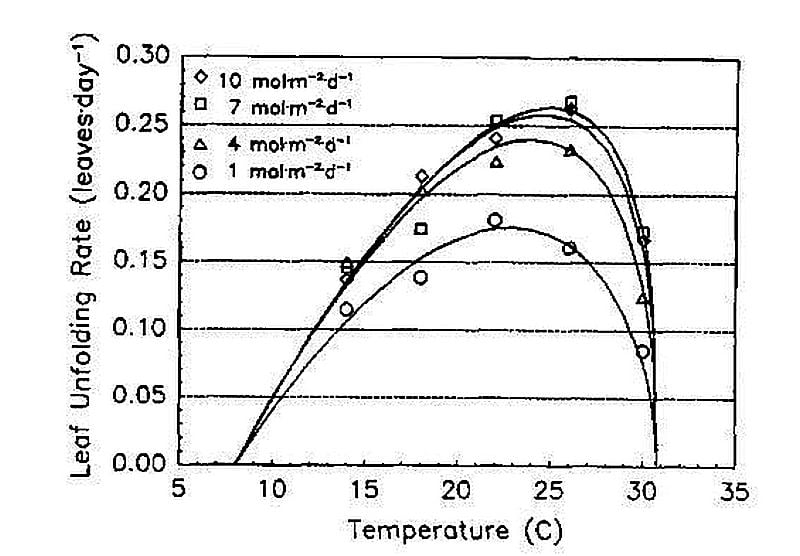
It is worthwhile noting that the temperature curve is very similar to many other plants. African violets are not as unique as some growers think.
Best Temperature for African Violets
Let’s summarize all of this data.
- Popular recommendations for homeowners are not very consistent. Neither is information from US government extension offices. Since almost none of these sources provide references for their sources, we have no way of knowing which is more reliable.
- The common recommendation that African violets must be grown below 80°F (27°C) is not correct, but temperatures over 80°F (27°C) are not ideal.
- African violets are not really “cool” growers. They may not like hot tropical climates, but they grow just fine in normal home temperatures.
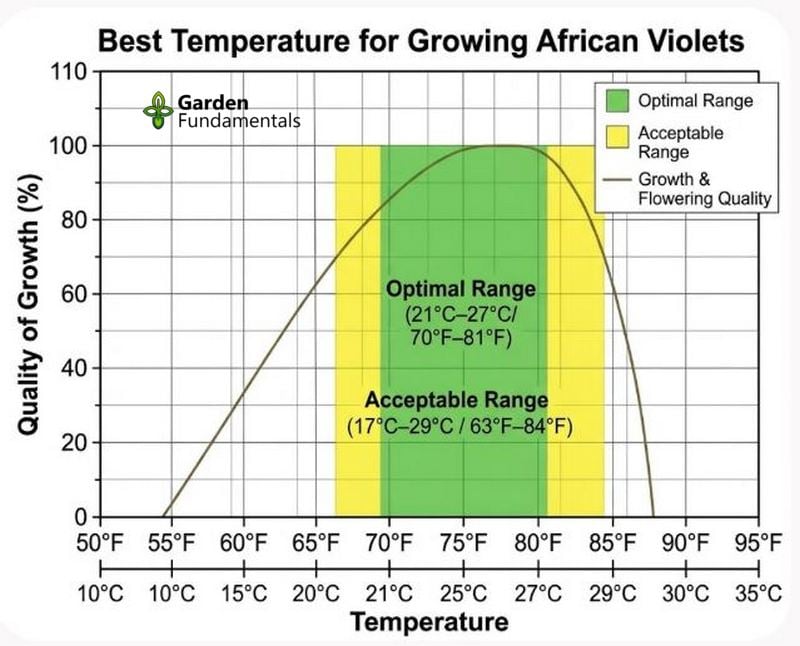
I have summarized all of the above data and came up with this new recommendation for growing African violets. The sweet spot is 75°F (24°C), but anything from 70-80°F (21-27°C) will grow good plants with lots of flowers. Since the average home temperature in developed countries is 68-76°F (20-24°C), plants will do well in most homes. They are clearly not cool-growing.
Be careful of sunny windows, which can get too hot.
The light level also needs to be in a suitable range (DLI of 4 to 7).
Nighttime Temperatures
There is little evidence that African violets require a temperature drop at night, so the home grower can ignore this.
The plants may get a natural drop in temperature without any effort from us. The important temperature is the plant temperature, not the room temperature. The African violet has a rosette growth habit, and the meristem is typically <3 cm above the soil surface. The plant traps cool air from evaporation under it and keeps the leaves cooler than the air temperature above them. This effect is stronger during dark periods.