

African violets have been grown for many years, and I have been growing them more. They are very similar to my streptocarpus and require almost the same care. Unfortunately, the large interest in the hobby has resulted in several myths. Here are the ones I have identified so far.

Watch the YouTube version of this blog post: https://youtu.be/vI-d4d_WWoo
Key Takeaways
- African violets are easier to grow than you think.
- A lot of online information about them is wrong.
Myth #1: Don’t Water From Above
The claim is that you should not water from above because wet leaves and a wet crown will cause rot to destroy the plant. This does not make a lot of sense since African violets do exist in nature where it rains, and rain gets the leaves wet. But I tested it. I took a violet and wet the leaves and crown every day for two weeks. The plant was fine. I water from above, using an old coffee pot, and the crown and leaves of all of my plants get wet every time I water.
What do commercial AV producers do? I decided to ask an expert. I contacted HoltKamp Greenhouses, the producer of Optimara violets. Those are the African violets you see everywhere, and they are “Earth’s largest grower of African Violets”. I asked them if they use top or bottom watering. I got a reply directly from their Vice President, Reinhold Holtkamp, and he said,
“In our greenhouses, we use temperate water and overhead water our plants with water that is adjusted to the same room temperature. Once they start to flower, we water from the bottom. All our tables have a capillary mat that will allow for water to be more evenly distributed. “ Water from above can damage flowers, but it does not harm plants.

He goes on to say, “Most African Violets die because of overwatering. Many plants are potted into a peat moss blend that has wetting agents and that causes the plants to stay moist too long. If not properly monitored, it is easy to allow the plants to get waterlogged, and the lack of oxygen getting to the roots will cause them to develop a fungus called Phytophthora. You can see a lot more information on https://myviolet.com/easy-care or the self-diagnostic tool on Optimara.com Dr. Optimara: Symptom-Based Guide for Diagnosing African Violets“.
Lyndon Lyon Greenhouses also waters their African violets by spraying water all over them.
There ae two common reasons for not getting leaves wet: water is too cold, and droplet burn leaves in sunlight. Very cold water may damage leaves, but the idea that leaves burn from water droplets is a myth.

Clearly, African Violets can be watered from above or below. Using the right soil and watering frequency are the keys to healthy plants.
Myth #2: It’s Important to Cultivate Mycorrhizal Fungi
A lot of gardeners now know that about 90% of plants in the wild benefit from an association with mycorrhizal fungi. At the same time, producers of potting media are adding the “much-needed” mycorrhizal fungi to their product. Gardeners have concluded that they are essential for growing great plants and have started to do several things to keep the fungi healthy.
- Add Dried Molasses: The molasses is food for fungi.
- Use Organic Fertilizer: Organic fertilizer is better for fungi since synthetic fertilizer will kill them.
- Add Additional Fungi: Mycorrhizal fungi don’t live very long in a pot, os it is a good idea to add them periodically.
None of these make any sense. Molasses is mostly sugar and is great for bacteria, but it’s not that great for growing fungi. They prefer a higher C/N ratio in their food. Synthetic fertilizer does NOT harm fungi. This is a long-held belief of the pro-organic group. Plants are the ones that initiate contact with the fungi. Plants secrete specific chemicals that cause fungal spores to germinate and make the association. It is a well-known fact that when plants have access to enough nutrients, such as a fertilized pot, they are reluctant to form these associations. Most potting media do not add mycorrhizal fungi, and the ones that do usually add 2 to 6 different ones. The species are selected because they are easy to grow in a factory, not because they are specific to African violets.
To learn more about mycorrhizal fungi and plant interactions, have a look at this: Mycorrhizal Fungi Myths
Mycorrhizal fungi are not needed to grow great African violets, and commercial products will be of little value. There is an interesting study that looked at adding special mycorrhizal fungi to the production of African violets. They found that just adding the fungi did not improve growth or flowering. Adding just synthetic fertilizer or a combination of fertilizer and mycorrhizal fungi did increase growth and flowering. It is important to note that the fungi inoculum used in this study is not commercially available.
Myth #3: Produce More Blooms With Epsom Salt
There are so many claims for Epsom salts in horticulture. 99% of them are false. Unless you need to add magnesium to your soil, it has no value for gardeners.
For more details, see: Epsom Salt Myths – learn the truth about using it in the garden
Myth #4: High Phosphorus Produces More Blooms
This is another common belief for all types of houseplants and garden plants. It is not true. Plants use less phosphorus than nitrogen, so the middle number of your fertilizer should be lower than the first.
Myth #5: African Violets Belong to the Genus Saintpaulia
AV used to be called Saintpaulia ionantha, but has been reclassified as Streptocarpus ionantha following 1990s DNA comparisons, which revealed that the popular houseplants actually evolved from within the African Streptocarpus subgenus. Botanically, they are now often referred to as Streptocarpus section Saintpaulia.
Myth #6: Do Not Use Chlorinated Tap Water
Chlorine can be toxic to African violets, and hobbyists are concerned about the chlorine in their drinking water. To solve this problem, many will let the water sit overnight so that the chlorine can escape. This is not required for several reasons.
- The level of chlorine in tap water, at least in developed countries, is so low that it does not affect plants.
- Letting water sit overnight does nothing to remove chloramine, a compound that is being used more frequently to treat drinking water. Its levels are also so low that they don’t affect plants.
- Chlorine is an essential nutrient that plants need to survive.
Forget about chlorine and chloramine, and use your tap water.
Myth #7: You Must Use Pure Water
Pure water includes RO, distilled, and rainwater. These have almost no minerals in them, and it is believed that such water is required by AV.
If your water has very high hardness, or high alkalinity (calcium + magnesium), or high pH, using pure water may be beneficial. But keep in mind that you then need to add the nutrients the plant needs, including calcium and magnesium ( ie cal-mag mixtures), which are not normally found in fertilizers.

However, African violets do not need such pure water, and they can be grown well in most tap water. How do you know if your tap water is suitable? You have to be willing to do a bit of work to get the numbers, as I have outlined in Is Your Tap Water Suitable for Plants?
I have not found specific data for AV, but general numbers for sensitive greenhouse-grown plants have the following recommendations:
- Hardness: 0 to 100 ppm calcium carbonate, with 30 to 60 ppm being ideal. Mature plants grow well up to 130 ppm.
- Calcium: 40 to 100 ppm.
- Magnesium: 30 to 50 ppm.
- pH: keep the substrate between 6.0 and 6.5 pH
Hardness is also measured in grains per gallon (gpg). To convert this to the more common parts per million (ppm) unit, use this formula: PPM = 17.1 x gpg.
I have hard water, and to solve that problem, I mix 1/3 tap water with 2/3 rainwater. This saves the expense of installing an RO system or buying distilled water.
Myth #8: Water Before Fertilizing
The claim is that you should not use liquid fertilizer on plants until you have watered them. I think people are concerned that “synthetic” fertilizer will burn roots. That is also a myth. Synthetic fertilizer does not burn roots when used at the correct dilution.
When you water, you fill the pot with water. Adding fertilizer solution then pushes the water out of the pot before it fills the pot. Why do this? Nobody seems to be able to give a reason. You also have the problem of knowing how much fertilizer to add. If you don’t add enough, the pot is mostly filled with water, and the plant starves. If you add too much, you are just wasting fertilizer.
Make up the fertilizer solution correctly and use it for watering. Gardening can be so simple if you ignore the myths online.
One person suggested that you should water after fertilizing. That makes even less sense. The water would just wash the fertilizer out and waste it.
Flushing your pots from time to time does make sense. The purpose of this is to wash excess salts ( ie fertilizer) out of the pot.
Myth #9: Fertilize With 1/4 of the Recommended Amount
African violets do not need as much fertilizer as some other plants, so people suggest using 1/4 of the recommended amount. By the way, orchid growers, including myself, made this suggestion for years, but now we know it is the wrong advice.
I looked at commercial fertilizers, and their recommendations are all over the map. They ranged from 135 ppm N down to a low of 1.6 ppm N. Except for one, all of the recommendations were incorrect. If you use 1/4 of these incorrect values, you are using far too little fertilizer.
What is the right amount? Ignore product labels and online advice. Fertilize with 100 ppm nitrogen each time you water.
How do you know how to make a 100 ppm solution? Easy: Use the Nitrogen PPM Calculator.
Do you need “African violet” fertilizer? This is a clear no. There is no difference between a fertilizer branded for African violets and one branded for general use. Provided it is soluble and has an NPK of 3-1-2, with micronutrients, it will work just fine. Stop wasting money on specialty fertilizer.
Wick Watering
When people wick water or use self-watering pots, they tend to cut the fertilizer used. It is unclear why this is.
I contacted Optimara about their African violet fertilizer, their 14-12-14 product. Reinhold Holtkamp, president, confirmed that they recommend 50 ppm nitrogen for a continuous feed. They use a mat wicking system.
But users report using 1/4 tsp (45 ppm) or more commonly 1/8 tsp (22 ppm). Most growers are under-fertilizing their plants.
Myth #10: Increase Humidity With a Pebble Tray
African violets thrive in a relative humidity of 50% to 60%. This will prevent bud drop, allow flower buds to open properly, and stop the foliage from losing its natural luster.
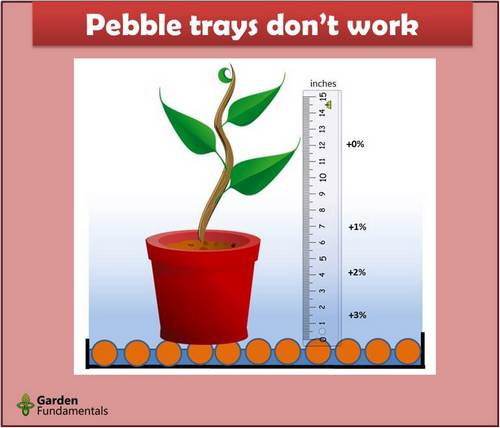
Keeping a 50% humidity in winter can be a challenge if you are heating your home. To solve this problem, some people recommend the use of a pebble tray. This seems to make sense at first glance, but they do not work. The water in the tray does evaporate and increases humidity above the tray, but then the extra water vapor moves to fill the whole room. It does not stay around the plant. And a pebble tray does not provide enough water to change the humidity of the room.
Pebble trays do NOT increase the humidity around a plant.
Myth #11: Decapitate After Using a Systemic Insecticide
This suggestion is really weird and makes no sense!
The suggestion was given in response to solving a root mealybug problem. Treat the plant with a systemic soil drench – that works for root mealies. Then decapitate the AV and reroot the top of the plant.
The point of using a systemic is to drench the roots so they absorb the insecticide. The plant’s metabolism then moves the insecticide throughout the plant, including the leaves and roots. When a bug now chews on the plant, it ingests the poison and dies.
If you decapitate the plant, the insecticide will not be transported within the plant because the growing part is no longer there. Decapitation also shuts down the roots, so they will absorb less insecticide.
Do one or the other, but not both. Treat with a systemic and leave the plant alone. Or decapitate, reroot the top, which should not have root mealybugs on it, and discard the root system and soil. Clearly, the decapitation option won’t work for leaf mealybugs since they live on the leaves.
Myth #12: Remove Center Leaves to Stimulate Blooms
The claim is that removing the center leaves will encourage the plant to make more blooms.
Anyone who believes such claims does not understand basic plant biology. A plant will grow in size until it has produced a certain amount of energy. The term energy here is used in a broad sense and includes sugars, carbohydrates, proteins, and thousands of other compounds. When a plant has enough of these stored away in its leaves, it starts making flowers.
Removing any leaves that are still green will reduce the plant’s ability to photosynthesize and make more energy, and the plant loses the energy that is already in leaves that are removed. This leads to fewer flowers, not more.
This myth probably stems from the idea that some plants will flower as they near death, in a last-ditch effort to produce offspring. This is not a good approach to getting plants.
Myth # 13: The pH of the Potting Media Drops Over Time
There is a common belief that the pH of peat-based potting media drops over time. If the pH gets too low, the plant suffers, and it should be repotted.
I found no clear explanation as to why the pH drops, so I decided to contact Premier Tech, the largest supplier of peat moss for gardeners. They are the producers of the ProMix line of products, and this is what they had to say: “Ignoring inputs (water and fertilizer), peat moss pH will increase slightly as it ages due to decomposition of the peat moss.” PRO-MIX has calcitic and dolomitic limestone added to help increase the pH of the media to the desired range of 5.8 – 6.2. Depending on the inputs used for growing, it should last 12 – 14 weeks”.
This is in agreement with NordAgri, another peat moss producer who says, “during growth, nitrate-based fertilization and hard water raise the pH level of growing media, while ammonium-based fertilization and soft water lower it. The chemical exchange mechanisms between the plant and the growing medium are the basis for this effect”.
What about the “inputs”? How do they affect pH?
- Water Used: The alkalinity and hardness of the water also affect pH. Most tap water will increase the pH of the media, but soft tap water and pure water (RO, rain, distilled) will decrease the pH.
- Fertilizer: This is a bit more complicated. Nitrate-based fertilizer tends to increase pH, while ammonium-based fertilizer decreases it. Most plant fertilizer is urea-based, which is converted to ammonium and therefore tends to lower pH. However, soil microbes will convert ammonium to nitrate.
- Nutrients Absorbed by the Plant: The growing plant also affects pH. Plants need to maintain a balanced charge. As they absorb the charged nutrients, they must balance that charge, and the form of nitrogen absorbed has a big impact on this. When the plant absorbs positive ammonium ions, it releases positive hydrogen ions, which in turn makes the potting media more acidic. Absorbing nitrate has the opposite effect.
- Respiration: As roots grow, they breathe, producing CO2, just like us. The CO2 reacts with moisture in the peat moss, forming carbonic acid, which also lowers pH.
These kinds of effects are not very important in real soil, but they are critical in a small pot filled with peat moss. The small amount of potting media in the pot results in faster pH swings, while the low CEC (low buffering capacity) of the peat moss exaggerates the effect.
Back to the original question. Does the pH drop over time?
The pH of the potting media is the accumulated sum of all of the above factors, and that makes it complicated for home gardeners. If you use soft water with urea or ammonium-based fertilizer, the pH will drop over time, and it can become too acidic for African violets. On the other hand, if your water has a high alkalinity (not the same thing as “alkaline”), the pH of the media may become too high.
It is incorrect to say that “the pH of the potting media drops over time” for two reasons: as the potting media decomposes, the pH increases, and its actual pH depends on the input ingredients.
Myth #14: Remove Older Leaves For Better Growth
Should you remove the older leaves around the outside of an African violet? A common response is yes; they serve no purpose other than to take the growth energy from the main plant and reduce bloom production.
The idea that old leaves don’t contribute to the health of the plant is incorrect. Leaves go through a natural life cycle. They start as small leaves where they are fed by the mother plant. At some point, they are large enough to photosynthesize and produce their own food. They even produce an excess to support other new starting leaves and a root system. They are now a productive member of the plant.
One study on African violets found that old leaves were photosynthesizing at 50% that of a new leaf, which means it is still very productive for the plant.
At some point, the leaf starts a process called senescence, which is the last stage of development, and it ultimately leads to the death of the leaf. Senescence can be caused by several factors, including the environment, external chemicals, and disease. But in the case of a healthy plant, it is just a natural process triggered by internal hormones.
The most obvious phenotypic change during senescence is the yellowing of the leaves caused by the breakdown of chlorophyll. There is also a breakdown of other molecules such as proteins, carbohydrates, lipids, and nucleic acids. The smaller molecules resulting from this process are moved to other parts of the plant that need them (new leaves, developing roots, flowers, and seeds). All of this is controlled by plant genetics in a very deliberate and timely process.
As the leaves turn yellow, they are feeding the plant. The idea that they serve no purpose at this point is completely wrong.
Older green leaves are an important food source for the growing plant. Removing them harms the plant and reduces flowering in the long term.
Myth #14: Pot Size Should Be 1/3 Width of the Plant
When someone posts a picture of a plant that is declining, the first recommendation is to repot in a smaller pot that is 1/3 the size of the plant. Growers are convinced African violets need pots that are smaller than the plant. This is simply not true.
African violets grow just fine in larger pots. For more proof of this see: Best Pot Size for African Violets
A common belief is that large pots are wetter than small pots, which can make the soil too wet. That is not true for wick watering or automatic watering pots, and only partially true for top watering. Right after watering, all watering methods have the same soil moisture. The soil in top watering does dry out over time, until the next watering. Other forms of watering stay constantly wet.
Here is a clear example to prove larger pots work.
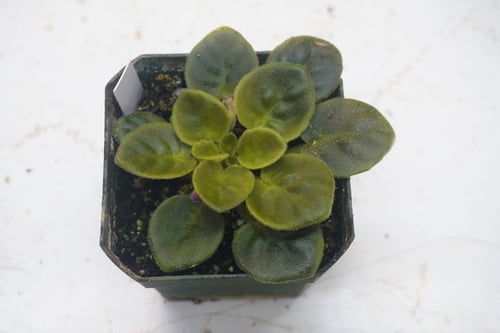


I have an african violet that is over 50 yrs old. It grew to a very large size – about 24″ wide. It is now starting to dye off somewhat and is only about 10″ wide but it still looks healthy. I am a novice gardener and just planted it as a wee new plant in a small pot. I water it when I remember to do so, I used tap water for years but now use well water. I give it a shot of liquid fertilizer now and then. Guess I’m lucky. I read your work often and enjoy and appreciate your generous advice. I am 95 yrs old and limited in the garden but still plod along. Thank you for all you share. Cheers
I LOVE reading your columns, your articles and your comments. They confirm everything I learned in “General Science,” 9th grade, 1961. And they confirm everything I learned in that dense textbook in grade 10, “BIOLOGY.” Then in grade 11, there was Chemistry and Physics, and in 12th grade, Advanced Biology, a deep, deep dive into my favorite subject! Then I had to change my major out of natural science because I happen to have a little disability in learning higher maths: calculus. But that early learning stuck to me and I can usually spot a fallacy, and if I’m unsure, I can find YOU to serve up the simple and factual truth.
I especially enjoyed your column her on Africa Violets. It was my first winter living “North of 60º ” and I saw for the first time…winter where not even a bug crawled. No blade of grass could be found. Only the ravens and silent foxes seemed to exist around outside. Silence and lifelessness was my entire world. THEN, picking up something at Walmart I saw PLANTS!!! I burst into tears! I took home twelve pots of African Violets and set them up in my studio in a bay window and hung a “grow-light” a few inches above them. I knew NOTHING about them except that they were PLANTS. I also didn’t KNOW any of the myths so I just used common gardening sense translated a bit for potted indoor plants. They THRIVED and filled the window with color and growth throughout the long, dark winter. Perhaps the only thing I mistakenly did was to buy the “AV plant food.” But what did I know? I liked the way I could just use the dropper to feed each pot. I looked up AV’s in one of my mother’s old, OLD gardening books (ca 1940), and it described rooting the leaves, so I made NEW plants and gave them to friends and continued to fill the bay window that looked out onto the Great Slave Lake. When summer came, they maintained their beauty with little more than removing a yellow leaf (9th grade had taught me about photosynthesis and the yellow leaf was no longer manufacturing in that amazing way). I deadheaded old flowers and enjoyed “working” in them.
Your article brought back a very cherished memory of an important time in my life and its little side story of meeting and learning to love African Violets.
Thank you for the kind words.