

Go into almost any organic gardening group, read an online gardening blog, or talk to a local permaculture enthusiast, and you will inevitably hear some variation of this rule: “Pests only attack weak, stressed, or sick plants. If your plants are healthy, pests will leave them alone.”
It sounds wonderfully comforting. It places the gardener in total control. If your cabbages are eaten by caterpillars or your roses are covered in aphids, the fault isn’t bad luck or nature being nature—it’s your fault for failing to nurture a healthy plant. The logical flip side is equally enticing: feed your soil, keep your plants robust, and you can throw away your pest control tools forever.
It is a great narrative. But is it true? Does science actually support the idea that insect pests avoid healthy plants?
Let’s dive into the research and separate plant physiology from pure garden fiction.
Key Takeaways
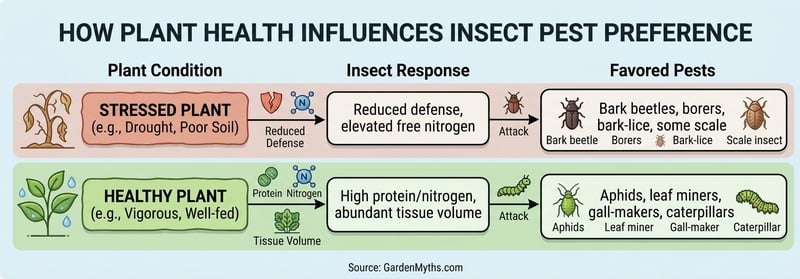
- The myth is false: Insect pests do not automatically avoid healthy plants; in fact, many sap-feeders and herbivores prefer them because healthy tissue is richer in nitrogen and sugars.
- Plant selection by pests is much more complex than a simple statement.
Where Did This Myth Come From?
The concept was popularized in the mid-20th century by early organic pioneers, including Sir Albert Howard and later J.I. Rodale. They argued that a plant grown in fertile, humus-rich soil develops an inherent “immunity” to diseases and pests.
In recent years, this idea has been repackaged with pseudo-scientific metrics like Brix values (refractometer measurements of dissolved sugars in plant sap). Proponents claim that once a plant achieves a high enough sugar content, its sap becomes “indigestible” to insects, or that insects lack the organs to process complex proteins, causing them to turn away in search of sick plants. The claim that insects can’t digest complex sugars or proteins is biologically absurd—insects have sophisticated digestive tracts, enzymes, and specialized gut microbes.
To evaluate whether this holds water, we first need to define what a pest is and what a healthy plant is. We also have to understand what a pest sees when they look at a plant, and how plant health actually affects insect behavior.

What is a Pest?
The term pest is not limited to insects. It includes viruses, fungi, molds, and bacteria. Some of these pests, eg molds, don’t select their host. They are stuck on the plant they find themselves on, with wind playing a big role in the selection process. Clearly, this kind of pest does not select healthy or unhealthy plants.
The focus of this post is on insects.
What is a Healthy Plant?
Is it any plant that is growing well? Is a water-stressed plant a healthy plant? Is a plant healthy if it is growing very rapidly due to an overapplication of fertilizer? A general definition is “an organism in an optimal condition of growth, physiological function, and productivity that can withstand environmental stress, pests, and competition”. This sounds great, but the definition is so general it is not much use for this discussion.
How Do Insects Choose Their Food: Quality vs. Defense
From an insect’s perspective, a plant is two things at once: a nutrition source and a toxic battlefield.
Plants are primarily made of carbon, water, and structural cellulose, but insects require nitrogen (to build proteins, enzymes, and exoskeletons) along with carbohydrates and trace minerals. Compared to animal tissue, plant tissue is notoriously low in nitrogen. Nitrogen is almost always the limiting nutrient for insect growth and reproduction.
When an insect pest evaluates a potential host plant, it weighs two main factors:
- Nutritional Quality: How much nitrogen, soluble protein, amino acids, and sugars does the plant tissue contain?
- Defensive Obstacles: Does the plant have physical barriers (thick cuticles, trichomes, hairs) or chemical deterrents (alkaloids, tannins, glucosinolates)?
The myth assumes that a “healthy” plant maximizes its defenses while rendering its nutrients inaccessible or unappealing. But in plant biology, nutrition and defense are involved in a constant evolutionary tug-of-war.
The Two Scientific Theories: Stress vs. Vigor
Entomologists and plant ecologists have studied the relationship between plant health and insect herbivory for decades. The debate primarily revolves around two competing scientific models: the Plant Stress Hypothesis and the Plant Vigor Hypothesis.
The Plant Stress Hypothesis
Formulated by white-fly specialist T.C.R. White in the late 1960s, the Plant Stress Hypothesis posits that plants under physiological stress (such as drought, waterlogging, or nutrient deficiency) become more susceptible to insect attack.
Why would a stressed plant be more attractive?
- Protein Breakdown: When a plant is stressed (particularly by drought), it slows down protein synthesis and begins breaking down existing proteins into free amino acids. This temporary spike in soluble nitrogen makes the sap easier to digest for certain insects.
- Compromised Defenses: A plant struggling for resources lacks the energy required to manufacture chemical defenses (like tannins or terpenoids) or repair damaged tissue.
Where the myth gets it right: The Plant Stress Hypothesis explains why wood-boring insects (such as emerald ash borer or metallic wood-boring beetles) and bark beetles overwhelmingly target weak, dying, or stressed trees. Their chemical detection mechanisms specifically tune into stress volatiles (like ethanol or ethylene) emitted by struggling trees.
However, advocates of the “healthy plants repel pests” myth take this specific ecological interaction and incorrectly apply it to all plants and all insects.
The Plant Vigor Hypothesis
In 1989, ecologist Peter W. Price proposed a counter-balance: the Plant Vigor Hypothesis. Price observed that many insect species do not target weak plants at all. Instead, they actively seek out, feed on, and lay eggs on the most vigorous, rapidly growing, healthy plants in a population.
Why do insects prefer vigorous plants?
- Nutrient Density: Healthy, rapidly growing tissue (such as new shoot tips) contains high concentrations of nitrogen, water, and sugars.
- Volume of Tissue: A robust, large plant provides more surface area, shelter, and reliable food resources for larvae to complete their lifecycle.
- Better Offspring Survival: Females that select healthy host plants produce more offspring, and those offspring grow larger and survive at higher rates.
Extensive field research supports the Plant Vigor Hypothesis across multiple insect feeding groups:
- Gall-Forming Insects: Galls require active, rapidly dividing plant tissue to form. Insects that induce galls (like gall wasps and midges) almost exclusively select vigorous shoots on healthy host plants. Weak plants simply cannot produce galls.
- Leaf Miners: Insects whose larvae live inside leaf tissue prefer large, thick, nutrient-dense leaves found on robust plants.
- Chewing Herbivores: Many caterpillars and beetles show significantly higher survival rates and faster development times when fed lush leaves from healthy, well-fertilized plants rather than tough, nutrient-deficient leaves from stressed plants.
What Happens When You Give Plants “Too Much” Health?
In agriculture and horticulture, a common practice intended to create “healthy” plants is nitrogen fertilization. But what does science tell us about fertilizer, plant health, and insect populations?

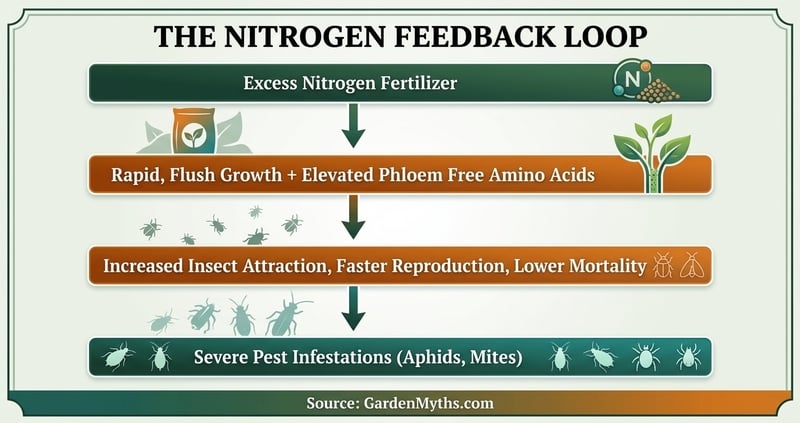
If the myth were true, applying optimal nutrients to produce a lush, green, thriving plant should decrease pest pressure. In reality, the exact opposite occurs.
Numerous university trials and published studies demonstrate that high nitrogen levels consistently lead to increased pest populations:
- Aphids and Sap-Feeders: Studies on green peach aphids (Myzus persicae) and cotton aphids (Aphis gossypii) demonstrate a direct positive correlation between plant nitrogen levels and aphid reproduction rates. Higher nitrogen leads to elevated amino acid concentration in the phloem. Aphids feeding on high-nitrogen plants reproduce faster, live longer, and form larger colonies.
- Spider Mites: Two-spotted spider mites (Tetranychus urticae) thrive on well-fertilized plants. Research from University Extension programs shows that plants given excess nitrogen have higher leaf chlorophyll and protein content, resulting in rapid mite population booms.
- Thrips and Whiteflies: Experiments on greenhouse crops show that Western flower thrips (Frankliniella occidentalis) and sweetpotato whiteflies (Bemisia tabaci) lay significantly more eggs on leaves with high nitrogen content.
When gardeners over-fertilize to achieve maximum plant growth, they are essentially laying out a high-protein feast for insect pests. A plant experiencing rapid, nitrogen-fueled growth often has thinner cell walls and lower concentrations of protective secondary compounds—making it easier, not harder, for pests to attack.
Co-evolution: The Arms Race Between Plants and Pests
The core flaw in the belief that “pests dislike healthy plants” is a fundamental misunderstanding of evolution.
Plants and insects have co-evolved for over 300 million years. Plants did not evolve in a vacuum where pests are simply scavengers designed to remove “defective” vegetation. Insects are primary consumers; they have evolved specifically to eat plants.
To defend themselves, plants have developed an array of defenses:
- Physical Defenses: Spines, trichomes (leaf hairs), thick cuticles, and silica deposits.
- Chemical Defenses (Secondary Metabolites): Alkaloids (like nicotine or caffeine), glucosinolates (found in brassicas), phenolics, tannins, and terpenoids.
If healthy plants were immune to pests, insect pests would have gone extinct millions of years ago. Instead, insects evolved mechanisms to bypass plant defenses:
- Specialists vs. Generalists: Generalist pests (like Japanese beetles) eat a wide variety of plants and avoid tissue with high toxicity. Specialist pests (like the monarch caterpillar or the cabbage white butterfly larva), however, have adapted to detoxify or even sequester the specific chemicals their host plant uses for defense.
- Attractants, Not Deterrents: For specialist pests, the very chemical compounds that make a healthy plant toxic to other insects act as a dinner bell. A cabbage white butterfly (Pieris rapae) uses glucosinolates—the chemical defense mechanism of healthy brassicas—to locate where to lay her eggs. She does not look for a weak, diseased cabbage; she searches for a vibrant, healthy cabbage loaded with glucosinolates so her caterpillars will have an abundant nutrient source.
Stress Type Matters: Not All Stress is Equal
To add another layer of complexity, scientific research shows that how an insect reacts to plant health depends heavily on the type of stress the plant is experiencing.
The Growth-Differentiated Balance Hypothesis (GDBH) explains how plants allocate resources between growth and defense depending on resource availability:
- Nutrient or Water Limitation: When water or soil nutrients are moderately scarce, a plant stops growing new tissue, but photosynthesis continues. Because the plant isn’t spending energy on new leaves, it diverts surplus carbon into producing chemical defenses (like tannins and phenolics). In this specific scenario, a moderately stressed plant can actually be more defensive and less palatable to pests than a healthy, well-watered plant!
- Severe Stress: If stress becomes severe (e.g., total drought or complete shade), photosynthesis shuts down. The plant can no longer produce defensive chemicals or maintain growth, making it vulnerable to opportunistic pests.
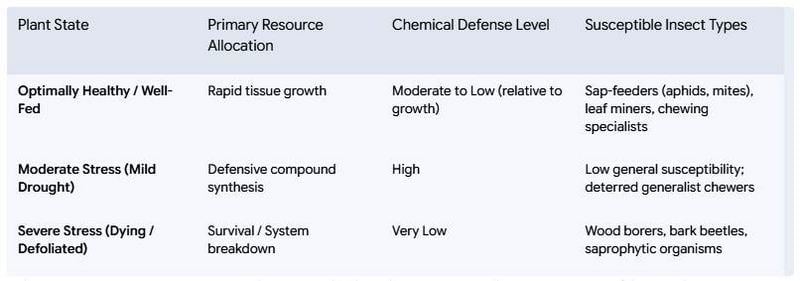
This nuance demonstrates why sweeping generalizations like “pests don’t like healthy plants” fail. Plant-insect interactions are dynamic, contingent on the specific insect species, the specific plant species, and the exact environmental conditions.
Evaluating Common Claims
Let’s break down some specific claims made by proponents of this myth and see how they hold up under scientific scrutiny:
Claim 1: “Insects only eat sick plants because they are Nature’s garbage collectors.”
The Science: False. While saprophytic organisms (fungi, bacteria, scavenger beetles) decompose dead and dying organic matter, herbivores are primary consumers designed to feed on living plant tissue. Many of the most destructive agricultural pests—such as the Colorado potato beetle, the corn earworm, and the cotton bollworm—prefer healthy, nutrient-rich crops.
Claim 2: “Healthy plants have thick cell walls that insects cannot pierce.”
The Science: Partially true for physical barriers, but overstated. While mature leaves have thicker cuticles than tender young leaves, insect mouthparts have evolved specifically to pierce or chew plant tissue. Stylets of sap-sucking insects (like aphids and scale) can navigate between plant cells to reach the phloem regardless of cell wall thickness in healthy tissue.
Claim 3: “If you improve your soil organic matter, pests will disappear.”
The Science: Misleading. Soil organic matter improves soil structure, water retention, and microbial activity, which helps plants withstand damage (tolerance). However, building healthy soil does not make plants invisible or unpalatable to insects. In fact, plants grown in rich, organic soil that produce abundant, lush growth often attract more sap-feeding insects due to high nitrogen availability.
Tolerance vs. Resistance: The Key Distinction
Why does the myth persist among observant gardeners? Much of the confusion comes from mixing up two distinct botanical concepts: resistance and tolerance.
- Resistance: The ability of a plant to prevent or reduce insect feeding/damage (e.g., deterrent chemicals, toxic sap, dense trichomes).
- Tolerance: The ability of a plant to withstand insect damage and still produce a good yield or survive without showing significant decline.
A healthy, well-cared-for plant in fertile soil may not have fewer pests (resistance), but it has a much higher capacity to endure pest feeding without dying (tolerance).
If an aphid colony attacks a weak, drought-stressed tomato plant, the plant quickly wilts, yellowing and dying because it lacks the water and nutrient reserves to compensate for the lost sap. If the same aphid colony attacks a robust, healthy tomato plant with a massive root system and ample water, the plant continues growing and producing fruit as if nothing happened.
Summary: What Does Science Say?
So, do pests dislike healthy plants?
No. Science unequivocally shows that insect pests prefer healthy plants. While certain opportunistic pests (like bark beetles and borers) target weak or dying host plants, a vast number of insect pests—including aphids, leaf miners, caterpillars, mites, and thrips—actively prefer healthy, vigorous, nutrient-rich plants.
Promoting the idea that healthy plants are immune to pests does gardeners a disservice. It leads to frustration when well-cared-for gardens inevitably attract insects, and it encourages over-application of fertilizers in a misguided attempt to make plants “immune”—which actually makes pest infestations worse.
As gardeners, our goal shouldn’t be to create an imaginary “pest-proof” plant through secret soil tricks or high Brix numbers. Instead, we should focus on:
- Understanding the specific life cycles and preferences of the pests in our region.
- Growing plants suited to our local conditions so they possess natural tolerance.
- Avoiding excessive nitrogen fertilization that creates pest-attracting flush growth.
- Supporting biological controls (like predatory insects and birds) that keep pest populations in check.


