

Gardeners growing under lights are starting to understand how important DLI is to their growing environment. References to K levels and distance from bulbs are long gone. These values are obsolete, especially when using LED lights to grow plants.
Now it is all about DLI, the Daily Light Integral. Get that right, and you can grow some great plants.
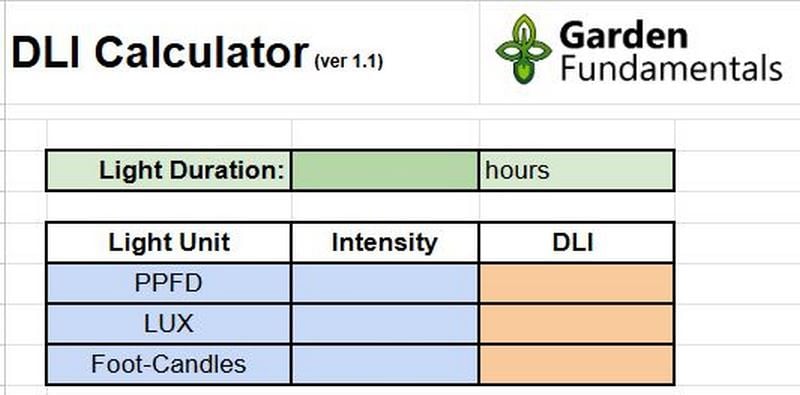
The problem is that DLI requires you to do some calculations, which nobody wants to do. That is why I developed a FREE DLI Calculator.
Key Takeaways
- Gardeners need to start using DLI to describe their lights.
- It is easy with the DLI Calculator
DLI Calculator
It is a simple spreadsheet program that does all the calculations for you. It is based on the Google Sheets platform.
Most Windows computers are configured to use Sheets. If you are on mobile, you will need to add the Google Sheets app to your device if you don’t already have it.
Press here to use the DLI Calculator.


Love this.
I appreciate the foot-candles option. Many serious old-school photographers still have light meters that read in foot-candles and know how to use those meters almost instinctively.
Good work!
I plan to use Photone’s app with the paper trick on my newish iPhone and see how that compares to what my decades-old Sekonic incident meter tells me.
This article plus your YouTube vid got me to poking around the interweb about “the best DLI value” for my cacti. OK, you can stop laughing now. I expected varying widths of ranges and that the ranges might be plus-or-minus maybe 20-30% from each other. Way too many variables to pretend precision. That’s all fine. But I’m seeing numbers that don’t differ by the tens of percents, but in the hundreds of percents from each other, e.g. a max of 15 compared to a max of 50. Feels like the same witchcraft from days of yore. There has got to be an explanation, and we growers would benefit from “those guys” being more forthcoming in explaining their equipment and technique.
Sorry for the rant, I expect that this is normal daily life for you. As a mathie, this is all just integral calculus. What’s the total energy as depicted by the area under the time-intensity curve?
Glad you’re putting the cookies on the lower shelf.
I started my plant hobby with cactus. I would have expected they can take just about as much light as they can get.
From AI: “The average Daily Light Integral (DLI)—which measures the total amount of photosynthetically active radiation (PAR) received per square meter in a 24-hour period—near the equator typically ranges between 40 to 60 mol·m⁻²·d⁻¹ on clear, sunny days, and averages around 30 to 45 mol·m⁻²·d⁻¹ year-round when accounting for cloud cover and rain patterns”
That is not the same thing as the required DLI for growing cactus.