What is the correct pot size for African violets?
The 2019 May- June issue of the African Violet Magazine clarified this by stating, “pot size should be 1/3 the diameter of the plant”. This is repeated on numerous sites providing growing information, including the African Violet Society of America, and it is stated almost daily in African violet Facebook Groups.
If a plant shows any signs of decline or problems and is in a pot larger than 1/3 the diameter, owners are immediately told to repot it into a smaller pot.
That advice and the 1/3 rule are incorrect.
Watch the video version of this blog post: https://youtu.be/03mihVFxkKA
Key Takeaways
- The 1/3 pot size recommendation for African violets is wrong.
- Taller pots are drier than shorter pots.
Does the 1/3 Rule Prevent Wet Soil?
Many believe the 1/3 rule prevents potting media (i.e., soil) from getting too wet. If conditions are too wet, roots rot. To prevent this, you are told to use a small pot with very little soil. The claim is that small amounts of soil can’t get too wet.
That is a myth! The following statements are incorrect and ignore the basic physics of a potted plant.
- Soggy Soil: Because there are not enough roots in a large pot to drink up moisture from the outer sections of the pot, that soil stays too wet.
- Suffocation: This stagnant moisture blocks essential oxygen from reaching the roots, creating a breeding ground for deadly root rot and fungal diseases.
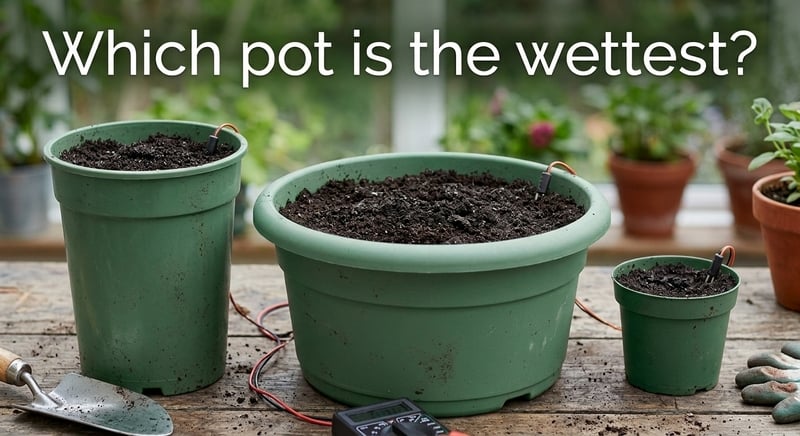
The degree of wetness in a small pot and a large pot of the same height is identical right after being watered. This assumes proper watering, where enough is added by top watering so that some comes out the bottom and that the soil types are the same.
Granted, a pot with a large diameter dries more slowly than a small-diameter pot, but they start out with the same moisture level.
Many growers use wick watering or self-watering pots. These have a consistent moisture level that is the same as a pot that has just been top watered. Therefore, the moisture level in a small-diameter pot and a large-diameter pot is the same for wick and self-watering pots.
Watch my video: Comparison of 4 Different Watering Methods
What About New Transplants With Small Root Systems?
The 1/3 pot rule is frequently accompanied by a comment about the small root system found on many plants as they are being repotted.

It is true that they may have a small root system. The same is true for seedlings and leaf propagations. But will a large pot harm a small root system?
What happens if we follow the 1/3 rule with a seedling? A seedling might have a root system that is 1/2″ wide. The rule says it should be planted in a pot that is 1/6″ in diameter? Who does that? Nobody! Seedlings grow just fine in a relatively larger pot.
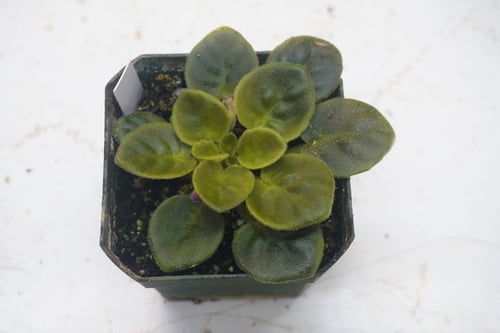
Here is African violet ‘Munchkin Kisses’, which is just ready to flower. It was a leaf propagation that was 1/2 the diameter of the pot when it was planted. It now just fits the pot and is not only growing well, but is covered in buds. It grew just fine in a pot that is much larger than the 1/3 rule.
The logic used to recommend a small pot for a small root system is to prevent the roots from rotting. They rot if they are too wet. The thinking is that a small pot will dry out before the roots rot. But is that really a good strategy? Hoping the pot dries out enough before the roots rot?
A much better approach is to use potting media that is formulated to have the right moisture level to prevent root rot. If you do that, a small root system in a large pot will not rot. This approach is especially important for anyone who does wick watering, since that soil does not dry out.
Small root systems do not need small pots!
Are Small Pots Killing Your Plants?
The main driver for selecting small pots is to keep the root system drier so it won’t rot. Growers incorrectly assume a small pot is drier, but is that really true?
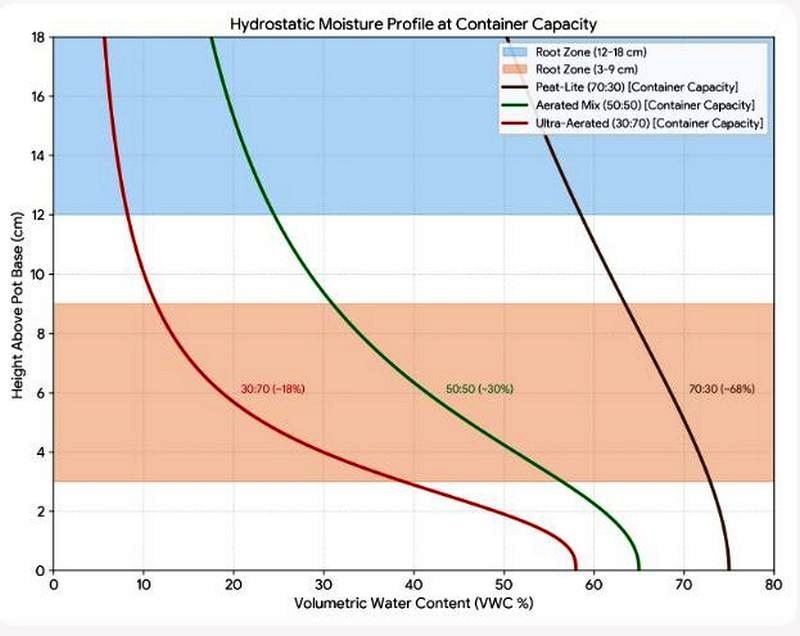
The chart below shows the amount of moisture at various points inside a pot that is 18 cm ( 7″) tall. These are the values at “container capacity”, the most water the pot can hold, which is the case right after top or bottom watering, and it is always the case with wick and self-watering pots.
The amount of moisture depends on the soil mixture. The chart shows three different profiles for 70:30 (peat:perlite) mix, a 50:50 mix, and a 30:70 mix.
Note that most of the moisture is located at the bottom of the pot, a zone gardeners call the “perched water table”. To learn about this zone, have a look at my article called: What is a Perched Water Table?
How wet is the root ball?
Let’s assume we have a plant with a root ball that is 6 cm (2.4″) deep. If it is planted in a pot that is 18 cm tall, the root ball would be located in the blue area of the chart. In a 50:50 mix, it is exposed to about 20% moisture. Keep in mind that this is the same for any diameter pot that has the same height.

What happens when you go to a smaller pot? Smaller pots are normally also shorter. Let’s assume our small pot is only 9 cm (3.5″) tall. The roots are now located in the light red band. In a 50:50 mix, it is exposed to an average moisture level of 42%. That is twice as wet as the taller pot!
Shorter pots expose roots to higher moisture levels.
As a percentage of total volume, a shallow container holds more water and less air than a tall container using the exact same potting mix. A taller pot gives roots a drier, more aerated environment because it lifts the root zone higher above the saturated base.
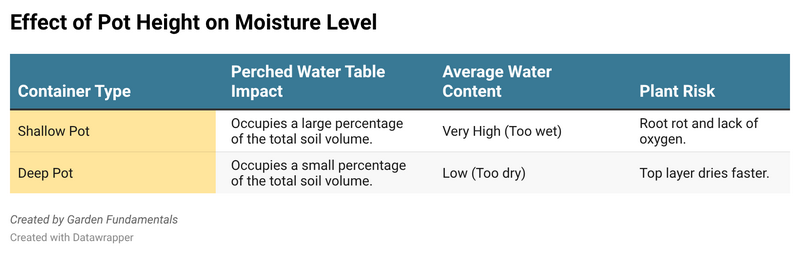
Small short pots combined with either top or bottom watering do have the advantage that they dry faster than larger pots because they contain less total water to start with. Keep in mind that a narrow pot dries at a slower rate than a wide pot because it has less surface area.
What is The Correct Pot Size for African Violets?
For practical reasons, you might not want a really big pot, but such a pot should work just fine. The 1/3 rule has nothing to do with the health of the plant.
Apparently, there is a show rule that says African violets entered in a show should be in a pot that is 1/3 the size of the plant. Let me know in the comments if you have a link to confirm or deny this.
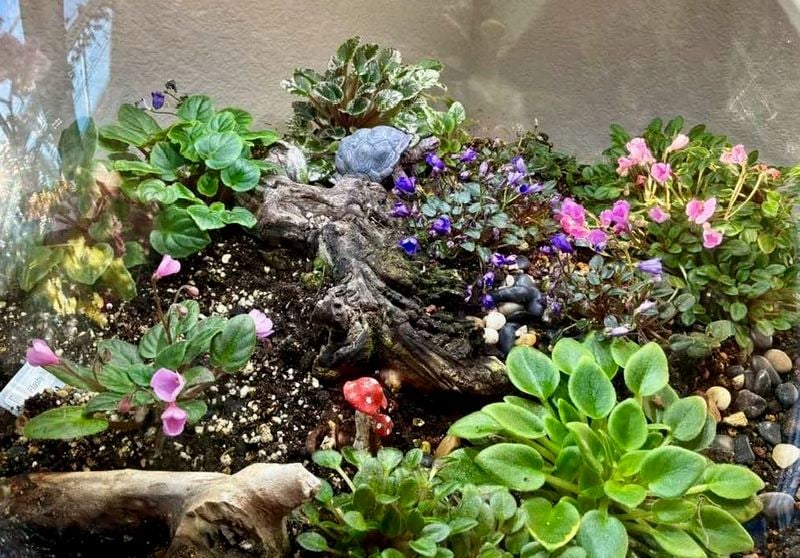
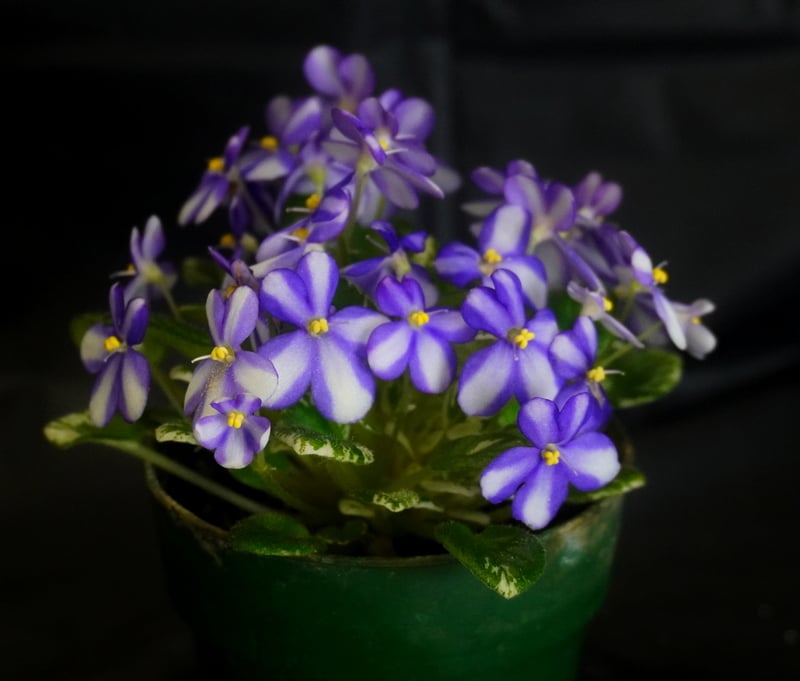
Plants in reasonably sized pots will grow just fine. Here are some examples:
Other Myths About Pot Size
Myth #1: Azalea Pots are Better
The suggestion is to use Azalea pots because they are shallow. The belief is that shallow pots provide drier soil. As shown above, that is not true. Deep pots are better. Azalea pots are not a good choice.
Myth #2: Large Pots Encourage Root Growth
It is claimed that when African Violets are planted in a pot size that is too large, they will expend the greatest part of their energy trying to fill the pot with roots, rather than growing leaves or flowers.
Plant biology does not work that way.
First of all, plants don’t know the size of the pot or how much soil is around their roots. Therefore, the claim is clearly false.
Secondly, plants balance root size to top growth. If you damage a lot of roots during potting, you disrupt this balance, and the plant reacts by growing roots. If you reduce top growth by removing leaves, the plant stops growing roots and focuses on top growth to get back into balance. Once in balance, plants do not grow a lot of roots without also growing leaves. This is true for all plants.
Myth #3: Overwatering
This is probably the biggest myth in houseplants: “One of the most common threats to African Violets is overwatering.
You can’t overwater a potted plant. If you try to add more water than the pot holds, gravity just pulls the excess out the bottom. Give it a try. Pour a gallon of water into a small pot. Almost all of it comes out the bottom.
You can use a potting medium that is too wet, and you can water too frequently, but you can’t overwater when you water. However, you can underwater: learn to water correctly.