

There are four basic ways to water a houseplant: from the top, from the bottom, with a wick system, or with self-watering pots. Which is best? What are the pros and cons of each method?
Let’s look at the science behind each method to see whether they work and which plants actually prefer each one.
Watch the video version of this post: https://youtu.be/E8m2Aoh5ClQ
Key Takeaways
- All 4 methods work if used correctly
- Match the method to your environment and habits.
Which Watering Method is Best?
There is no “best” method. Each has benefits for both the user and the plants. Each one works better in certain environments. Each one, when done correctly for the right kind of plant, will produce great plants.
Top Watering (The Conventional Method)
How It Works
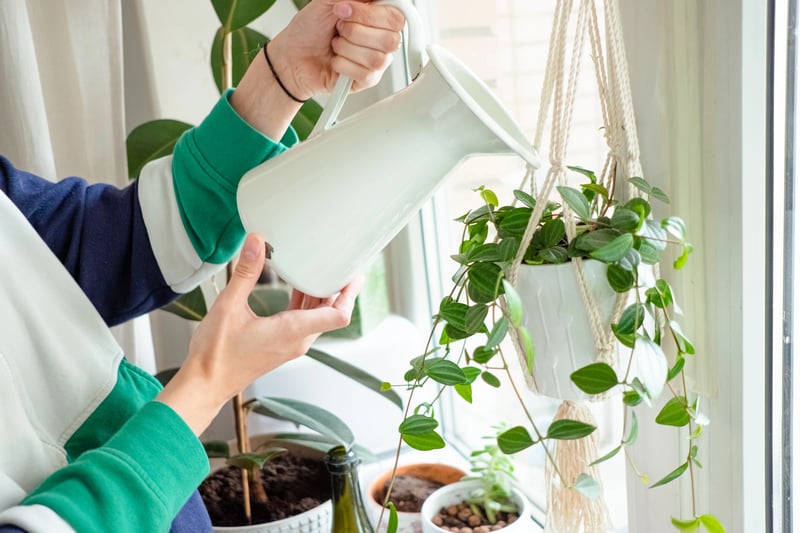
Top watering means pouring water onto the soil surface until excess liquid drains out the bottom holes of the container.
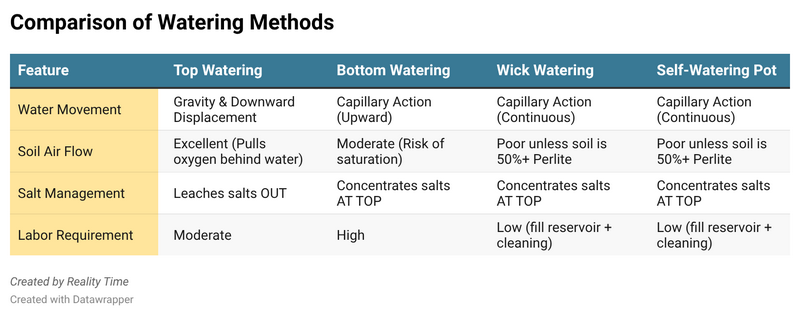
As water moves downward through the potting mix, gravity pulls it through macropores (the larger air spaces between particles). This downward movement creates a piston effect: as the water drains out the bottom, it pulls fresh oxygen down into the root zone behind it.
Pros
- Flushes Out Soluble Salts: Tap water and fertilizers contain mineral salts: the nutrients. As water flows through the root zone and out the bottom, it leaches accumulating fertilizer residues out of the soil mix.
- Refreshes Soil Aeration: The physical movement of draining water pulls fresh air into the soil profile.
- Simple and Quick: Requires no specialized equipment or setup.
- You’re in Control: Watering only happens when you decide it is required.
Cons
- Foliage Damage in Specific Species: Cold water splashed on crown tissue or cold-sensitive leaves can cause cell wall collapse, resulting in permanent white spots or localized necrosis. The solution is simple: don’t use cold water. Contrary to popular belief, water at room temperature does not harm leaves. This is a common myth in many plant groups, including African violets and Streptocarpus.
- Erosion and Channeling: Pouring water too quickly distorts light potting media, exposing surface roots or creating localized channels where water runs straight down without wetting the surrounding soil mix.
- Super Dry Media: Potting media containing peat moss can get very dry and hydrophobic, at which point water poured in the top simply runs down between the soil and pot. The water does not soak into the media.
Best Environment and Conditions
Top watering is ideal for low-humidity indoor environments where soil surface evaporation is high, and for growers using standard tap water or synthetic fertilizers that accumulate mineral salts over time.

It is also a good choice for people growing a variety of plants, each requiring individual attention and a different watering frequency.
Plant Preferences
- Best For: Heavy feeders, large tropicals, and plants in large containers (e.g., Ficus, Monstera, Pothos, Philodendron). Large pots hold a significant volume; regularly leaching salts is critical to preventing root burn.
Bottom Watering (Sub-Irrigation)
How It Works
Bottom watering involves setting a pot into a shallow reservoir of water. Capillary action draws liquid upward against gravity until the soil is wet.
Bottom Watering Myth: It encourages strong, deeper roots. This is not true. Roots grow where they get the right amount of moisture and air.
Pros
- Keeps Crown Dry: Keeps water entirely off susceptible foliage and stems. This is rarely a problem with houseplants.
- Rehydrates Peat-Based Mixes: Peat moss becomes hydrophobic when completely dry. Sub-irrigation allows hydrophobic media time to absorb water.
Cons
- Salt Accumulation: Because water flows upward and evaporates from the soil surface, dissolved mineral salts move upward too. Over time, white crusts of mineral deposits form on the upper soil layer, which can damage roots.
- Risk of Hypoxia: Leaving pots standing in water for extended periods fills all macropores, displacing air and creating anaerobic conditions that encourage root rot.
- Slower Process: The gardener has to control the length of time the plant sits in water.
Best Environment and Conditions
Best for high-humidity rooms where the soil surface dries out slowly. Works better for small plant collections and smaller pots.
Plant Preferences
- Best For: Plants grown in hydrophobic peat or coir-based substrates that like to dry out between watering.
- Avoid For: Salt-sensitive species or plants potted in heavy clay soils with poor drainage.
Wick Watering (Continuous Capillary Feed)
How It Works
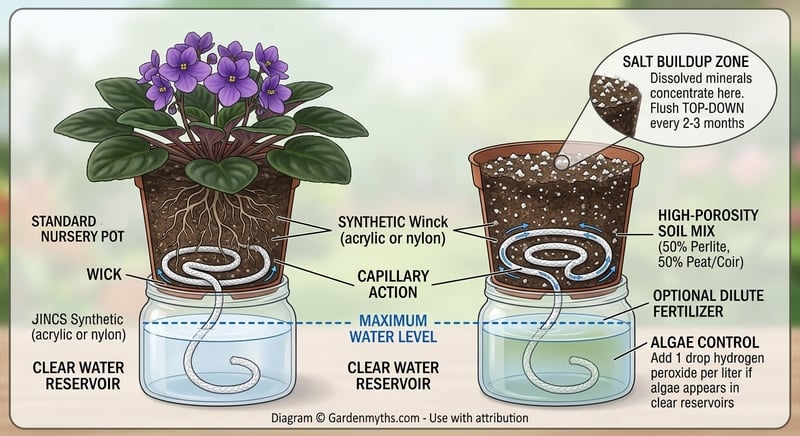
Wick watering relies on a synthetic cord (usually braided nylon or acrylic) placed through a pot’s drainage hole, touching the potting medium inside. The other end hangs into a separate water reservoir below the pot. Capillary action continually pulls moisture up the wick as the soil dries, keeping the potting mix at a constant moisture level.
Pros
- Consistent Water Potential: Eliminates the extreme wet-to-dry fluctuation cycle that stresses fine root structures.
- Low Maintenance: Ideal for growers who travel frequently or manage large collections.
Cons
- Requires Custom Soil Mixes: Standard commercial potting soils hold too much water when continuously wicked, leading to saturated, oxygen-deprived conditions. A wick-watering mix requires at least 50% perlite or coarse vermiculite to preserve sufficient air porosity (aeration).
- Algae Buildup: Fertilizer solutions in clear reservoirs exposed to light quickly grow algae.
- Salt Buildup: Fertilizer salts accumulate at the soil surface faster than with other watering methods. Growers using this method usually repot more frequently and flush regularly.
- Pots are Not as Mobile: Pots need to be moved with their reservoir.
Best Environment and Conditions
Ideal for climate-controlled indoor rooms, plant stands with artificial lighting, and plant racks where ambient temperatures remain steady above 18°C (65°F). Cold temperatures combined with continuous moisture cause rapid root loss.
Works well for larger collections where all plants have similar needs.
Plant Preferences
- Best For: Moisture-loving, fine-rooted Gesneriads (Saintpaulia (African violets), Streptocarpus, Achimenes), Ferns, and Fittonia.
- Avoid For: Succulents, cacti, Sansevieria, and dormant seasonal bulbs. These plants require distinct drying periods to prevent root oxidation failures and rot. For example, cacti and succulents enter semi-dormancy in winter; continuous moisture during reduced light periods will kill the root system.
Self-Watering Pots (Dual-Chamber & Sub-Irrigation Systems)
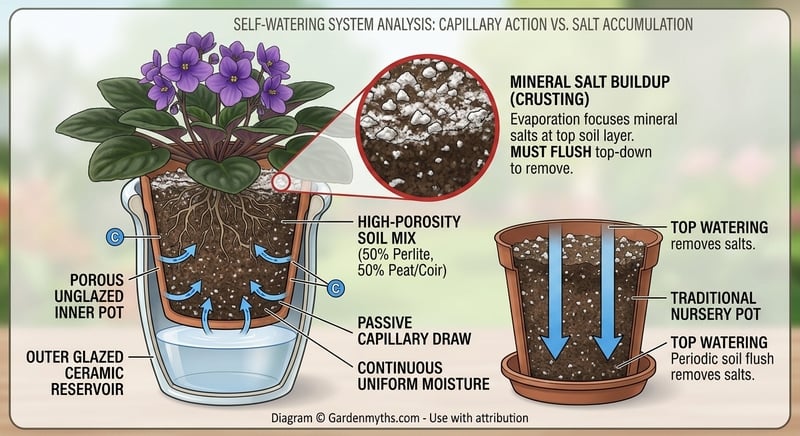
How It Works
Self-watering pots are closed, dual-chamber systems consisting of an inner plant pot nestled inside an outer water reservoir.
There are two primary designs:
- Unglazed Ceramic/Clay-in-Plastic (Oyama-style): An unglazed, porous ceramic inner pot sits inside a glazed outer reservoir. Water seeps through the porous clay walls directly into the potting mix via passive percolation.
- Capillary-Leg/Sub-Irrigation: The inner pot features hollow sub-irrigation feet packed with soil, or a built-in matting insert, extending down into the water chamber below.
Like wick watering, water moves upward against gravity via capillary action through micropores. However, instead of relying on a narrow cord, water moves across a much larger contact surface area.
Pros
- Prevents Foliage Damage: Water is added directly to the outer reservoir fill spout, completely protecting sensitive leaves and crowns from water drops or temperature shock.
- Stable Hydrodynamics: Provides a continuous, uniform supply of moisture, avoiding the drought-to-flood cycle that stresses delicate feeder roots.
- Visually Clean and Self-Contained: Unlike open wick-and-reservoir setups or drainage saucers, self-watering pots hide the reservoir inside an aesthetically clean, closed outer container.
Cons
- Severe Mineral Salt Trapping: Because water evaporates continuously from the top surface while fresh water enters from the bottom, dissolved fertilizer salts and minerals from tap water migrate upward. Over time, an unsightly white crust forms on the top layer of soil, which can burn the plant’s crown and stems. Flushing is a good idea, but many of these pots are hard to flush.
- Over-Saturation with Standard Soils: If planted in heavy, fine-particle commercial potting soil, the capillary draw keeps the substrate completely waterlogged. The macropores fill with water instead of air, causing root hypoxia (oxygen starvation) and root rot.
- Maintenance and Stagnation: Algae, mineral crusting, and bacterial slime can build up on the porous ceramic walls or in the bottom reservoir, requiring periodic disassembly and scrubbing.
- Expensive: This is the most expensive option and not really suitable for a large collection.
Best Environment and Conditions
Self-watering pots work best in warm rooms with good air circulation (which drives transpiration and prevents soil stagnation). They are ideal for gardeners who want the hands-off convenience of a continuous water supply without the untidy look of exposed wicks and jars.
Plant Preferences
- Best For: Moisture-loving, fine-rooted Gesneriads—especially African violets (Saintpaulia), Streptocarpus, Sinningia, and small Gloxinias—as well as humidity-loving tropicals like Calathea, Peace Lilies (Spathiphyllum), and Ferns. Crucial Rule: You must mix coarse perlite into the potting media at a ratio of at least 1:1 (50% perlite, 50% peat/coir). This creates enough macropores to preserve root aeration while the mix stays continuously wet.
- Avoid For: All succulents, cacti, Sansevieria, Pothos, and winter-dormant tuberous plants. These plants require the soil substrate to dry out between waterings. Keeping them in a continuous sub-irrigation system prevents the root system from breathing and leads to rapid root collapse.
The Salt Buildup Problem
The four watering methods can be classified into two groups: top water and bottom water (sub-irrigation, wick, self-watering pot). Each group handles salt buildup differently.
In top watering, each application of water moves salts down the pot. If excess water is used, some of these salts are pushed out the bottom. This keeps salt concentrations low in the pot, which prevents root burn and pH fluctuations.

When watered from below, fertilizer and salts from tap water are pushed up into the pot. Water, but not salts, evaporates at the soil surface. This accumulates salts at the top of the pot. Concentrated salts affect pH and burn roots.
Growers using bottom methods tend to repot frequently to partially overcome these detrimental problems, but that also does harm to plants.
This is the main reason I have never liked bottom watering.


