I have been growing houseplants for 50 years, and flushing is a critical step in the process. It makes plants grow better, it solves issues with hard/alkaline tap water and it reduces the number of times you need to replace potting media. So it saves money. Will it harm plants? If done correctly, it can’t possibly harm your plants.
View the video for this blog post: https://youtu.be/FS4g7uuVsJU
Key Takeaways
- Plants should be flushed.
- The frequency depends on your growing conditions.
How Do You Flush a Potted Plant?
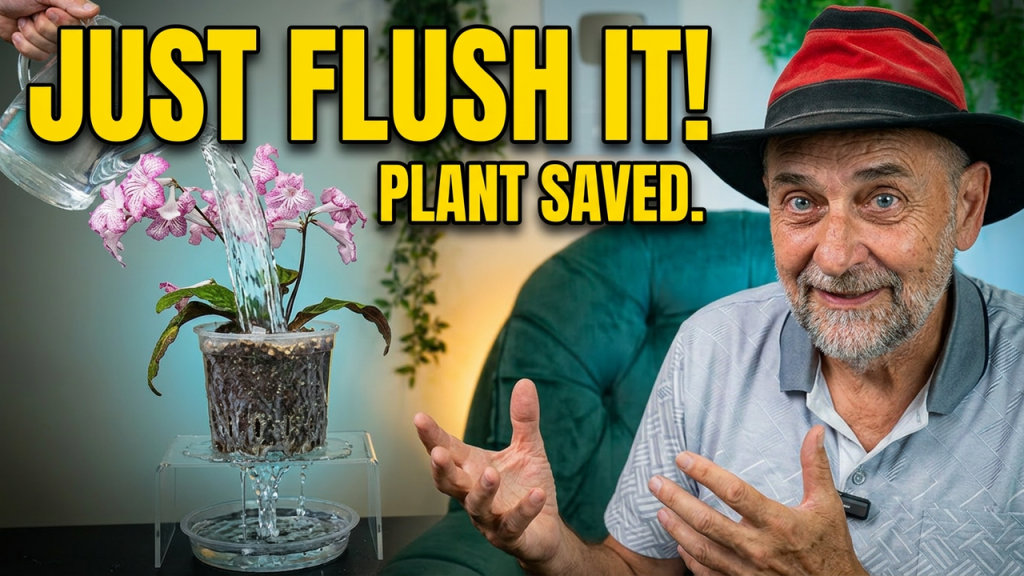
Flushing is a confusing topic in gardening circles, but it really is very simple. Take your potted plant and pour water into the pot. Let the excess come out the bottom. Keep pouring more into the pot. Let the pot sit to drain, and you are done. I told you it was simple. Discard the collected water down the drain or use it in your outdoor garden – it does contain nutrients plants will use.
How much water do you use?
That is harder to answer. If you flush regularly, you don’t need to use very much. If you do it infrequently, then use more flush water to get the job done. As a rule of thumb, the amount flowing out of the pot should equal at least half of the pot’s total volume. More is better, but it is not an exact science for homeowners.
How often should you flush?
That depends on your fertilizing habits and the quality of your water. If you tend to use a lot of fertilizer, flush more often. If your water is hard or alkaline (see below to understand what this means), you should flush more often. If you bottom water or wick water (see below), you should flush more often. If you have any of these conditions, a monthly flush is a good idea. If you don’t have these conditions, flush every 2-3 months.
Water and Flush at the Same Time
I water with a fertilizer solution each time I water. I top-water by pouring the solution over the plant and onto the potting media. It flows through the pot, and if I use enough of the solution, some comes out the bottom. In this way, I flush a small amount each time I water, so I don’t normally bother with a monthly flush. I also like this method because I know I have not underwatered the pot.
Can Flushing Harm Plants?
Online comments such as this: “I don’t flush because I tried it once and it killed my plant” are simply wrong. Flushing will not harm plants provided you are growing them properly.

Some people are concerned that flushing makes the soil too wet. That can’t happen as I explain below, unless you are growing in potting media that is not suitable for the plant. For example, orchids like a very porous medium. I use coconut husk for them, and you simply can’t add too much water to the pot. If your orchid is in peat moss and you water by adding an ice cube a week, then flushing can make the soil too wet. But the problem is not the flushing. The problem is that you are not using the right medium, and you are not watering properly.
Streptocarpus and African violets are similar. Growers tend to add 20 to 50% perlite to standard potting media because these plants like more air around their roots. If you don’t do this and water very sparingly, then a flush may make the media too wet. Again, the problem is not the flush; it is the media and watering method you are using.
If you never fertilize your plants, then flushing reduces the small amount of nutrients in the pot, and that will starve the plants. You need to fertilize properly. If you use the correct potting media, fertilize correctly, and water correctly, flushing will only help the plant grow. It won’t do any harm.
The Potting Media Will Not Get Too Wet
A common myth about flushing is that the process makes the media too wet. This is not true, and here is why.
What is in a planted pot? You have plant roots, potting media (soil), water, and air. Things like nutrients and microbes take up so little space that we can ignore them. Plant roots do grow, but the amount of space they use is fairly small and fairly constant; we can ignore them too. Most of the space in a pot is soil, air, and water. As a pot dries, the amount of water goes down while the amount of air goes up. When a pot is properly watered, most of the air is pushed out and replaced by water. A pot can only hold a fixed amount of water. It is the volume of the pot, less the volume of soil.
If a pot is fully watered so that it holds as much water as possible, and we add some more water to the pot, the new water pushes some of the existing water out the bottom. You simply can’t “overwater” the pot. It only holds a certain amount of water. When you water a planted pot, you should add as much as the pot will hold. After watering, it is full of water and soil, with very little air.
What happens during flushing? The same thing as when you water. You pour a lot of water into the pot, but all the excess flows out the bottom. No matter how much flush water you use, when the procedure is done, the pot only holds the fixed amount of water it can hold, and this amount is the same as when you water without flushing. The pot can never hold too much water, no matter how much you pour in. That is why flushing will not get the soil too wet, nor will it harm plants. Flushing will NOT cause root rot.
Why Should You Flush?
Every gardener should understand this, but it can be a bit technical. A simple non-technical answer is: salts (fertilizer) build up in the soil, which can harm roots at high levels. Flushing washes these salts out of the bottom and prevents damage to the plant. Several factors in your potting media can cause problems.
- Too Much Fertilizer: If you fertilize a lot, the excess nutrients can build up in the pot. A flush gets these out.
- Alkaline Water: A lot of people worry about hard water, but it is really the alkalinity in the water that causes the problem. Alkalinity is the amount of carbonates in the water. Carbonates combine with magnesium and calcium to form a precipitate. You see this as a white deposit in your kettle and on the surface of your soil. This white crust can cause problems for roots. Flushing washes some of this out and reduces the amount of carbonates in the soil.
- Nutrient Imbalance: The fertilizer used should match what plants need, which is around an NPK of 3-1-2. But plants use the nutrients they need, not what you supply. So if a plant uses more nitrogen than phosphate, the ratio of N to P changes to a value that is not ideal for plant growth. When this happens over weeks and months, the imbalance becomes worse. Flushing washes the excess out, and a fresh fertilizer solution rebalances the nutrients in the potting media. It’s like putting on a new pair of underwear – clean and fresh!
- Nutrient Solubility: Potting media absorb nutrients, and some are absorbed better than others. The ones that are absorbed less strongly, like nitrogen and sulfur, tend to be washed out of the pot quicker. This can also lead to a nutrient imbalance, which is minimised by a flush.
- Plant-Produced Chemicals: Plants produce thousands of chemicals, and some of these exudates are released into the soil. Flushing washes these out of the bottom of the pot.
Flushing removes a lot of unwanted chemicals from the soil, returning the potting media to a state that is similar to new potting media. It’s a renewal process. When salts build up in potting media, you have two choices: flush or replace the potting media. Flushing is less stressful on the plant and costs less.
The Problem With Bottom Watering and Wicking
When a potted plant is watered from above, the new water pushes the old water out the bottom, carrying excess salts with it. Provided that water does come out of the bottom of the pot, top watering is a form of flushing. It is just not as dramatic and as effective as a real flush. That is why people who top water need to flush less often.

What happens when you bottom water or wick water? Fresh water (or fertilizer solution) moves from the bottom of the pot up into the pot, pushing air out the top. Nothing runs our the bottom. Evaporation then removes water from the top of the pot. This pulls more water up from the bottom, which eventually evaporates from the top of the pot. This is a process that happens continually.
What happens to the nutrients (salts)? Salts do not evaporate. So they concentrate at the top of the pot, and eventually the concentration gets high enough that they harm roots and start to precipitate out as a white-yellowish crust at the top of the pot. That harms plant roots. This is why people who bottom water or wick water need to flush more often. It is also why I do not like either of these watering methods – they have a higher potential for causing a problem.
Hardness vs Alkalinity
Hardness and alkalinity are two different things, but are commonly confused. For a detailed review, have a look at: Water Hardness and Alkalinity – Why They Both Matter.
And alkal
Does Flushing Improve Flavour?
Many gardeners growing tomatoes or cannabis believe flushing the soil before harvest improves flavor. A study on cannabis showed that it is a myth. I am sure the same holds for tomatoes, but if you have evidence that it works, please add a link to the study in the comments below.
Flushing removes chemicals from the soil; it does not remove them from the plant.
Water Frequency Can Damage Plants
Watering plants seems so simple. Just give them some water. But watering incorrectly kills a lot of plants. The common belief is that you can overwater a plant. You can’t. As explained above, the amount of water you use does not matter. If you use too much, the excess just flows out the bottom. However, you can water too often. Learn to water properly.