

If you scroll through online health forums, social media, or sensationalized health blogs, you have likely seen alarmist headlines claiming that a humble bowl of rice is poisoning you with toxic heavy metals. Some claim you should cut rice out of your diet entirely, while others insist that organic rice is somehow immune to soil contaminants.
Internet health claims are often rooted in a kernel of truth that gets blown entirely out of proportion. Let’s skip the fear-mongering and look at what actual scientific research tells us about arsenic levels in rice.

To watch the video version of this post, watch: https://youtu.be/oZOSkMTUCN4
Key Takeaways
- Rice does contain arsenic.
- Selecting the Right Rice and cooking it properly limits your exposure.
Why is Arsenic a Health Concern?
Arsenic is a naturally occurring element found in the Earth’s crust. It is classified as a heavy metal and is ubiquitous in soil, rock, water, and air. Because it is a natural part of the planet’s geology, zero exposure is impossible; nearly all foods contain trace amounts.
Arsenic exists in two main chemical forms:
- Organic Arsenic: In this form, arsenic is chemically bonded to carbon atoms. Organic arsenic compounds are commonly found in seafood like fish and shellfish. These forms are generally considered far less toxic because the human body metabolizes and excretes them rapidly through urine without significant tissue interaction.
- Inorganic Arsenic: In this form, arsenic is bonded to elements other than carbon—typically oxygen, chlorine, or sulfur. Inorganic arsenic is the form found in industrial pollutants, contaminated groundwater, and soil minerals. This is the highly toxic form that presents a human health concern.
Toxicity and Mechanism in the Body
Inorganic arsenic is a potent cellular toxin and a known Class 1 human carcinogen.
When you ingest inorganic arsenic, it is readily absorbed into the bloodstream, where it is distributed to organs throughout the body, including the liver, kidneys, lungs, skin, and nervous system.
The primary concern is chronic, low-dose exposure over months, years, or decades, which can cause cancer and cardiovascular disease.
Because inorganic arsenic, as well as other heavy metals, accumulates in tissues over time and is cleared slowly, chronic intake—even at micrograms per day—causes cellular damage over time.
Why Does Rice Have High Levels of Arsenic?
If arsenic is present in soil everywhere, why does rice contain significantly higher levels of inorganic arsenic compared to other staple crops like wheat, corn, oats, or potatoes?

It comes down to a combination of agricultural growing conditions and plant physiology.
1. Flooded Paddy Agriculture
Unlike wheat, corn, or barley, which are grown in dryland aerated soils, rice is traditionally cultivated in flooded paddies. Plants are submerged under several inches of water for much of the growing season to control weeds and optimize water supply.
This continuous flooding fundamentally changes the chemistry of the soil. The lack of oxygen converts the insoluble Arsenate (AsV) form into a highly soluble Arsenite (As III). This soluble form of arsenic is more easily absorbed by rice roots.
In dry soil, the arsenic remains in the insoluble form, making it difficult for plant roots to absorb.
2. Plant Physiology: The Silicon Hijack
Even in a flooded environment, why does rice take up so much more arsenic than other aquatic or semi-aquatic plants?
Rice is a silicon accumulator. It absorbs massive quantities of silicic acid from the soil to strengthen its cell walls, build stiff leaves, and protect against pests, fungal pathogens, and lodging (falling over in wind).
Here is the biological catch: at a molecular level, the chemical structure of dissolved arsenite closely mimics that of silicic acid. Plant roots can’t easily tell them apart. As the rice plant actively pumps silicic acid through its root transport channels, it also picks up a lot of arsenic, some of which ends up in developing seed heads.
3. Historical Soil Contamination
In addition to naturally occurring background arsenic in soil minerals, certain agricultural regions suffer from elevated soil arsenic due to historical human activities.
In the late 19th and early-to-mid 20th centuries, lead arsenate and organic arsenical herbicides were applied heavily to cotton fields in the southern United States (e.g., Texas, Arkansas, Louisiana, Mississippi) to combat the boll weevil. Decades later, many of those former cotton fields were converted to rice paddies, which now contain higher than normal levels of arsenic.
Which Type of Rice Has More Arsenic?
Arsenic accumulation in rice is not uniform. The final concentration in your bowl depends on three factors: grain processing (brown vs. white), geographic origin, and grain variety.
Brown Rice vs. White Rice
There is a widespread belief that brown rice is unconditionally superior to white rice across every health metric. When it comes to nutrition (fiber, vitamins, minerals), brown rice wins hands down. But when it comes to inorganic arsenic, brown rice contains significantly more than white rice.
Why? It comes down to seed anatomy:
- Whole Grain Anatomy: A whole rice grain consists of an inedible outer hull, a nutrient-rich outer bran layer (which includes the aleurone layer and germ), and an inner starchy endosperm.
- Arsenic Localization: As the rice plant translocates inorganic arsenic into the grain, the heavy metal accumulates primarily in the outer bran layer.
- Polishing/Milling: To produce white rice, the grain undergoes milling and polishing to strip away the outer bran layer and germ, leaving only the starchy endosperm. This mechanical process removes a large portion of the stored arsenic.
On average, laboratory testing by the FDA and independent food safety laboratories shows that brown rice contains roughly 50% to 80% more arsenic than polished white rice of the same variety.
A Note on Bioavailability
While brown rice contains higher raw concentrations of inorganic arsenic, nutritional studies show that the fiber and phytic acid in the bran layer may slightly reduce how much of that arsenic is absorbed by the human digestive tract. However, even after accounting for reduced bioavailability, eating brown rice increases the amount of arsenic you consume.

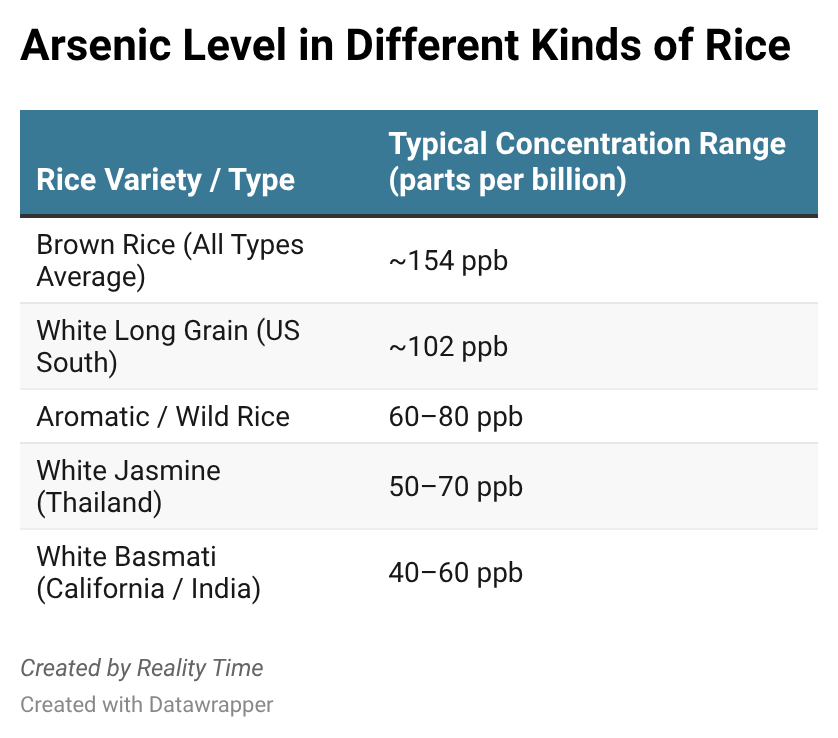
Average Inorganic Arsenic Levels in Rice
Geographic Origin Matters Most
Where your rice is grown is often more important than the specific grain variety.
- High-Arsenic Regions: Rice grown in the southern region of the United States (Texas, Arkansas, Louisiana, Missouri) tends to test higher in inorganic arsenic due to both geology and historical cotton pesticide use.
- Lower-Arsenic Regions:
- California: Rice grown in California consistently tests lower in inorganic arsenic.
- India and Pakistan: Imported Basmati rice from northern India and Pakistan generally shows substantially lower inorganic arsenic levels.
- Thailand: Imported Jasmine rice from Thailand typically exhibits lower levels compared to U.S. long-grain varieties.
Organic vs. Non-Organic (Conventional) Rice
Does buying certified organic rice protect you from arsenic?
No. Organic certification makes no difference when it comes to heavy metal uptake.
Organic rice plants absorb soil arsenic through the exact same silicon transport pathways as conventional rice. Multiple testing surveys demonstrate that organic brown and white rice have virtually identical arsenic concentrations to conventional rice grown in the same soil.
Recommendations for Eating and Cooking Rice to Keep Levels Low
1. Change How You Cook Rice (The “Pasta Method”)
The standard kitchen ratio for cooking rice is the absorption method: 1 cup of rice to 2 cups of water, cooked with a lid on until all water is absorbed. While this yields fluffy rice, it locks all the arsenic dissolved in the cooking water right back into the grain.
Because inorganic arsenic is water-soluble, you can leach a significant portion of it out during cooking. Use 6 to 10 parts water for every 1 part rice. Boil the rice until tender, then pour off and drain the excess cooking water.
Research from the FDA and academic researchers shows that cooking rice like pasta and draining the excess water reduces inorganic arsenic content by 40% to 60%.
2. Thoroughly Rinse Your Rice Before Cooking
Rinsing dry rice under cold running water in a fine-mesh strainer until the water runs clear removes surface dust, starch, and loose inorganic arsenic. This can reduce arsenic levels by 10% to 15%.
3. Choose Low-Arsenic Rice Varieties and Sources
Buy Basmati rice imported from India or Pakistan, or Jasmine rice imported from Thailand.
4. Diversify Your Grains (The Most Effective Strategy)
Use a variety of grains to limit the amount of rice you eat.
- Quinoa: Naturally gluten-free, rich in complete protein, and absorbs almost no arsenic.
- Buckwheat: A nutrient-dense pseudocereal with negligible arsenic levels.
- Millet & Sorghum: Highly drought-resistant grains with very low heavy metal uptake.
- Bulgur, Farro, and Barley: Excellent options for those who eat gluten.
- Oats and Amaranth: Great breakfast or side-dish alternatives.
The Verdict: Myth vs. Reality
So, is arsenic in rice a health concern?
Yes, but it is a manageable concern—not a cause for panic.
When eaten in reasonable amounts, the amount of arsenic in rice is not a great concern. Select rice with lower levels and cook it like pasta – problem solved.
Science-based decisions come down to understanding the mechanisms, evaluating the real risks, and taking practical steps without falling for internet fear-mongering. Enjoy your rice.


Please comment in a future post about heavy metal /arsenic in red and black rice.