Wick watering is a fairly popular way to water houseplants. The initial setup is more complicated, but once a pot is set up for wicking, you spend less time watering your plants.
This post looks at the underlying science and uses that information to debunk some common myths about wick watering.
Watch the video version of this blog post: https://youtu.be/D7WEMqPPAYw
Key Takeaways
- The size of the wick does not affect the moisture level in a pot.
- The wick can’t make the potting media too wet, but the technique can produce pots that are too wet for plants.
The Wicking System for Watering Plants
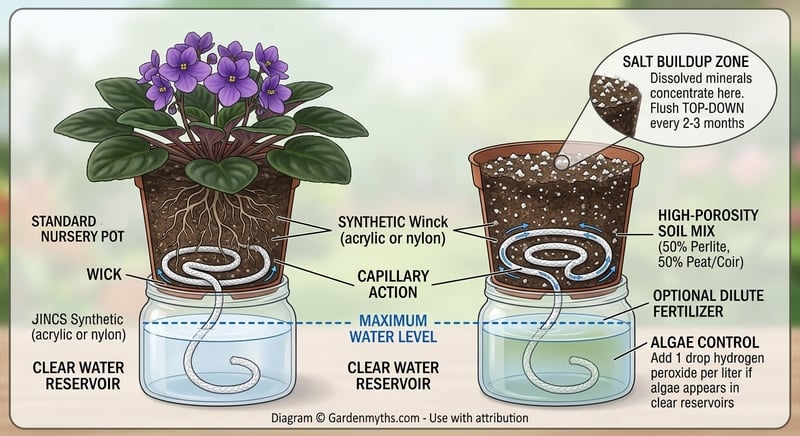
The wicking system is one way to water plants. A wick, usually of some cloth or string material, is inserted into the pot so that one end contacts the soil and the other end dangles out of the bottom of the pot. This loose end is inserted in a reservoir containing water or fertilizer solution.
There are three important components to the system.
- Reservoir + Wick: This moves water into the bottom of the pot.
- Plant + Air: The plant and air both remove water from the pot.
- Pot + Soil: Receives water from the wick and provides it to the plant.
Reservoir and Wick
The reservoir does not play a major role, provided it maintains a minimum of liquid for the wick to work.
The wick is also a simple system, but growers make it much more complicated than it needs to be.
The wick is an inert material such as wool, nylon, or acrylic. Each of these is made up of small strands of material that form tiny pockets of air.
The Physics of Wick Watering
Water moves up the wick due to two forces: capillary action and gravity. Gravity is constantly pulling water down, and at the same time, capillary action is pulling water up. When the right material is used, capillary action is stronger than gravity, and water moves up the wick.
Capillary action happens because water molecules are sticky. They stick to each other as well as to their surroundings. If one molecule moves up the wick, it pulls others along with it. Water molecules also stick to solid material like the fibers in the wick. Together, these forces cause water to move up the wick. The height of this movement is determined by the pore sizes in the wick (Jurin’s Law).

The rate at which water flows depends on the material of the wick as well as its thickness. A thicker wick is like a thicker garden hose. It allows water to move more quickly.
What Happens At the Top of the Wick?
Imagine the water molecules slowly climbing up the wick. They are now inside the pot and come in contact with soil. What happens?
Water sticks to both the wicking material and the soil. If the soil is drier than the wick, water molecules move from the wick to the soil. Water moves from an area of high concentration to one of lower concentration.
What happens if the soil is already wet?
If the soil is full of water, then movement from the wick to the soil stops. In fact, if the soil is wetter than the wick, water starts moving down the wick. That happens when you top water to flush the soil. This fact helps debug a common myth.
Myth: A Thick Wick Makes the Soil Wetter
Many growers recommend using thinner wicks. They will take a yarn that has three strands, remove one, and use the single strand of material. The claim is that a single strand is less likely to overwater the pot.
That is a myth. The difference between a thin wick and a thick wick is the rate at which water moves (volume delivery per unit time) into the pot. Once the soil contains enough water (discussed below), capillary action stops regardless of wick thickness.
The thickness of the wick does not affect the moisture level in the pot except for a special case. A really thin wick may not be able to provide enough water to a large pot to keep it hydrated. This is why thick wicks are a better choice.
The Effect of Different Types of Wicks
Almost any material can be used as a wick, but some work better than others. The ideal wick has lots of small air pockets in it to help water move through the material. It should be synthetic because natural materials like wool and cotton decompose. Acrylic and nylon are commonly used.
Here are some common myths about wicking material.
Green String Won’t Grow Algae: Some growers suggest using “green” material to cut down on the amount of algae growth, but that is a myth. The light from the room grows algae and has nothing to do with the color of the wick.
Nylon Moves Water Mostly on Its Surface: This is not true. Capillary action is very poor on the surface of materials. Water moves up nylon by using micropores in the material.

Acrylic Makes Soil Too Wet: This myth claims that if acrylic makes the soil too wet, you can use nylon or polyester. As mentioned above, the wicking material can’t provide too much water. If the potting media is too wet, it is a soil issue, not a wick problem (see below).
If your potting media is too wet, don’t try to fix it by changing your wick – the problem is in the soil.
The Effect of Plants and Air
Discussions about wick watering tend to skip these two very important factors: plants and air. Both of these affect the moisture level in the potting media.
Plants Affect Soil Moisture
Plant roots absorb water from the soil, move it up the plant into the leaves, where it is lost through transpiration. This process slows down at night and speeds up when the lights come on, but plants are continually removing water from the soil.
The amount of water plants use depends on the size of the plant and the size of the root system. Seedlings and divisions use very little compared to mature plants. Right after planting, they use less than a few weeks later when they have established their root system.
Humidity also plays a big role. Plants pull more water from the soil in low-humidity conditions because they lose it faster from the leaves.
The Effect of Evaporation
The top layer of soil is exposed to the air, and water easily evaporates from the moist soil. This effect is significant and lowers the moisture level in the soil.
Humidity plays an important role here. Water evaporates faster from soil in a dry environment than in a moist one. High humidity slows down evaporation and keeps the soil wet much longer.
The Pot and Potting Soil
I use the terms soil and potting soil interchangeably in this post. In most cases, we are talking about a soilless mix, which is commonly called “potting soil” in North America.
Potting soil is a type of wick. Water moves through soil the same way it moves up a wick. The sticky water molecules stick to each other and to soil particles in the pot. It moves from areas of high concentration (ie wet areas) to areas of low concentration (ie dry locations).
One big difference between soil and wicks is that wicks tend to move water faster than soil.
The plant removes water from the soil wherever the roots are located. At the same time, evaporation removes air at the surface of the soil. The net effect is that the soil at the top of the pot dries faster than the soil at the bottom.
As the top dries, the wicking action of the soil pulls water from the bottom of the pot to the top. This change reduces the amount of water at the wick, which in turn causes water to start flowing up the wick. Most of the time, this movement of water is continuous, forming an equilibrium in the soil. In a wicking system, the amount of moisture at any particular location in the pot is constant. The scientific term for this is hydrostatic equilibrium.
Degree of Wetness
What determines the wetness of soil?
As explained above, wick size has no impact, provided it is at least a minimum size. It has to be large enough to supply the water that the plant and air remove, or else the soil dries out. This is not a problem in most wicking systems unless the pot is quite large.
The size of the plant and humidity also do not control the moisture level in the soil, provided the wick can keep up with the water loss.
The only thing left is the soil, and it is the main determinant of wetness. The characteristics of the soil determine the hydrostatic equilibrium point, and therefore the soil controls the wetness.
People growing African violets and streptocarpus have learned that normal potting soil, including so-called African violet soil, stays too wet in a wick pot. To correct this, they add extra perlite to change the properties of the soil. Without knowing it, they are adjusting the hydrostatic equilibrium so that the soil has the right wetness for the plants they are growing.
Different plants will require a different hydrostatic equilibrium and therefore a different soil mixture.
This diagram shows the moisture level in a pot containing different soil mixes.
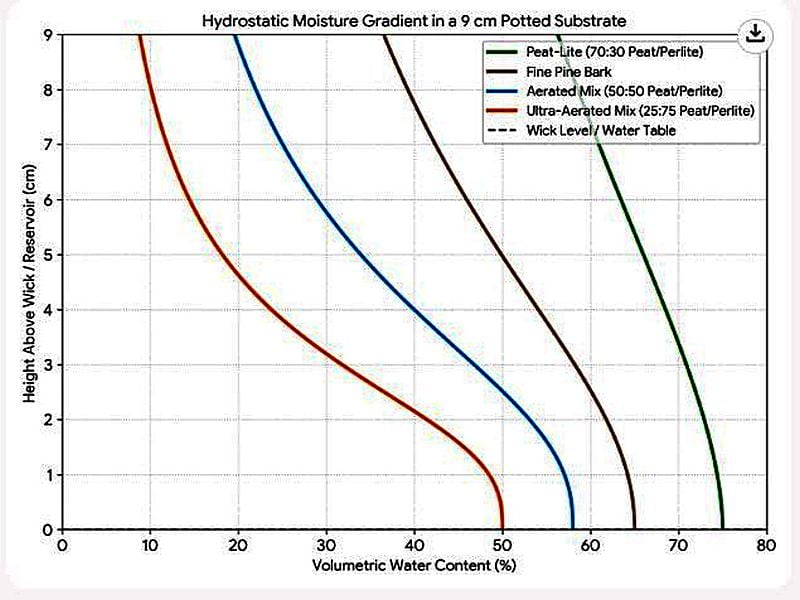
The Volumetric Water Content (VWC) compares the volume of water to the total volume of the container. For example, a 50% value means that half of the container space is water. The “wick level” is at height zero and assumes the wick is at the bottom of the pot.
One of the major points in the chart is that soil moisture varies within the pot. The very bottom, next to the wick, is the wettest. The top is the driest. The change from top to bottom is not linear, and different mixtures have different moisture profiles.
A soil with 75% perlite (orange line above) is wetter at the bottom 1 cm (1/2″). As you go up the pot, the amount of moisture drops quickly. The top half of the pot has less than half as much water as the bottom. This configuration provides roots a better opportunity to find a condition they like.
Gesneriad Preferences
The following are the most common mixtures used in wicking pots.
- African violets: 60-70% perlite.
- Streptocarpus: 50-60% perlite
Perlite vs Vermiculite
This post talks about perlite being used to change the characteristics of the potting media. Some people also mix in vermiculite, while others use vermiculite exclusively. I have reviewed those two products extensively in Perlite vs Vermiculite – Which Soil Additive is Better?
Contrary to popular belief, they both hold water and release about the same amount to the soil. I have found no reason to use both in the same mix.
Perlite Layer in the Bottom of the Pot
Some growers add a layer of 100% perlite in the bottom of the pot—often called a perlite reservoir or perlite drainage layer. Explanations suggest that this layer decreases the wetness of the soil, but that is mostly a myth.
If the wick is placed above the perlite layer, it functions just like a wick without the perlite.
If the wick is located below the perlite layer, water moves from the wick to the porous perlite and wets the perlite layer. Once water reaches the interface between soil and perlite, water continues to move into the soil. The perlite layer acts like a very thick wick.
The perlite layer does not block or slow down water delivery; it simply acts as a highly aerated distribution bridge between the wick and the main root zone.
The perlite layer does reduce the amount of soil in the pot, and it moves the perched water table (the saturated zone) higher in the pot. Both of these have negative effects on the root system.
There seems to be no good reason for using a perlite layer.
Where Should the Wick Be Placed?
There are two common places to place the wick: the bottom of the pot or halfway up the pot. Does the placement make a difference to the moisture level in the pot?
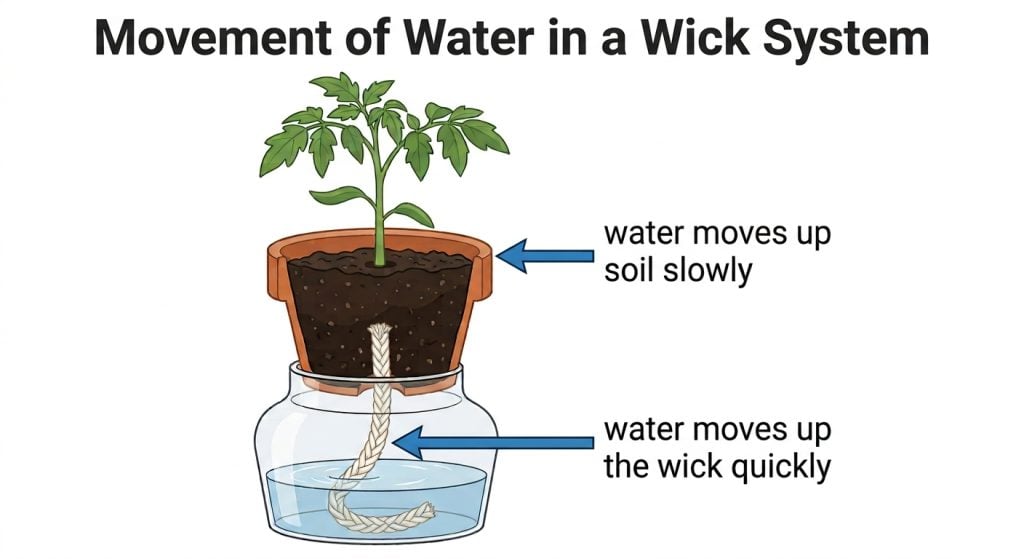
Synthetic wicks move water more efficiently than soil. This results in water moving up the wick quickly, but once it reaches the soil, water movement slows down.
Another important fact is that the bottom of the pot is wetter than the middle of the pot.
The above diagrams show the moisture levels in the pot when the wick is placed at the bottom. What happens if the end of the wick is now placed in the center of the pot? Water moves up the wick faster than water moves up the soil around the wick. At the top of the wick, water moves into the soil, creating a wet spot in the center of the pot.
A wick in the center of the pot has the effect of making the center of he pot wetter than when the wick is in the bottom of the pot.
A hydrostatic equilibrium is still created, but it looks a bit different than in the above diagrams. Even though the center is wetter, it is still drier than the soil at the bottom of the pot. The difference probably has little effect for most growers, given all the other variables that are involved.
What should a gardener do? Leave the wick at the bottom of the pot. If the soil is too dry in the middle of the pot for the plants you grow, reduce the perlite level instead of moving the wick.
Wick length also does not matter, provided you have a couple of inches in the pot.
Does Wick Watering Work for Baby Plants
It is a common myth that baby plants can’t be grown with wick watering. The belief stems from the fact that such plants have small root systems which don’t remove enough water, and therefore a wick system will keep the soil too wet and rot the roots.
As discussed above, this is not what happens. If a small root system and a large root system are put in the same-sized pot with the same potting soil, the moisture level in the pot is the same, because both pots have the same hydrostatic equilibrium. Remember that the wetness depends on the hydrostatic equilibrium, which is determined by the structure of the soil, not the rate at which roots remove water.
There is one important caution here. Small plants tend to have shallow roots, and shallow roots are near the top of the pot where the soil is the driest. Larger root systems reach deeper in the pot where it is wetter. A baby plant with a small root system may be too dry. In that case, top-water for a few weeks until the baby gets established.
Using a Dome
How does a dome cover affect water movement? The humidity inside a closed dome or plastic bag will quickly reach 100%. At that point, evaporation from the soil surface stops and plants have trouble absorbing water from the soil. Water also stops moving up the soil, since none is lost from the top of the pot.
Since no water leaves the pot, it is in constant equilibrium, and no water moves from the wick into the soil. The idea that the wick keeps adding water to the soil, making it too wet, is a myth.
Domes should only be used for plants or leaves that have no root system or a very small root system. As soon as the plant can absorb water through its roots, remove the dome.