

Many people believe that all of a potato’s nutrients are locked inside the skin, while others believe that potato skins have no nutritional value. And then there is the belief that potato skins are toxic, especially the green ones.
What is the real truth about potato skins? Should you be eating them?
Watch the YouTube video for this post: https://youtu.be/YqFsoPH434c
Key Takeaways
- Normal potato skins are safe to eat, but green ones are not.
- Potato skins are nutritious, but what about sweet potatoes?
Potato Nutrition
Answering the question about nutrition is fairly easy. The levels of nutrition are well known.
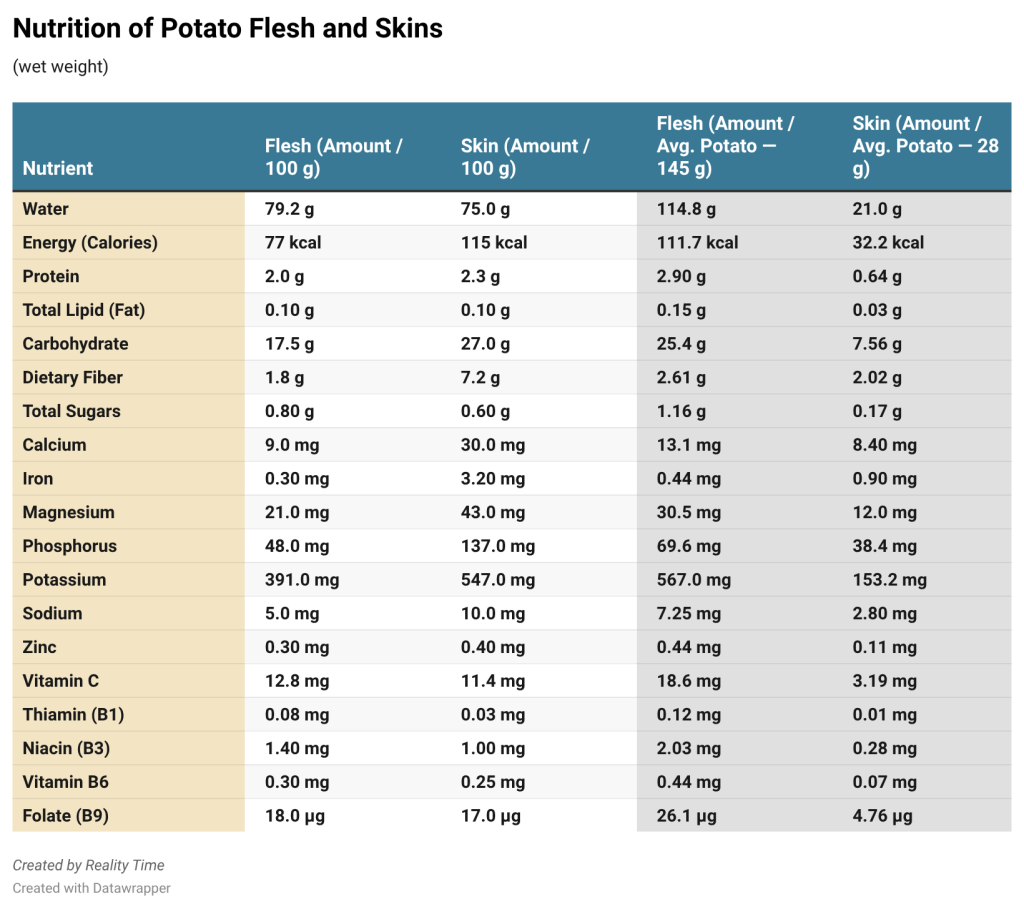
The second and third columns in the table below show the amount of a particular nutrient you will consume if you eat 100 grams of either potato flesh or skin. Skins have almost as much nutritional value as the flesh, and in some cases, such as fiber, calcium, iron, and phosphorus, they have more. They do have twice as much sodium as well, but that just means you don’t have to add as much salt to your baked potato if you leave the skin on.
Another way to look at this is to compare what you actually eat. An average potato weighs 173 g. The majority of this (145 g) is the flesh. The two columns on the right compare the nutrients you consume when you eat an average-sized potato. The skin may be more nutrient dense, but you actually get more nutrients from the flesh because it makes up the majority of the meal.
Does the skin give you a lot of fiber? Not as much as the flesh, but that is because a potato is only 16% skin (by weight). However, it is surprising that at 16% of the total potato weight, the skins still provide almost as much fiber as the flesh (2.6 g vs 2.0 g)
Are Potato Skins Safe to Eat?
The above table looked at the nutritional value of the potato, but it is also important to consider its toxic compounds.
It is a common belief that all fruits and vegetables are good for you. What is less known is that all fruits and vegetables contain natural toxins. These are chemicals that plants make to keep bugs from eating them. In fact, 99.9% of the pesticides we eat are natural pesticides that plants make.


Since potatoes are a root crop, most of the natural pesticides will be found in the leaves, but some are also found in the roots.
The potato belongs to the nightshade family (Solanaceae) and produces natural toxic glycoalkaloids called solanine and chaconine. The tomato and the deadly nightshade or belladonna, are also in this family of plants.
The average glycoalkaloid amount in market potatoes should be less than 200 mg/kg. The dose becomes toxic to humans at 2 mg/kg of body weight.
That means the average adult (70 kg) eating average-sized potatoes (173 g) with 13 mg of glycoalkaloid, would need to eat 11 potatoes to reach the toxic level. It is therefore highly unlikely to eat a toxic amount of potatoes, with the exception of ‘green potatoes”.
Are Green Potatoes Safe to Eat?
Potatoes are normally stored in dark locations. When they are exposed to light, they start producing chlorophyll and turn green. Chlorophyll itself is completely non-toxic and harmless, but light exposure triggers a simultaneous, independent biochemical pathway that synthesizes glycoalkaloids as a chemical defense mechanism. The green color serves as a visual indicator that glycoalkaloid levels have elevated.
Green potato skins can reach glycoalkaloid concentrations of 1,500 to 2,200 mg/kg. At this level, it takes only 2 potatoes to reach toxic levels, instead of 11 for regular potatoes.
The glycoalkaloids are heat-stable. Standard cooking methods do not decrease the level in food. Deep-frying at high heat reduces total levels slightly via leaching into oil, but not enough to render severely green skins safe.
If a potato shows some green spots, remove them before eating. If a potato is mostly green, don’t eat the skin.
The inside flesh of the potato is safe to eat even if the skin is green, provided it does not taste bitter. If a potato is bitter, discard it.
Are Sprouted Eyes Toxic?
When a potato gets older, is exposed to warmer temperatures or to light, it will start growing. The eyes start to grow small shoots. Is it safe to eat such sprouted potatoes?
When a potato begins to sprout, its metabolic state shifts. To nourish the shoot and defend itself against soil pests and fungi, the potato rapidly synthesizes glycoalkaloids—specifically solanine and chaconine.

These toxins accumulate mostly in the growing eyes, but they also increase in the skin and flesh around the eyes.
If the tuber is firm, the skin is not green, and the sprouts are less than 1/2” (1 cm) long, cut out the eyes and the surrounding tissue with a paring knife or the tip of a vegetable peeler. The rest of the potato is safe to eat.
If the tuber is soft, the skin is green, and the sprouts are already long, it is best to discard the potato.
The Toxic Lenape Potato
Humans have produced toxic potatoes in the past. Here are a couple of examples.
In an effort to produce a great potato for making chips, breeders used conventional breeding methods to develop a variety called Lenape. After a successful commercial launch, it was found to have a dangerously high level of solanine and was removed from the market. It did make great chips, though!
The average Russet potato contains about 8 mg/100 g of solanine, while the Lenape has 30 mg/100 g. The Lenape potato is still used for breeding because of its pest resistance, but offspring are tested for alkaloid content, as are most new varieties of potatoes.
A similar high-solanine potato was removed from the market in Sweden in 1995. In this case, the cultivar was an heirloom variety developed in the UK in the nineteenth century, called Magnum Bonum.
A hybrid potato produced from two species, S. tuberosum and S. brevidens, produces the normal alkaloids but also a new toxin called demissidine, which was not present in either parent. Traditional breeding methods were used to create this hybrid, illustrating the danger of mixing thousands of genes without controls. This is something the anti-GMO crowd needs to understand.
Read about other toxic vegetables in: Hybrid Vegetables Can Be Toxic
Other Potato Myths
Myth #1: Potatoes contribute to weight gain.
Some studies have been reported that seem to indicate people gain weight when they eat potatoes. However, these studies did not look at how the potatoes were prepared. French fries, potato chips, and baked potatoes with a lot of butter will lead to weight gain.
Other studies have found no link between eating potatoes and weight gain, provided they are eaten in moderation.
Myth #2: Potatoes Are an “Empty” Carb
Potatoes have been called “bad carbs” or “empty carbs”. The reality is that there is no such thing as truly “empty.” Potatoes, in particular, are a nutrient-dense vegetable, especially with the skin on.
Myth #3: Sweet Potatoes are More Nutritious Than Regular Potatoes
Both are called potatoes, both grow underground, and they look very similar. You can even buy fries made with either one, but they are not related. Regular potatoes belong to the nightshade family (Solanaceae), while sweet potatoes belong to the morning glory family (Convolvulaceae).
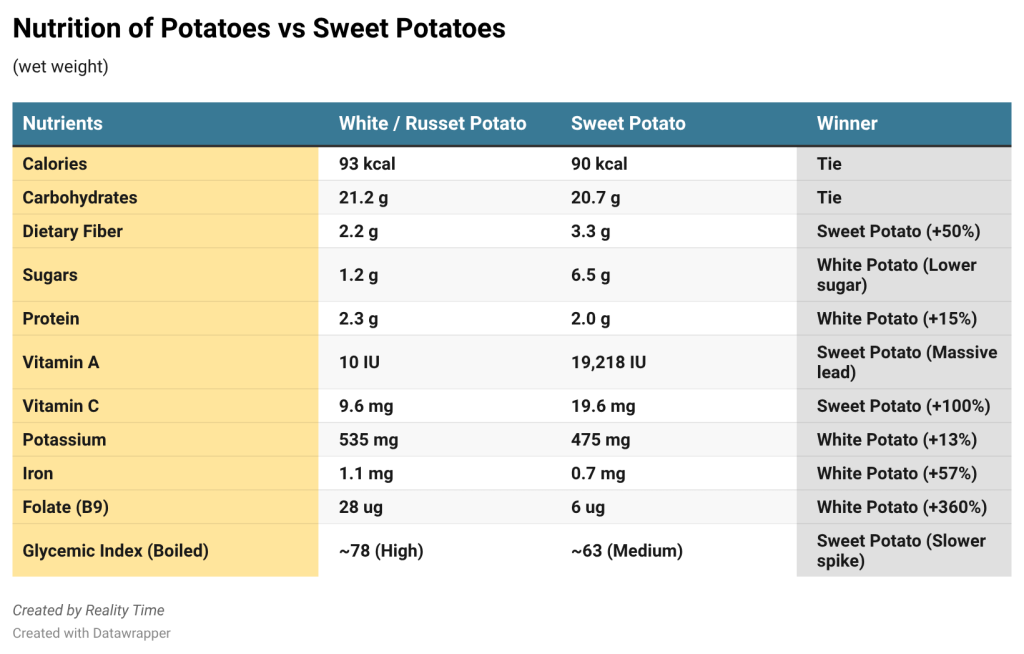
The following table compares the nutrition of each.
Every nutrition discussion is flawed, and I have discussed this in The Myth of High Nutrient Density in Food.
The only important nutrients are the ones your body needs. For example, sweet potatoes have twice as much vitamin C as potatoes. Some would argue that this fact proves sweet potatoes are more nutritious. But in developed countries, most people consume too much vitamin C. Eating more provides zero benefit. It is therefore not a nutritious compound for this group of people.
It should also be noted that vitamin C is degraded when food is heated, and since we usually cook potatoes, we don’t really get much vitamin C from them.
This group of people can have low iron levels. Potatoes provide more iron, so for this group of people, potatoes are more nutritious.
Overall, both options provide a fairly high level of needed nutrients.
Myth #4: The Fridge is Too Cold for Storing Potatoes
The fridge may not be the best storage location, but it works well for short-term storage.
Standard home refrigerators are typically set between 1.5°C and 4°C (35°F and 40°F). The best storage temperature for potatoes is 7°C to 10°C (45°F to 50°F). Check the temperature of your fridge.
Storing potatoes too cold triggers a process called cold-induced sweetening (CIS). During this process, starch is converted to sugar, making the potato sweeter and altering the texture and flavour. The flesh turns dark or gray, soggy, and gritty when cooked.
Most people won’t notice a change in flavour unless they are stored for more than 2 weeks.
Unless you have a fruit cellar, the alternative is storage at room temperature. The problem with this is that the potatoes start to grow eyes and will get green in light. Growth starts in 2-4 weeks.
A fruit cellar may be the best option provided it is cool, dry, and dark.
Myth #5: Potatoes Are Inflammatory
Although this is a popular belief, there is no scientific support for it. Potatoes contain anti-inflammatory compounds like vitamin C, potassium, and fiber (resistant starch).



As a Californian of Irish descent, and interested in learning about The Great Famine, I appreciate all of the solid info here about the nutrition of the beloved potato. Great article! Thank you!