I have been gardening my whole life and have a science background. Besides writing and speaking about gardening, I own and operate a 6 acre private garden called Aspen Grove Gardens which now has over 3,000 perennials, grasses, shrubs and trees. Yes--I am a plantaholic!
I have seen hundreds of reports about the honeybees dying. If we don’t do something soon we will loose 75% of our food supply. Chemicals are killing them by the millions. But are they really dying? Do we have a catastrophe on our hands or do we have a bunch of fear mongering authors who do not understand science?
From a myth busting point of view this is an interesting story. The truth depends very much on how you ask the question.
Primulas are great garden plants for part shade and Primula elatior ssp pallasii is one of the best. I normally do not care for pale colored flowers, but the light yellow of this one, combined with its early flowering, makes it stand out in the garden. It is a real gem that seems easy to grow.
The misuse of the word “bees” is leading the general public to reach all kinds of incorrect conclusions.
Headlines about bees are common, but many are incorrect or at least misleading. What do these headlines really mean? Which bees are they talking about?
Go into any nursery and try to find lavender and Russian sage; they will be in the perennial section. Check these plants online or in books, and most sources will tell you they are perennials. Lavender and Russian sage are subshrubs, a fancy name for a small shrub. Once you understand they are NOT perennials, they become easy to grow.
Spring is the best time to cleanup your garden. What do you need to do? How should you do it? What should you not do? In this post I will discuss early spring cleanup and point you in the right direction.
Spring is a special time for gardeners. The world is coming to life, and the warm days get our blood boiling – we need to get out there and do something. The problem is that at this time of year many people do work in their garden that does not need to be done and some of it actually damages soil and plants.
What happens when science says one thing and you believe something different? Our brains are designed to fight such situations, and we try to apply logic to justify our beliefs – we basically make stuff up so that we can continue to accept our beliefs.
One of the most common reasons to dismiss science is to point out the fact that “science does not know everything”. If it does not know everything, then it might be wrong in all cases.
Indoor plants have a great reputation for purifying the air in our homes. In Air Purifying Plants – Do They Work?, I debunked the idea that houseplants remove VOCs (toxic chemicals) from our home – it is just a well publicized myth. Several people commenting on that post and the post called A Garden Myth is Born – Plants Don’t Purify Air, to make the point that plants do more than remove chemicals – indoor plants increase oxygen levels in the air. This increased oxygen contributes a lot to our well being – or so people claim. Do houseplants increase oxygen levels in the home?
House plants don’t increase oxygen levels in the home.
It is difficult to find plants for dry shade but Pachysandra procumbens will be quite happy in such conditions, at least in cooler climates. In warm areas you might need to provide more moisture.
The claim is that slugs and snails are attracted to cornmeal, and after eating it, the cornmeal expands and kills them. What a simple organic method for getting rid of slugs, but does it work?
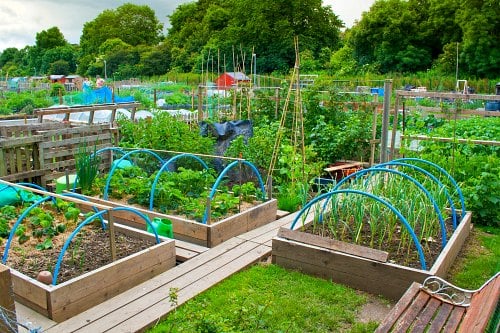
You have decided to make raised beds and now need to fill them with soil. What is the best soil for raised beds? How often does it need to be replaced? How much compost should be added? Should you mix in some garden soil? I’ll answers these and other question in this post.
Before we start, lets define the term raised beds. I discussed raised beds in Raised Beds – Pros & Cons, and defined them as having walls. I will continue to use this definition in this post.
I just replied to a comment in my Fish Fertilizer Post which said, “It’s surprising the article makes no mention of the full spectrum of minerals present in sea food, and therefore the fertilizer. Sea water is known to have an astounding 82 elements (don’t have the link, please Google it) The only thing that prevents us from using sea water as fertilizer is the high sodium content. Fish do the wonderful job of filtering out that excess sodium and leaving you with extremely mineral rich organic matter ! “.
A couple of weeks ago at the Guelph Organic Conference, one of the salespeople selling an Australian sea salt extract, claimed that his product contained 99 nutrients that plants need.
I found the following claim on a company website; “Azomite – Organic Trace Mineral Powder – 67 Essential Minerals for You and Your Garden”. Azomite is a brand name product made from “special” rock dust.
Why does fertilizer only show three nutrient numbers, NPK, when plants need either 67, 82 or 99 nutrients? Inquisitive gardeners want to know.
Raised beds are becoming more popular, but do they make sense for the garden? What benefits do they provide? Will they grow more food than convention low beds? Does a raised bed need to have side walls? What is the best building material and soil for raised beds? In this and the following posts I will try to answer all of these questions so that you can make an informed decision about adding raised beds to your garden.