

I was working on a new video about growing tomatoes in hot climates and found all kinds of suggestions about the best NPK for tomatoes. Much of that information was wrong. People are just picking numbers out of the air.
What does science say?

Key Takeaways
- Online suggestions for tomato fertilizers are mostly wrong.
- Commercial tomato fertilizers are not science-based and use the wrong NPK.
- The best NPK for tomatoes is 2-1-1.5.
This post uses affiliate links
Common Claims for Tomato Fertilizer
What are people recommending?
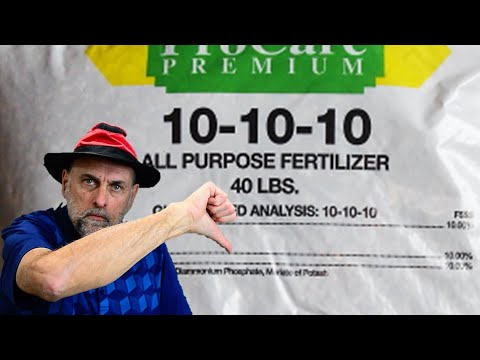
Most people use a 10-10-10. This was a common fertilizer 40 years ago, but no plant needs a 10-10-10, and it would be extremely rare for this to be suitable for soil. I explore this in detail in this video:
PennState Extension says this for growing in containers: “Once flowering, change over to a high potassium fertilizer. Most fertilizers blended for tomatoes fit this description. In our program, we’ve been using a fertilizer with a 9-15-30 (NPK ratio = 1-1.7-3.3) plus micro-nutrients analysis. ” Plants do NOT need a high potassium fertilizer when they flower. They have the same nutrient requirements before and after flowering.
Someone on the Master Gardener of Ontario Facebook Group said, “Alaska Fish Fertilizer (5-1-1) is excellent for tomato seedlings. Its high nitrogen formula supports strong, steady growth, promoting healthy leaf development without burning plants. When I tested fish fertilizer on seedlings, it did not perform better than synthetic fertilizer.
Tomato expert and author of Epic Tomatoes, Craig LeHoullier, suggests a fertilizer with a higher middle number, such as a 5-10-5 (NPK ratio = 1-2-1), during the flower and fruiting phase.
Note that the above three suggestions do not agree! One says high nitrogen, another says high potassium, and the third says high phosphate. The average NPK ratio for the above claims is 1.4-1-1.1

What Do Fertilizer Manufacturers say?
Here are three common products I reviewed:
- Miracle-Gro Tomato Plant Food: 18-18-21 (balanced)
- Burpee Organic Tomato & Vegetable: 3-6-4 (high phosphate)
- Espoma Tomato Tone: 3-4-6 (high potassium)
Each of the selected products used different methods of application, different coverage areas and different units of measurement, making it difficult to compare products. Each also contains different amounts of soluble nitrogen.
For the purpose of the comparison, I have normalized the recommendations and calculated the amount of soluble nitrogen that is applied to one tomato plant, growing in a 2 x 2 foot space, during a 4-month season. The following table summarizes the data.

The total amount of nitrogen added by each product was about the same, around 7 g per plant. The synthetic fertilizer (Miracle-Gro) added this amount in the form of soluble nitrogen so it was immediately available to plants. The organic fertilizers added the nitrogen mostly as insoluble forms. If they are similar to compost, the insoluble nitrogen will be released slowly over the next 5 years.
There is no consistency between manufacturers of tomato fertilizer. They all have different NPK ratios, and they apply different amounts of available nitrogen.
The average of the commercial NPK ratios = 1-1.4-1.4
What Does Research Say?
I checked out several research papers on the best NPK ratios for growing tomatoes.
| Reference | Best NPK ratio | Comment |
|---|---|---|
| Feng Qu et al | 3.5-1.6-1 | Greenhouse, bag culture |
| Chunyan Wu et al | 2.2-1-2.6 | Outdoor, in-ground |
| Manoj Kumar, M.L. et al | 2-2-1 | Field study |
| Wangxiong Li et al | 2.4-1-3.3 | Pot culture |
| U. of Florida research | 1.3-1-1.5 | various |
| Average: | 1.8-1-1.5 |
The University of Florida has done extensive research on tomatoes over the years, and their current recommendation is 1.3-1-1.5.
If you average the above research values, including the U. of Florida, you get an NPK of 1.8-1-1.5.
The Best NPK for Tomatoes
The following table summarizes the above information.
| Source | Average NPK ratio | Comment |
|---|---|---|
| Common claim | 1-1-1 | A balanced formula is never right |
| PennState | 1-1.7-3.3 | Not enough nitrogen |
| Fish Fertilizer | 5-1-1 | Wrong NPK for plants |
| Craig LeHoullier | 1-2-1 | High P not needed for blooms |
| Average of Commercial Fertilizers | 1-1.4-1.5 | Not based on science |
| Average of Research | 1.8-1-1.5 |
The range of values is surprisingly large, given that we have been researching tomato growth for quite a few years.
- Most of the suggestions found in gardening groups and websites do NOT match the research.
- Commercial “tomato” fertilizers are NOT formulated based on science.
- Plants do NOT need more phosphorus during flowering.
A while ago, I researched NPK values for a variety of plants and came up with an average of 3-1-2.5, which I rounded off to 3-1-2 to make it easier for the general public to remember. Plants need mostly nitrogen, a low amount of phosphorus, and potassium somewhere between the two.
The average research NPK is 1.8-1-1.5, which is not far off from the average for all plants. The fact that they need a lower relative nitrogen is a surprise.
The best NPK for tomatoes is 2-1-1.5.
In the Ground vs Containers
Just because the best NPK is 2-1-1.5, does not mean that is the fertilizer you should be using. Your job as a gardener is to add the nutrients your soil needs.
Soil in the ground already contains nutrients. You only need to add the missing ones to bring the level up to what plants need.
Soil in pots, containers, and many raised beds does not contain real soil. When they are based mostly on peat moss, coir, or decomposed wood, they contain almost no nutrients. In that case, you can fertilize with an NPK of 2-1-1.5.

If your raised bed contains a lot of compost or manure, you may already have very high levels of nutrients, particularly phosphorus. The levels in such raised beds can be so high that they become toxic. You only add what is missing.
Amount of Fertilizer
The NPK ratio does not tell you how much fertilizer to use – it is just the ratio of nutrients.
For pots and containers using soilless mix, including seedlings, aim for 100 ppm nitrogen. To calculate this for your fertilizer, use my handy PPM calculator.
The amount of nitrogen for the soil depends on the current level of nitrogen. In good-quality soil with high organic matter levels, you may not need to add any fertilizer.


How did you calculate the 3.6-1.6-1 for the feng paper? It looks like 5-1-2 to me.
Hey Robert, Great article. My question is, I have a lot of 10-10-10 just lying around. I bought it before I started reading you. Is there any harm in just using this fertilizer up first, then switching to your recommendations? I hate to just waste the money (after I’ve already wasted the money buying it) and toss it out. Thanks! Joe
Use the fertilizer. just understand it adds too much phosphorus.
an alternative is to use less and mix in some urea to increase the nitrogen level.
I may have missed something, when referring to ppm levels I assume we are trying to keep that level of concentration over time. But the concentration is just a snapshot in time. These nutrients are taken up by the plant, leached, immobilized in the soil, or tie up in the chemistry. They need to be replenished to keep the concentration near the target. Depending on the frequency, the volume delivered to keep the concentration up will change. This not made clear in a lot of what I have read.
The 100 ppm recommendation is for potted plants. You water so that some of the old water and nutrients are washed out the bottom and replaced with the new solution. When used with each watering, the nutrient level at the roots is about equal to the nutrient level in the water. You are correct it will change over time. Then with the next watering it is again the same as the in the water.
It is close enough for growing plants. It could be made much more complicated, but then gardeners would not follow it.
Would you recommend a 3-1-2 or 2-1-1 for tomatoes ?
Based on the review, 2-1-1 is closer. But can you find a fertilizer at that ratio? I also use 3-1-2 for everything else, so I just use 3-1-2 for tomatoes. Once in the ground this ratio is no longer valid for fertilizer anyway, since there you add missing nutrients, you don’t fertilize plants.