

Here is a quote that was posted in our Facebook Group: “If you give a tomato plant too much nitrogen, it grows lots of green stuff, but not many tomatoes. Apparently, for maximum production, you have to intentionally starve it of nitrogen a little bit to force it into fruit mode. What is the “right” amount of nitrogen and when?”
I have seen this claim before. Too much nitrogen produces too many leaves and little fruit. But is the claim correct? Should gardeners reduce nitrogen levels as the plant starts producing fruit?
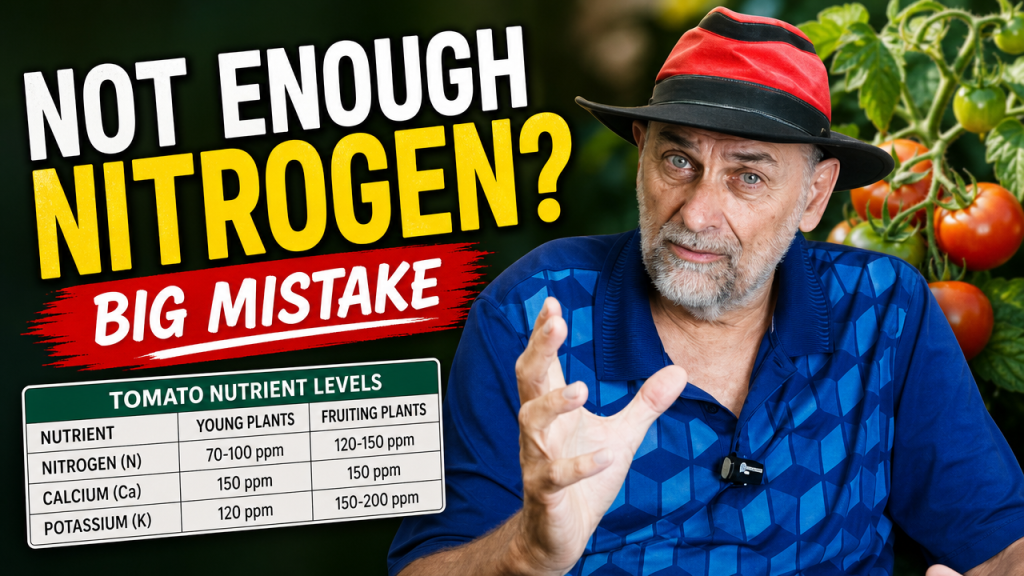
Watch the video version of this post: https://youtu.be/IyKjz77edm4
Key Takeaways
- Garden advice for feeding tomatoes is wrong.
- Increase nitrogen as the plant grows.
This post uses affiliate links
What Gardeners are Being Told
Gardeners tend to listen to other gardeners on social media, and garden writers and YouTubers. Unfortunately, these are not always good sources of information, but let’s try to understand the logic they are giving.
Too much nitrogen causes plants to grow more leaves. If they grow more leaves, they are not growing flowers and fruit. This concept is in line with the claim that nitrogen is for leaves, phosphorus for roots and flowers, and potassium for health. I have already debunked this myth.
What do you do in the garden according to these claims?
- Once a plant is large enough to flower, you should cut back on the nitrogen. The lack of nitrogen forces the plant to make more flowers and fruit.
- Give more nitrogen to small plants and less as they grow larger.
What Do The Experts Say?
Fertilizer rates for soil can be useful, but the numbers depend very much on the type of soil and the amount of organic matter in it. Therefore, these numbers are not that useful to answer the question.
However, commercial growers who produce hydroponic tomatoes don’t have the soil variability. They not only monitor the nutrient levels very carefully, but they also adjust them for the best yield.

What do hydroponic tomato growers say?
Florida is a major tomato producer and has done extensive research on the topic. Here is what they say, “A common problem comes early in the season when plants become too vegetative (bullish) from too much N”. This suggests that nitrogen levels need to be kept low for smaller plants, which is the opposite of what gardeners are being told.
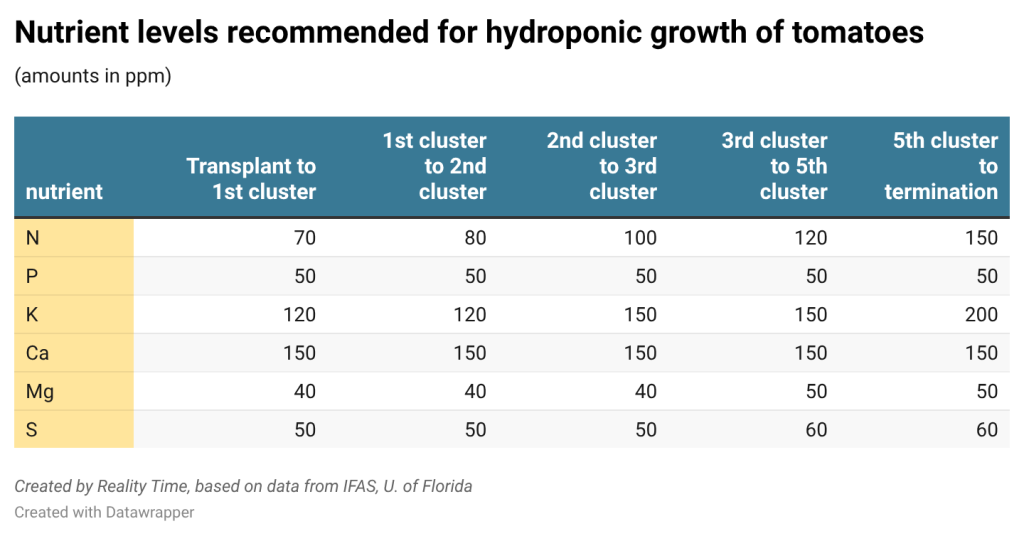
The above table is the recommendation from IFAS, University of Florida. Use more nitrogen as plants grow bigger.
The Ohio State University has this to say:
- Young plants require and should be provided with lower nutrient concentrations than mature plants, to prevent plants from becoming too vegetative.
- Plants in early fruiting stages require increased levels of specific nutrients like nitrogen (N), calcium (Ca), and potassium (K) because the developing fruits demand greater amounts of these nutrients.
- Mature fruiting plants require the highest levels of nutrients to promote plant growth and fruit development, as well as an appropriate balance of specific nutrients to ensure high fruit quality.
These recommendations are not the same as those in Florida, but they are consistent regarding nitrogen. Also note that Florida focuses on growing in warm climates, and Ohio is for cooler climates.
Science in Hydroponics suggests two common formulations for growing tomatoes.
- The Arizonia formula: seedling = 113 ppm, fruiting = 144 ppm
- The Florida formula: seedling = 65 ppm, fruiting = 175 ppm
Each of these sites, including several others that I looked at, suggested:
lower nitrogen levels in the early stage of growth and higher nitrogen levels once the plant starts fruiting.
The expert advice is the exact opposite of the gardening advice.
Growing in Soil
Does this conclusion apply to tomatoes grown in real soil?
A study in Italy looked at this and found that higher nitrogen levels (N > 150 kg ha−1) increased fruit yield and mean fruit weight. It also increased fruit firmness and reduced sunscald, probably because the increased leaf growth shaded the fruits.
This study also showed that at very high levels of nitrogen (250 kg N ha−1), fruit has lower levels of dry matter, pH, glucose, fructose, soluble solids, and ascorbic acid, which may affect flavour.
They concluded that a level of 200 kg N ha−1 is the best compromise for improving yield, maintaining good fruit quality attributes.
This illustrates one of the problems with data from soil experiments. The value can’t be directly converted to a level of fertilization in your garden because your soil and other growing conditions are different.
However, just like the hydroponic research, this work suggests that higher levels of nitrogen are a good idea while a plant is fruiting.
Why Increase Nitrogen?
What is the logic behind increasing nitrogen? Nitrogen is used for every aspect of growing. When plants are flowering and producing fruit, a lot of nitrogen is used in making the fruit. If nitrogen levels are not increased to match this need, the rest of the plant grows more slowly due to a lack of nitrogen.
As plants grow and get bigger, they need more nitrogen.
Growing in Cold Climates
A common practice in cold climates (and even in super-hot ones like Florida) is to top the plants and remove flowers late in the season. None of these will produce ripe fruit before frost, so you might as well remove them.
At this point, you might also reduce nitrogen, because most of the plant growth has come to an end.
Supper High Nitrogen Levels
Another special case might be a situation where you have used a lot of nitrogen early in the season. Here we are defining “a lot’ as a number that is higher than any of the above suggestions from experts.

This could be due to the addition of a lot of manure or high levels of synthetic fertilizer.
In this case, fertilizing less as the season goes along might work well, but only because the levels are too high to begin with.
The Bottom Line
The common gardening advice to reduce nitrogen to encourage more fruit is wrong. This myth is busted.
The Best NPK for Tomatoes
I have dealt with this topic before. You can read about it or watch the video:
- Blog post for The Best NPK for Tomatoes


I am growing tomatoes, peppers and cucumbers in raised beds. I live in Northern California where the temperature is rising, and I have to irrigate daily. I have been fertilizing weekly alternating weekly between a water soluble synthetic 24-8-16 and a 5-1-1 fish emulsion. My concern is that I am leaching out my nutrients with my increased watering, at a time when my plants need it the most with a heavy crop. Do you recommend applying my water soluble over multiple days and/or using foliar applications. I’ve also considered using granular fertilizers that will release over a longer period. Any thoughts or suggestions would be appreciated. Thanks!
Too much water will leach nutrients away. Either water less, or fertilize after watering.
With mulch – do you still need to water daily? That seems like a lot.
There is something about transplanting tomato seedlings on the internet. Almost all the gardeners recommend planting the seedlings very deep, how true is that assertion
It is a good question. I have found no studies to support the idea.
Deep planting may have value in very hot climates because deeper roots do better in summer. I am less convinced that planting in a trough works better in cold climates.
All I’ve done for the past 20 years is add an inch or so of home made compost annually to the beds in my greenhouse & polytunnel.
This grows me a fine crop of garlic, then peppers, tomatoes, cucumbers, melons & climbing French beans through to October, followed by winter salads, spinach & turnips until late spring.
Never noticed anything which suggests more nutrients were needed.
True – but without running controls you would not see if the system can be improved.