

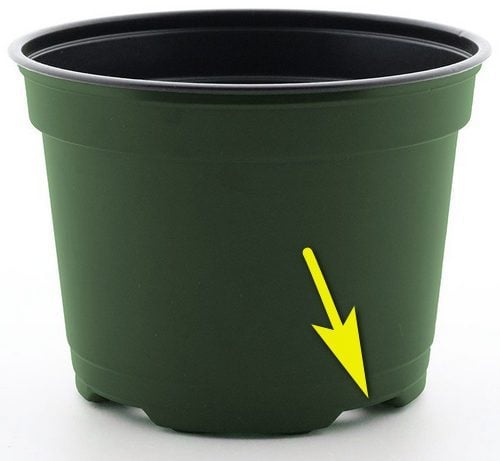
I have been growing orchids for over 40 years, and at one point, I grew over 1,000 orchids. Whenever I was asked about the best orchid pot, I responded with the same answer. Any green plastic pot will work just fine. If it had a raised bottom with drainage holes at the bottom rim (azalea pot), to allow better water drainage, that would be better, but any pot will work.
That answer is still correct. We know that because most hobbyists use that kind of pot.
However, there is some new research that suggests a clear pot may be better. Let’s have a look at what the new science says.
Key Takeaways
- Opaque has been the standard for many years and still works great.
- New science says there are some benefits from clear pots.
This post uses affiliate links
Why Use Clear Pots?
Terrestrial orchids, the ones most hobbyists have, grow on trees with their roots exposed to sunlight. When dry, they are a whitish color, but when wet, they are green. It has always been claimed that the roots contain chlorophyll and therefore photosynthesize, producing food for the plant.
If roots are an important contributor to the energy of the plant, it makes sense to keep them in light. Therefore, a transplant or clear plastic pot should produce healthier plants than a solid green pot.
That sounds very logical, but there have been very few studies supporting this claim.
The counterargument is that roots do have some chlorophyll in them, but they add very little food to the plant. Therefore, they grow just as well in an opaque pot as a clear pot.
Users do make some claims for clear pots:
- Clear pots allow you to see the roots. That is partially true, but you can only see the roots between the pot and the media.
- Claims such as “Silvery or white roots indicate the plant is dry”, are not entirely correct. Firstly, you can only see the outer roots. The center of the media could still be wet and have green roots. Secondly, a silver root does not mean the media in the pot is dry. You can have quite wet media and still see silver outer roots. You should water based on feel or by hefting the pot (ie, lifting it).
- Clear pots allow growers to spot root rot (brown or mushy), pests (like fungus gnat larvae or snails), or mold. This is partially true, but the first roots to rot are the ones on the inside of the media, which you can’t see. The same goes for most pests – they live where they get more moisture. In over 40 years of growing orchids, I have never had fungus gnats in orchids. There is too much air in a proper orchid growing medium.
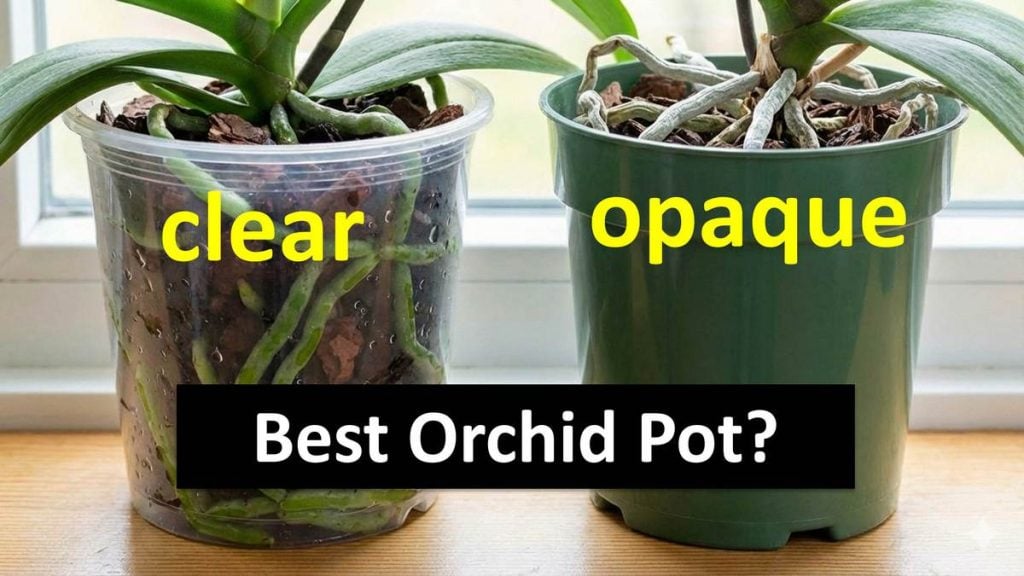
- Orchid bark and moss eventually decompose and become “sour,” losing the air pockets orchids need. Transparency lets you see when the medium has compressed or broken down, signaling it’s time to repot. Partially correct. However, you should not be using moss in the pot. And if you water correctly and report every two years, which I highly recommend, broken-down media is never a problem. The pot on the left shows the green roots after being watered. The one on the right shows the dry, silvery white roots. Source: Reality Time
What about the benefits of chlorophyll? Many hobbyists use a “two-pot system. “The orchid is grown in a clear plastic liner, which is then placed inside a decorative, opaque outer pot. When it’s time to water or inspect the roots, the clear liner is lifted out. If you do this, then the benefit of photosynthesis in the roots is lost, since not enough light gets to the roots to be of any benefit.

Opaque pots also have some benefits:
- They are less expensive and readily available. All of mine are recycled from plants I’ve purchased.
- Algae does not build up inside the pot. A lot of algae growth can keep the roots too wet.
There are now two new arguments for using clear pots:
- Most commercial propagators of Phalaenopsis, the most popular orchid, are now using clear pots – they must have a good reason?
- A recent study offers valuable insights into the benefits of clear pots.
The Latest Science on Clear Pots
Before looking at the latest science, it is useful to understand some basic plant chemistry. Photosynthesis is a process where CO2 is converted to oxygen and sugars (carbohydrates).
Note: The above description is what we normally tell people, but in truth, it is not correct. To learn more, have a look at Plants Don’t Produce Oxygen (O2) From Carbon Dioxide (CO2)
The sugars are used by the plant as an energy source to carry out just about everything that goes on in a plant. The process of using the sugars to create energy is called respiration. This process takes the sugars, plus oxygen, and extracts the energy, converting them to water and CO2. Respiration happens all of the time and is similar to what humans do.
Most plant roots can’t photosynthesize, so they don’t produce oxygen. Instead, they get the oxygen needed for respiration from the air in the soil and from the leaves. This works quite well for most plants, but orchids are different.
Orchid roots are covered with a very thick layer of pongy material called velamen. When dry, it is the silvery white material you see on orchid roots.
The problem with velamen is that it is not good at transporting oxygen into the root. To make matters worse, the orchid leaves don’t photosynthesize very much and are a poor source of oxygen for the roots. What this means is that the roots can suffocate from a lack of oxygen, a process known as hypoxia.
FREE Orchid Growing Course on YouTube:
Roots Need Oxygen
In the wild, orchid roots perform some photosynthesis, but much less than in leaves. However, the process does provide enough oxygen to prevent hypoxia in the roots.
A recent study from 2024 demonstrated that Phalaenopsis growing in clear pots photosynthesize enough to prevent hypoxia, but when grown in the dark, they don’t. The researchers suggested that roots growing in dense media, as well as roots growing in an opaque pot, will suffer from hypoxia.
Clear pots help orchid roots get enough oxygen through photosynthesis and thereby grow better.
Roots Grow Toward Light
Orchid roots tend to grow out of the pot as they try to reach light. Near the surface of the media, growth is usually above the pot and up into the air. In the media, roots will start growing out of holes cut into the side of pots.
This is not a big concern for a home gardener. You can simply push the roots back into the media at the next potting, which should be done every 2 years. However, it is a big problem for commercial facilities. Sticking out roots makes it difficult to move pots, especially with automated machinery.

A study from 2007 looked at the effect of the pot on aerial root growth. After 30 days of growth, plants in opaque pots had more than 7 roots outside of each container, whereas clear pots had fewer than 2 roots outside.
Clear pots seem to keep roots growing inside the pot. No matter which media is used, as the plant produces more roots, they will eventually grow outside of the pot.
Roots growing inside the pot will also have better access to water in our dry homes than roots dangling outside the pot.
The study also examined the effect of media on root growth in opaque pots. Plants grown in a medium consisting of 1:1 (by volume) chunky peat:perlite or 2:1:1 perlite:chunky peat:coconut coir had fewer aerial roots than plants grown in a bark-based or 1:1 perlite:charcoal media.
In addition, plants grown in the chunky peat:perlite mix or chunky peat: charcoal mix had the greatest increase in leaf span compared to the other media.
Even though chunky peat works in a controlled lab situation and many commercial growers do use peat moss, I strongly recommend homeowners stay away from the stuff. Unless watering is very carefully controlled, it leads to root rot, and is one of the main reasons howowners have trouble growing orchids. Use chunky coconut coir instead.
If you don’t believe me, maybe you will believe the scientists who say, “Inexperienced consumers often overwater plants sold in sphagnum, leading to root rot and plant decline.”
Does Photosynthesis in Roots Produce Better Plants?
Most sources feel that photosynthesis in roots does not add much carbon (sugars) to the plant. However, by providing some local oxygen to the roots, they remain healthier and more actively growing, which contributes to the health of the plant.
Indirectly, photosynthesis in the roots helps the plant grow, and since orchids are slow growers anyway, a small amount of help can have a significant effect.
What Does the Industry Use?
“A majority of Phalaenopsis growers in Taiwan and the Netherlands, and increasingly, growers in the United States, use clear pots that allow light to penetrate the pots.”
Root photosynthesis likely contributes little to total plant photosynthesis. However, because Phalaenopsis roots avoid darkness, the roots stay inside the pot better than the roots of plants grown in opaque pots.
Orchid production is now more automated than ever before.
“Growers in the Netherlands have the most sophisticated production facilities with the lowest labor inputs; it is estimated that each plant is cumulatively handled less than one minute from the time plants are removed from flasks as tissue-cultured propagules until they are flowering and are placed on carts for transport to market.”
In order to make it easier for robotic devices to move the pots, keeping the roots inside the pots would be a large benefit. This is probably the main reason the industry uses clear pots.


Can I use clean, not colored. bark packaged as mulch to keep them in. Secondly, I live in the southwest desert and keep my orchids in my non airconditioned Az room, which get hot, my orchids for the last 2 years have sent out flower stems in winter and have flowered in February, I thought they liked the heat, I am confused. Thx full of knowledge as always
I tried arborist wood chips and they did not work very well. I would use coconut chunks, or real bark.
Orchids like warmth, but htey also like a cooling down at night and in fall to initiate flowers.