

For millennia, wool has been prized as a textile fiber, valued for its warmth, durability, and moisture-wicking properties. Is it also a great soil amendment and fertilizer in the garden?
Watch the video for this post here: https://youtu.be/nC3h7vkPozY
Key Takeaways
- Wool is a high-nitrogen organic material.
- It works much like compost.
- It does not control slugs.
This post uses affiliate links
Wool – A New Tool for Gardeners
There are different grades of wool.
- Apparel Wool: This is a high-grade wool that’s used for making clothing.
- Waste Wool (Tags, Daggings, or Belly Wool): This is the wool from the sheep’s underside, legs, and rear. It is often contaminated with manure, urine, and “vegetable matter” (hay and burrs) and is a waste product.
- Coarse Wools: Many meat-breed sheep produce wool that is thick and scratchy. While perfect for carpets or insulation, there is currently a global glut of this wool. For many farmers, the cost of shearing the sheep is actually higher than the price they receive for this coarse wool.
- Mill Waste: During the scouring (washing) and carding process at textile mills, short fibers called “noils” fall out of the machines.
Except for apparel wool, there has been a limited market for wool, so it is commonly buried or burned. The wool industry is trying to use this waste product and make it available to gardeners as either raw wool or wool pellets.
- Raw Wool: This is non-apparel wool that is mostly left as is and sold as mulch material. It is often called “greasy wool, because it contains lanolin (sheep wax) and suint (dried sweat).
- Wool Pellets: The raw wool can be processed and formed into compressed pellets. Pellets can be used as mulch, but are more commonly used as a soil amendment.
Properties of Wool
Wool has a number of properties that make it useful in the garden.
- Retains moisture
- High nitrogen content
- Organic material that decomposes slowly
- Aerates soil
Retains Moisture
Wool consists of fibres that easily absorb water. It can absorb as much as 20% of its weight in water, similar to peat moss, but unlike peat moss, it expands in size as it absorbs water.
One product manufacturer claims that “wool pellets holds 10% more water than peat moss”, but I could not find supporting evidence for this. Even if they do hold more water, is that a good thing? Potting media in pots is routinely overwatered and can lead to root rot.
High Nitrogen Content
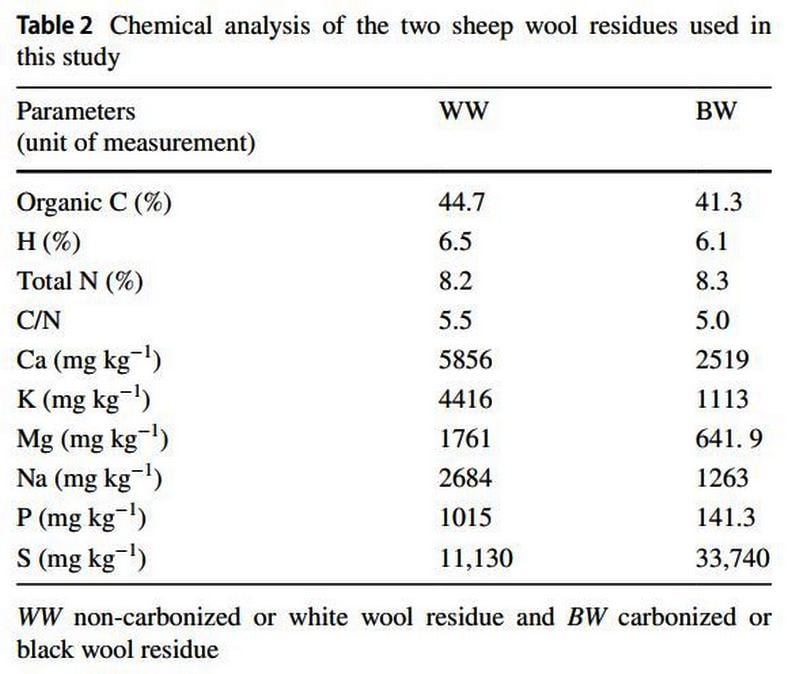
Wool has an NPK of approximately 9-0-2. It also contains a significant amount of sulfur, as well as other micronutrients. The pH is usually around 8.4.
Organic Material that Decomposes Slowly
It is a non-certified organic material that decomposes slowly, not unlike compost. As it decomposes, it slowly releases its nutrients.

Wool is a protein fiber composed of keratin—the same protein found in human hair and fingernails. Keratin is rich in sulfur-containing amino acids (like cysteine) and, crucially, nitrogen.
Fungi and specialized bacteria (keratinolytic microbes) begin to colonize the fibers. They secrete enzymes called keratinases that break the tough wool fibers. Wool pellets typically lose their physical structure within 3 to 6 months. Very little nitrogen is released during the first month.
A study that looked at the release of nitrogen and sulfur from both whole wool and wool pellets found a very slow release of nutrients. Most of the nutrients were still not released after 12 months. Another study concluded that “wool is difficult to biodegrade and maintains its properties for a long time, lasting longer than one vegetation season”. Another said, “results indicate that a single addition of wool or hair-waste of 0.33% by weight to soil would support two to five harvests“, indicating that it can take as much as 5 years to fully decompose.
I could not find clear data to show how slowly wool decomposes. Based on the evidence we have, wool releases nutrients very slowly over a period of years.
Aerates Soil
Wool pellets are compressed wool, but the pellets contain quite a bit of air. As they absorb water from the soil, they swell, creating openings in the soil. Together, these properties help loosen and aerate soil.
Using Raw Wool
Raw wool is fluffy and bulky, making it difficult to incorporate into soil. It is used mostly as a mulch. As a mulch, it performs like other mulches, keeping soil cool, slowing evaporation, keeping weeds down, and slowly adding organic matter to the soil.
As a mulch, wool may be better than straw or bark. Using it for strawberries, researchers concluded that “wool compared to straw and bark was better at controlling soil temperature fluctuations by a factor of two, and it was more effective at managing soil moisture”.
One product description mentioned that it is important not to have the wool touch plants, as the extra moisture in it could rot plants.
It also has some drawbacks. It is difficult to handle and is easily blown away when dry. The biggest problem with wool as a mulch is that it is very expensive, unless you can get some cheaply, directly from a farmer.
Using Wool Pellets
Most consumers would use wool pellets instead of raw wool. Pellets can be laid on the surface of the soil as a mulch, but that would be ridiculously expensive. It might be a suitable use in a pot.

The pellets are normally incorporated into the soil, much like any other amendment. As an amendment, it slowly decomposes like other organic fertilizers (compost, manure). Wool has more nitrogen than almost any other organic amendment. It releases these nutrients slowly, which is OK in the ground but not suitable for potted plants, where you want a quick feed.
Wool pellets expand when they absorb water, which may help aerate soil better than other options, but none of the research I looked at concluded that it is a superior product in this regard.
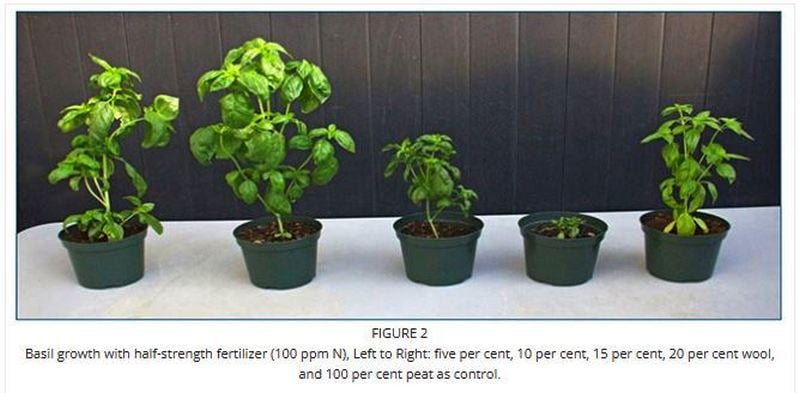
If you use the pellets in pots, be careful how much you use. A study conducted in 2024 at the Assiniboine College greenhouse in Brandon, Manitoba, growing basil in pots showed that adding 5% or 10% wool pellets to a peat-based potting media, along with regular fertilizer, did improve growth. However, 15% wool was detrimental, and 20% wool resulted in dead plants.
Do wool pellets work as a source of fertilizer? A study that compared commercial fertilizer to wool pellets for growing tomatoes and spinach found, “no differences between commercial and wool pellet fertilizers applied at the same rate of nitrogen”. Nitrogen from any fertilizer will grow plants – no surprise there. Wool pellets don’t have special advantages over other nutrient sources.
Slug Control
Many claim that wool controls slugs, and there are even “slug control” products made with wool pellets. The claim is that the wool has microscopic scales on the fibers, and these are too sharp for slugs.
Claims like this one are fictitious: “The tiny fibres of wool can irritate slugs by disrupting their mucus trail. This disruption causes discomfort as slugs attempt to cross the wool, making the experience unpleasant and prompting them to avoid these areas altogether”.
The story of the “microscopic scales” reminds me of the claim that egg shells are too sharp for slugs – a complete myth.
Another claim is that the natural lanolin on wool irritates slugs, keeping them away. The problem with this claim is that lanolin is usually removed while making the wool pellets. Even videos using whole wool show slugs crawling over it, and I found no evidence that lanolin plays a role in deterring slugs and snails.
Wool is also less effective when wet.
Some YouTubers have tried to show that slugs don’t like wool, but none of these tests are properly done, nor do they convincingly show that wool works.
The RHS has looked at this and concluded that wool pellets don’t work.
For something that really does work, check out this video:

The Cost of Nitrogen From Wool Pellets
I compared two fertilizer products from Amazon:
Howard Johnsons 7136 All-Purpose Fertilizer, 10-10-10, 35 lbs – $46.62, which is $13/lbs nitrogen. A similar product at Home Depot is half that price.
Wool Pellets Ovis Aries, 2 lbs, (assume 9-0-2) – $28.99, which is $161/lbs nitrogen.
This puts the price of wool pellets at 12 times that of synthetic fertilizer.
Should You Use Wool in the Garden?
Wool can work as a mulch or a soil amendment. It does contain a higher nitrogen level than most other organic sources.
Used in smaller amounts, it will feed plants, improve soil structure, and help hold moisture, just like other organic products.
It does not work for controlling slugs.
The real problem with this product is the price. It has a very high price, without bringing anything special to the table. Compost with a little added nitrogen fertilizer will work just as well at a fraction of the cost.
If you have cheap or free access to wool, use it – there is nothing wrong with the product. But if you have to buy commercial products, don’t bother. Many cheaper options are just as good.


Slugs! This was helpful.