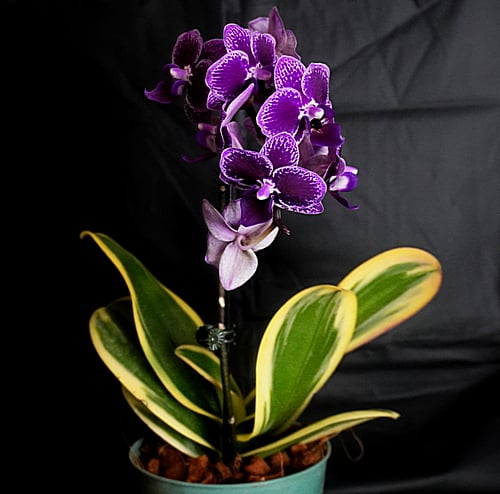
A couple of years ago, I purchased a variegated phalaenopsis with beautiful yellow/green leaves and reddish-purple flowers. It flowered regularly, but not with a huge number of flowers. I suspect the lack of fully green leaves reduced the number of flowers.
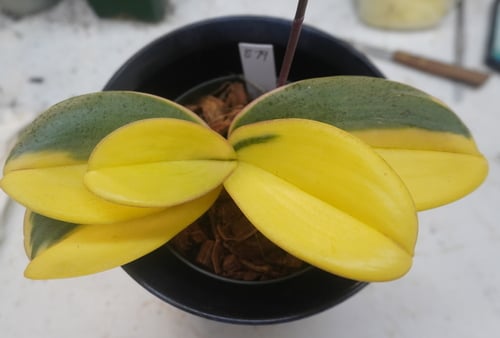
Over time, the new leaves became more and more yellow, until I had the plant pictured below, which is now making leaves that are 100% yellow. I hunted for a solution, which led me down a chimera rabbit hole. This post summarizes the surprising findings I found and how I tried to save the orchid.
The proper name for this plant is Phalaenopsis Chia E Yenlin ‘Variegata’.
Key Takeaways
- Variegated Phal orchid won’t return to 50% green leaves on its own.
The Common Advice Is Wrong
Years ago I had heard of a method for producing basal keikis. In short, you decapitate the plant and hope the resulting stem and roots form keikis. The hope in this case is that they return to their 1/2 green state.
I posted a question on the American Orchid Society Facebook Group to see if anyone had advice on how I can save this plant. I got lots of suggestions but no references to supporting information that would validate the suggestions.
Here are some of them.
- Lower light will result in more green leaves. Lower light indeed makes the leaves a darker green, but in this case we are trying to make the yellow area smaller. Light levels won’t affect this.
- Magnesium sulphate (Epsom salt). The darling solution for plant problems. Unfortunately, it solves very few plant problems and won’t help this plant. Besides, magnesium levels are not low.
- Use a clear pot. Roots in a clear pot get more light and contribute to the food the plant can make. Although this is true, I doubt it would compensate for a complete lack of green in the leaves.
- Increase fertilizer. It is currently fertilized properly at 100 ppm nitrogen. More fertilizer will not change the variegation.
Almost 100% of the comments said, don’t decapitate the plant. I think this is also wrong. I suspect the plant will get slowly weaker over time. The plant may naturally react to the yellow leaves and reduced photosynthesis by producing basal keikis, or it might just wither away.
General Culture
Grow like any other Phalaenopsis. It does not need special care.
Periclinal Chimera in Phalaenopsis
Phalaenopsis Chia-E Yenlin ‘varigata’ is an example of a periclinal chimera. This is a genetic mutation that affects one entire cell layer of the plant’s growing tip (shoot apical meristem) while the adjacent layers retain the original DNA. Because the mutation covers an entire distinct layer rather than a random patch, periclinal chimeras are the most stable type of plant chimera and are responsible for many prized, uniform leaf variegations and consistent color mutations in commercial orchids as well as many of our garden plants.

Phalaenopsis ‘Sogo Vivien’ is another example of a periclinal chimera which has been closely studied.
Because the chimera is a physical arrangement of cells rather than a uniform mutation throughout the entire plant, dormant nodes lower down on the stem often retain the original balanced cell layers (or revert to solid green). That means a basal keiki may have the half yellow coloration.
Photosynthesis of Green and Yellow Tissue
How good is the yellow tissue at photosynthesis? This was studied in Phalaenopsis ‘Chia-E Yenlin’ and researchers found that the yellow tissue had 1/3 the amount of chlorophyll as green tissue.
In theory, a fully yellow plant would grow, but at a slower rate than a variegated plant. It would probably also grow smaller and flower less.
Perform Decapitation?
The last leaf is completely yellow, and the previous one was almost all yellow. It will survive with yellow leaves, but will not thrive. What can be done?
Option 1: Do Nothing
If I do nothing, the plant will survive and should grow for a long time. The yellow leaves are not efficient at photosynthesis, but they can manage.
The plant may sense that it is suffering from low food production and naturally make a basal keiki. That can then be removed and grown on its own. The keiki could be all green or be similar to the original half-yellow form.
Option 2: Wait For Flowers
If the plant flowers again, I could use keiki paste and try to force a flower stem keiki to grow. There is no guarantee it will not be a green one.
The plant just stopped flowering, so this could be a long wait.
Option 3: Decapitate The Plant
The stem can be cut in half to form a lower portion with no leaves but lots of roots, and an upper section that has leaves and a few roots. The key is to cut at a point where both halves have some roots.
Both halves are then planted so that they continue to grow. The upper part will still have yellow leaves, but it can be grown to see if it reverts back to more green leaves. If not, it can be enjoyed as a yellow-leaved phalaenopsis.
Hopefully, the lower portion will initiate one or more basal keikis.
The Choice: Decapitation
I chose option 3 for a couple of reasons. I just happened to find a similar plant and bought it. So even if the decapitation fails, I still have the plant. Secondly, I wanted to see if it would work. I have decapitated cacti and African violets with success, but never a phal.

You can view the decapitation process in this video: https://youtu.be/EhPIwW3ws9I