

Fasciation is an abnormal growth found in over 100 vascular plant families that forms weird-looking roots, stems, and flowers. The science is not well understood, but citizen scientists can contribute to our body of knowledge.
Become fascinated with fasciation.
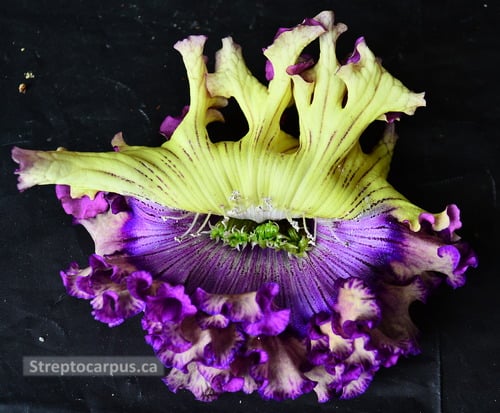
Key Takeaways
- Science does not know a lot about fasciation
- Hobbyists can contribute to our knowledge
This post uses affiliate links
What is Fasciation?
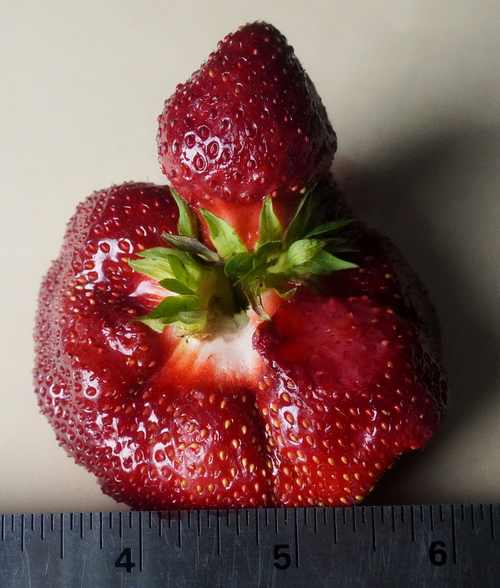
Fasciation is also known as cresting, and African violet (AV) enthusiasts call it zippering. It is a relatively rare condition in which the growing tip (apical meristem) develops abnormally. This growth produces flattened, ribbon-like stems with a fan-like enlargement on the end. In flowers, it produces flattened, wide flowers with an unusually high number of petals. The actual shape that is formed depends on the location of the meristem and the species of plant demonstrating the phenomenon.

In stems, it causes flattened stems which may also have weird curved shapes.

The cause of fasciation is not well understood and can be caused in several ways:
- Hormonal imbalances
- Random somatic mutations
- Bacterial and viral infections
- Fungi, mite or insect attack
- Exposure to cold
- Genetic inheritance (eg cockscomb Celosia)
“In some plants a single recessive gene controls this condition, although the degree of expression is often very dependent on environmental conditions”. Fasciation affects the appearance of a plant but does not affect the health of the plant, nor its cultural requirements. The last cause on the list is of particular interest to plant enthusiasts. Fasciated specimens of cactus and other succulents with their unusual forms – which can often be perpetuated by vegetative propagation and are highly sought by collectors. Many of the ones perpetuated by vegetative propagation become cultivars with descriptive names such as ‘Monstrosa’, ‘Cristata’ or ‘Tortulosa’. The condition is rarely passed on through seeds, but an exception is that the “cockscomb” cultivars of celosia (Celosia argentea var. cristata) are grown especially for their dependably fasciated flower heads.
Fasciation in African Violets (AV)
African violets, along with streptocarpus, belong to the gesneriad family, but they seem to demonstrate a different form of fasciation than found in streptocarpus (see below). Most of the fasciation reported in AV is in the form of modified leaves. The petiole of the leaf may be wider than usual. The leaf may have two parts to it, a condition referred to as “zippered”. In some cases, the left half of a leaf has a slightly different shape than the right side of the same leaf.


If the above leaf is used for propagation, they generally revert to normal leaves. It is not a one-time unstable mutation. Fasciation can also affect the crown of the plant. In this case, you get a wide crown instead of a normal circular one. In the following picture, you see a wide crown going from the top of the picture to the bottom.

Growers report that plants growing this kind of crown won’t flower, and if leaf propagated, the resulting plants will also form a “zippered” (fasciated) crown. It is a permanent mutation, and you might as well discard the plant.

Fasciation in Other Gesneriads
I found only one example of fasciation in a gesneriad other than AV or Streptocarpus, and that is a flower tip on this Sinningia eumorpha.


If you have pictures of other examples, please let me know in the comments.
Fasciation in Streptocarpus
The occurrence of fasciation in streptocarpus seems to be rare, or at least it is rarely reported. I became interested in the phenomenon because several of my plants have demonstrated the condition, and in some it even seems like a stable mutation. It can affect the flower stems, forming flat stems that then produce numerous flower buds at their tips. These usually open to form normally shaped flowers. However, in some cases, one or more of the flowers becomes a double flower with 10 petals. Part of the purpose of this post is to document these examples and to carry out some tests to better understand the condition. A number of my plants form fasciated stems. Once a leaf forms such a stem, all following flower stems on the same leaf also tend to be fasciated. The flowers on such stems are usually normal, but such stems can also form double flowers. Normal stems do not form double flowers.


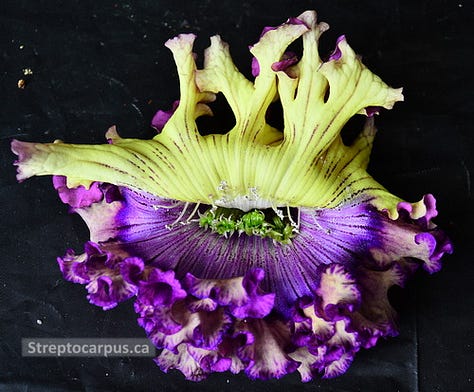


I have found very little information about the cause of fasciation in streptocarpus and no research studies on it. Some interesting questions remain: Stability of the Mutation: How stable is the mutation? Streptocarpus flower stems are formed on a leaf, not from the crown of the plant. Once a leaf forms a fasciated stem, each subsequent stem is also fasciated. Do leaf cuttings transfer the trait? Effect of Environment: How does the environment (light, temperature, fertilizer) affect fasciation? Double flowers? Cause of Double Flowers: What causes the double flowers? They are not consistently formed on a fasciated stem. Is it just a matter of chance, or does the environment affect the flower’s form?
I have set up some experiments to try and answer these questions and will post results as they become available.


I’ve wondered about crested cactus. I have a large rooted cutting from a crested cactus (probably Opuntia, but unknown species.) Most of the new growth, which I remove, is like a normal Cylindropuntia. It has a couple of new slightly crested pads, but they do not grow big. I wonder whether this is a genetic mutation; I would think that if the were just bacterial, viral or hormonal, that such forms would be commercially propagated. I’ve searched for images of”crested cactus” and there are many. As far as monstrose forms, I do not find them appealing.
P.S.: I’ve never been able to post comments on substack; I’m glad that this post also appears on gardenmyths.com)
Have a very thick oval circumference stem on purple delphinium but flowers are fairly normal.