

Someone on a social site asked if anyone knew of a light meter that would measure the amount of light in their garden. I burst out in laughter thinking this was a great joke. Then someone posted a link to just such a product; the Sunlight Calculator. I cried. Are people really buying such a product?

Sunlight Calculator – The Claims
The following are taken from the dealers ad.
- “The lighting conditions of the micro-climates in your garden aren’t always obvious.” Yes they are – just hold out your hand and look for shadows.
- “This meter measures the duration and intensity of sunlight falling at a given spot over a 12-hour period.” It might measure these things but it does not report them. It only reports sun, part sun, part shade or shade. You get neither duration nor intensity readings.
- “Though not a panacea for all garden problems, it can help you locate plants where they will grow best.” Not really, since light levels are just one of the parameters to consider.
SunCalc® – How It Works
After you turn it on, the meter measure the amount of light for 12 hours and determines how much sun you have. That is simple enough.
What happens if you turn it on at noon?
Sunlight Calculator then measure light for only part of the day, and will give you the wrong readings. So to make this work you need to go outside and turn it on before sunup. Sorry – I am in bed sleeping.
Results
The Sunlight Calculator gives one of four readings which translate into the following.
- Full sun: 6+ hours
- Partial sun: 4-6 hours
- Partial shade: 1.5 – 4 hours
- Full shade: less then 1.5 hours
May I suggest that if you go outside 3 or 4 times during a single day, and look up, you can determine these values without a meter. Warning – do not look directly at the sun.
If you are a visual learner, my video will show you how to make a sun map.

If the above video does not play, use this link: https://youtu.be/AAIhO_olcDg
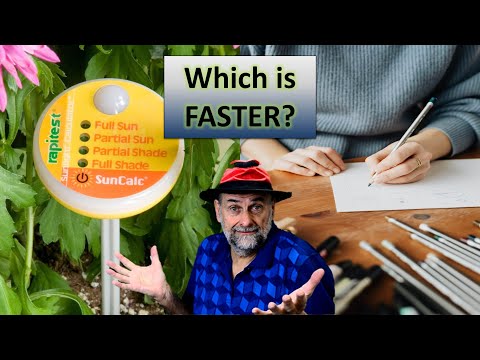
Is SunCalc Faster Than Pen and Paper?
Added Aug 2023.
This blog post has received more negative feedback than almost every other one I have written. Several people claim that they don’t have time to go outside and use the paper method and the CunCalc is so much more efficient and faster. I decided to put that claim to the test. I compared SunCalc and my paper method for a fairly small garden consisting of 2 beds with a total of 274 square feet.
Pen and Paper: Total time was 60 minutes spread over 1 day.
SunCalc: Total time was 121 minutes spread over 67 days.

You can see the full details of this experiment in this video.
Plants Require Sun or Shade
Some plants prefer sun and some prefer shade. Almost all will grow in part sun/shade. The more I grow things the more I am surprised that so called sun plants do just fine in shade and vice versa. The plants are adaptable.
My shade garden was shaded by two medium sized sugar maples. The two trees had to be removed one winter, and my garden was suddenly a full sun garden. All of the plants did just fine. Some of the shade plants are actually growing better now than before. Admittedly, this garden does get watered a couple of times a season, but it can go several weeks without water.
Accuracy of Plant Information
Some people claim that just knowing sun or shade is not accurate enough and that plants are fussier than that. They might be fussier but plant labels and on line information about plants is not more detailed. Look at plant labels and check the light requirements. They are not more detailed than sun, shade or part shade, and most give a range, “sun to part shade”.
Keep in mind that the same plant label is used over a wide geographic area. We get the same plant label here in Ontario that is used in California, but full sun in the two areas means something completely different. We grow hydrangea in full sun in Ontario, while the south recommends part shade.
Isolation Level
Two-thirds of the technical brochure deals with something called “isolation level”. There are lots of formulas and technical information on this, but it never tells you how you should use the information.
Here is some of it. WARNING: read this only if you want a nap.
The values are generally expressed in kWh/m²/day. This is the amount of solar energy that strikes a square meter of the earth’s surface in a single day. Of course, this value is averaged to account for differences in day length. There are several units used throughout the world.
The conversions based on surface area are: 1 kWh/m²/day = 317.1 btu/ft²/day = 3.6MJ/m²/day
The raw energy conversions are:1kWh = 3412 Btu = 3.6MJ = 859.8kcal
Do they really believe gardeners are going to do these calculations?
Stop Buying Unnecessary Products
The Sunlight Calculator is not something you need. You can make a sun map following the procedure in my video in less than an hour and you don’t have to buy anything.
What really bothers me about such products is that they are damaging the environment. The product needs to be manufactured, packaged, and shipped around the country – probably half way around the world. That all takes resources including oil. In the process it adds pollution to the environment and increases global warming. You will use it once, and store it in the shed.
If you care about the environment – don’t buy the Sunlight Calculator.


I suppose that depends upon the garden. My new greenhouse is definitely part of my garden, and the siting may be crucial to productivity. $300 is a small price to pay for success.
Update-
I found the device I need!
It’s simple, brilliant, and not that expensive.
https://www.solarpathfinder.com/video/2?autostart=1
Could be good for research, but overkill for gardening.
I found this page while searching for a device to measure dawn-to-dusk sunlight on specific sites.
I live in a canyon in Canada and am surrounded by 150 foot fir and cedar trees; situating my new greenhouse to maximize sunlight is essential.
This particular device won’t do what I need done, but neither is it an electronic coffee stirrer.
For those who are confused by this issue, if you have a sun plant how many hours of full sun a space receives, and don’t worry about the varying degrees of shade. If you want full range and more accurate information than even a light meter will give you, and are confused about different angles and positions of objects shading your garden: then search Sun mapping your yard.
To the author: instead of criticizing why someone doesn’t need a tool to figure out something they are confused about; you should put more effort into helping them understand how to figure out that information — besides telling them to just look outside at any random time of day. Realize that people search for gardening answers usually because they have no experience.
I plan to do just that – just have not got around to it. Probably make a post and video about how to figure out the amount of light.
My neighbor put their vegetable garden against the north side of her house. I think some people may have a problem with spatial awareness or problem solving skills, and because of our culture, they find it easier to just buy a light meter than to actually asked someone knowledgeable. That is, AFTER they learn the hard way, that they have to consider what their plants need. So I agree it’s like buying a book to teach you how to vacuum, because you don’t want to figure it out yourself or ask someone, but some people just have a difficult time doing those two things for many reasons (and others take advantage and make money off of them), but we shouldn’t make them feel stupid for it.
Opinionated review that doesnt take into account an individual’s lifestyle/work schedule. The product works as advertised and assists those of us that dont have the time to properly check for accurate sunlight within their garden/property. In order to accurately measure the amount of sunlight, one needs to monitor an area on an hourly basis. Most gardeners can’t do this and this simple product is sufficient to do the job for them. Personally I find your review very biased and just a joke altogether.
The statement “to accurately measure the amount of sunlight, one needs to monitor an area on an hourly basis.” is not correct. We don’t know enough about the plants we are using to use such detailed information.
You know, we both work during daytime and Colorado climate is very-very hot, sunny and dry. So the difference between full sun and partial shade is HUGE. One dries out in a day and and another can tolerate a day without watering. It is semi-arid climate, so basically The only plants that can tolerate full sun here are native plants, cactuses in particular. Even partial shade can be the way too sunny (ultraviolet is higher here considering one mile elevation and more than 300 days of sunny weather a year). For me this device would be very helpful, though reviews on Amazon do not favor those few that they sell. In fact I found only one so far
Before writing such a negative review it would be nice to consider the fact that gardeners’ circumstances can be very different and most of us work for living
I am sure you do not work 7 days a week – check on weekends.
What are you going to do with the info? Lets say one spot is 4 hrs full sun, and another is 3 hrs. How will you use this info to select plants, when none of the plants sold come with this detailed information? They are either shade, part shade or sun.
Maybe if you lived in a large property and had garden space without any structures nearby , then I suppose it would easy to determine the sun exposure for each planting area but here in Orange County CA, we have very limited garden spaces with multiple structures to block the sun, I think it would be extremely useful to have a device like that to record how many hours or intensity of the sun that each spot could receives. Since I’ve just moved to a new house, it is taking a while for me to figure out sun exposure for each planting area. Especially my side yard is challenging due to multiple structures like houses, trees, fences and etc. Even within the side yard, sun exposure is different from spot to spot, or from summer to winter. I have burned few plants under trees because I assumed they were partial shade. Here in southern CA, less than 2 hours of sun in the late afternoon during summer was too much for some of partial shade plants. Similarly, I had to relocated some plants because they didn’t get enough sun exposures. After all if you have full time jobs or kids to raise, only few of us are lucky enough to observe sun exposure for every spot of our garden.
Wow. I find your article to be very condescending and partial. I did a Google search for sunlight meter – because there IS a need for one – and ran across this unfortunate article. Why would you laugh at someone who asked a legitimate question – or any question for that matter…? Personally, I do not have time to check the area in question multiple times a day. I have trees surrounding portions of my area that give shade at different times and locations. I am not able to record the amount of time that one tree blocks the sun. To know how the shade will affect my flowers IS important. To write such a smug review is a complete turn off to anything else you may have to say whether on your website or your book. I hope in the future you can write articles that are more informative and less insulting.
You missed one of the main points of the article. If you have trees that give “shade at different times and locations” – you have part shade. Done. You do not need the Sunlight Calculator.
Actually, just because a tree casts a shadow on an area doesn’t mean it’s automatically a partial shade area. A four hour shadow may be cast as the sun rotates thru the sky during a twelve hour day. That would make the spot still a full sun spot. If it catches five to six hours of sun during the day it would be a partial sun spot. Partial shade is when you get sun but at lower rates, around two to three hours. Or dappled sun areas.
For those people that work a lot during the week and have many areas to determine sun activity for it becomes a useful product. They can place it in the ground in one spot before they leave for work and check it when they come home or after dinner. Then move the next day and have readings for the whole yard after a week or two. A process that may take seven times longer if you were only able to do it on your days off.
A lot of us plant vegetables and herbs in our yards in flower beds rather than having dedicated gardens in open areas of the yard. Many plans can be very sensitive to sun/shade rates and if you are looking to maximize yields that information is very important.
The product may not be useful to you in your situation but is actually quite useful to many other people for a variety of reasons.
I love that he has no rebuttal for the fact that people have full time jobs.
https://youtu.be/AAIhO_olcDg
Nobody works 7 days a week every week and also gardens. If you watch the video you will see it takes almost no time at all to map your garden.
Amy this isn’t so much as condescending as it is partial – it’s a full-on advertisement. You have to get your income from somewhere, but he should have stated that he IS getting a kickback here.
There is no affiliate link in this post, so there is no way for me to get a ‘kickback’. Besides that I am telling you NOT to buy the product.
If they made a version that was more specific for orchids. I would buy in an instant. When your growing plants that are so specific with light that you don’t get to see for half the day this would be very useful. Outdoor plants I have never had a problem. But when I started growing orchids realized that moving orchids to a spot that got a tiny bit more sun than before makes a huge different. Doing it without a tool means having healthy plants that don’t bloom for years.
For almost all orchids, more light is better except in tropical climates where you have to be a bit more careful.