

It seems like every summer now, a familiar haze blankets large parts of North America. We check the Air Quality Health Index (AQHI) or PM2.5 levels before stepping outside, grab an N95 mask to walk the dog, and worry about what this toxic soup is doing to our lungs.
But as you stand in your backyard looking through that eerie orange or gray sky, you have to wonder: what about the garden? Your tomatoes, hostas, and apple trees are stuck outside breathing this stuff 24 hours a day.
Does wildfire smoke harm plants?
The internet is full of conflicting advice. Some bloggers claim smoke is great for gardens because it blocks harsh sunlight and provides carbon dioxide. Others warn that your vegetables are absorbing deadly toxins and should be thrown into the landfill.
The reality is that the smoke has both positive and negative effects. Let’s dig into the data and look at what wildfire smoke really does to plant physiology.

Watch the Video version of this blog post: https://youtu.be/vlneaGoBvIs
Key Takeaways
- Wildfire smoke stresses plants.
- You can help plants survive.
- Produce is safe to eat provided you wash it correctly.
What is Wildfire Smoke?
To understand how smoke affects a plant, we first need to look at what is actually inside it. Wildfire smoke is not just a single substance; it is a highly complex, dynamic chemical soup that changes as it travels.
It consists of two main components: gases and particulate matter (PM).
The Gases
When forests, brush, and unfortunately, homes burn, they release a massive array of gases. The most abundant is carbon dioxide (CO2), along with carbon monoxide (CO). However, the smoke also carries a mixture of volatile organic compounds (VOCs), nitrogen oxides (NOx), sulfur dioxide (SO2), and polycyclic aromatic hydrocarbons (PAHs).

As this gas mixture drifts downwind and interacts with sunlight, chemical reactions occur. This process creates ground-level ozone (O3), which is one of the most destructive components of smoke when it comes to plant health.
The Particulate Matter (PM)
The visible part of smoke consists of tiny unburnt bits of carbon, ash, and liquid droplets. Scientists categorize these particles by size:
- PM10: Coarse particles less than 10 micrometers in diameter (like dust or pollen).
- PM2.5: Fine particles less than 2.5 micrometers in diameter.
To give you some perspective, a human hair is about 70 micrometers wide. PM2.5 particles are so small they can stay suspended in the atmosphere for weeks and travel thousands of miles. It is these microscopic PM2.5 particles that do the most damage, both to human lungs and to the microscopic structures on plant leaves.
Effect on Photosynthesis
Plants rely on light, water, and carbon dioxide to make food through photosynthesis. Wildfire smoke strikes a direct blow to this process in two distinct ways: by altering light quality and by physically choking the leaves.
1. Diffuse Light vs. Shading
A thick blanket of smoke reduces the total amount of solar radiation reaching your garden. On heavily active smoke days, total light can drop by 10% to 50%. Less light generally means less energy for photosynthesis.
However, atmospheric science reveals an interesting twist. Smoke particles scatter light. Instead of direct, harsh sunbeams casting deep shadows, smoke creates highly diffuse light.
For a single, isolated leaf, less total light means less photosynthesis. But for a dense plant canopy—like a mature tomato patch or a fruit tree—diffuse light penetrates deeper into the lower layers of the plant. Leaves that are normally shaded by top growth suddenly get a uniform, soft light.
In commercial forestry and large-scale agriculture, studies show that light smoke can sometimes maintain or even slightly increase overall ecosystem productivity because the lower leaves work harder. But there is a tipping point. Once the smoke gets thick enough to block out the sun completely, the net benefit of diffuse light disappears, and total photosynthesis plummets.
2. Physical Blockage of Stomata
This is where the real trouble starts for gardeners. Plants breathe through microscopic pores on the undersides (and sometimes tops) of their leaves called stomata. These pores open to take in CO2 and release oxygen and water vapor.
Fine particulate matter (PM2.5) settles out of the smoke onto the surface of the leaves. Because these particles are often sticky with resins and oils from the burning vegetation, they don’t just blow away. They physically clog the stomata.

When stomata are blocked:
- The plant cannot efficiently absorb CO2.
- The plant cannot transpire (evaporate water), which is how it cools itself down on a hot day and gets nutrients from the roots.
- The mechanical abrasion of the sharp ash particles can tear the delicate waxy cuticle layer of the leaf, causing the plant to lose moisture rapidly and dehydrate.
Effect of Increased CO2
Commercial greenhouse growers often artificially pump carbon dioxide into their facilities up to 1,000 parts per million (ppm) to accelerate plant growth. Since wildfires release massive amounts of CO2, shouldn’t this smoke act as a free fertilizer for our gardens?
In theory, yes. In practice, no.
While a localized boost in CO2 can technically increase the rate of photosynthesis, the plant can only utilize that extra carbon if it has ample sunlight and open stomata.
As we just established, wildfire smoke simultaneously blocks out the sun and chokes the stomata with ash. Such a plant cannot process extra CO2.
Furthermore, any minor benefit from elevated CO2 is completely wiped out by the toxic gases traveling right alongside it—specifically, ozone.
Effect of Ozone
While ozone high up in the stratosphere protects us from ultraviolet rays, ground-level ozone is a toxic air pollutant. It is formed when nitrogen oxides (NOx) and volatile organic compounds (VOCs) from wildfire smoke react in the presence of sunlight and heat. This means that even if the physical soot and ash have started to thin out, the invisible ozone levels downwind can remain dangerously high.
Ozone is arguably the most damaging component of wildfire smoke to plant tissue.
When a plant opens its stomata to breathe, it inhales ozone gas. Once inside the leaf, ozone reacts with the moisture in the plant cells to form reactive oxygen molecules that are highly destructive free radicals.
These chemicals attack and destroy the cell membranes, damaging the chlorophyll needed for photosynthesis. The visual symptoms of ozone damage on plants include:
- Stippling: Tiny, distinct dark dots or flecks (often purple, black, or bleached white) on the upper surface of older leaves.
- Chlorosis: Yellowing of the tissue.
- Interveinal chlorosis: yellowing of the tissue between the leaf veins.
- Necrosis: Dead, brown patches on the leaves.
- Premature leaf drop: The plant sheds its damaged leaves early to conserve resources.
Over time, chronic ozone exposure permanently weakens the plant, reducing its yields and making it far more susceptible to pests and fungal diseases later in the season.
Overall Change in Plant Growth Over a Season
How does this play out over a normal North American growing season? The physical and chemical stress of wildfire smoke results in a measurable reduction in overall plant growth and crop yields.
When smoke episodes last for weeks at a time during the peak of summer (June through August), plants enter a defensive survival mode. Because their photosynthetic engine is throttled by low light, clogged stomata, and ozone damage, they stop investing energy into new vegetative growth, flower production, and fruit development.
In agricultural studies across the midwestern and western United States, extended smoke cover during the summer has been linked to:
- Delayed ripening: Tomatoes, peppers, and winter squash take significantly longer to turn color and mature because they lack the sugars produced by active photosynthesis.
- Reduced fruit size: Fruit trees and fruiting vegetables produce smaller yields.
- Impaired flower pollination: High smoke density can physically deter pollinators like bees, and the reduced visibility alters their navigation systems, leading to poor fruit set.
For the home gardener, this means a temporary halt in your garden’s progress. Your plants will look stagnant, flowers may drop off without setting fruit, and the expected mid-summer harvest explosion will likely be delayed by several weeks.
Is Produce Toxic?
This is the number one question I receive from concerned backyard growers. If my vegetable garden is covered in smoke containing toxic chemicals like polycyclic aromatic hydrocarbons (PAHs), heavy metals, and dioxins, is the food safe to eat? Or do the plants absorb these toxins, making the produce dangerous?
Let’s look at the science of how plants handle these compounds.
Do roots absorb smoke toxins from the soil?
Most of the heavy organic toxins found in wildfire smoke (like PAHs) are highly hydrophobic. This means they do not dissolve well in water and bind tightly to soil particles and organic matter. Because they are locked up in the soil complex, plant roots cannot easily absorb them. Even if trace amounts are taken up by the root system, plants lack the internal transport mechanisms to move these large, complex molecules up into the fruit.
Do leaves absorb smoke toxins?
The waxy cuticle layer on the outside of leaves and fruit acts as a highly effective barrier. While gases like ozone and CO2 pass through the stomata, the heavy, toxic compounds bound to particulate matter stay on the outside of the plant. They do not penetrate into the internal flesh of your tomatoes, apples, or zucchini.
The Real Risk: Surface Contamination
The danger is not internal absorption; it is external accumulation. The ash settling on your crops contains concentrated trace elements and particulates.
If you pick a tomato covered in wood ash and eat it directly from the vine, you are ingesting those smoke compounds.
The consensus from food safety authorities, including various university agricultural extensions, is clear: The food is safe to eat, provided it is washed thoroughly.
There is one exception: leafy greens. Crops with highly textured, crinkled surfaces like kale, lettuce, and Swiss chard can trap ash particles in their folds, making them very difficult to clean completely. If a smoke event was exceptionally severe or involved burning structures (which release much higher levels of synthetic toxins), it is wise to discard the outermost leaves of these crops.
What Can a Gardener Do to Protect Plants?
You can’t put a giant dome over your yard, but there are a few practical, science-based steps you can take to help your garden survive a heavy smoke event.
1. Keep the Soil Moist
When air quality is poor, plants are under extreme stress. Clogged stomata impair their ability to regulate water loss. Ensure your plants have steady, deep moisture at the root zone. Do not let the soil dry out completely, as drought stress combined with smoke stress can quickly kill a plant.
2. Avoid Overhead Watering (During the Smoke)
It is tempting to spray down your plants with a hose to wash the ash off while it’s smoky. Don’t do this. Wetting the leaves while ash is actively falling creates a sticky paste that cements the particles directly over the stomata, making the blockage worse. Wait until the smoke event has cleared before you wash the plants.
3. Wash the Plants After the Smoke Clears
Once the air clears and the wind changes, give your entire garden a thorough rinse with a garden hose. Spray both the tops and bottoms of the leaves to wash away the accumulated ash and crusty residues. This reopens the stomata and allows the plant to resume normal respiration and photosynthesis.
4. Put Away the Fertilizer
Do not fertilize your garden during or immediately after a heavy smoke event. Fertilizer encourages plants to push out tender new vegetative growth. A smoke-stressed plant needs to focus its limited energy reserves on cellular repair and basic survival, not on growing new leaves. Wait a week or two after the air clears before resuming your regular feeding schedule.
5. Delay Pruning
Avoid pruning or taking cuttings during a smoke episode. Every cut creates a wound that requires metabolic energy to heal and opens a pathway for opportunistic diseases at a time when the plant’s immune system is severely compromised.
Common Myths About Wildfire Smoke and Plants
Let’s wrap this up by busting some of the common myths circulating on gardening forums and social media.
Myth 1: “Smoke ash is a great fertilizer, so let it sit on the leaves.”
- The Reality: While completely combusted wood ash applied directly to the soil contains potassium and trace minerals, unburnt smoke residue sitting on the leaves is harmful. It blocks light, clogs stomata, and contains acidic compounds that can scorch leaf tissue. Wash it off.
Myth 2: “Plants cleanse the air of smoke, so my garden is helping the neighborhood.”
- The Reality: Houseplants can absorb minor amounts of certain VOCs inside a closed room, but a backyard garden cannot filter a moving mass of outdoor wildfire smoke. The volume of pollutants vastly overwhelms the plants’ capacity. The smoke harms the plants far more than the plants clean the smoke.
Myth 3: “Smoke causes long-term genetic damage to perennials.”
- The Reality: Unless a plant is physically scorched by fire, wildfire smoke does not alter its genetics. The damage is environmental and physiological. Once the air clears and new leaves grow next spring, the plant will carry no lasting “memory” or genetic defects from the previous summer’s smoke.
Myth 4: “You must throw away all vegetables grown during a smoke season.”
- The Reality: As discussed, toxins do not readily penetrate the interior flesh of fruits and vegetables. Wash your produce thoroughly with water (and a splash of vinegar if you like) to remove surface ash, and it is perfectly safe to consume.
Myth 5: “The Ash Changes Soil pH.”
- The Reality: Over thousands of years, the soil pH might change, but it won’t change in your lifetime. This myth probably stems from the fact that wood ash is alkaline, and when enough is added to acidic soil, it raises the pH. The smoke from forest fires is not adding enough ash to make a difference. The soil right in the burn area might see an increase in pH.
Are Forest Fires Getting Worse in Canada?
The news headlines clearly say yes. On June 11, 2026 the government said, “The 2026 wildfire season began more slowly than in 2023 or 2025, which were the worst and second-worst wildfire seasons in Canadian history.
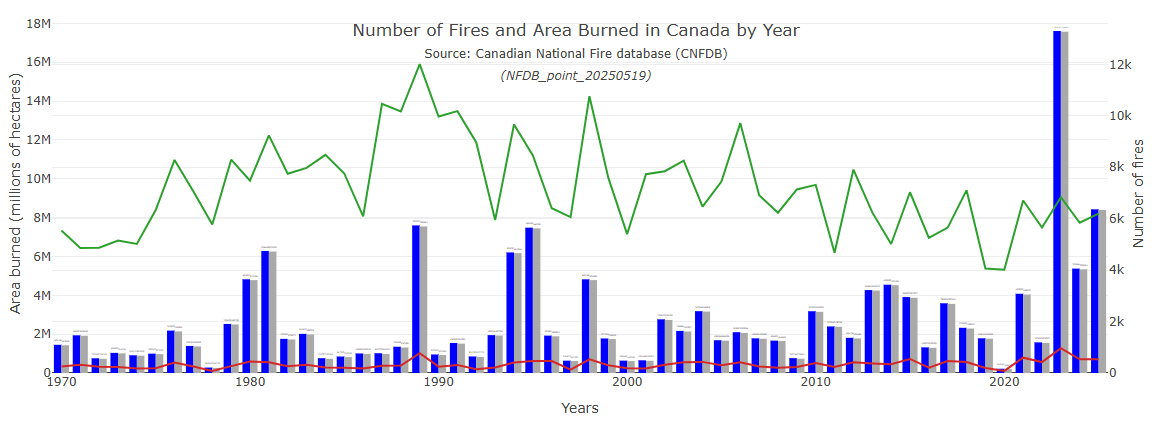
That is not quite true. The following graph from the Canadian Government shows that the number of wildfires has been decreasing (green line) while the burned area has been higher in very recent years (blue bars).
Lightning causes about 46% of the fires, with many of the others being caused by human activity.
Climate change would cause increases in lightning strikes and more fires. That is not happening.
Burned area is based more on forest mismanagement and on how quickly resources are distributed to fight fires. It is not a sign of climate change or global warming. Forests in North America have been mismanaged for a long time.


Thank you for sharing all this information with us about the wild fires and how they affect our planting season. It was very different to wake up and see the world had turned YELLOW in our area. Thank you for sharing how to care for our plants and any fruit they produce this season, was wonderful to learn. I now know how to take care of my yard with all the advice you shared in the article. GREAT INFORMATION!!!!!!!!!
Burned area is based more on forest mismanagement
Not necessarily true. Read about BOB fires, fires being observed but not fought due to remote location and low risk,