

Someone on a social site asked if anyone knew of a light meter that would measure the amount of light in their garden. I burst out in laughter thinking this was a great joke. Then someone posted a link to just such a product; the Sunlight Calculator. I cried. Are people really buying such a product?

Sunlight Calculator – The Claims
The following are taken from the dealers ad.
- “The lighting conditions of the micro-climates in your garden aren’t always obvious.” Yes they are – just hold out your hand and look for shadows.
- “This meter measures the duration and intensity of sunlight falling at a given spot over a 12-hour period.” It might measure these things but it does not report them. It only reports sun, part sun, part shade or shade. You get neither duration nor intensity readings.
- “Though not a panacea for all garden problems, it can help you locate plants where they will grow best.” Not really, since light levels are just one of the parameters to consider.
SunCalc® – How It Works
After you turn it on, the meter measure the amount of light for 12 hours and determines how much sun you have. That is simple enough.
What happens if you turn it on at noon?
Sunlight Calculator then measure light for only part of the day, and will give you the wrong readings. So to make this work you need to go outside and turn it on before sunup. Sorry – I am in bed sleeping.
Results
The Sunlight Calculator gives one of four readings which translate into the following.
- Full sun: 6+ hours
- Partial sun: 4-6 hours
- Partial shade: 1.5 – 4 hours
- Full shade: less then 1.5 hours
May I suggest that if you go outside 3 or 4 times during a single day, and look up, you can determine these values without a meter. Warning – do not look directly at the sun.
If you are a visual learner, my video will show you how to make a sun map.

If the above video does not play, use this link: https://youtu.be/AAIhO_olcDg
Is SunCalc Faster Than Pen and Paper?
Added Aug 2023.
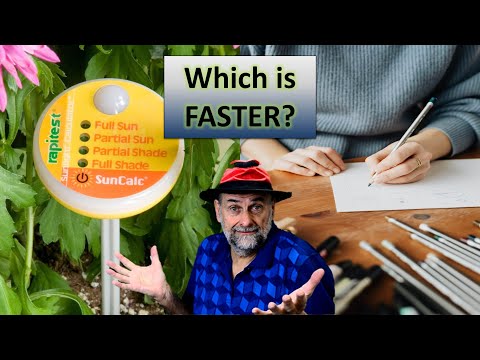
This blog post has received more negative feedback than almost every other one I have written. Several people claim that they don’t have time to go outside and use the paper method and the CunCalc is so much more efficient and faster. I decided to put that claim to the test. I compared SunCalc and my paper method for a fairly small garden consisting of 2 beds with a total of 274 square feet.
Pen and Paper: Total time was 60 minutes spread over 1 day.
SunCalc: Total time was 121 minutes spread over 67 days.

You can see the full details of this experiment in this video.
Plants Require Sun or Shade
Some plants prefer sun and some prefer shade. Almost all will grow in part sun/shade. The more I grow things the more I am surprised that so called sun plants do just fine in shade and vice versa. The plants are adaptable.
My shade garden was shaded by two medium sized sugar maples. The two trees had to be removed one winter, and my garden was suddenly a full sun garden. All of the plants did just fine. Some of the shade plants are actually growing better now than before. Admittedly, this garden does get watered a couple of times a season, but it can go several weeks without water.
Accuracy of Plant Information
Some people claim that just knowing sun or shade is not accurate enough and that plants are fussier than that. They might be fussier but plant labels and on line information about plants is not more detailed. Look at plant labels and check the light requirements. They are not more detailed than sun, shade or part shade, and most give a range, “sun to part shade”.
Keep in mind that the same plant label is used over a wide geographic area. We get the same plant label here in Ontario that is used in California, but full sun in the two areas means something completely different. We grow hydrangea in full sun in Ontario, while the south recommends part shade.
Isolation Level
Two-thirds of the technical brochure deals with something called “isolation level”. There are lots of formulas and technical information on this, but it never tells you how you should use the information.
Here is some of it. WARNING: read this only if you want a nap.
The values are generally expressed in kWh/m²/day. This is the amount of solar energy that strikes a square meter of the earth’s surface in a single day. Of course, this value is averaged to account for differences in day length. There are several units used throughout the world.
The conversions based on surface area are: 1 kWh/m²/day = 317.1 btu/ft²/day = 3.6MJ/m²/day
The raw energy conversions are:1kWh = 3412 Btu = 3.6MJ = 859.8kcal
Do they really believe gardeners are going to do these calculations?
Stop Buying Unnecessary Products
The Sunlight Calculator is not something you need. You can make a sun map following the procedure in my video in less than an hour and you don’t have to buy anything.
What really bothers me about such products is that they are damaging the environment. The product needs to be manufactured, packaged, and shipped around the country – probably half way around the world. That all takes resources including oil. In the process it adds pollution to the environment and increases global warming. You will use it once, and store it in the shed.
If you care about the environment – don’t buy the Sunlight Calculator.


While you are right for a homeowner or someone on a small scale. There is a need for such devices for people on a larger scale. I have a medical school complex that is 110 acres of greenspace, 70 or so buildings and 100’s of trees. I am here from 6am to 2:30. I can’t go watch every nook and cranny everyday all day to see how much sun it gets. I can try to guess but many areas are rather hard to gauge. So before you laugh off products think about all its uses. Now that being said, there are much better products out there than this one.
Even with a large property, plants are simply not that fussy. If you had perfect data about the amount of sun, you will not be able to select plants because we do not have that kind of accuracy for the plants.
I’ve been a gardener most of my life and became a professional gardener in 2010. I’d not heard of a sun calculator until today. I am doing an on-line landscape gardening course. The module I am currently working on stated:
“Many gardeners either over or underestimate how much sun their plants get. If you are getting plants that are not growing as high or as strong as they should, you could be giving them too little sun, and if they get too much sun, the sun could easily bake your plants. One way around this is to use a sun calculator, which you place in your containers. It will tell you how much sun your plants are getting.”
So, doubting the need for such a tool I Googled ‘Sun Calculator’ and discovered your skeptical comments on this device.
In conclusion, I have to disagree with your conclusions. This device led me directly to your fine website and I am finding it most useful. So, if only as a pointer to your website, it’s great.
Will I be investing in one? – Not a chance!
Another gimmick wrapped in pseudo technology!
Unfortunately new gardeners often have a very poor appreciation of the need for light. I sometimes don’t know whether to laugh or cry when I see where some gardeners attempt to grow vegetables – even in our own family.
It is all a learning process – that keeps us both busy with our blogs 🙂
David Hannum was right … “There’s a sucker born every minute.”
Hi Robert,
I totally understand your comments, especially about the uselessness of these types of products. One of my hobbies is astronomy, so people often mistake me for someone who is all knowing about the sun and moon. I have frequently been asked “Is this spot in my garden going to be a good place to grow plants that want full shade, partial shade, or full sun year round?” Like you, I suggest that they just go out and take a look, but I’m usually met with smoldering stares and I’m forced to admit that many people, possibly most, have no idea of what to look for.
It’s probably worth answering this question, though I am not going to try to do that here. I think we’d be doing a service to many people by describing what to look at to answer this important question.
We all understand that the sun changes position in the sky from sunrise to sundown. But many people do not quite understand that the path that the sun takes through the sky varies every day (except near the equator). So to learn about how much sun a location receives, one must look at the spot multiple times. Not just multiple times throughout a day, but multiple times throughout a year.
Could you please post your thoughts on how to look at a garden to decide what kind of sunlight it receives? I know that many of our (website) readers will appreciate hearing your thoughts.
Best regards,
Ron S.
Sounds like this would be a good post for my GardenFundamentals blog. As a short answer, if the spot gets 6 hours or more sun it is a sun location. Less than 2 hours is probably shade.
It is true the amount changes every day, but plants are extremely flexible. Also full sun in Florida is quite different than full sun in Alberta.
I agree that one doesn’t need the sunlight gadget, but I think your flippant attitude toward differing light requirements of various edible plants does a disservice to gardeners trying their best to get maximum food production from less-than-ideal lots.
Most edible plants want as much sun as they can get. So put them in the sunniest spot. Do you really need a meter for that?
Considering my options are a small stretch that gets 1.5 hours of partial shade and 4 hours intense midday sun, or an area that gets 1.5 hours early morning partial shade, 2 hours full sun, 3 hours partial shade from the southern heat, another 1.5 hours full sun, and another 1.5 hours partial shade, it would be nice if I had some more measured and calculated approach of determining how much solar energy my plants have access to than “go have a look.” I only have space for a few plants so it would be nice if I could help these little tomatoes produce as much sugar content as possible. When I looked to google I’d hoped to find a calculator utility or equations to help me make more sense of my measurements, but all I’ve found so far is consumeristic junk and snark.
You have part shade which will grow most plants. Put tomatoes in the sunniest spot.
I can so relate, Caleb. I’m just trying to raise some nice flowers in a backyard with a few very tall ponderosa pines (north Idaho) and some deciduous trees overhanging from neighbor’s yards. The sun filters through in varying amounts throughout the day. 20 years ago my day lilies and iris grew fine; now those plants look puny or don’t come up at all. Hostas grow in some areas of the landscaping beautifully, but other places THEY are puny. By the way, I also have a couple day lilies that are large plants and their leaves look healthy, but they never get any flowers! I’m a frustrated wanna be gardener. Mr. Pavlis et al, please don’t laugh at those of us who don’t know what we’re doing. We’re just trying to learn. As a concert pianist, I wouldn’t laugh at you if you tried to play Chopin without years of lessons. 🙂
Right on.
Some people don’t like to use their brains! 🙂 I’ve been with a retail garden center for 31 years and sometimes think I’ve seen it all. People don’t pay attention! I’ve had customers come in looking for a plant for a lot of sun. After questioning, I find that this “sunny” window faces east (only morning sun), has blinds (which they don’t open because the sun fades the carpet–Even a south window with closed blinds is low to moderate light) AND the window in question is in the living room facing a full front porch (which means even the morning sun only gets in there for a hour or so before it gets too high in the sky–and only then if they leave the blinds open…)
oooh, myth-buster gets riled by uselessness. Don’t get into tools whch fall into this category, or you may burst an artery.
…and of course everywhere can be partial sun on the wrong day when clouds are over head. I haven’t looked, because it isn’t worth looking, but also the time of year may well show partial shade, or partial sun, since in the UK at least, March has rather less sun hours than June, so unless the machine takes this into account you’ll have the wrong reason.
The other year I recorded the sun, it’s strength, UV readings, for a year and plotted the results along with all weather readings from a weather station, just for a project using a solar panel, for other reasons. What it actually told me was that it’s easier to look at a weather website which will give you all the info you need for your area. Combined with going outside and looking at where the sun is and shade is within your garden you have all the knowledge you need.
Things like Poly tunnels actually block a huge amount of light compared to direct sunlight, they must become a partial sun area if you look at sun intensity over a day and of course all those plants do just fine.
You used the term “isolation level” – I think you meant “Insolation level”
I think I got the quote from their instruction manual.