

Every summer, gardeners across North America brace themselves for the inevitable green-and-copper invasion. The Japanese beetle (Popillia japonica) arrives like clockwork in late June or early July, stripping rose bushes to lace, skeletonizing fruit trees, and turning prized hibiscus plants into ragged remnants.
Over the decades, gardeners have tried everything to fight back. We’ve hung yellow traps (which actually draw more beetles into your yard than they catch), sprayed chemical insecticides, dumped milky spore on lawns, coated leaves with diatomaceous earth, and spent endless mornings hand-picking beetles into buckets of soapy water.
Yet, year after year, the beetles return.
But now there is hope. A very tiny parasitic fly might save your sanity and your garden plants.
Is this truly the end of Japanese beetles? Or is it just another gardening myth wrapped in overhyped enthusiasm?
Let’s look at the actual science behind this predator, how it works, its history, and what it realistically means for your garden.
To watch the video version of this post, click on: https://youtu.be/1FVVW9AKXLM
Key Takeaways
- Winsome fly will help get rid of Japanese beetles.
- Learn to ID their eggs so you don’t destroy the wrong beetles.
New Predator for Japanese Beetles
The predator making headlines isn’t a newly engineered biological weapon or a recent discovery in a high-tech lab. It’s a tiny parasitic fly known scientifically as Istocheta aldrichi, commonly called the Winsome Fly.
What Is the Winsome Fly?
The Winsome fly belongs to the family Tachinidae, a large group of parasitoid flies whose larvae develop internally within other arthropods, primarily insects. While many flies are scavengers or nectar feeders, tachinid flies are specialized natural killers.
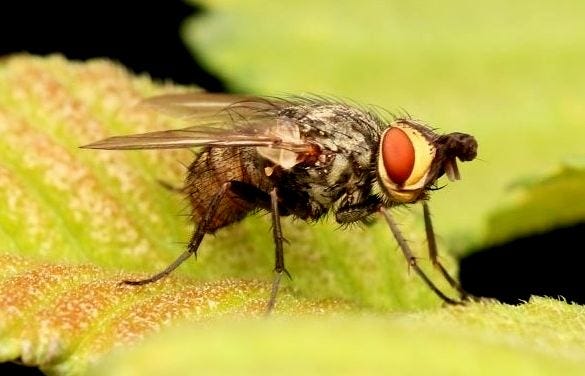
To the untrained eye, an adult Winsome fly looks remarkably ordinary:
- Size: Small, roughly 5 mm long (slightly smaller than or equal to a standard housefly).
- Appearance: Gray to beige or brownish-gray body, featuring subtle striping on the thorax and bristly hairs along its abdomen.
- Behavior: Fast-moving, active during warm, sunny days, and frequently found sipping nectar from small, open flowers before hunting for host beetles.
Unlike chemical sprays or broad-spectrum insecticides that kill everything in sight, the Winsome fly is a host-specific parasitoid. It feeds on floral nectar as an adult, but its primary biological mission during its adult life is locating live Japanese beetles to serve as incubators for its offspring.

How to Recognize Infected Beetles
You don’t need a microscope to tell if Winsome flies are active in your garden. The female fly leaves behind a clear visual signature directly on the Japanese beetle’s body.
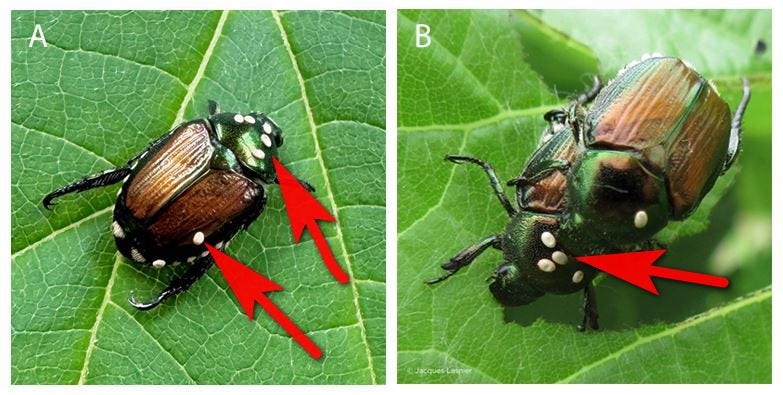
When a female Winsome fly strikes, she glues tiny, distinct, pearly-white eggs directly onto the exoskeleton of the adult beetle.
Here is what to look for:
- Appearance of the Egg: A small, bright white, hard-shelled oval egg that resembles a miniature grain of white rice or a speck of white sesame seed.
- Location: The egg is almost always deposited on the pronotum—the hard plate located directly behind the beetle’s head—or occasionally on the hard wing covers.
- Placement Strategy: The fly places the egg on the upper side of the thorax because the beetle cannot reach that spot with its legs or mouthparts to scratch or groom the egg off.
If you spot a Japanese beetle crawling on your foliage with one or more small white dots stuck to the back of its neck, you are looking at a beetle that has been marked for death.
What Should a Gardener Do If They Find Infected Beetles?
When gardeners spot Japanese beetles on their plants, their instinctive reaction is to squish them, knock them into soapy water, or hit the foliage with an insecticide.
If you see white eggs on a Japanese beetle, STOP. Do NOT kill it.
Here is why:
- The Beetle Is Already Finished: Once an egg is laid on a beetle, that beetle’s days are numbered. It will stop eating within 3 to 4 days and die shortly after.
- You Are Destroying the Parasite: If you drown an infected beetle in soapy water or crush it, you kill the Winsome fly larva inside or on top of it.
- You Stop the Population Cycle: To build up a local population of Winsome flies in your neighborhood, those larvae must survive, complete their development inside the dying beetle, and overwinter to produce next spring’s flies.
When you find an egg-burdened beetle, leave it alone. Consider it an active nursery for next year’s biological control team.
Other Articles About Japanese Beetles
Do Geraniums Control Japanese Beetles?
How to Get Rid of Japanese Beetles in the Garden
Japanese Beetle Traps – Do They Work in the Garden?
What Happens to the Beetle After Egg Laying?
Once the egg is attached, the clock begins ticking for the beetle:
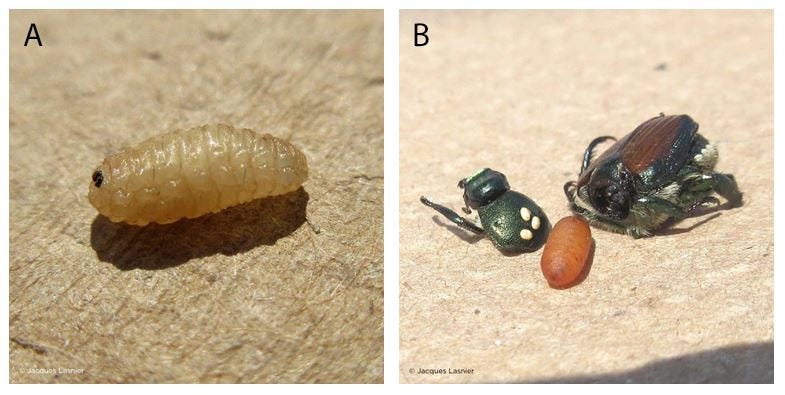
- Days 1–2 (Hatching): Within 24 to 48 hours, the fly egg hatches into a tiny maggot (larva). Armed with specialized, serrated mouth-hooks, the larva immediately chews directly through the eggshell and down through the beetle’s hard outer cuticle into its body cavity.
- Days 3–4 (Feeding Cessation): The larva feeds internally on the beetle’s hemolymph (blood) and soft tissues. As internal organs are consumed, the beetle experiences severe physiological shock. Crucially, the beetle stops feeding on your plants within 3 to 4 days. It becomes sluggish, lethargic, and loses its appetite.
- Days 5–10 (Death): As the fly larva progresses through its three larval stages (instars), it consumes the vital organs. The beetle dies within 5 to 10 days of the initial egg-laying.
- Pupation: The mature fly maggot—now nearly filling the internal cavity of the dead beetle abdomen—uses the hollowed-out carcass as a protective shelter. It forms a hard pupa inside the beetle’s body. The dead beetle falls to the ground, where leaf litter and soil protect the pupa through the fall, winter, and spring.
Biology and Annual Cycle of the Winsome Fly
The Winsome fly completes only one generation per year.
Its lifecycle is tied to the season:
- Late June: Adult flies emerge from overwintered pupae in the soil. They emerge slightly before or right alongside the first batch of adult Japanese beetles.
- Early to Mid-July: Adults spend several days feeding on nectar from flowers to build energy for reproduction, mate, and then search out active adult beetles.
- July to Early August: Peak egg-laying period.
- August to Next June: The fly exists entirely in the pupal stage inside the buried beetle shell under the soil surface, awaiting the return of warm soil temperatures the following summer.
Geographic Distribution of the Fly
To understand whether the Winsome fly is present in your region, we need to trace where it naturally exists and where it has established itself across North America.
Native Range
Istocheta aldrichi is native to East Asia, including Japan, the Korean Peninsula, Taiwan, and parts of Far Eastern Russia. In its native habitats, it lives alongside Popillia japonica, serving as one of several natural regulators that keep Japanese beetle numbers low enough that they rarely become severe agricultural pests there.
Distribution in North America
In North America, where Japanese beetles were accidentally introduced without their native natural predators in the early 20th century, biological control programs sought to import Istocheta aldrichi to restore balance.
Today, the established range of the Winsome fly covers broad regions of eastern and central North America:
- Eastern Canada: Highly established in Ontario and Quebec. In southern Quebec and along the St. Lawrence River valley, I. aldrichi is widely distributed and recognized as an effective parasitoid. Recent detections in British Columbia also show the fly expanding into western pockets.
- Northeastern United States: The fly is firmly established throughout New England and the Mid-Atlantic states, including Maine, New Hampshire, Vermont, Massachusetts, Connecticut, New York, New Jersey, and Pennsylvania.
- Upper Midwest and Central US: Extensive monitoring by the Minnesota Department of Agriculture and the University of Minnesota has documented widespread establishment across eastern and central Minnesota. It is also established across northern and central counties in Wisconsin, Illinois, and Iowa, with localized populations confirmed in urban pockets of Colorado.
History of the Release
The story of how the Winsome fly came to North America is a fascinating lesson in biological control, ecological adaptation, and evolutionary timing.
Initial Introduction (1922–1923)
In 1916, Japanese beetles were discovered in a nursery near Riverton, New Jersey, likely brought in accidentally on iris bulbs prior to import inspections. Unchecked by native predators, the beetle population exploded.

In response, federal entomologists from the USDA traveled to East Asia in the early 1920s to find natural enemies. They identified Istocheta aldrichi and imported thousands of pupae to New Jersey, releasing them in 1922 and 1923.
Why It Was Initially Labeled a Failure
Shortly after its release, early field surveys declared the biological control program an utter failure.
The reason came down to phenology—the timing of biological events:
- Premature Emergence: The imported stock of flies emerged from their pupae in late May to early June.
- Missing Host: In the Northeastern climate of the 1920s and 1930s, Japanese beetles didn’t emerge from the ground until late June or early July.
- Starvation and Death: Female Winsome flies live as adults for only 2 to 4 weeks. By the time the Japanese beetles emerged, the adult Winsome flies had already died without finding hosts to lay eggs on.
Because scientists saw minimal parasitism in field crops, funding shifted toward other pest management strategies, and I. aldrichi was largely written off as an ineffective control agent.
How the Fly Survived and Adapted
Despite early disappointment, the fly did not go extinct. Tiny remnant populations managed to persist in microclimates where early beetle emergence overlapped slightly with late fly emergence.
Over the next 80 to 100 years, two major factors changed the landscape:
- Natural Evolutionary Selection: Flies that possessed genetic variations causing them to emerge slightly later in summer had access to abundant beetles, successfully laid eggs, and passed those “late emergence” genes to their offspring. Over generations, the fly population evolved a shifted emergence schedule.
- Climate Shifts and Phenology Sync: Warming spring temperatures across North America altered soil thermal degree-days. Today, beetle emergence and fly emergence overlap cleanly across the Upper Midwest and Northeast.
When entomologists in Quebec and Minnesota resurveyed orchard and vineyard sites in the late 2010s and early 2020s, they found a surprise: parasitism rates had climbed from historical traces (under 1%) to 30% to 55% in peak mid-summer monitoring.
The “failed” release of 1923 had become a functional biocontrol success a century later.
How Effective Do Scientists Expect This Method to Be?
With news of high parasitism rates circulating on the web, gardeners are asking the obvious question: Is this the end of the Japanese beetle problem? Can I finally plant roses without fear?
As a gardener grounded in evidence rather than hype, my answer is simple: No, Japanese beetles are not going away completely—and you shouldn’t throw out your sensible garden plans just yet.
In nature, biological control operates on predator-prey dynamics, not complete eradication.
Here is what science tells us to expect:
- Population Suppression, Not Extinction: No parasitoid ever completely eliminates its host species. If a parasitoid kills 100% of its hosts, it starves itself out of existence. Instead, Istocheta aldrichi acts as a population dampener, keeping average beetle populations lower over time.
- The Fecundity Advantage: Because Winsome flies preferentially target female beetles and stop them from feeding within 3 to 4 days, parasitized females fail to deposit their normal quota of ~80 soil eggs. High parasitism in July directly reduces the number of destructive soil grubs present in lawns during August and September, resulting in fewer emerging beetles the following spring.
- Temporal Window Limits: Winsome flies are most active during the early-to-mid part of the Japanese beetle season (late June through late July). Beetles that emerge late in August may experience lower parasitism rates because the adult fly population declines later in the season.
Should Gardeners Start Planting Plants Sensitive to Japanese Beetles?
If you’ve avoided growing susceptible species—like sweet-scented roses, Hibiscus, grapevines, lindens, or birch trees—because of Japanese beetles, here is practical advice:
- Exercise Cautious Optimism: If you live in an area with established Winsome fly populations, you will likely see noticeably lighter beetle damage than you did a decade ago.
- Don’t Rely on a Single Miracle: Good landscape design relies on plant diversity. Do not fill your yard exclusively with hyper-sensitive plants assuming flies will handle every pest.
- Combine Strategies: Biological control works best alongside smart cultural practices—such as picking resistant cultivars, maintaining soil health, and avoiding trap devices that attract beetles from blocks away.
What Can Gardeners Do to Attract the Winsome Fly?
If you want the Winsome fly working in your yard, you need to create an environment where adult flies can thrive, feed, and reproduce.
Here are concrete, science-backed actions you can take in your garden:
1. Plant Nectar Sources for Adult Flies
While the larva of the Winsome fly eats Japanese beetles, the adult fly eats flower nectar and pollen.
Because Winsome flies have small, shallow mouthparts (unlike long-tongued bees or butterflies), they cannot access nectar buried deep inside long tubular flowers. They require flowers with accessible, shallow, open nectar sources.
Focus on planting species from two main plant families:
A. The Carrot Family (Apiaceae)
These plants produce flat flower clusters (umbels) made of dozens of tiny, shallow blossoms:
- Dill (Anethum graveolens)
- Fennel (Foeniculum vulgare)
- Coriander / Cilantro (Coriandrum sativum) – let it bolt and bloom!
- Lovage (Levisticum officinale)
- Ammi / False Queen Anne’s Lace (Ammi majus)
B. The Daisy Family (Asteraceae) & Shallow Bloomers
- Yarrow (Achillea millefolium)
- Sweet Alyssum (Lobularia maritima) – an exceptional border plant that blooms continuously.
- Buckwheat (Fagopyrum esculentum) – a fast-growing cover crop whose white flowers produce abundant nectar.
- White Clover (Trifolium repens) – allow clover to bloom in portions of your lawn!
2. Stop Using Broad-Spectrum Insecticides
The fastest way to wipe out local Winsome flies is spraying broad-spectrum chemical insecticides (such as carbaryl, pyrethroids, or neonicotinoids) on leaf surfaces to kill adult beetles.
These sprays kill indiscriminately:
- They kill the adult beetles temporarily, but more fly in from surrounding properties anyway.
- They kill adult Winsome flies feeding on foliage or flowers.
- They poison the parasitoid larvae developing inside feeding beetles.
Shift to targeted non-chemical methods or spot management so beneficial insects survive.
3. Protect Parasitized Beetles
Train yourself to inspect beetles before reacting.
If you see a beetle with one or more distinct white eggs glued to its pronotum:
- Do not crush it.
- Do not drop it into soapy water.
- Do not feed it to chickens or birds.
Let that beetle remain on the plant. It will stop eating in a couple of days, die naturally, and release a new generation of Winsome fly pupae into your soil to guard your garden next season.
4. Protect Overwintering Habitat
Winsome fly larvae pupate inside host cadavers on or just beneath the soil surface. Heavy chemical treatments across lawns, intense soil sterilization, or constant deep rototilling during late summer can disturb or crush overwintering pupae.
Maintaining mulched garden beds, organic matter, and undisturbed soil borders gives pupae the stable ground shelter they need to survive the winter.
The Bottom Line
The Winsome fly is not an internet fantasy or a hyped-up miracle product sold in a bottle. It is a proven, natural biological control agent that has successfully adapted to North American climates over a century of subtle evolution.
Where established, it delivers measurable benefits:
- High parasitism rates (30% to 55% at peak summer monitoring).
- Rapid cessation of host feeding within 3 to 4 days of infection.
- Preferential reduction of egg-laying female beetles.
Will it erase Japanese beetles from North America forever? No. Ecology doesn’t work that way. But by planting nectar-rich flowers, eliminating broad-spectrum chemical sprays, and leaving egg-bearing beetles to complete their cycle, gardeners can help this beneficial predator do what it does best: restore balance to our landscapes.


Can I get winsome flies to release in NC
Thanks for a well researched and interesting article. No winsome flies here yet in my little corner of Chatham-Kent, but as I spray soapy water, I’m looking for evidence. I will leave any parasitized beetle if I ever see them.
Is there any research on whether the flies might help in areas of the country where they haven’t yet naturalized? Since many beneficial insects can be mail-ordered, I’m wondering if they’d have the proper emergence overlap where I am, in zone 6b/7a in the mountains of western NC.