

Someone on a social site asked if anyone knew of a light meter that would measure the amount of light in their garden. I burst out in laughter thinking this was a great joke. Then someone posted a link to just such a product; the Sunlight Calculator. I cried. Are people really buying such a product?

Sunlight Calculator – The Claims
The following are taken from the dealers ad.
- “The lighting conditions of the micro-climates in your garden aren’t always obvious.” Yes they are – just hold out your hand and look for shadows.
- “This meter measures the duration and intensity of sunlight falling at a given spot over a 12-hour period.” It might measure these things but it does not report them. It only reports sun, part sun, part shade or shade. You get neither duration nor intensity readings.
- “Though not a panacea for all garden problems, it can help you locate plants where they will grow best.” Not really, since light levels are just one of the parameters to consider.
SunCalc® – How It Works
After you turn it on, the meter measure the amount of light for 12 hours and determines how much sun you have. That is simple enough.
What happens if you turn it on at noon?
Sunlight Calculator then measure light for only part of the day, and will give you the wrong readings. So to make this work you need to go outside and turn it on before sunup. Sorry – I am in bed sleeping.
Results
The Sunlight Calculator gives one of four readings which translate into the following.
- Full sun: 6+ hours
- Partial sun: 4-6 hours
- Partial shade: 1.5 – 4 hours
- Full shade: less then 1.5 hours
May I suggest that if you go outside 3 or 4 times during a single day, and look up, you can determine these values without a meter. Warning – do not look directly at the sun.
If you are a visual learner, my video will show you how to make a sun map.

If the above video does not play, use this link: https://youtu.be/AAIhO_olcDg
Is SunCalc Faster Than Pen and Paper?
Added Aug 2023.
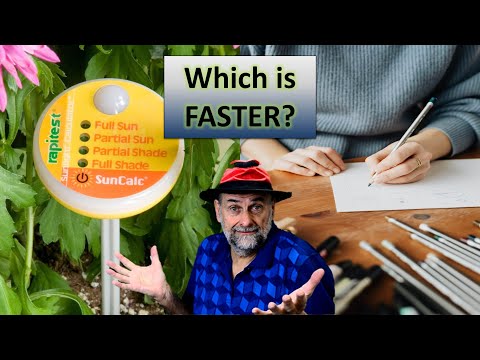
This blog post has received more negative feedback than almost every other one I have written. Several people claim that they don’t have time to go outside and use the paper method and the CunCalc is so much more efficient and faster. I decided to put that claim to the test. I compared SunCalc and my paper method for a fairly small garden consisting of 2 beds with a total of 274 square feet.
Pen and Paper: Total time was 60 minutes spread over 1 day.
SunCalc: Total time was 121 minutes spread over 67 days.

You can see the full details of this experiment in this video.
Plants Require Sun or Shade
Some plants prefer sun and some prefer shade. Almost all will grow in part sun/shade. The more I grow things the more I am surprised that so called sun plants do just fine in shade and vice versa. The plants are adaptable.
My shade garden was shaded by two medium sized sugar maples. The two trees had to be removed one winter, and my garden was suddenly a full sun garden. All of the plants did just fine. Some of the shade plants are actually growing better now than before. Admittedly, this garden does get watered a couple of times a season, but it can go several weeks without water.
Accuracy of Plant Information
Some people claim that just knowing sun or shade is not accurate enough and that plants are fussier than that. They might be fussier but plant labels and on line information about plants is not more detailed. Look at plant labels and check the light requirements. They are not more detailed than sun, shade or part shade, and most give a range, “sun to part shade”.
Keep in mind that the same plant label is used over a wide geographic area. We get the same plant label here in Ontario that is used in California, but full sun in the two areas means something completely different. We grow hydrangea in full sun in Ontario, while the south recommends part shade.
Isolation Level
Two-thirds of the technical brochure deals with something called “isolation level”. There are lots of formulas and technical information on this, but it never tells you how you should use the information.
Here is some of it. WARNING: read this only if you want a nap.
The values are generally expressed in kWh/m²/day. This is the amount of solar energy that strikes a square meter of the earth’s surface in a single day. Of course, this value is averaged to account for differences in day length. There are several units used throughout the world.
The conversions based on surface area are: 1 kWh/m²/day = 317.1 btu/ft²/day = 3.6MJ/m²/day
The raw energy conversions are:1kWh = 3412 Btu = 3.6MJ = 859.8kcal
Do they really believe gardeners are going to do these calculations?
Stop Buying Unnecessary Products
The Sunlight Calculator is not something you need. You can make a sun map following the procedure in my video in less than an hour and you don’t have to buy anything.
What really bothers me about such products is that they are damaging the environment. The product needs to be manufactured, packaged, and shipped around the country – probably half way around the world. That all takes resources including oil. In the process it adds pollution to the environment and increases global warming. You will use it once, and store it in the shed.
If you care about the environment – don’t buy the Sunlight Calculator.


maybe if you live in a parking lot, but if you have a place will lots of trees and plants with specific requirements, it’s not as easy as looking outside, my friend.
Yes it is – https://youtu.be/AAIhO_olcDg
Thanks for this info. Just what I needed. I tend to overthink things. I enjoy your simplified approach.
If a device helps a novice gardener feel confident planting somewhere, then i say go for it. Most novice gardeners are overwhelmed by all the information out there. Sun levels, sun/shade, ph of soil, types of soil, fertilizers, growing zones… etc. A guide of read this, draw a map to scale, go out multiple times a day to measure shade – adds to the feelings that gardening is more complicated than it actually is.
So yeah, I see the appeal of a device that says look, if you aren’t confident in this, put this out in a spot and start there. Once people take that initial step, they may or may not want to learn more and advance their gardening know-how. Maybe the plant they put out matches the sun need but dies… and so the novice learns about watering needs. Then soil types. Or whatever.
Does a gardener with 45 years of experience need this? No. Does a novice gardener *need* this? No. But if it helps them take that first step – I say go for it. And no need to call them a joke.
This was great information and I am mapping out the sun in my yard right now!! I am sorry you’ve had to read so many negative responses.
You’ve convinced me. I need this product.
Loved this as a newbie gardener! Thank you!
The main suggestion “go outside 3 or 4 times during a single day, and look up” does not work at all.
The truth is that there are too many trees and branches and sun moves too fast.
I have to watch non-stop – I see my plant container in full sun for 15 minutes and then in shade for another 15 minutes. At any time there are multiple sunny spots and multiple shady spots in the back yard.
Now the task: find the spot with the required 6 hours of sunlight. Repeat every few days.
That “Sunlight Calculator” device would be OK if I can buy a hundred of them and place them everywhere, then find a spot with the maximum reading, but it is not practical.
“Solar Pathfinder” may be a solution, but too expensive.
Greg’s suggested a “security camera” – good start, but did you try to review 12 hours of security footage? It is a full time job. Note: here some software may help if I can find one.
I did not try this “Sun and Shade Analyzer”(SASHA) app, but did read description – GPS, augmented reality, NOAA’s algorithms – looks too complicated, and not enough details whether it can work for me.
So, I am still searching for a solution.
You are missing a main point – plants are not that fussy, so you don’t have to be very accurate.
My plants disagree.There are spots in my backyard where even plain grass died – so little sun they receive. But few feet away grass is flourishing. But by a casual observation I cannot tell which one would be sufficient for cucumbers. I would buy that “Sunlight Calculator” if it will give me some numerical value rather than just 4 indicators.
Now try to research grass or cucumbers and find anyone who will tell you how many hours it needs to grow? No plants are researched that much and such data is not published.
If you have grass dying in one area and growing in another due to a difference in sunlight, then maybe you have only a single or limited variety of grass growing in your yard? Try introducing a mixed seed grass mix that is tailored for shade. Eventually each type of grass will colonize and grow where it can, minimizing the dead areas. As for your cucumbers, just plant them where you think they will do well, and if they grow then good, if not plant somewhere else next time. We only have so many years of growing plants in us, don’t spend all your time trying to figure out all the best parameters and neglect actual planting.
I think you may have dismissed SASHA a bit too quickly. It really does what you want (tell you how much direct sunlight a location can expect). Visit https://bi.ly/SA_SHA and watch the video. It’s easy!
I was looking for a *device* for just this reason. I agree with the author about that particular device being useless. I also like the idea of sun mapping, but understand some people having issues doing that ( for some strange reason +0 ) Being that its 2020, I am sure there is a compromise between using a device and going outside every so often. So I found the solution. A device that can accurately monitor sun exposure to the minute and can be analyzed at ANY time of the day… I don:t want to be accused of being an internet shill, so I will not promote a specific product. the funny thing is I already owned one and you might have one already as well and not even realize it. Ready? A security camera +0.. there are many out there that cost a fraction of the price.. you can playback the recording at different times of the day and see where the sun hits. The best thing about it, is after you get the mapping of your land, you can go back to using it to monitor you property as intended..
Your welcome
There is now a MUCH better way to determine how many hours of sun a plant location will get! Take a look at an app called “Sun and Shade Analyzer”. You go to a point of interest, scan your surroundings using the app, and it computes the expected average hours of sunlight available at that location during any part of the year. All trees, buildings, etc., that can cast shade are fully taken into account.
You say it is better – but have provided no proof of that?
As others have noted, we can not all go out 3-4 times a day for multiple locations. I could most Sunday but weather dependent of course. This tool is fine ad long as you understand its limitations and use common sense.
If there is a version that gives an actual value readout for an average over time (being able to adjust the time would be nice) I would buy it. In fact I’m going to see if there are wifi light meters I can just check with my phone 3-4 times a day, just average myself.
The average homeowner would need about an hour to do this – and it does not have to be all in one day. If you don’t have that time to be in the garden – why try to garden.
https://www.gardenfundamentals.com/sun-mapping-garden/