

Is climate change real? Is the Earth warming? Are humans the main cause of warming?
If you are like me, you believed all of the headlines. Global warming is mostly caused by humans burning fossil fuels. This heating phenomenon is causing huge changes in the climate. Ice caps are melting, reefs are bleaching and dying, the sea level is rising, the intensity of storms is worse, there are more forest fires, etc.
You would have to be living in a cave not to know this is all happening. It is on the news almost every night.
A few years ago, I started looking at the scientific data. In summary:
There is almost no data to support the catastrophic headlines you see.
However, there is a lot of published data to show that the climate is not changing at alarming rates.
Based on the comments, I think a lot of people did NOT read this last sentence. The Earth is warming. Climate change is happening – it is always happening. But …. climate change is not changing at an alarming rate.
What if all of the information you have been fed is wrong?
It means that most of the government efforts, using your hard-earned tax money, are a waste. It means alternative energy sources won’t solve anything. It means governments and society are doing the wrong things to make our future better.
This is so serious that we all need to start asking questions. We need to demand data to support the news claims.
The purpose of this blog post is to collect and summarize the data we do know. The post will be published shortly, but I will continually add new data as I find it. In some ways, it is a documentation of my journey towards the truth. If you find some data, for or against climate change, please let me know in the comments, and I will add it.
I am not a climate denier. I am a climate realist!
Global Warming vs Climate Change
About 8 years ago, we talked about global warming. The temperature is rising, and that would cause a number of problems. Then, suddenly, everyone was talking about climate change as if the two things were the same. They are not the same.

Global warming means that the Earth and the air above it are getting warmer. It does not mean higher intensity storms or more or less rainfall, although there is some effect on such things. It is simply a measure of the temperature.
Scientists agree that the Earth is warming. But scientists do not agree on the cause of this warming.
Headlines such as “97% of scientists agree humans are causing global warming” are completely wrong. No such survey was ever conducted.
Many top scientists are quite sure humans are not causing global warming.
What about climate change? Scientists agree that the climate is changing. It always changes and has done so for millions of years. It is also clear that we do not understand the effects of various forces on climate change. Most claims about future climate change are at best “estimated guesses” based on limited knowledge.
Here is just one example. We have very little understanding of how clouds affect climate change. More clouds mean less solar radiation reaches the ground. But they also trap heat against the surface of the Earth. More moisture in the air causes more clouds, and water vapor is just as good a greenhouse gas as CO2. Do clouds affect the heating of Earth more than CO2? What effect do more clouds have on climate change? Scientists agree that we don’t know.
Is Climate Change a Real Threat?
The majority of headlines say YES.
Melting Ice Threatens Shoelines
The Climate Crisis – A Race We Can’t Win
How Climate Change Is Causing World Hunger
Climate Change Makes Hurricanes More Destructive
Al Gore, a Nobel prize winner, said this in 2009, “There is a 75 percent chance that the entire north polar ice cap…during some of the summer months, could be completely ice-free within five to seven years.”
It is now 16 years later, and the ice cap has lots of ice even in summer.
Almost none of the predictions from climate activists have come true. Hurricanes and storms have not gotten any worse. The number of forest fires is decreasing. Increased CO2 is making plants grow better and allowing us to grow more food, not less. Sea levels are not significantly rising. Coral reefs are growing in size, not dying.
We need to understand climate change better so that we can adapt and make changes to accommodate it. There is no real evidence that our near-term lives are threatened or that our way of life will suddenly need to change.
The rest of this post will look at specific cases to investigate the reality of Climate Change.
What Does The IPCC Say?
The International Panel on Climate Change (IPCC) is the global organization tasked with evaluating climate change. It takes data from thousands of scientists and summarizes what we know.
Climate activists, news organizations, politicians, and the majority of the population have the understanding that the IPCC makes the following claims:
- Climate change is an emergency, and we need to act now.
- Extreme weather is bad and getting worse due to greenhouse gases.
What does the IPCC actually say?
You can read the full report for yourself. A summary of the current climate situation can be found in the IPCC AR6 WG1 report, chapter 12, table 12.12, section 12.5.2. You can read the details in the report, or watch a video highlighting them from a lecture given by Ross McKitrick, University of Guelph. The latter is much easier to digest and uses actual quotes.

What the IPCC actually says, in both the AR5 and AR6 reports, is the following.
There is no evidence of climate change, beyond natural variability, for the following:
- River floods
- Heavy precipitation
- Landslides
- Drought of all types
- Severe windstorms
- Tropical cyclones
- Sand and dust storms
- Heavy snowfall and hail
- Ice storms
- Coastal flooding
- Marine heat waves
- Ocean acidification
- Risk of fire
The evidence for climate change, over and above normal variability, does not exist. There is, however, evidence of global warming, which has resulted in glacier ice melt and permafrost melting.
The IPCC is in agreement with most of the points made in this post.
Reality:
- The IPCC report suggests there is no climate change.
- The IPCC confirms the existence of global warming.
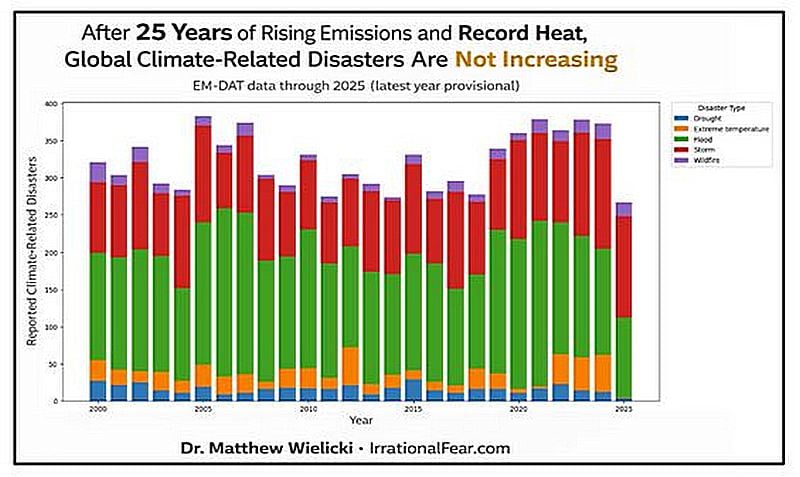
Climate-Related Disasters
If the climate were changing rapidly and causing a crisis, you would expect that climate-related disasters would also be on the rise. But …… they that is not happening.
Is the Arctic Melting?
Let’s first look at Al Gore’s prediction: the Arctic is melting.
Pictures do show less ice in the Arctic, but this is just surface ice. Most of the Arctic ice is below sea level. Here is the data from the Canadian Ice Service, Environment Canada.
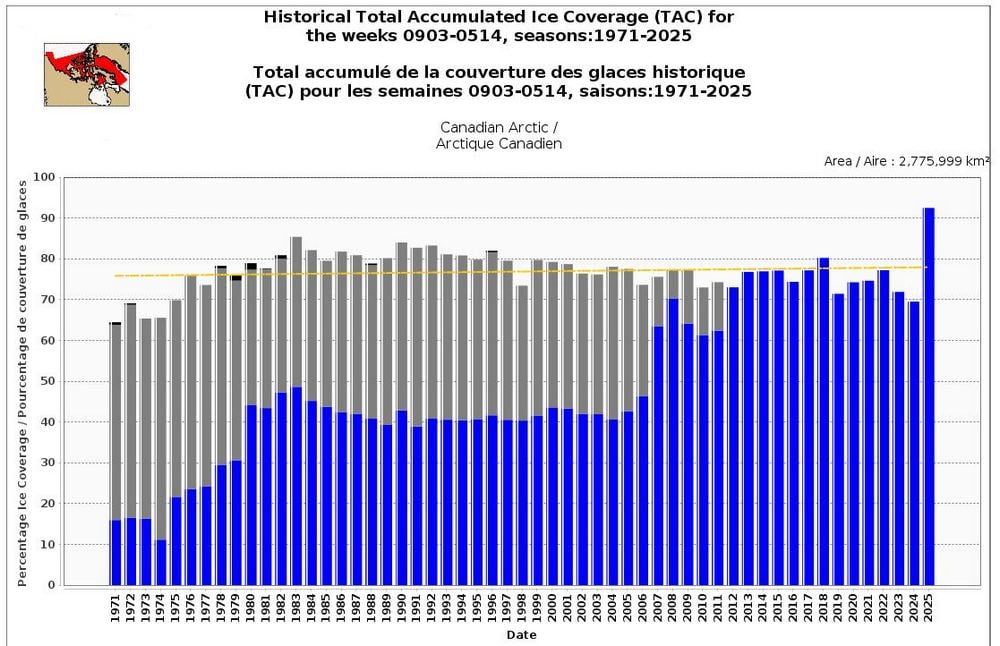
The graph shows the Historical Total Accumulated Ice Coverage (TAC), which is the total area covered by ice for the indicated time period. The blue line is the measured amount. The gray line is a corrected amount, probably due to better measurement systems like satellites in more recent years.
The data shows either a steady increase in ice or ice that is not changing much.
What about the pictures showing less ice? They are real. Global warming will cause more ice to melt in summer, but this is a very tiny amount of the total ice. The amount of ice can also increase in winter due to an increase in snowfall.
Reality:
- Some ice is melting in the summer.
- Most of the Arctic ice is stable.
- There is no ice melt catastrophe.
Ice loss in Greenland
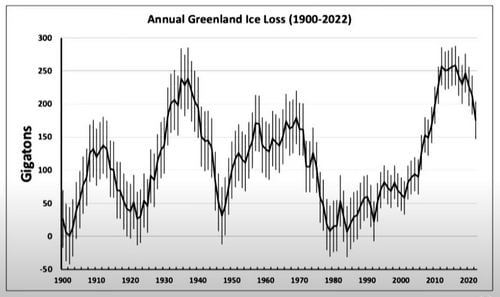
Ice has been melting at a faster rate since 2000. But if you look at 1930, a time when human activity was much less, the increase in ice melting was just as fast as in 2000. It has continually fluctuated up and down over the last 120 years.
The Earth has been warming during this whole time period, but melting has been going up and down. That indicates the two events are not as connected as many claim, and there is more to the story.
Glaciers Are Melting
Temperatures have been rising, and the mountain glaciers have been melting.
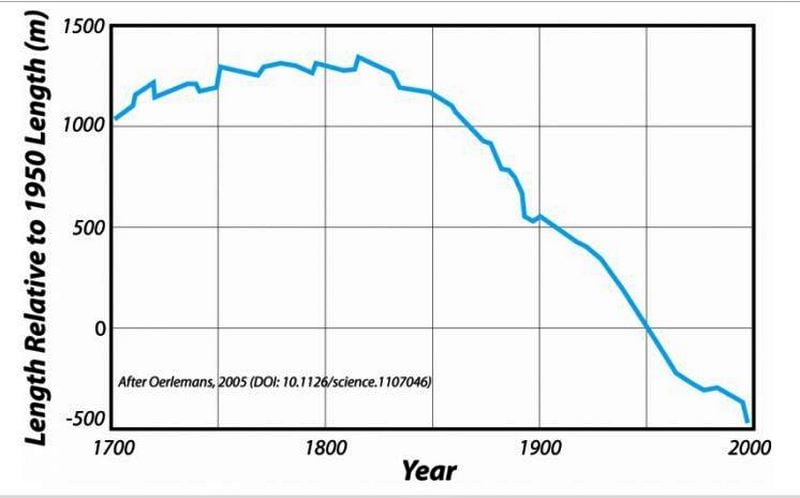
The melting has been attributed to climate warming, not climate change. The melting process does not influence climate change, although it can contribute to sea level rise, which is discussed below.
Melting started about 1850, which is about 100 years before humans started producing CO2 in any significant amount. Clearly, glacier melting can’t be blamed on anthropogenic (human-caused) global warming.
Reality:
- Glaciers are melting.
- It is not a climate change catastrophe.
Are Forest Fires Increasing?
Early last spring, Western Canada seemed to have a lot of forest fires, and the alarmists and news outlets around here were predicting another terrible year due to “climate change”.
Then there was a brief news article. Alberta had declared that every one of their approximately 150 fires was human-caused. They did not say it, but clearly, these were not due to climate change.
Why would climate change cause forest fires? The logic goes something like this. Climate change causes more severe storms, resulting in more lightning. More lightning means more forest fires because it’s the main cause of natural forest fires.

The above chart shows the historical number of forest fires in Canada, which has been declining since the mid-1990s. The data has been confirmed by the Fraser Institute.
So why does everyone think they are getting worse? This is mostly due to poor news reporting, but there is another underlying reason. The severity and cost of them are increasing. This is due to forest mismanagement as well as the fact that more and more people live in forested regions. But this increase in severity and cost is not due to climate change.
It is the summer of 2025, and based on news reports, Canada is having a lot of forest fires. Most are caused by humans.
Forest Fires in the USA
What about the USA? They seem to have a lot of fires, especially in California.
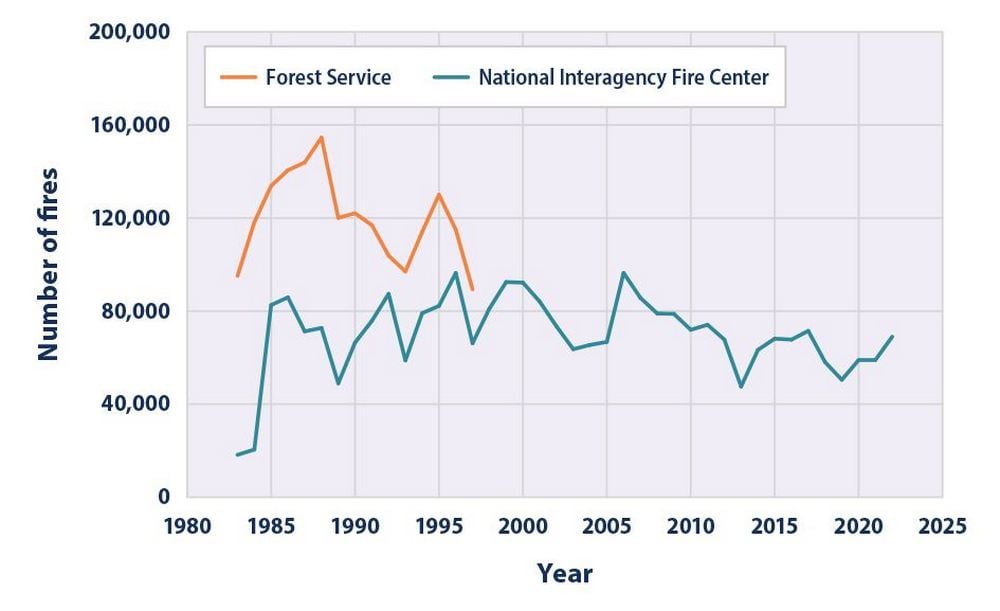
The number of forest fires is not increasing. There is a slight downward trend since 2010.
What about California? Same trend. The number of forest fires has been decreasing since the 1990s.
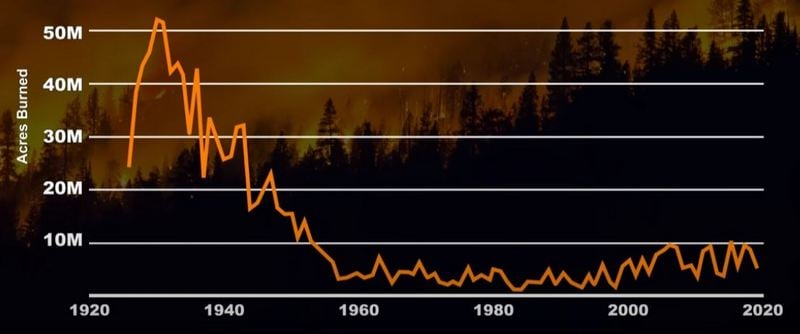
What about longer-term trends? Here is the burnt area for the US since 1926.
Global Forest Fires
A review of global fires, published in 2016, found that “the global area burned by forest fires appears to have overall declined over past decades, and there is increasing evidence that there is less fire in the global landscape today than centuries ago. “
What About the Burned Area?
Several of the comments suggested I am cherry-picking the data. Instead of focusing on the number of fires, I should be looking at the area burned. No one gave a reason why this is a better measure of climate change, and it is probably not better. Burned area depends very much on forest management, which in North America is poor, and on an area’s ability to respond to fires. It is difficult to separate these factors from weather factors.
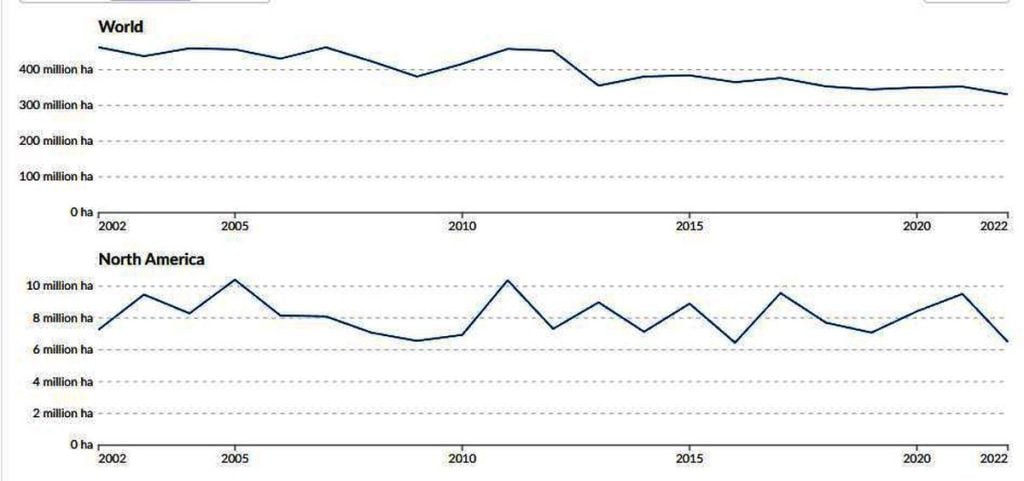
The burnt area in North America is flat, while the global burn area is trending down. The same site also has data for other regions, and they are all flat or trending down.
Reality:
- The number of forest fires is not increasing in Canada, the USA, or globally.
- The burned area from fires is not increasing in North America or globally.
News Changes Its Approach to Scare People About Climate Change
For years, news outlets have been warning about the dire consequences of “Climate Change Caused Forest Fires”. But this year, 2025, has seen a big drop in the number of forest fires, and news outlets have finally checked the facts.
The New York Times has just reported that:
“Costly and Deadly Wildfires Really Are on the Rise, New Research Finds”
Instead of being honest and letting people know that Climate Change is not causing a crisis and that it is not causing an increase in forest fires, they have decided to pivot and focus on “the cost of fire”. Even if their data was right, it only tells us that we are building more structures near forests, and these structures keep getting more expensive every year. That has nothing to do with climate change!
Record Hot Days in the US
It has been a hot summer in North America, and Europe has broken numerous heat records. Are heat waves more common now?
The Heat Wave Index in the US
The Heat Wave Index, more commonly known as the Heat Index or apparent temperature, is a measure of how hot it “feels” to the human body, combining the effects of air temperature and relative humidity. It is used to assess potential health risks during hot weather.
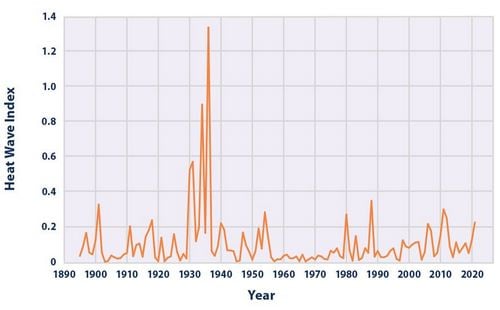
There is no significant change since 1930, and in recent years, the heat index is lower than in the 30’s, before humans produced so much CO2.
Hot Days in the US
The above data shows us how it feels, but it does not show the actual temperature. Does the US have more hot days now than in the past?
This chart shows the average number of hot days per year in the US, with a daily maximum temperature ≥95°, ≥100°, and ≥105°. It is a reconstruction by Chris Martz using official data from the United States Historical Climatology Network (USHCN).

There is clearly no upward trend during the period of 1900 and today.
Annual Average Temperatures in the US
Another way to look at temperature is to measure the average annual temperature.
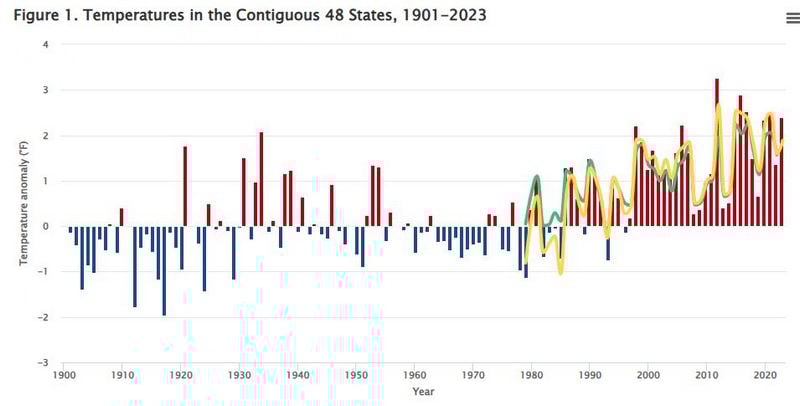
There is a clear trend upwards over the last 100 years, but even in the last 20 years, there are highs and lows, and many of the years are cooler than some years in the 1930s.
Why is the average temperature increasing when the record highs are not? This seems contradictory until you look at nighttime temperatures.
An average temperature is the average between the daily high and low. If the nighttime temperatures (the lows) are trending up and the daytime temperatures remain stationary, the daily average goes up, and that is what is happening. Nighttime lows are getting warmer more quickly than daytime highs.
From a gardener’s perspective, this is a positive trend. Hardiness zones are based on the lows. As they trend higher, cold climates can grow more warm-temperature plants.
Reality:
- Heat waves are not getting worse than in the 1930s.
- Temperatures are steadily going up. Average daily temperatures are increasing mostly due to warmer nights.
- Heat waves and record high temperature days are not as severe as reported in the media.
Are Storms Increasing?
We now have good data about global storms thanks to satellites. We know where they all are and how intense they are.

Tropical storms are not increasing. The number of hurricanes is stable or slightly decreasing. Major hurricanes are stable.
Hurricanes In The US
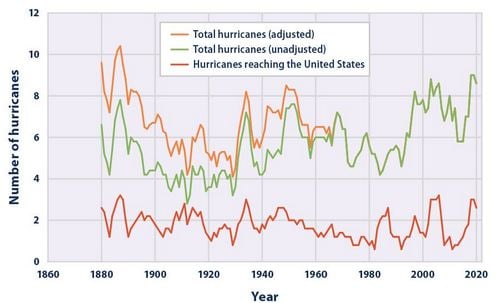
NOAA has reported on the number of major hurricanes to strike mainland USA for each decade since 1951. The average for the entire time is 5.6. The average since 2011 is only 3.5. The highest number occurred between 1941 and 1950, which had 10. Clearly, the number of major hurricanes in the US is not increasing.
Reality:
- The number and intensity of storms are stable, both in North America and globally.
Is Precipitation Increasing?
A satellite study on this concluded “No overall significant trend is noted in the global precipitation mean value, unlike that for surface temperature and atmospheric water vapor. However, there is a pattern of positive and negative trends across the planet with increases over tropical oceans and decreases over some middle latitude regions”.
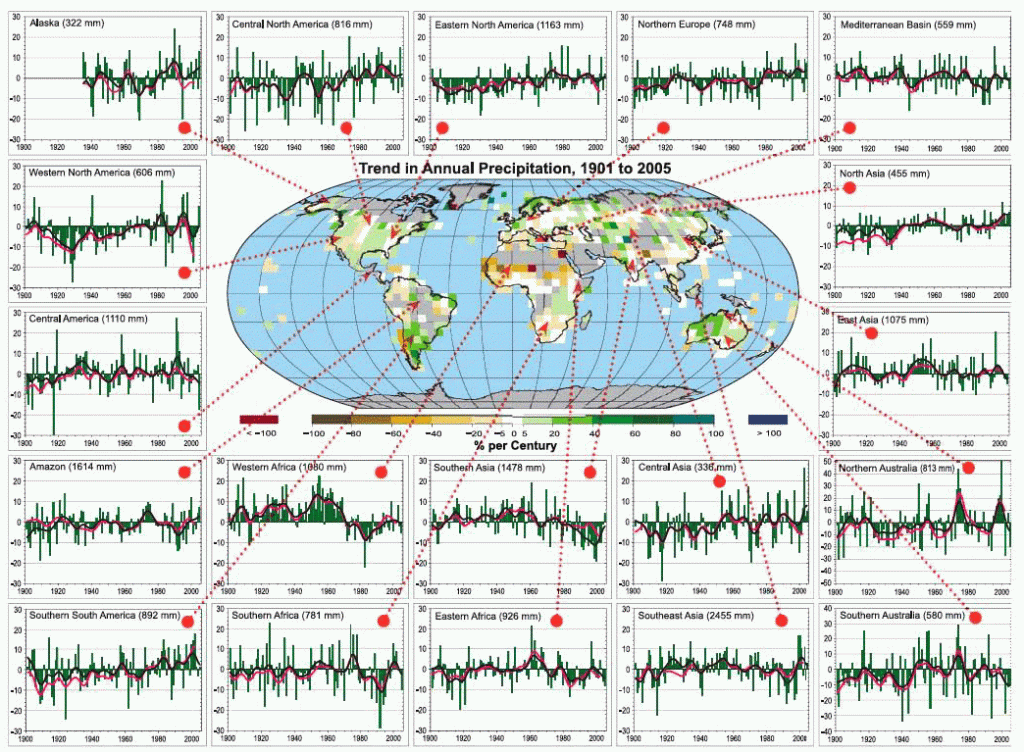

Overall, there is no clear trend in a change in precipitation; however, smaller regions can experience a change. The El Niño-Southern Oscillation (ENSO) cycle and volcanic activity also influence local rainfall.
Reality:
- The amount of precipitation falling globally or in the US has not seen a major change.
Are Sea Levels Rising?
Temperatures are rising, which causes the ice caps to melt, which causes the sea to rise. The news has predicted dire consequences from this, with many island nations being underwater in a few years.
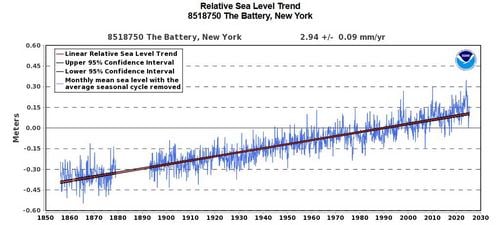
Sea levels have been rising from at least the mid-1800s, and the rise has been fairly stable in New York.
Several of the comments below disagree with this assessment. They claim it is rising at an alarming rate. We can ask the people who live in New York what they think:
- Are New Yorkers fleeing the city? Is the population dropping? No.
- Has the government stopped issuing building permits for New York? No.
- Have companies stopped building? No.
- Has the government started building flood prevention systems? No.
Clearly, the residents of New York don’t think this is a crisis. Neither do I.
A study from 2011 looked at tide-gauge data from 57 US locations and found “the records show small decelerations that are consistent with a number of earlier studies of worldwide-gauge records.”
Sea gauge data does have some issues. Gauges are mounted to land, and we don’t monitor the up or down movement of land very well. If the Earth under a gauge rises, then it will show a smaller sea level rise. And the reverse is also true. For example, New York is sinking, and taking the sea level gauge with it. So the amount of sea level rise in New York is actually less than reported.
Satellite data solves this problem, but it has only been collecting data for 30 years, not enough to determine a long-term trend.
Global Sea Level Rise
An independent analysis of global sea level gauge data was recently done by Roy Spencer, Climatologist and former NSA scientist, who showed that:
- Natural sea-level rise accounts for 1/2″ per decade (5″ per century).
- The human contribution to this is 3/10″ per decade (3″ per century).
A study (2025) that looked at global tide gauge data found that sea level rise is not accelerating in most areas. A few areas are experiencing an acceleration, but this can be explained by land disruptions that have nothing to do with climate change.
This study found that the median sea level rise is 1.5 mm/year, or 6”/ 100 years.
Sea levels are rising, but the rate is low. There is no sign of a short-term problem. The news headline “Melting Ice Threatens Shoelines” is certainly not correct.
Are Islands disappearing?
Islands are not very high, and even small rises in sea level could spell trouble.
You have probably heard of the Maldives? It’s one of the smallest countries in the world and the lowest country on Earth. On average, the ground here is only five feet above sea level. For years, news has warned of a looming catastrophe when sea levels rise.
More than 30 years ago, the AFP international news agency reported that all 1,196 islands that comprise the Maldives could be completely underwater over the next few decades (by 2015).
You would expect the islands to be shrinking as sea levels rise. However, a 2020 study showed that over the past decade, 59.1 % of Maldivian inhabited and resort islands expanded in size. Businesses are increasing the construction of new buildings and resorts. There are potential problems in the future, but for now, there is no looming crisis. All 1,196 islands are still above water.
Another example is the island of Tuvalu, a Polynesian island nation. News has frequently reported that they will sink into the ocean as sea levels rise. However, “a recent peer-reviewed study found eight of Tuvalu’s nine large coral atolls have grown in size during recent decades, and 75 percent of Tuvalu’s 101 smaller reef islands have increased as well”. The citizens are not worried. The population of Tuvalu has increased by 20 percent over the previous 30 years.
Reality:
- Sea levels are rising at a very slow rate.
- Islands are not sinking into the ocean.
Are Coral Reefs Dying
The oceans are getting warmer and more acidic as they absorb CO2. That is bleaching the coral reefs and killing them, or so it is claimed.
There are some important facts about coral that the news outlets ignore:
- Coral thrives in warm water. That is why it is found mostly in warm regions of the world.
- Almost none of the coral reefs in the world have been studied. The one that has been studied the most is the Great Barrier Reef around Australia, and due in part to its vast size, it has only been superficially studied.
- Coral bleaching can be caused by several factors, and it usually recovers in a few years.
- Coral has existed for 60 million years, surviving temperature and carbon dioxide levels significantly higher than those occurring today.
Coral reefs are very difficult to study. You can fly over them and take pictures, but that only shows you the top of shallow reefs. Most of the coral is found much deeper and requires divers to examine it. That is every expensive and why most coral is not examined.
How is the Great Barrier Reef doing? It is doing just fine. It is not dying. In fact, it is growing at both the northern and southern ends.
Growth at the southern tip may not be a surprise. The water there is warming, and that is what coral likes. So it is growing and doing well.
The surprise is that the northern end is also growing in places with warmer water. Ocean warming is not harming it.

The amount of coral in the Great Barrier Reef has decreased in the last couple of years, but it is at an all-time high since 1985.
How are coral reefs doing? It is estimated that 30% will be destroyed or seriously degraded in the next ten years, but not due to climate change.
The causes of reef degradation are many and man-caused: grounding of ships, improperly placed anchorages, destructive fishing practices, such as dynamiting or cyanide poisoning, overfishing, pollution, and sediment runoff.
Bleaching can be caused by sediment and fertilizer pollution. Even sunscreen oil can harm them. It can also be caused by heat waves and cold snaps. In most cases, they recover in a few years.
If ocean warming becomes extreme, coral will simply migrate towards the poles.
Reality:
- Coral is not impacted very much by global warming.
- Coral reefs are expanding where human activity is low.
The Indo-Pacific Warm Pool (IPWP)
The Indo-Pacific Warm Pool (IPWP) is the largest body of consistently warm ocean water on Earth. It is often referred to as the “heat engine of the world” or the “steam engine of the world” due to its immense size and its role in generating heat, moisture, and intense atmospheric convection. The defining characteristic of the Warm Pool is that its Sea Surface Temperature (SST) remains consistently above 28 °C (82.4 °F) year-round.
You would expect that such hot water would have very little coral because it is just too hot for it.
The area is known as the Coral Triangle because it contains the overwhelming majority of the Earth’s coral species and coral reefs. It is home to 76% of the world’s reef-building coral species and makes up approximately 91% of the world’s total coral reef areas.
Coral likes growing in warm water!
Are There More Floods?
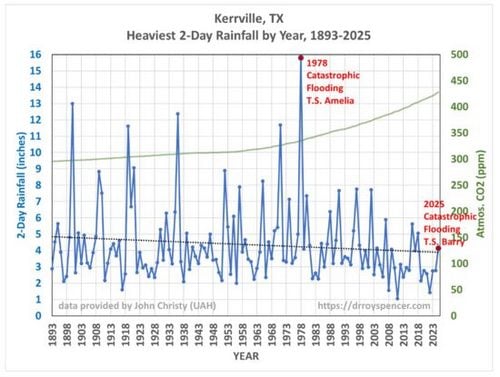
A devastating flash flood impacted the Texas Hill Country, particularly along the Guadalupe River in Kerr County, on July 4, 2025, resulting in numerous fatalities and widespread destruction. It was documented by all the news outlets, who blamed it all on climate change.
Was it climate change?
The area is called “Flash Flood Alley“ for a reason. The topography lends itself to such events. For our discussion, the key question is, was this an unusual event? Are floods in his region increasing? A single event is not proof of climate change. We need to see a longer-term trend to blame climate change.
Roy Spencer, climatologist and former NSA scientist, has done a good job analysing this. The rainfall data shows that this was not an unusual event. Flood events have been trending down since the 1978 flood.
Maybe the news outlets should have reported that climate change is reducing flood events?
The Department of Energy’s report entitled, A Critical Review of Impacts of Greenhouse Gas Emissions on the U.S. Climate, reported that “when one looks at rainfall statistics across the U.S. extending back to the mid- to late-1800s, there is little evidence for anything that might be considered related to human-caused climate change”.
Using floods to determine climate change is tricky. A lot of the data shows financial losses, but it should be no surprise that this is going up. More people are living in more floodplains and building expensive buildings. There is also the issue that humans have moved earth to redirect flooding, which in many cases makes flooding worse in one area while protecting another. We can’t blame any of this on climate change.
Reality:
- Flood data does not show an increase in floods in the US
- Floods are largely influenced by human activity on the ground that has nothing to do with CO2 or global warming.
Is Climate Change a Threat
Climate change happens and will continue to happen. The important question is, is climate change a threat to our lives?
Based on the above data, it’s not. The data does not warrant the views of climate alarmists.
The truth is that global warming has been good for humanity. The following shows the impact since 1900. A reduction in deaths due to weather, longer life expectancy, higher GDP, and less poverty. On a global scale, it is hard to find a negative.

Several people commented that the above information is wrong, without providing evidence that it’s wrong. So I checked the data for the weather-related death rate.
It is very clear that global warming is saving lives:

As mentioned in the introduction, I am making this post public before it is complete. I will be adding many other topics in the coming weeks, months, and years.
It is important that all of us understand this topic better, so that we can influence government leaders to act more responsibly. Trying to solve a problem that does not exist costs dearly.
Number of People Killed by Climate-related Disasters
If climate-related disasters are increasing, you would expect more people to die from them. The general public and the news media certainly think so.
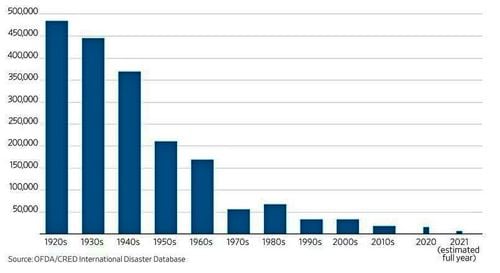
The reality is that the number of deaths from floods, droughts, storms, wildfires, and extreme temperatures has dropped dramatically. Most of this is due to human advancement in technology, but there is certainly no evidence of an increase.
Cost of Disasters
An increase in the number of disasters or the severity of disasters should result in an increase in cost.
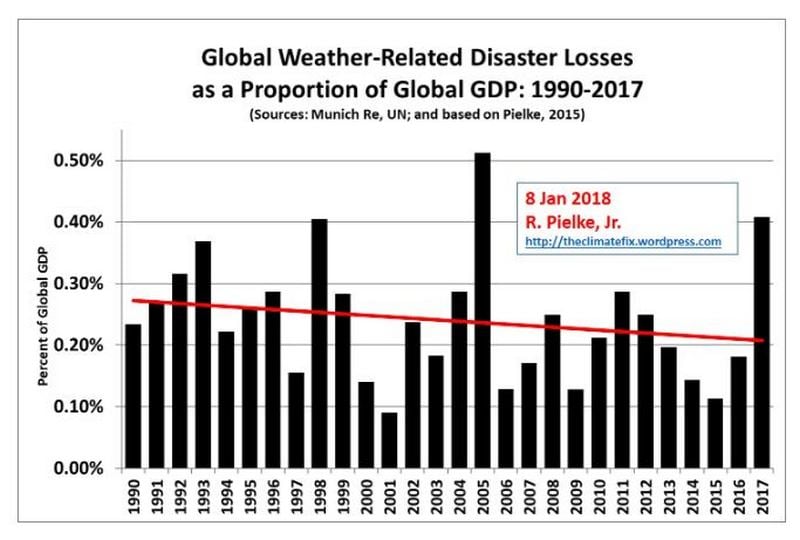
The trend between 1990 and 2017 is down, not up. The opposite if disasters are on the rise.
There are charts that show an increase in actual costs for this time period, but they don’t take into account the increasing value of human-made structures. For NOAA’s charts, they say, “A major driver of increased costs of extreme weather is the increase in population and material wealth over the last several decades”. The above chart, based on GDP, more correctly reflects those costs.


Robert: I am a recent subscriber and you have helped me tremendously with my gardening. Thank you for going against the flow on the subject of AGW. I’ve written thousands of words on this topic over the last couple of decades at least. One day, while driving to work, I heard on the ‘news’ that human’s production of CO2 was causing the earth’s temperatures to rapidly rise. I was quite alarmed and after I got back home I started doing my own research. I have a science background and knew how to do research and read studies. I first started with the Arctic ice core studies which showed CO2 rising over the millennia but this was only ‘after’ temps started rising about 400 years earlier. It made sense too when one considers with more warmth there is more life thus resulting in more CO2. Unfortunately Al Gore in his ridiculous movie “Inconvenient Truth” reversed the trend lines and showed the opposite – that CO2 rose first ‘before’ the rise in temps hundreds of years later. That put me on notice re the ‘truth’ and I started doing much more research.
There’s a mantra in science that says “Correlation doesn’t prove causation but you can’t prove causation without correlation.” Here is a chart over the last 600 million years showing CO2 levels and temps and one can see there is no correlation between the two. https://tinyurl.com/267vuykx In addition I discovered that CO2 only makes up 0.045% of our atmosphere and humans contribute only 3-4% of that CO2 annually. That puts our ‘contribution’ in infinitesimally small amounts. In other words the climate alarmists are saying it’s human’s 3-4% contribution of a 0.045% gas that is creating all this “climate change”. It is incredibly ridiculous to think that a gas that only makes up 0.045% of our atmosphere can ’cause’ the ‘changes’ they constantly refer to that, as you’ve pointed out, are going against their predictions as well as their restatement of the climate facts. For instance the alarmists keep stating that our recent high temps, both here and in Europe, are the highest ever recorded and people just accept it without question when, in fact, they have been much higher in the mid 1930s as well as the Roman Warm Period and the Medieval Warm Period when human population levels exploded. Remember when it was revealed that the ‘scientists’ in their emails to one another said they had to get rid of the Medieval Warm Period for their research to be valid? It was called at the time “Climate-gate”. Michael Mann left this period out of his “Hockey Stick” graph and he wouldn’t reveal his data for his so-called ‘study’ so it could be checked by other scientists. This is why a court found against him in his lawsuit against those who questioned his study and, in addition, was made to pay for their lawyer fees. There’s also the chimera that 97%, recently updated to 99.9%, of scientists agree in anthropogenic global warming. This article shows just how flawed this claim is: https://tinyurl.com/3kx5a4cd
All the grants issued for studies are only for those that will purport to show anthropogenic causes. I personally know of scientists who have been ghosted and lost funding because they didn’t buy into the anthropogenic lie. John Clauser is a Nobel prize winning physicist, 2022, and because of his status he will say what he wants regardless of the consequences and he totally disagrees with the anthropogenic global warming thesis.
In case it’s not obvious to everyone this has turned into a political football foisted by the left. When they were touting global cooling back in the 70’s they twisted themselves into knots trying to show it was anthropogenic caused by particulates emitted, etc. Now it’s the gas CO2 for one primary reason… it’s the one gas that humans produce and emit due to rapid technological advancements. I have quotes from UN executives saying that they will use climate change as the tool to redistribute the world’s income.
Here are some inconvenient ‘facts’. 1) They constantly refer to CO2 as a “greenhouse gas” when, in fact, there has never been a true peer-reviewed study showing CO2 raises temps either in vivo or in vitro. Whenever one has been purported the results could not be duplicated. If there was then we could easily deduce how much reduction of ‘our’ CO2 will result in how much decrease in the world’s temps. Instead all we hear is we must reduce our CO2 output but they can’t tell us by how much and what the results will be. 2) Humans and all life thrives in warmth. Life can cope with warmth but dies in the cold. You can’t grow food in cold. 3) Higher CO2 levels increase plant vigor and are documented to show higher growth rates and crop yields today vs. over a hundred years ago. Plants start to starve and die at CO2 levels of 250 ppm which we weren’t too far from reaching when all this started. I heard a NASA head scientist once say our optimum CO2 levels would be around 1000 ppm and we’re now around 430 ppm. Humans would hardly even notice increased CO2 levels until around 5000 ppm. Submariners and space station occupants normally experience CO2 levels in the 2,000 – 5,000 ppm range.
When has the left ever been accurate in their doom and gloom ‘predictions’? Remember “The Population Bomb” or “Peak Oil” or… the list is endless. It’s always one disaster after another with the far left and when one is debunked they just go to another and it’s always centered around taking money away from the producers and redistributing it to their fantasies which usually results in enriching themselves as well as their ‘friends’.
BTW just for the record I believe in clean energy and less dependence on ‘fossil fuels’, if that’s even an accurate term since it looks more and more like oil is turning out to be an abiotic resource, to achieve that energy. I used to be a big proponent of nuclear energy, and it shows how disingenuous the left is in reducing CO2 because nuclear emits no CO2, but now think the future is primarily solar and battery storage of energy. It’s far cheaper than nuclear and with the batteries now being developed, no lithium, the battery storage facilities can easily last over 30 years of recharging. I recently purchased a Tesla Model Y and with home charging at 9c/kwh it’s far cheaper than gasoline and I’ll almost never have to charge outside of my home since I rarely drive over 340 miles in one day. Electric motors are far simpler than ICE and easily last 500K miles and current battery technology will easily handle over 200K miles of recharging cycles and this is improving exponentially.
People, such as yourself, are starting to wise up to the left’s constant scare tactics to try and achieve their child-like level one thinking (Thomas Sowell). I will always remember Michael Crichton, an MD and with a masters in biology, saying that man thinking we can control the Earth’s environment is “intoxicating vanity”. I agree with what he says that the Earth hardly knows we’re here. We could kill ourselves off tomorrow and in a million years, or less, an alien from another planet wouldn’t even know we existed. The Earth would swallow up everything and leave little of ‘us’ behind.
That’s Climate Change worries sorted then! Same with Roundup… and peat moss – all myths causing us needless anxiety, debunked by Mr RP. What would we do without him?
Just make sure you put the World Health Organisation and Sir David Attenborough straight, won’t you?
https://www.who.foundation/climate-and-health
David Attenborough: The Truth About Climate Change –
https://www.youtube.com/watch?v=HK47Pnx46rM
He’ll be telling us Trump is the best thing since sliced bread next.
You should look at your facts more closely.
From your reference, Who says “37% of heat-related deaths are attributed to climate change.” So what??
The reality is that “Globally, cold deaths are 9 times higher than heat-related ones. In no region is this ratio less than 3, and in many, it’s over 10 times higher. Cold is more deadly than heat, even in the hottest parts of the world.”
from: https://ourworldindata.org/part-one-how-many-people-die-from-extreme-temperatures-and-how-could-this-change-in-the-future
Clearly, global warming will reduce the number of deaths from extreme temperatures.
The two charts I would include in a global warming presentation are the Keeling Curve which is a measure of carbon dioxide taken at Mona Loa in Hawaii. This location is far from pollution from major cities, so it gives an accurate reading.
The other chart I would include is a measure of carbon dioxide taken from air bubbles taken from ice cores drilled out of ancient Antarctic ice sheets.
The Keeling Curve shows an increase in carbon dioxide since the measurement was first taken decades ago.
The carbon dioxide reading through past epochs of geologic time shows a fluctuation of carbon dioxide up and down repeating over millions of years until you get to the industrial revolution. Then the level goes up well beyond anything earth has experienced.
The date the air bubbles are trapped in the ice is dated using isotopes that have known decay times.
Those would be appropriate in an article about CO2 levels, not necessarily one on global warming.
What do those charts tell us? There seems to be general agreement on the fact that CO2 levels have increased. Showing they have increased is not really news?
Hi Robert,
Can you please explain your comments on the IPCC report that there is no impact on extreme weather, when Chapter 11 (the correct chapter on extreme weather) summary categorically contridicts that by stating:
“This chapter assesses changes in weather and climate extremes on regional and global scales, including observed changes and their attribution, as well as projected changes. The extremes considered include temperature extremes, heavy precipitation and pluvial floods, river floods, droughts, storms (including tropical cyclones), as well as compound events (multivariate and concurrent extremes). The assessment focuses on land regions excluding Antarctica. Changes in marine extremes are addressed in Chapter 9 and Cross-Chapter Box 9.1. Assessments of past changes and their drivers are from 1950 onward, unless indicated otherwise. Projections for changes in extremes are presented for different levels of global warming, supplemented with information for the conversion to emissions scenario-based projections (Cross-Chapter Box 11.1 and Table 4.2). Since the IPCC Fifth Assessment Report (AR5), there have been important new developments and knowledge advances on changes in weather and climate extremes, in particular regarding human influence on individual extreme events, on changes in droughts, tropical cyclones, and compound events, and on projections at different global warming levels (1.5°C–4°C). These, together with new evidence at regional scales, provide a stronger basis and more regional information for the AR6 assessment on weather and climate extremes.
It is an established fact that human-induced greenhouse gas emissions have led to an increased frequency and/or intensity of some weather and climate extremes since pre-industrial time, in particular for temperature extremes. Evidence of observed changes in extremes and their attribution to human influence (including greenhouse gas and aerosol emissions and land-use changes) has strengthened since AR5, in particular for extreme precipitation, droughts, tropical cyclones and compound extremes (including dry/hot events and fire weather). Some recent hot extreme events would have been extremely unlikely to occur without human influence on the climate system. {11.2, 11.3, 11.4, 11.6, 11.7, 11.8}
Regional changes in the intensity and frequency of climate extremes generally scale with global warming. New evidence strengthens the conclusion from the IPCC Special Report on Global Warming of 1.5°C (SR1.5) that even relatively small incremental increases in global warming (+0.5°C) cause statistically significant changes in extremes on the global scale and for large regions (high confidence). In particular, this is the case for temperature extremes (very likely ), the intensification of heavy precipitation (high confidence) including that associated with tropical cyclones (medium confidence), and the worsening of droughts in some regions (high confidence). The occurrence of extreme events unprecedented in the observed record will rise with increasing global warming, even at 1.5°C of global warming. Projected percentage changes in frequency are higher for the rarer extreme events (high confidence). {11.1, 11.2, 11.3, 11.4, 11.6, 11.9, Cross-Chapter Box 11.1}”
In sections of the IPCC where they make conclusions they do say climate is changing and quickly, but these sections are more political and contradict what they give as actual evidence. See the teble in my reference where they clearly say they can’t find any evidence in several key climate change factors.
Keep in mind that this post is not about global warming, which is accepted.
How do you explain this? I am 62 and live in New Brunswick. When I was a teenager I did a lot of snowmobiling, long before we had groomed trails. We used to travel a lot on rivers and creeks. These were highways for snowmobiling. Now they are not even safe to cross, open water. We do not get the amounts of snow and cold weather that we used to. Many people are getting rid of their machines because of lack of snow. I have a relative in Thunder Bay making the same claim. I don’t need some alleged credible study to tell me what I can see with my own eyes. By the way, my well is low (first time) and giving me problems now and we have lots of forest fires in the area.
Climate changes – nobody denies that. So what? It does not mean CO2 is causing global warming.
Forest fires are decreasing. That does not mean a specific are might not have more in one year or another.
Excellent article Robert, and bravo for having the the courage to post this. I find it ironic that many of the negative comment on this post and on climate change in general, accused skeptics (we should all be more skeptical) of doing the exactly same thing they do, namely cherry picking data. I laugh when they use the term “The Science” and “Consensus” it it really shows how little they understand about the scientific process. I have been following this topic very closely for almost 30 years and I’m encouraged to see more and more actual scientist are starting to speak out.