

Mosquitoes are becoming a more important pest as new varieties move north in North America, and the incidence of diseases increases. Around here there is a big concern about the West Nile Virus so it is only natural that people try to find simple ways to keep mosquitoes away.
A very common solution is citronella. Some suggest planting the citronella plant next to your patio to keep mosquitoes away. Others rely on citronella candles. These solutions are just myths.

What is the Citronella Plant?
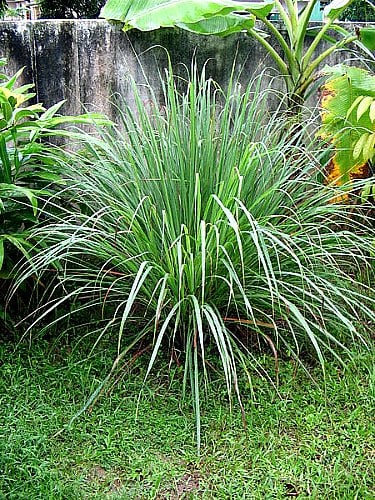
As I started researching for this post I was very surprised to learn that the so-called “citronella plant” is not the plant that produces citronella oil – the active ingredient in citronella candles. The picture above shows the citronella plant; also called Pelargonium citrosum. This geranium is unrelated to the true citronella. Not only that but the scientific name of the plant is not even recognized as a valid name. It is a geranium (ie Pelargonium) and it sort of smells like citronella. It even has some of the same aromatic chemicals found in citronella, but it is a different plant.
But does it work? Testing shows that it does not repel mosquitoes. In fact, mosquitoes seem to enjoy sitting on the plant. For more details see Mosquito Plant, Pelargonium Citrosum – The Citrosa Plant.
What is the Real Citronella Plant
Citronella oil is extracted from various species of lemongrass (genus Cymbopogon – say that name 3 times fast!). This is a perennial clumping grass that grows to a height of 6 feet. It is not frost hardy.
Does Citronella Control Mosquitoes?
So much for botany – does the real citronella plant or the oil work?
Let’s first consider the plant itself. If the aroma from the plant wards off mosquitoes, then this would only work for you if you are sitting in or right next to the plant. The reality is the amount of chemicals given off by plants is very small. You will smell them most when you brush against them or you crush a leaf. Growing the plant will have almost no effect on mosquito control.

Research in North America has confirmed that citronella oil is effective and the oil is registered as an insect repellant in the US. Studies in the EU failed to validate its effectiveness and they have banned the product as an insecticide. We must conclude from this that “we don’t know if it works”, but if Europe can’t find any evidence that citronella oil works, I tend to be skeptical.

If it does work, it does need to be applied frequently – at least every hour.
Citronella oil is a natural product – a good ‘organic product’. Keep in mind that it is also 2 times more deadly than Roundup. Both products are relatively safe, but it is important to understand that this organic solution does have a risk. How toxic is citronella oil? One way to measure toxicity is to measure the LD 50, in this case, the LD 50 on rabbit skin. It turns out citronella oil has a value (4700 mg/Kg) and DEET is (4280 mg/Kg). Both have similar toxicities and both are very safe.
You might also be interested in this post: Mosquito Repellents That Work Against Zika Virus
What About Citronella Candles – Do They Keep Mosquitoes Away?
This is a myth. The amount of oil in candles is extremely small and citronella candles don’t work any better than regular candles – neither works well.
Correction: The above statement was the initial entry in the post. It is not quite correct. Work at the University of Guelph tested citronella candles. In a 5 minute period subjects received 6, 8, and 11 bites for citronella candles, regular candles, and no candles, respectively. Citronella candles were marginally better than regular candles and reduced bites by half compared to using nothing. So they work, a bit, but I don’t consider 1 bite a minute as satisfactory. Deet is much more effective.
Fragrant Plants and Mosquitoes
There are lots claims that fragrant plants such as catnip, citronella grass, beebalm, marigolds, lemon balm, lavender, geraniums, thyme, wormwood, rosemary and various mints, repel mosquitoes in the garden. Do they work? I’ve reviewed this in Mosquitoes Repelled By Fragrant Plants.
What Did the Voyageurs Do About Mosquitoes?
The voyageurs were responsible for exploring much of North America for the white man. They traveled through the wilderness with few comforts of home. A million black flies and mosquitoes and no DEET! Just think about that. What did they use? One source, The Voyageurs, suggests that the best repellant was a mixture of bear grease and skunk urine. I guess that after collecting the skunk urine you smelled so bad that even the bugs stayed away. Another source suggests that spruce bows tied around the neck are of some help. I have spent a lot of time in the wilderness and have tried the spruce boughs – I’ll stick to DEET.
What Does Work for Mosquitoes?
You will see from the above list that most mosquito repelling devices either don’t work, or work in a very limited way. So how do you keep mosquitoes from biting?
DEET and Picaridin are still your best choice for both safety and efficacy.
Here are some other posts that might interest you.
Mosquito Repellents – Best Options
Mosquito Repelling Devices – Do They Work?
Mosquito Apps for Your Smart Phone – Do They Keep Mosquitoes Away?
Mosquitoes Repelled By Fragrant Plants
Mosquito Repellents That Work Against Zika Virus


IN THE ”DEEP SOUTH” OF THE US,THE PLANTS DO WORK,I’VE BEEN USING ”CITTRONELLA OIL” FOR 60 YEARS,IN CANDLES & MY PATIO TORCHES !
I am glad they work for you. But science can’t be based on anecdotal observations.
So the “facts” that you present are all just reports you’ve read? If one can visually see results that work, doesn’t that make it proof? You keep refering to this sience and contest anyone with an opinion or experience other that yours.
Visually seeing results that work is NOT scientific evidence, and it is NOT proof of anything.
People are easily fooled with impressions. That is why science always measures things with numbers, and uses controls.
https://www.gardenmyths.com/anecdotal-evidence-not-worth-the-screen-its-displayed-on/
I live in Tennessee where there are a gazillion insects. I recently took care of a citronella plant of my friend while she underwent hip replacement. I had the plant for two weeks. During that time I did not have one mosquito, ladybug, stinkbug, wasp, gnat or ANY flying critter. These are insects I’ve been battling for years! So don’t tell me it doesn’t repel them.
I took a trip to South America (Machu Pichu), and put 100% DEET on my arms and an all natural bug repellent made from herbs that naturally repel insects. Quess which one worked! The herbal formula worked, and I did receive bites from “no see-ums” on my arms where I had the 100% DEET.
The plant did not give off an odor I could detect, but the insects sure did and avoided it. I’m getting one for myself. By the way, I abhor the odor of citronella candles or any scents for the reason they trigger my asthma. This plant did not.
So one citronella plant in your backyard kept away all flying insects? That is a powerful plant. If that were really true, don’t you think we would all have the plant in our back yard? Or that scientists would have confirmed this effect by now?
I am glad it worked for you. The placebo effect can be very powerful.
Bwahahahahahaha! Oh man! There’s like ten psychosomatic red flags in this single comment, it’s amazing. Robert – I love that you actually reply to the idiots who refuse to acknowledge reality, I’d get sick of it. I also like the people citing citronella success by proffering results of one bite a minute down from two bites a minute. There is one and only one thing I am allergic to: MOSQUITO bites. I get a single bite and I’m miserable for a week. In the warm months I do not put a toe outside without deet, meat tenderizer, chigarid and benadryl. One bite a minute for 15 minutes and I’d shoot myself!
This was such a great article, thanks!
Thanks – more mosquito posts to come shortly.
Shiraz,
What would be the psychosomatic symptom of the lady with the geranium plant? Would it be the bites she got before she got the plant? Or the bites she didn’t get AFTER she got the plant? Or perhaps that she got bites AFTER the plant but that because she believed she should not get bitten her body had no histamine response to the bites and therefore didn’t even know she’d gotten bitten? It’s an interesting notion! I’m a firm believer in mind/body syndrome aka psychogenic pain syndromes and, you probably won’t like this, allergies. Yup. Allergies can be psychosomatic… usually are actually. Sigh…alas I still have them. Knowledge is power but only to a point. I can’t seem to get completely allergy free, though I have successfully staved off my SEVERE cat allergy on one and only one occasion. Oh well. If you are interested in learning more about the mind body connection you should pick up one of Dr. Sarno’s books. Good luck staying bite free this summer!
Dale
P.S. I’ve used lemongrass oil on my skin with success but it is incredibly gross and oily and you don’t want to get it in your eyes. I’ve also used, since I was a kid, Avon’s skin so soft bath oil. Again, oily. Avon caught on to what people were doing in the 70s and now they sell a Skin So Soft insect repellant. Works well but really I think it is the oiliness that keeps you from getting bitten. So I don’t think it is a repellant but more of a bite deterrent. I think I remember being bitten on my face when the rest of me was slathered down in Avon SSS oil. Same with lemongrass oil. I just went out back a few hours ago and got about 6 bites in 5 minutes. I supposed that means I’ll be slip sliding through summer. Although I did order something today online called Wondercide. It is cedar oil I think. You are supposed to spray it on your yard to control fleas and ticks. They claimed on the phone that it was also effective at repelling mosquitos. We’ll see. LOL. I just realized my “P.S.” was possibly longer than my post! Hee. Happy Summer all!
So why not just use citronella to your heart’s content, in peace and privacy, knowing that you have at your disposal an amazing weapon against mosquito attack, regardless of what science says — instead of being so defensive about something someone has posted that is contrary to your experience?
Or, if you are concerned that this article will cruelly misguide millions of mosquito-bite sufferers, why not share your secrets with the world and create your own website extolling the virtues of citronella (or whatever else youthink works)?
You’re so sure citronella (or other “natural” remedies) works and is less toxic than DEET, then go ahead and slather and surround yourself in the stuff and just sit back and laugh at all the fools around you who are dying of DEET poisoning.
This guy is discussing the efficacy of CITRONELLA and the studies that back up his understanding of it. Probably a lot of people (like me) stumbled across this website because they have NOT had good luck with “natural” remedies like citronella and suspect that it is all BS (and also wonder is there’s any comparative data out there).
It’s not like this guy is starting some kind of anti-citronella cult or taking anyone’s precious citronella plants away from them.
Ok, I’ve had my fun, ya’ll. Someone pass the DEET.
May be myth but use listerine original mouthwash put in spray bottle , apply to body works good
Do you have any scientific evidence to support this position? If it really worked – it would be recommended by health organizations – it is not!
I came upon your site after a search for natural mosquito repellents (I live in Northern Thailand and as you would know, the issues here at present with Dengue fever and the Zika scare are very real). There are certainly many suggested local methods but all anecdotal. If it works, happy to accept that ‘science’ in not required to solve issues of the world. PS. I think you need to consider who runs the health organisations.
I don’t know what the WHO has to do with this post, but I do mention it on my other posts about insect repellents. The latest testing was done by Consumer Reports – not the WHO. You might be interested in this latest post https://www.gardenmyths.com/mosquito-repellents-that-work-against-zika-virus/
Robert, please site scientific evidence that, “If it really worked – it would be recommended by health organizations – it is not!”? I seriously don’t think it is true. LOL
p.s.
In Florida, my subjective observation is that Avon Skin So Soft is very popular and effective.
I can’t find the quote you attributed to me on this post?? I did not discuss Avon Skin So Soft here?
Do you have a reference of any health organization recommending Avon Skin So Soft?
Here are references to some of the latest studies on controlling mosquitoes.
Mosquito Repellents Best Options
Mosquito Repellents that Work Against Zika Virus
It was your response to a comment:
Wally says:
May 12, 2015 at 12:53 am
May be myth but use listerine original mouthwash put in spray bottle , apply to body works good
Reply
Robert Pavlis says:
May 12, 2015 at 11:12 am
Do you have any scientific evidence to support this position? If it really worked – it would be recommended by health organizations – it is not!
I also wanted to congratulate you on your blog. This was the first article I’ve read, and will read more.
The original question was about using Listerine. I have not found any studies that have even looked at Listerine as a mosquito repellent. I found this one quote from this reference: “Likewise, spraying Listerine around your home or outdoor areas isn’t an all-purpose mosquito preventive. It may kill some mosquitoes on which it is directly sprayed, but it won’t serve to keep knocking mosquitoes dead for hours and hours afterwards. Because it contains trace amounts of eucalyptol, mouthwash may also have limited effectiveness as a mosquito repellent, but it needs be kept in mind that actual eucalyptus-based mosquito repellents contain the compound in concentrations as high as 75 percent whereas the eucalyptol in mouthwash is usually below 1 percent, which means if it works at all, it isn’t going to work very well or for very long. ”
My previously provided references show that eucalyptus-based mosquito repellents are only partially effective, and for short periods of time.
As far as Skin So Soft goes it is not an insect repellent.
this is what Consumers Report says
Even Avon does not recommend it as an insect repellent.
I’ve also heard this but never tried it!
I have had citronella geraniums on my back deck, on a pond, and have had little if no problems with mosquitos. I have around 8 plants scattered around and often pinch off a leaf and squeeze it, when I go out to sit for awhile. The odor smells so good. They work! just buy several to cover an area.
You may have the geranium, and you might not have mosquitoes, but scientific studies have shown the two events are not related. the geranium does not repel mosquitoes.
I live in the bush in Australia, when we have a camp fire, we stand in the smoke for a while, after this we get no bites until we wash to go to town. The fire usually has a lot of eucalypt varieties in it.
Even smoke from other types of wood discourage mosquitoes. Years ago, when our tents had no bottoms, we would fill them with smoke from a soldering stick before going to bed. Not very practical in most back yards here, where fires are not allowed.
Studies have shown even the smoke from candles has some effect.
on the river…camping sites…use garlic spray to ward off ticks, fleas, chiggers, and mosquitos…
Citronella candles may reduce the number of mosquitoes entering an area, but one of the reasons for this is just the smoke itself. When I was working on a cattle station in the Australian outback, at sundown each day we would ensure that a log was smouldering in the horse paddock (paddock was about 4 sq km!). When we went to catch a horse in the morning, all the horses would be in a nice straight line, downwind from the smouldering log, in the smoke. No citronella, not DEET, just eucalyptus log smoke, keeping the flies and mosquitoes away.
I read that citronella overloads their sense of smell, so they wouldn’t be able to detect your CO2. The plants may not repel mosquitos but do they confuse the mosquitos senses, like a flash grenade, so that they can’t find you to bite? That would explain why the plants don’t seem to repel but may keep you from getting bit as much in your backyard.
I am not sure I follow your logic, but the reason lemongrass don’t repel mosquitoes is that the amount of citronella produced by living lemongrass, is too small. It only has some effect when it is extracted from the plant and put into a concentrated form.
The logic is that what smell do we emit… very little and mosquito’s pick it up, The same goes for the plants. So plants + humans = confusion to mosquito.
The problem with logic is that it only works if all of the variables have been taken into account. You are assuming mosquitoes are able to smell all chemicals equally – that is not likely to be true. Just because we find the smell of a mint plant to be strong, does not mean a mosquito can even smell it. It further assumes that a lot of chemicals make it harder for the mosquito to locate the source of the ones they favour.
The latest research on why mosquitoes are attracted to some people and not others is that they can filter out the smells and they are attracted to certain combinations of smell. It is not just one smell.
There are lots of arguments that can be made based on logic – but is there any scientific testing that shows smelly plants confuse mosquitoes? the tests I have seen don’t support this idea.
Mosquitoes may prefer some oders over others, & may even vary from mosquito to mosquito just like peoples prefrences vary from person to person. I have been bitten many times when I am alone but am rarely bitten when others are around. People I am with cant belive that I am not using deet or other repellants as they are being bitten and I am not, I will have to check to be sure I don’t smell like skunk.
The degree one attracts mosquitoes does definitely vary – science is just starting to understand why.
Have you found any recent data that identifies factors that increase one’s susceptibility to mosquito bites? Would these findings also apply to other biting insects (i.e. biting flies?)
There is lots of research on the attraction between mosquitoes and people. They are starting to isolate the chemicals responsible for differing attractions.
nice to have all the facts about things that don’t repel mosquitos how about coming up with a solution
DEET – both safe and effective.
Safe in what sense? As an individual whose career is guided by pharmaceuticals, I can say leaning on the cdc for determining what is safe or not is not always the wisest choice. I see human safety has been covered in these comments (I don’t fully agree, since studies show it to be safe ince, not in another) the more pressing issue is the growing concentration of deet in water supplies (like the pharmas in water creating hermaphroditic mutations in some species), which is ironic because you think this would slow the spawning of mosquito larva. Most studies on this relate back to European waters, and for some more info I suggest a scholar search of deets impact on environment (I have no links on hand, my apologies). Safe, like many terms, is relative to how it is applied to the subject at hand.
DEET is safe from the point of view that it has been used for many years and the scientific community has not found detrimental effects from it’s use when used properly.
DEET keeps mosquitoes from landing on you – so they don’t bite. It is not logical to think that DEET in ponds would keep larvae from growing. In fact if, and I say if since I don’t agree with this, ponds had high levels of DEET in them and the mosquitoes still breed in the water it shows that DEET is not harmful to them. So in some ways you have just contradicted yourself. However chemicals can be safe for insects and harmful to humans.
I have not seen reports of DEET being a problem in water. Considering the fact that people use very small amounts I would be surprised if this is true. Here is one report showing levels are very low http://www.google.com/url?sa=t&rct=j&q=&esrc=s&source=web&cd=2&ved=0CCUQFjAB&url=http%3A%2F%2Fwww.health.state.mn.us%2Fdivs%2Feh%2Frisk%2Fguidance%2Fgw%2Fdeetinfo.pdf&ei=g-JRVf63Ko-MyASqy4CICQ&usg=AFQjCNECvyBggrCFAfVtpcHFDKhOuSg0XA&sig2=xDCUfzmUZlM0pCBKFLL22w&bvm=bv.92885102,d.aWw&cad=rjt
Wow a great read..thanks. I live in Australia and have ‘mossies’ but since a few years of drought, I haven’t noticed any…I make sure that all my yard is free from little bits of water..for eg. spouts, pot plant saucers and so on…
Regarding the bite I’ve heard honey is the best…just a wee dob or you’ll have it everywhere…and gawd knows what else it’ll attract. Cheers.
Well,bummer…bought a nice Cintonella plant a few weeks ago from Home Depot. Was having mosquitoes coming into office & thought that would do the trick. Oh,well, nice smelling plant. Thanks for the info.
My solution to mosquitoes when I am walking through their realm is tobacco. Smoke a good cigar while you walk about and mosquitoes won’t get close to you. And I know, smoking is bad for my health, but that part I don’t care.