

Mosquitoes are becoming a more important pest as new varieties move north in North America, and the incidence of diseases increases. Around here there is a big concern about the West Nile Virus so it is only natural that people try to find simple ways to keep mosquitoes away.
A very common solution is citronella. Some suggest planting the citronella plant next to your patio to keep mosquitoes away. Others rely on citronella candles. These solutions are just myths.

What is the Citronella Plant?
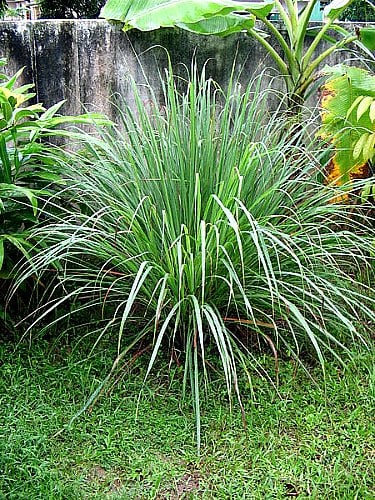
As I started researching for this post I was very surprised to learn that the so-called “citronella plant” is not the plant that produces citronella oil – the active ingredient in citronella candles. The picture above shows the citronella plant; also called Pelargonium citrosum. This geranium is unrelated to the true citronella. Not only that but the scientific name of the plant is not even recognized as a valid name. It is a geranium (ie Pelargonium) and it sort of smells like citronella. It even has some of the same aromatic chemicals found in citronella, but it is a different plant.
But does it work? Testing shows that it does not repel mosquitoes. In fact, mosquitoes seem to enjoy sitting on the plant. For more details see Mosquito Plant, Pelargonium Citrosum – The Citrosa Plant.
What is the Real Citronella Plant
Citronella oil is extracted from various species of lemongrass (genus Cymbopogon – say that name 3 times fast!). This is a perennial clumping grass that grows to a height of 6 feet. It is not frost hardy.
Does Citronella Control Mosquitoes?
So much for botany – does the real citronella plant or the oil work?
Let’s first consider the plant itself. If the aroma from the plant wards off mosquitoes, then this would only work for you if you are sitting in or right next to the plant. The reality is the amount of chemicals given off by plants is very small. You will smell them most when you brush against them or you crush a leaf. Growing the plant will have almost no effect on mosquito control.

Research in North America has confirmed that citronella oil is effective and the oil is registered as an insect repellant in the US. Studies in the EU failed to validate its effectiveness and they have banned the product as an insecticide. We must conclude from this that “we don’t know if it works”, but if Europe can’t find any evidence that citronella oil works, I tend to be skeptical.

If it does work, it does need to be applied frequently – at least every hour.
Citronella oil is a natural product – a good ‘organic product’. Keep in mind that it is also 2 times more deadly than Roundup. Both products are relatively safe, but it is important to understand that this organic solution does have a risk. How toxic is citronella oil? One way to measure toxicity is to measure the LD 50, in this case, the LD 50 on rabbit skin. It turns out citronella oil has a value (4700 mg/Kg) and DEET is (4280 mg/Kg). Both have similar toxicities and both are very safe.
You might also be interested in this post: Mosquito Repellents That Work Against Zika Virus
What About Citronella Candles – Do They Keep Mosquitoes Away?
This is a myth. The amount of oil in candles is extremely small and citronella candles don’t work any better than regular candles – neither works well.
Correction: The above statement was the initial entry in the post. It is not quite correct. Work at the University of Guelph tested citronella candles. In a 5 minute period subjects received 6, 8, and 11 bites for citronella candles, regular candles, and no candles, respectively. Citronella candles were marginally better than regular candles and reduced bites by half compared to using nothing. So they work, a bit, but I don’t consider 1 bite a minute as satisfactory. Deet is much more effective.
Fragrant Plants and Mosquitoes
There are lots claims that fragrant plants such as catnip, citronella grass, beebalm, marigolds, lemon balm, lavender, geraniums, thyme, wormwood, rosemary and various mints, repel mosquitoes in the garden. Do they work? I’ve reviewed this in Mosquitoes Repelled By Fragrant Plants.
What Did the Voyageurs Do About Mosquitoes?
The voyageurs were responsible for exploring much of North America for the white man. They traveled through the wilderness with few comforts of home. A million black flies and mosquitoes and no DEET! Just think about that. What did they use? One source, The Voyageurs, suggests that the best repellant was a mixture of bear grease and skunk urine. I guess that after collecting the skunk urine you smelled so bad that even the bugs stayed away. Another source suggests that spruce bows tied around the neck are of some help. I have spent a lot of time in the wilderness and have tried the spruce boughs – I’ll stick to DEET.
What Does Work for Mosquitoes?
You will see from the above list that most mosquito repelling devices either don’t work, or work in a very limited way. So how do you keep mosquitoes from biting?
DEET and Picaridin are still your best choice for both safety and efficacy.
Here are some other posts that might interest you.
Mosquito Repellents – Best Options
Mosquito Repelling Devices – Do They Work?
Mosquito Apps for Your Smart Phone – Do They Keep Mosquitoes Away?
Mosquitoes Repelled By Fragrant Plants
Mosquito Repellents That Work Against Zika Virus


What an interesting article. I live in Alaska where often times the mosquito is called our state bird. Our little vampires, here, are mostly deterred by several layers of Deet but when out in the bush, camping or elsewhere for tables or when holding still we’ve found that citronella candles and coils do deter the mosquitos and swamp flies to some degree. I’ve also used apple cider vinegar on the skin which has a slight repellant effect but better for puski burns. Even after reading the article and comments I can’t see anything not worth trying and imagine different repellents work better in different locations despite generalized opinions.
I doubt that different repellents work much differently in different areas. But there are many species of mosquitoes and only a couple of species are used for testing – usually the ones that are most responsible for transmitting diseases. Other species may react differently.
Robert, Your a man of doubt! LoL!! If I get a chance I will attempt to collect evidence of citronella deterrent via photo or video.
I’ve just recently planted a number of various so called insect repelling herbs around my decking area. I’m new to gardening. We had our first meal out there yesterday. We don’t get that many mosquitoes in the UK, but as soon as there’s food you’ll get flies. I placed a lemon verbena on the dinner table, well as being surrounded by other strong scented herbs, and guess what! Hardly a fly came to touch our table. As for mosquitoes I’ve yet to see. I myself wasn’t sure whether it’s a myth or fact, but wanted to try out insect repelling plants. Not only are they attractive and useful, but they seemed to do the job I got them for.
Ok I drank the cool aid and bought a citronella plant. Good news it’s very pretty . Now, when does it bloom or what do,I do to make it bloom would like to enjoy the flowers while swatting the mosquito . Any tips on odorous ants?
Thank you for researching this! We planted “citronella” plants purchased from Lowes last summer & they did absolutely nothing to repel mosquitos- now I know why!
I don’t know where you live, but I live in Ft. Worth Tx. and the Citronella plant is a staple around my house, it absolutely works, keeps mosquitoes away from my patio, we sit outside without a problem. I love my citronella plants, and by the way, before I got the plants, yes we had mosquitoes.
Without proper testing your observation is just anecdotal.
https://www.gardenmyths.com/tag/anecdotal-evidence/
How much ground cover or any other vegetation do you have around your patio area in Ft Worth?
I am not sure what kind of scientific tests would please you. If I told you I planted lemon grass in my front yard but not in my backyard, and found there to be much more mosquitos in the backyard…..you wouldnt believe me. You have your opinion and I have my knowledge.
A scientific study published in a peer reviewed journal would be convincing.
What you describe is not scientific since there are no controls, no replicates and no data. This type of evidence is call anecdotal. You can read more about its value here Anecdotal Evidence – Not Worth The Screen It is Written On.
What you have is not knowledge – it is a belief based on anecdotal evidence. You can find people who believe every side of every issue based on this.
Robert Pavlis: So when a scientific paper is written it cannot be wrong according to what you write. If it’s proven science then it’s true.
How wrong you are! Science is proving itself wrong on many levels on a daily basis.
Let’s face it, even Darwin’s Theory is still only a theory and is not backed by one shred of evidence that we descended from apes.
Where did I say a scientific paper is never wrong??
Darwin’s theory has many examples showing that it is right, including modern day DNA analysis.
https://www.gardenmyths.com/science-not-know-everything-conundrum/
I certainly believe you Enzo.
maybe it just means mosquitoes like your backyard, with or without any lemongrass. You can’t make a comparison with completely different environments
I have both growing in my garden.Neither of them have a strong smell until you break them open. Also a whole lot of Ponds in the neighborhood at the bottom of Alabama. Mosquitoes love water stagnant water even better
I have tried everything known to man to combat mosquitoes.
Foggers, citronella plants, citronella candles, bug zappers, sprays.
I think the only things that came remotely close to repelling
the mosquitoes was smoke.
I sprayed the perimeter of my patio with industrial strength
garlic oil, but I do not think that even worked (it actually made
me hungry).
So on that note, just go to the beach or your local cantina (bar) for
the summer and resume outdoor enjoyment come fall.
I live in West Africa in a malaria zone. I am looking for something to plant in our back yard around the patio that will deter Mosquitos. For obvious reasons, I won’t rely on this, but to minimize the bugs might help those who do not use other repellents (ie locals). Thanks
Citronella won’t help much.
The references in my blog post Mosquitoes Repelled By Fragrant Plants talk about plants native to Africa, and some of them did repel mosquitoes.
It’s a shame so many people are unwilling to use their own powers of observation. Scientific research is based on observation, statistics and interpretation. Unfortunately for us, interpretation is often influenced by factors such as funding/marketing-intent, and human beings seeking to increase their social status by “discovering” something new.
Whether your blind-faith is given to religion or to science, unless you are the scientist conducting the experiment you are accepting someone else’s word as truth; data interpreted through their environmentally-conditioned eyes. When you stop using your ability to think critically, you easily accept the opinions and perceptions of others, and since perception is reality (at least to us individually) you are no longer in control of the life you experience.
I apologize that this post is off-topic, I just think far too many people blindly follow the science-god, forgetting that most science is funded by business not for the advancement of science or the good of mankind, but as a marketing tool to sell more product.
Humans have been on this Earth for some time now, and have presumably been forced to deal with mosquitoes for all of history. Since most bug-repelling products sold in stores today have not been around long enough for long-term health effects (I’m talking generational) to be studied, I’ll stick to the “traditional” means effectively used by humans for thousands of years.
I’m off now to conduct a personal scientific experiment on the effectiveness of lemongrass to repel mosquitoes, at the very least my yard will smell nice. For those of you willing to accept my personal scientific observations, burning cedar and/or covering yourself in the smoke has been a good mosquito deterrent for me and many human beings for a very long time.
Mindfulness is freedom. May we all become more mindful beings.
Going further off-topic (sort-of):
Only faith in religion is “blind”. Whenever religon doesn’t explain something, religious folks will make up something off-the-cuff to explain it or re-interpret whatever’s in a religious text to try and explain it or simply say “the lord works in mysterious ways. you just have to have faith that there’s an answer/it makes sense, even if there isn’t/it doesn’t”
Science (and I’m talkking about real science, not “junk science” by spin doctors) doesn’t do this. If results are as expected, this is reported. If results are not as expected, this is reported. If results are unhelpful / don’t seem to explain anything, then this is reported. Whatever the result – it gets reported. Scientists don’t go around making up creative and fanciful stories about spirits in the sky and other such nonsense when (current) science reaches it limits.
There’s no “science god”. Just data and set (mathematical) methods to assist in understanding that data in a statistical way.
Mistakes and/or misinterpretations happen in science — even with absolute adherence to scientific methodology. But here is where you see another key difference between science and religion: when science makes a mistake and it is uncovered/discovered, it gets reported (again, I’m talking about REAL science and ethical scientists). Example: when antinausea medication commonly given to pregnant women back 40-ish years ago was found to cause limb deformity in fetuses/babies, the “medical/science world” reported this finding and the medication was no longer used. But what does religion do whenever a contradiction is found in religious texts? or when a religious leaderdoes or says something that isn’t quite kosher? Or when various religions simply disagree? (clearly, someone is WRONG in many of these disagreements) — Religion simply digs its heels in and explains all of it away, as per usual.
Please don’t compare science to religion. The only commonality between the two is, perhaps, the level of fidelity you find in its staunchest “followers”.
I don’t understand why people who live their live by anecdotal evidence even care what science says? Go use your erbs and ointments and magical shavings from unicorn horns. Whatever pleases you. But why argue science? Just do whatever you want. As a fan of science, I can tell you that I haver never “dabbled in” researching religious texts or folklore (or anything else subjective, like the testimonials of random strangers) in an attempt to supplement my knowledge or understanding of something. Either science is able to provide a likely answer/explanation or we just don’t know (yet).
I’m fine not knowing (rather that than superstition and fantasy).
Oh dear, Jacy Poo,
The conclusions of science are nearly always tentative, in the sense that tomorrow we will know more than we do today, but only so long as we are OPEN to the things we have yet to learn. In other words, a scientist isn’t arrogant about what our best knowledge is today. (And probably best not to be arrogant about those things about which it is clear to everyone else that one knows nothing. Theology and philosophy, for example.)
It’s possible that you, like most people for the last half century, are tracking your cholesterol numbers, regardless of the fact that a very high percentage of those who die of CVD have low cholesterol. And would you be surprised to learn that women with high cholesterol live longer? The cholesterol hypothesis, as the Minneapolis Star Tribune said a couple years ago, is the story of how bad science became federal policy. When I found this web site I immediately thought of the Teicholz book, The Big Fat Surprise, because as the Kirkus Reviews says, it “tracks the process by which a hypothesis morphs into truth without the benefit of supporting data.” And that is what Robert Pavlis is doing here on this site, for a different set of topics!
.
There are far-reaching, sometimes disastrous effects for arrogant “scientific” myth-making. The biochemist and honored nutritionist, David Kritchevsky, was one of many scientists who came up against the un-scientific POWER of the National Academy of Sciences and the National Institutes of Health many decades ago for suggesting that dietary fat standards should be changed. He and many others were persona non grata in professional societies, unable to rise in their occupations, excluded from scientific panels, cut off from grants, and unpublished in journals, all because they had a different opinion or set of conclusions — even though, as must be admitted forty or more years later, THEY WERE CORRECT. Far beyond careers being ruined, the health of millions of people have been adversely affected, to the point of death, because arrogance, aided by intellectual laziness, power, the desire for fame, greed, and simple herd instinct, overwhelmed the often besmirched IDEAL of science.
So, Jacy Poo, I’ll use mostly your own words, in the hope that you’ll think about this more than FIFTY-YEAR long “scientific” experiment on the American people, motivated and perpetuated entirely by FAITH in the “science” that was drummed into the heads of the populace:
“Only faith in [science] is “blind”. Whenever [science] doesn’t explain something, [scientific] folks will make up something off-the-cuff to explain it or reinterpret whatever’s in a [scientific] text to try and explain it….But what does [science] do whenever a contradiction is found in [scientific] texts ? Or when various [scientists] simply disagree ? [Scientists] simply dig in their heels….”
How many docs do you know that aren’t still pushing this “theory” ?
Interested folks may see a five page summary of this stubborn and health-damaging “scientifically” driven behavior at:
Dietary cholesterol, heart disease risk and cognitive dissonance; Proceedings of the Nutrition Society, Volume 73, Issue 2;
May 2014, pp. 161-166.
Best to all in your searches.
Well stated Strawberry!
Well said Drew
DEET does work and is safe. Picaridin also works. http://npic.orst.edu/factsheets/PicaridinGen.html
Try offering another solution such as catnip its 10 times more effective than Deet as a mosquito repelant or atleast that’s what a study found in 2010.
Don’t believe everything you read. I believe the study was from 2001 and it only tested catnip in the lab – not in a real world situation. The claim of being 10 times more effective than Deet is ridiculous. Deet is already 90% effective. How can a different product be 10 times more effective than this??
The authors are playing with words. What they found was that less catnip was needed to move the same number of mosquitoes from the treated end of a tube to the non-treated end of a tube. They did not study how the catnip extract worked on humans to repel mosquitoes. They did not determine if there are any side effects of having catnip extract on skin – does it irritate the skin, for example.
I could only find one obscure product that contained catnip, and it contained 3 other active ingredients. I guess the catnip alone is not that effective?
I was not able to find a study that tested catnip in real world conditions. If you have such a study I would like to see it.
You often mention science and scientific evidence. Science is only as good as people studying it and gets better when reviewed by others. The experiment mentioned here which is done at University of Iowa is an example when a poorly set-up experiment caused 100% wrong conclusion and is so funny that no other scientific body wanted to touch the subject. Meanwhile uncontested bombastic results propagated internet and became a topic of 1000’s of blogs.
Here is another take on this experiment: A small test tube is simply not suitable for testing effectiveness of DEET because of it’s high vapour pressure and high effectiveness at very low levels. The entire interior of the tube was quickly contaminated with DEET beyond of what mosquitoes can detect as a small or a large amount. For poor mosquitoes it was all same so they decided to stay put as their senses weren’t able to detect a gradient towards cleaner less toxic area. For catnip oil tube, however, it was obvious they were able to detect gradual change from toxic air to clean air along the tube so they moved towards the cleaner side. So this experiment seems to have two 180 degrees opposite possibilities and I was frankly shocked that the Phd. student and his advisor didn’t pick up on it and proceeded with other tests. I mean, this is not a pharmaceutical experiment with some astronomical costs in millions of $$$, how really expensive and hard would be for them to play with it a couple of more days to check out validity of their findings. What you mentioned is correct, a real environment test would be appropriate.
Very interesting. Is this analysis of the experiment published on line anywhere?
Was the original work by the University of Iowa ever published?
Citronella is not an insecticide – it does not kill insects of any kind unless you drown them in a bucket of it. So, is it surprising that it is not an approved insecticide in Europe? Numerous scientific studies have shown citronella, in plant form and/or as a wax or liquid candle, to be as effective as other insect repellents. It is safe (and effective) to spray the dilute oil on clothing or bare skin to ward of many flying and crawling insects.
DEET is more effective but much much more dangerous for people and the environment – read the labels. No such labels on citronella candles, oils, or concentrates. However, NO repellent is 100% effective.
Sorry, but you are way off base on this one.
Deciding if citronella is a pesticide has more to do with how it is used, and not if it is effective. If it is marketed as a insect repellent, than in Canada and the US it is considered to be a pesticide, ie an insecticide.
The studies have shown that citronella in plant form have no effect, and in candles has limited effect. You might want to read the reference in my post.
DEET is accepted by many health organizations as being safe. In fact most of them still recommend DEET as the most effect solution to combat mosquitoes. DEET has been used for many years and has been extensively studied, and results have found no serious health issues. Citronella oil has not been used as long, and has not been studied as thoroughly.
Here is what the MSDS (material safety data sheet) says about Citronella oil: “Very hazardous in case of contact with skin, or eye contact. Hazardous in case of inhalation.Carcinogenic effect: not available, mutagenic effects: not available, Developmental toxicity: not available” So we don’t know if citronella is carcinogenic, or causes developmental problems – how can you say it is safe?? Quote is from http://www.google.com/url?sa=t&rct=j&q=&esrc=s&source=web&cd=1&ved=0CB4QFjAA&url=http%3A%2F%2Fwww.sciencelab.com%2Fmsds.php%3FmsdsId%3D9923497&ei=HKZXVcGABoisyQSMv4HIDA&usg=AFQjCNGMXqAqZjq003i3V0uTkS4WlNLuLQ&sig2=A9024PXeMJYS9cAEJ23jcw&bvm=bv.93564037,d.aWw&cad=rjt
LOL this is funny. Here in my place lemongrass which produces citronella oil is soaked in a boiled water to make tea. The plant is also used as food condiments.
Very interesting. What country are you in?