

Mosquitoes are becoming a more important pest as new varieties move north in North America, and the incidence of diseases increases. Around here there is a big concern about the West Nile Virus so it is only natural that people try to find simple ways to keep mosquitoes away.
A very common solution is citronella. Some suggest planting the citronella plant next to your patio to keep mosquitoes away. Others rely on citronella candles. These solutions are just myths.

What is the Citronella Plant?
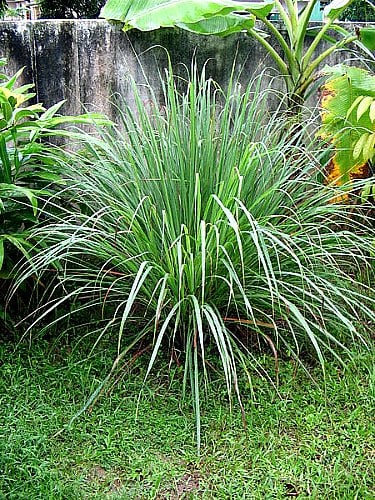
As I started researching for this post I was very surprised to learn that the so-called “citronella plant” is not the plant that produces citronella oil – the active ingredient in citronella candles. The picture above shows the citronella plant; also called Pelargonium citrosum. This geranium is unrelated to the true citronella. Not only that but the scientific name of the plant is not even recognized as a valid name. It is a geranium (ie Pelargonium) and it sort of smells like citronella. It even has some of the same aromatic chemicals found in citronella, but it is a different plant.
But does it work? Testing shows that it does not repel mosquitoes. In fact, mosquitoes seem to enjoy sitting on the plant. For more details see Mosquito Plant, Pelargonium Citrosum – The Citrosa Plant.
What is the Real Citronella Plant
Citronella oil is extracted from various species of lemongrass (genus Cymbopogon – say that name 3 times fast!). This is a perennial clumping grass that grows to a height of 6 feet. It is not frost hardy.
Does Citronella Control Mosquitoes?
So much for botany – does the real citronella plant or the oil work?
Let’s first consider the plant itself. If the aroma from the plant wards off mosquitoes, then this would only work for you if you are sitting in or right next to the plant. The reality is the amount of chemicals given off by plants is very small. You will smell them most when you brush against them or you crush a leaf. Growing the plant will have almost no effect on mosquito control.

Research in North America has confirmed that citronella oil is effective and the oil is registered as an insect repellant in the US. Studies in the EU failed to validate its effectiveness and they have banned the product as an insecticide. We must conclude from this that “we don’t know if it works”, but if Europe can’t find any evidence that citronella oil works, I tend to be skeptical.

If it does work, it does need to be applied frequently – at least every hour.
Citronella oil is a natural product – a good ‘organic product’. Keep in mind that it is also 2 times more deadly than Roundup. Both products are relatively safe, but it is important to understand that this organic solution does have a risk. How toxic is citronella oil? One way to measure toxicity is to measure the LD 50, in this case, the LD 50 on rabbit skin. It turns out citronella oil has a value (4700 mg/Kg) and DEET is (4280 mg/Kg). Both have similar toxicities and both are very safe.
You might also be interested in this post: Mosquito Repellents That Work Against Zika Virus
What About Citronella Candles – Do They Keep Mosquitoes Away?
This is a myth. The amount of oil in candles is extremely small and citronella candles don’t work any better than regular candles – neither works well.
Correction: The above statement was the initial entry in the post. It is not quite correct. Work at the University of Guelph tested citronella candles. In a 5 minute period subjects received 6, 8, and 11 bites for citronella candles, regular candles, and no candles, respectively. Citronella candles were marginally better than regular candles and reduced bites by half compared to using nothing. So they work, a bit, but I don’t consider 1 bite a minute as satisfactory. Deet is much more effective.
Fragrant Plants and Mosquitoes
There are lots claims that fragrant plants such as catnip, citronella grass, beebalm, marigolds, lemon balm, lavender, geraniums, thyme, wormwood, rosemary and various mints, repel mosquitoes in the garden. Do they work? I’ve reviewed this in Mosquitoes Repelled By Fragrant Plants.
What Did the Voyageurs Do About Mosquitoes?
The voyageurs were responsible for exploring much of North America for the white man. They traveled through the wilderness with few comforts of home. A million black flies and mosquitoes and no DEET! Just think about that. What did they use? One source, The Voyageurs, suggests that the best repellant was a mixture of bear grease and skunk urine. I guess that after collecting the skunk urine you smelled so bad that even the bugs stayed away. Another source suggests that spruce bows tied around the neck are of some help. I have spent a lot of time in the wilderness and have tried the spruce boughs – I’ll stick to DEET.
What Does Work for Mosquitoes?
You will see from the above list that most mosquito repelling devices either don’t work, or work in a very limited way. So how do you keep mosquitoes from biting?
DEET and Picaridin are still your best choice for both safety and efficacy.
Here are some other posts that might interest you.
Mosquito Repellents – Best Options
Mosquito Repelling Devices – Do They Work?
Mosquito Apps for Your Smart Phone – Do They Keep Mosquitoes Away?
Mosquitoes Repelled By Fragrant Plants
Mosquito Repellents That Work Against Zika Virus


http://www.ncbi.nlm.nih.gov/pmc/articles/PMC3059459/
This study/review of studies concludes citronella oil is as effective as deet, dose for dose, as well as looking at other potentially useful products. It also concludes citronella candles reduce bites by 50%, which is significant since it is not topically applied and results in no/little absorbtion into the skin (or via lungs) and eliminating many risk factors associated with applying chemicals to the body. The risk factors of DEET to humans and as a water pollutant after washing it off of plants or a human body are well known, as illustraded in the study linked a few comments upward.
It also furthers the point that cherry picking minimal studies instead of a broad spectrum study can prove any hypothesis correct, including my own, albeit that future studies will disprove this and others will prove it further. Although it is safe to say that the citronella variety of geraniums produce no repellant effect, but hey, they do smell nice.
Thanks for the good read.
Thank you so much for your comment and the reference.
One has to be careful of metadata studies such as this where they look at many papers. Setting the wrong criteria, or including non-peer reviewed research can lead to very incorrect results. Having said that, this study does seem to have done a good job. Most of the references are from respectable journals.
Citronella candles do reduce bites by 50% as this study, and my posted reference says. Is that significant? I guess it depends on how many bites you find acceptable. If I was trying to avoid malaria or west Nile, even 1 bite is not acceptable. Getting 1/minute instead of 2/minute is also not acceptable to me.
The risk factors of DEET to humans is extremely low. DEET is considered safe by many public health authorities and organizations, including the Centers for Disease Control and Protection (CDC), the Environmental Protection Agency (EPA), the American Academy of Pediatrics, and WHO. (http://www.medicaldaily.com/four-best-bug-repellents-deet-ir3535-picaridin-oil-lemon-eucalyptus-most-effective-says-ewg-247785).
Citronella oil, applied directly to skin is effective as you point out. But it is not effective for a long period of time. Your reference suggests it works for 2 hours, most other reports recommend it for only 1 hour–this may improve in future formulations. It is interesting that your reference, which is medically based, concludes that “for the time-being travellers to disease endemic areas should not be recommended citronella-based repellents”.
I live in western Washington State. Mosquitos are a problem at various times. I’ve found that putting a couple citronella candles on the edge of my hot tub keeps them away while I’m sitting out there. I’ve read that it’s the CO2 which we exhale that attracts them. Is it possible that the citronella smell hides the CO2, so they don’t know we’re there?
The study I quoted indicated that “Citronella candles were marginally better than regular candles”. I don’t think mosquitoes like the smoke. As a long time camper, I have always noticed that when we got good and smoky around a camp fire, we were less attacked by mosquitoes.
I doubt that citronella hides the smell of CO2. CO2 has no odor and mosquitoes must have a different way to recognize it–just guessing at this. It is interesting that anything burning, eg candle, fire, produces CO2 as part of the combustion process. You’d think that if they were attracted to CO2, that they would head for the candle or fire, not move away??
The study you quoted said, and I quote: “the overall reduction in bites provided by the citronella candles and incense was only 42.3 and 24.2%, respectively.”
42.3% reduction in bites is not insignificant. It’s not as effective as I thought/expected it would be, but cutting something nearly in half is not “insignificantly” reducing it.
I don’t believe the study looked at incense? Your conclusion is correct. How significant is it–I guess that is a judgement call. Reducing bites by half still means a lot of bites and you only need one bite from the wrong mosquito to catch a disease.
“have always noticed that when we got good and smoky around a camp fire, we were less attacked by mosquitoes.”
Interesting that you provide anecdotal story and dismiss others as not scientific. While I favor scientific evidence I don’t think one should close their minds to the idea that a scientific study can be poorly designed or exaggerate its application.
For example, if a citronella candle or intense burns for an hour is it more effective than if it burns 5 minutes? What if conditions are windy? Under what conditions provided 40% reduction?
Which anecdotal story?
I don’t agree with these findings. We have two grandkids that mosquitoes love. When they come to visit in the AM the mosquitoes would fly in queue to get a taste of their delicious young blood. We started using the citronella candles, about 1/2 hour before the kids arrive, and the mosquitoes are gone. I don’t know if its the smoke or the actual citronella smell that made then scram but they are gone.
Unfortunately, such anecdotal evidence does not change the scientific facts. The data I present in this blog is based on scientific research done with proper controls. The reference I added does show some effectiveness of citronella candles, but certainly not complete control.
The proof is in the pudding!
I live in south Louisiana and hunt / fish in the swamps and marshes. The best thing that I have found to work against the bites is Avon Skin So Soft. I don’t use it much while hunting because of the scent it puts off, but fishing or working in the garden is great to keep the blood suckered off of you.
For patio areas, I found that burning pinion wood in a pit is about the best.
Where do we get “pinion wood”? I live in south florida & we are plagued with skeeters!
If you Google you will find quite a few suppliers. Lowes seems to sell a brand of pinion wood.http://www.lowes.com/pd_88219-15892-PINON+WOOD_0__?productId=3471377
I also looked for someone who has tested pinion wood for combating mosquitoes, but did not find a reference. As it burns it does give off smoke, as well as a pine-smell; both of which work as weak mosquito repellants, so I suspect pinion wood works to some extent. Is it better than other kinds of wood?? I’ll keep looking for a reference.
How do you take care of the plants in winter, do they come back in spring? Do they live all year round?
Which plants are you interested in growing? what zone do you live in?
Deet is not safe
http://www.nlm.nih.gov/medlineplus/ency/article/002763.htm
If the research you refer to is so plentiful, it would be easy to cite.
I never said DEET is safe.
What I said is “One way to measure toxicity is to measure the LD 50, in this case the LD 50 on rabbit skin. It turns out citronella oil has a value (2000 mg/Kg) that is 2 times lower than DEET (4280 mg/Kg). That means DEET is less toxic than citronella oil, to the skin of rabbits. A value of 2000mg/Kg is a very high number which means booth products are quite safe.” I provided the references for the values in the post.
The FDA considers DEET to be a safe product:
I live in mosquito country. Seriously it’s a way of life here abd with 2 kids, i’m always in fear if both mosquitos and DEET. Been using inswct repelent with active ingredient called PICARDIN , as effective as the DEET option and less harmful.
Picardin is certainly a good alternative, however, you might be overly concerned about DEET. According to medical Daily, DEET is considered safe by many public health authorities and organizations, including the Centers for Disease Control and Protection (CDC), the Environmental Protection Agency (EPA), the American Academy of Pediatrics, and WHO. Picardin is just as effective as DEET, does not seem to have health concerns, but it has not been tested in the field for nearly as long as DEET.
Robert I for one, wish to thank you for your diligence in research and desire to educate by sharing your findings. I don’t all at mind checking behind you and must say… your findings are quite credible. You have in my opinion, shown humor regarding those who wish to purchase dragonflies as well as grace to those skeptics who’ve failed to do their own research… I am what is known as a host(ess) for most insects and DEET is the way I get through life. Thanks…
Good read. But the burning question is does anyone know the most effective way to keep the blood sucking pests away from ones yard and patio safely?
Good Question. I think it is really two questions; how do you keep them away from your yard, and secondly is a working method safe?
I don’t think there is a good way to keep mosquitoes away, short of enclosing the area. Mosquito machines and light zappers don’t work well. Any kind of spray, candles, etc that puts something in the air gets blown away by the wind. Deet, applied to skin is still the most effective option.
Is Deet safe? I have not done extensive research on this question, but it is considered a relatively safe product. I think it is as safe as many of our home cleaners–my opinion. I spend most days in the garden, and when the bugs are really bad I use it. I use the liquid rather than the spray, since most of the spray is lost and sprays are not good for the environment.
There have been controlled studies in the use of lemon grass oil as a repellent for stable flies and Mosquitos and the results conclude that lemon grass oil is an effective repellent against the pests
By ‘lemon grass oil’ I assume you are referring to citronella oil since lemon grass is the common name of the plant used to extract the oil. As the post says, research in North America does confirm it works, but reports from Europe disprove these findings. In science a fact is not a fact unless the research can be repeated.
The following reference was done in the field and does show some relief from mosquitoes by reducing the number of bites in half. Subjects got more than 1 bite a minute using citronella candles vs 2 without. Not nearly as effective as Deet.
As a lotion some studies have shown greater protection:
http://www.doi.gov/greening/procurement/upload/waysToBeatDEET.pdf
If you have references to newer studies, they would be of interest.
Born in mosiquito counrty the most natural way to control these blood suckers is with Dragon flyies.
Can you purchase dragon flies? I love them and if they eat mosquitoes … even better!
I have never seen dragon flies for sale. Even if you could buy them, they would not stay on your property. Just like other insect such as lady bugs, they fly away fairly quickly. Buying beneficial insects only works in closed quarters like a greenhouse.
Not entirely true. Predators will stay in an area until the prey falls below a level that will sustain them. You are right though about dragon flies – they are just too mobile, and can cover a large distance in a short time. Ladybugs are better, but still able to move quite a distance in a short time, however there are other species – for instance parasitic wasps – that are very small (1/2 mm long), and because of their size, don’t move large distances quickly (unless there is a breeze blowing!!!!)
It is well documented that ladybugs don’t stay long, even if there is food around.