

Is fish fertilizer better than a synthetic fertilizer like Miracle-Gro?
If you read the advertising for fish fertilizer, you might conclude that it will grow much better plants, but those same products don’t show you any data to support the claims. Where is the proof?
I decided to run my own test to see if fish fertilizer grows bigger tomato plants.
Key Takeaways
- Fish fertilizer did not grow statistically better plants.
- The extra cost of fish fertilizer can’t be justified based on growth.
This post uses affiliate links
Fish Fertilizer vs Miracle-Gro
Lots of people use fish fertilizer, thinking that it is a better product. I went looking for some research that validates this fact, and was very surprised that I could not find a single study that tested a commercial product.
I reached out to Neptune’s Harvest and had a meeting with Ann Molloy. She confirmed that they did not have any scientific studies to show their product is better than synthetic fertilizer. I also reached out to Alaska Fish Fertilizer and a Canadian manufacturer called Acadie; neither had studies supporting their claims.
The companies make numerous claims, but all they have to validate them is anecdotal data, which we know is not “worth the screen it is displayed on“.
So, I decided to do some testing myself.
My Experiment Setup
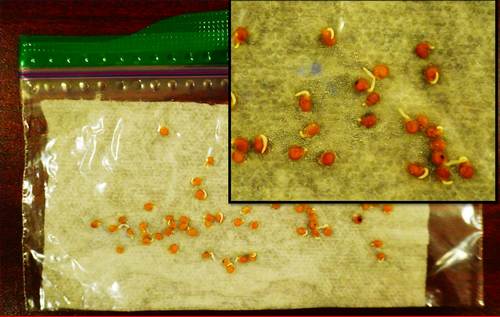
I started a bunch of tomato ‘Roma’ seeds using my standard baggy method. It is a great way to start all seeds, and it makes it easy to know you are sowing germinated seed.
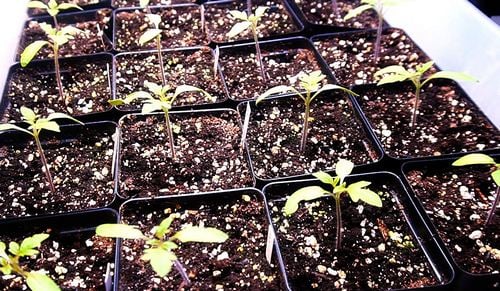
Twenty 3.5″ square pots were filled with my standard ProMix HP potting media. A germinated seed was planted in each pot. In a couple of days, they were showing above the soil line.

The pots were put under a MetryGrow 100W LED grow light. It produced 8,000 lux (PPFD of 120) at soil level, set in veg mode, for 16 hours, at 50%. The light amount was quite constant across all pots, but to ensure that all plants received equal lighting, they were shifted around every couple of days, so each plant spent some time under the center of the light.
The plants were split into 2 groups at the time of planting to eliminate any bias on my part. One-half received fish fertilizer and the other received Miracle-Gro; both mixtures were made up to a 100 ppm nitrogen level, as calculated by the PPM Fertilizer Calculator.
Fish Fertilizer: Acadie hydrolyzed fish fertilizer, made by Acti-Sol, was used, with an NPK of 2-4-0.5.
Synthetic Fertilizer: Miracle-Gro 24-8-16 water-soluble fertilizer.
Pots were watered with fertilizer solution, as needed, starting as soon as the germinated seed was added. ProMix does contain some fertilizer, but the manufacturer recommends plants be fertilized soon after planting.
Plant Growth
Plants grew well during the experiment. At about the halfway mark, both groups of leaves did show some edema, which was probably caused by too much water at the roots. Leaves grew better in the second half of the experiment.
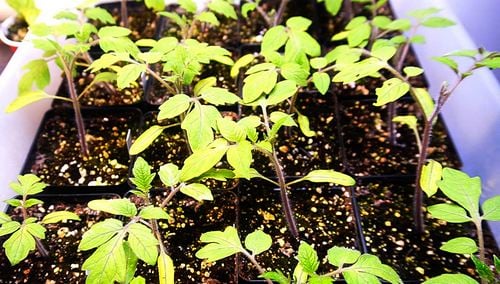
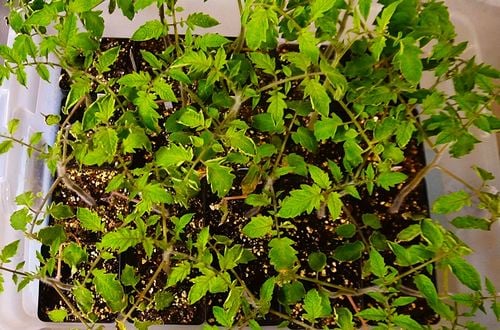
At the end of the experiment, on August 25, each seedling was cut off at the soil level. The length between the base and the uppermost branch was measured. Since the upper leaves curved to varying degrees, this seemed like a more consistent way to measure height.
In speaking to Neptune’s Harvest, they pointed out that height might not vary too much in this experiment, but that the thickness of the stem should be more pronounced with fish fertilizer. They gave no reason for this, and I don’t see why this should be the case. However, I decided to also measure the stem thickness at the base, just above soil level.
Experimental Data
Here are the results comparing Fish to Miracle-Gro fertilizer.
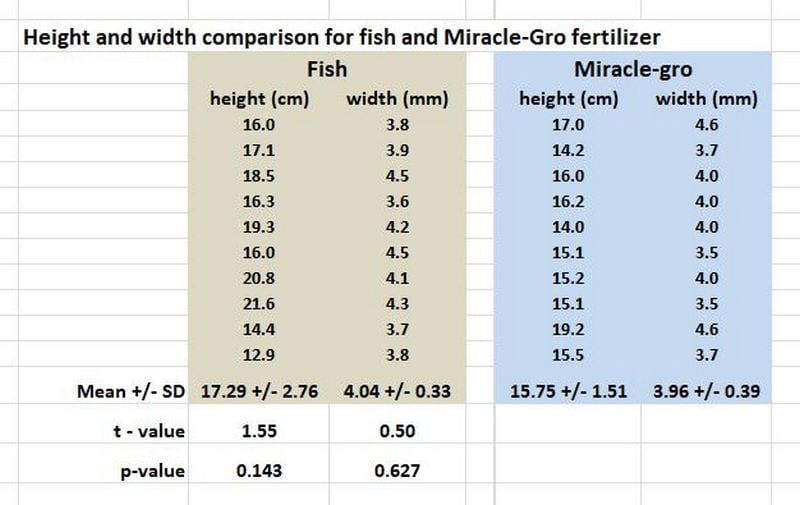
The width of the stems was the same for both fertilizers. Plants fertilized with fish fertilizer were slightly higher, but the height difference is not statistically significant at a 5% level.
Is Fish Fertilizer Better Than a Synthetic Fertilizer?
Based on this experiment, there is no significant difference in growth between the two fertilizers.
Fish fertilizer also has some “strong” negatives.
- Smell. When mixed and used fresh, fish hydrolysate fertilizer does not have a strong odor. But once it sits for a couple of days, it reeks.
- High cost. Acadie fish fertilizer is 29 times more expensive than Miracle-Gro, for the same amount of nitrogen. Neptune’s Harvest is 60 times more expensive, and Alaska Fish Fertilizer is 25 times more expensive than Miracle-Gro (prices are based on Canadian sources).
- Convenience. Synthetic fertilizer can be made up and used as needed. Manufacturers recommend that fish fertilizer be diluted fresh each time it is required, mostly to keep the smell down.
- Correct NPK ratio. Hydrolyzed fish fertilizer has an NPK of 2-4-0.5. Emulsified fish fertilizer has an NPK of 5-1-1. The Miracle-Gro fertilizer has the ideal NPK ratio for plants of 3-1-2.
- Harming the Environment. Some types of fish fertilizer are harming the environment by harvesting fresh fish from the ocean; Alaska is an example. Acadie and Neptune’s Harvest are more responsible and use leftover fish waste.
The only plus for fish fertilizer is that it is “organic”. I have looked into this in detail in Is Fish Fertilizer Better Than Compost?
Plants can’t really use organic nutrients until they are decomposed into non-organic nutrients. Some claim that the amino acids and vitamins in fish fertilizer add benefits. Plant roots can indeed absorb amino acids, and access to them should allow a plant to grow better, but there seems to be little scientific evidence that such organic sources work for cultured plants. If you have such references, please add them to the comments.
I can’t see any reason for using fish fertilizer. I’ll stick to synthetic fertilizer.


An interesting experiment. The situation in Australia is slightly different coz carp are a pest species in our rivers. Using them in fertilizer helps commercialize the removal of carp, benefiting our environment and addressing a waste disposal problem.
Agreed. Using environmentally sound fish makes a huge difference.
https://www.gardenmyths.com/fish-fertilizer-damaging-environment/
Thanks for interesting perspective and research.
Do you have any information on the chemicals used in synthetic fertilizers and where they come from?
You mention your fave potting mix. For some reason it can’t be shippped to Seattle.
Promix used to be equal parts of peat, perlite. Is that still the case? Can I use a little garden soil to kickstart the microrhyzzai? Or buy spores?
“Promix used to be equal parts of peat, perlite” – I have used it for about 30 years – it has never been equal amounts. The perlite amount is quite small – maybe 5%?
Any ground soil has mycorrhizal fungi – but it is not needed in potted plants.
Thank you, Robert,
I appreciated the information you provided and the methods you used to test the fertilizers.
I have read a lot of your posts and look forward to reading more. Please continue your excellent work.
Gary Beck
Thanks so much for all your fantastic work. Greatly appreciated. Curious why synthetic fertilizer would get your final nod? Would carbon footprint be a factor?
Lets see a comparison numbers for carbon foot print for the two products. Then we have some data to talk about. It is incorrect to assume fish fertilizer has a lower carbon foot print.
Just heard a presentation that the salts in synthetic fertilizers build up in the soil and kill the micro-organisms that breakdown nutrients to ingredients that plants can use. Your thoughts?
You were listening to someone who knows nothing about the subject.
The “salts” in fertilizer are the nutrients we want. Both synthetic and fish have these salts.
The salts DO NOT KILL microbes. Microbes depend on them for life.
“micro-organisms that breakdown nutrients to ingredients” – the nutrients are the chemicals plants need to grow – they do not get broken down into ingredients.
https://www.gardenmyths.com/salts-dont-kill-plants-or-microbes/
Thank you for conducting the test between the fertilizers & putting my mind to rest as to which was the best between the two. I automatically thought the organic fertilizer would be better but you have showed that there is very little difference as far as performance goes but a huge difference in cost. Thank you Robert for another very interesting read. Regards KD