

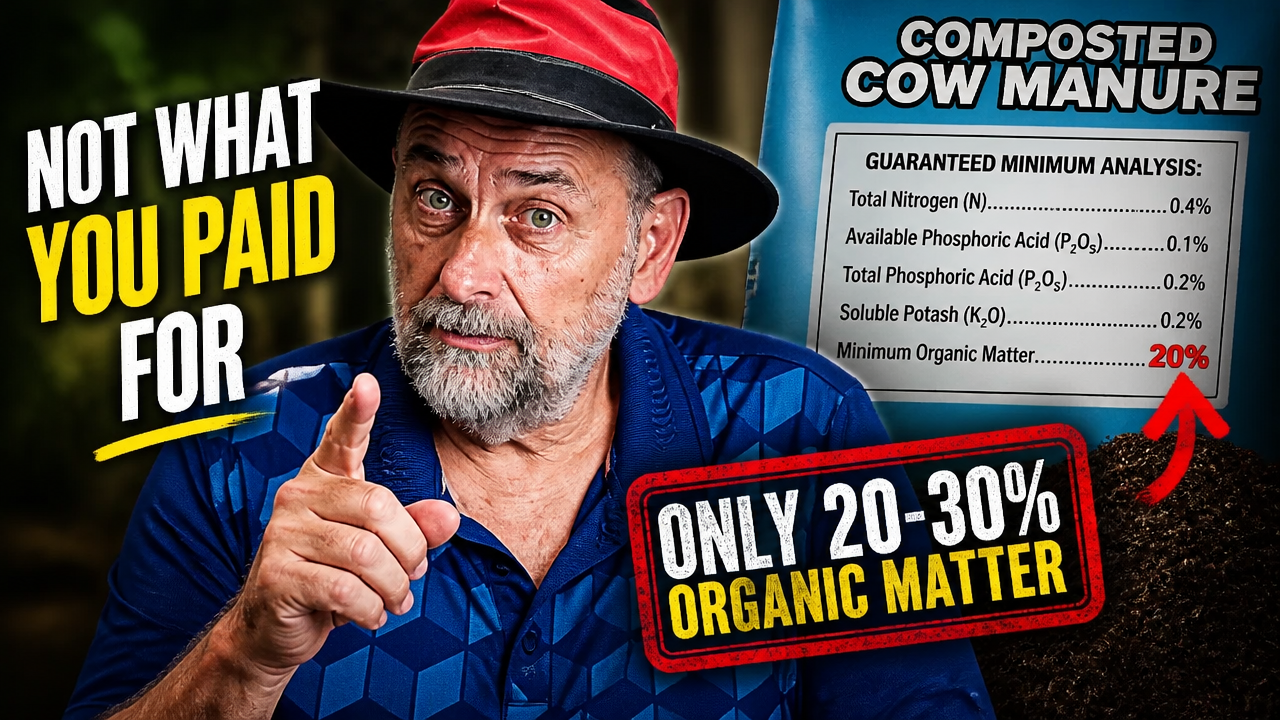
I went shopping for some compost and was surprised at what I found on the label. Most of the contents in a bag of compost are NOT compost!
Watch this post as a video: https://youtu.be/N4fTRkQJJOE
Key Takeaways
- Bags of compost are only about 30% organic matter.
- You are buying mostly water and soil.
Shopping for Compost
I went shopping for compost and read the ingredients of various lower-end products available around here (Ontario, Canada). They were all made from animal manure, including cow and sheep.
- The amount of organic matter (OM) ranged from 20% to 30%.
- The moisture level ranged from 60% to 70%.
- The weight of nutrients in a bag of compost is extremely small, and even though they are important, we can ignore them from this calculation because they are no more than 1% or 2%.
These values are the extremes. The OM is a “minimum value,” and the water is a “maximum level”. Online information suggests typical average values would be moisture at 45% and OM at 30%. What is the other 25%? It is usually soil. This means that only about 1/3 of the bag is compost. The other 2/3 are things you don’t need: water and soil.
What’s In The Organic Matter?
There are two basic components in the organic matter: composted plant material and wood products.
- Composted Plant Material: This can be composted municipal waste collected from homes or manure from animals. Manure is just partially composted plant material, so both sources are very similar and beneficial for the garden. These are the things you want.
- Wood Products: This is wood chips or shaved wood that may or may not have been composted well. There is nothing fundamentally wrong with this item, except it provides almost no nutrients to the compost. It also takes longer to fully compost than composted plant material, which already takes about 5 years to decompose.
If you see wood in your purchased compost, you know that it’s not even 30% compost.
Why Does Compost Have So Much Water?
I always figured that the main reason is to increase the weight, and since the product is sold by weight, it is a cheap way to increase the price. It also makes the consumer feel that they are getting a bargain when they try to lift the heavy bags. This is partially true, but there is a reason for some of the moisture. If the moisture level drops below 20%, the microbes die off or go dormant, and the product becomes intensely dusty and difficult to wet. If it goes above 60%, it becomes heavy, muddy, anaerobic, and foul-smelling. But even with a requirement for 20% moisture, it means commercial compost has about twice the amount of water it needs. What about the dying microbes? People think they buy compost to get microbes to improve their soil, but that is a myth. Your soil, even if it is crappy, is full of microbes. You do not need to add more. OM is microbe food, and it will allow your native microbes to grow and multiply. You actually don’t want to import live microbes from other places.
How to Buy Compost
When buying compost, pick a product that meets the following conditions:
- Has a high organic matter level.
- Contains no wood products
- Has a low moisture level
- Has a lower price
There are lots of high-end products that cost a lot of money and make all kinds of false promises. Products labeled “organic” are not any better than other products. Ingredients with mysterious properties, like fish meal, kelp, shrimp/crab shells, and even vermicompost, do not add extra value. All of these items are organic matter and are all about the same once they completely break down. Make your own compost or use the cut-and-drop composting method. Learn more with these other links:
Make Your Own Compost: Methods Compared
Composting Cut-and-Drop Method
Buying Real Compost
Where do you get real compost? The best place is right from the source. Drive around in the country and look for animal farms that bag their manure and sell it by the road. It may be a bit fresh, but it is the real stuff. It still contains water.


I live in Germany where bagged compost is sold by volume not weight, as Robert states, e. g. 40l, I guess water will cause volume to increase?
I go to the local recycling business where I can either deposit my garden waste , which they will compost for sale, or buy finished compost. This is normally piled up in a roofed enclosure, so it‘s usually dry.
Compared to bagged compost it costs very little depending on the mood of the guy at the exit ☺️
My company has been extracting liquid from spent mushroom compost for 15 years and sold primarily to farmers. The fungal metabolites unique to mushroom compost contain the enzymes that breakdown lignin. Added to the metabolites in the regular composting, it is considered a complete system neutralizing chemicals and feeding microbes already in soil. We have achieved world’s records in corn and soybeans. We understand the benefits of 100% compost. Wouod love to compare notes.
Post a link to the study to prove your claim.
I bought Scotts Top Soil and it was compost not dirt. It contained shredded plastic and rocks and sticks. Even some metal pieces were in it. Needless to say I was royally P.O’d!