

Nitrogen is one of the most important nutrients for plants because it is almost always in short supply. The amount of nitrogen available controls plant growth.
Synthetic fertilizer usually supplies nitrogen as urea or nitrate. Organic fertilizer supplies it as proteins and amino acids, and they claim these forms are better for plants. Which forms of nitrogen can plants use, and which is the best form for gardeners to use for growing plants?
Key Takeaways
- Nitrate and ammonium are the main forms of nitrogen used by plants.
- Plants can use urea and amino acids directly.
- Plants also seem to be able to digest proteins and then absorb them through roots, probably as amino acids.
- Organic gardening techniques don’t seem to significantly alter the amino acids in soil.
Different Forms of Nitrogen
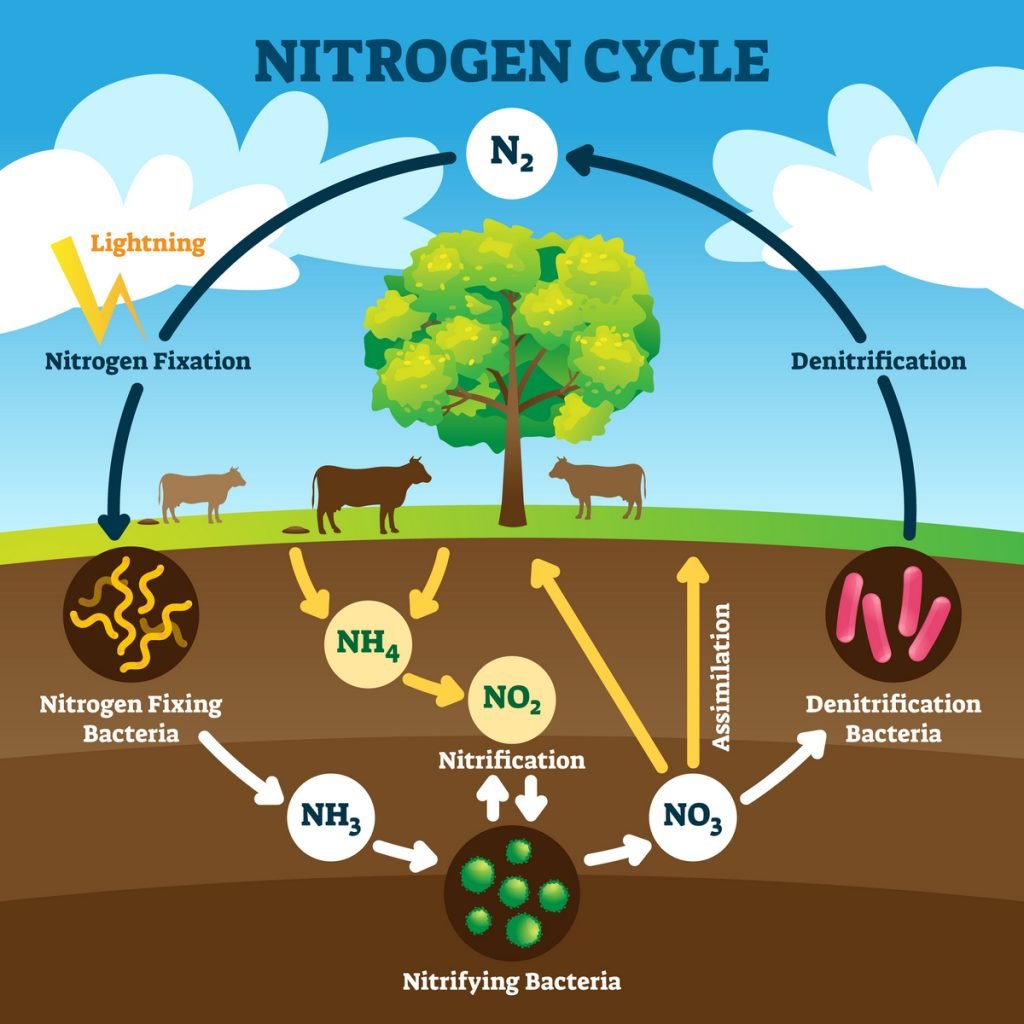
Nitrogen is available in many forms, but only some forms can be used by plants. The most common form is N2, which makes up 78% of the air we breathe. But plants can’t use this form of nitrogen.
You might have heard that some plants, like legumes, can “fix” nitrogen from the air, but that is a myth. Only bacteria and some other microbes can do that. Legumes utilize rhizobium bacteria to fix nitrogen for their use.
Inorganic forms of nitrogen include ammonium (NH₄⁺), nitrite (NO₂⁻), and nitrate (NO₃⁻). Plants can absorb ammonium and nitrate through their roots. These forms of nitrogen, as well as urea, are easily converted from one to another by bacteria in the soil.
Urea (CO(NH₂)₂) is the most commonly manufactured form of nitrogen because it is relatively inexpensive to make. Chemists consider it to be organic because it contains carbon. Organic gardeners consider it to be synthetic because it’s manufactured. Urea is also produced naturally during the decomposition of organic material, and plants produce it internally as part of their metabolism.

Nitrogen is also found in all kinds of large molecules, including amino acids, proteins, DNA, RNA, and chlorophyll. Protein contains 16% nitrogen.
Plants Use Nitrate and Ammonium
The primary source of nitrogen for plants is nitrate and ammonium. Both forms are found in fertilizer.
Nitrate is highly soluble and mobile in soil, making it readily available to plant roots. It moves with water through the soil profile. Most plants have specialized nitrate transporters that actively absorb it into roots.
Ammonium, on the other hand, is less mobile because it binds to negatively charged soil particles. Plants have separate ammonium transporters and can quickly absorb it through roots.
In most aerobic (well-aerated), neutral to slightly alkaline soils, nitrate is the dominant form of nitrogen absorbed, accounting for 70% of the nitrogen absorbed. This is because it is more mobile and more stable in oxygen-rich soils. Also, many plants show a higher affinity for nitrate, particularly during active growth.
In contrast, ammonium becomes more significant in acidic and waterlogged soil, where it is more stable than nitrate.
Some plant species, such as tea, rice, and blueberries, prefer ammonium-dominated nutrition, while corn, wheat, and lettuce tend to favor nitrate. For many crops, optimal growth is achieved with a nitrate to ammonium ratio between 2:1 and 4:1.
Can Plants Use Urea?
Yes, plant roots can absorb urea directly, but this is not the primary way plants take up nitrogen.
Urea (CO(NH₂)₂) is a small, uncharged molecule that can pass through cell membranes, and some plants do have urea transporters in their root cells to help absorb it. However, direct uptake of urea by roots occurs only in small amounts compared to nitrate and ammonium.
Plants can absorb urea through leaves after a foliar spray. It is also formed inside plant cells as a normal metabolic process. When properly applied, urea produces the same crop yields as other forms of nitrogen.
Urea is not very stable in soil because microbes convert it to ammonium in 1-3 days. They then convert it to nitrate over a 1-3 week period. The amount of urea in soil is normally quite low.
So while urea can be absorbed directly, most of the nitrogen from urea enters the plant as ammonium or nitrate after it is transformed in the soil.
Can Plants Use Amino Acids?
Amino acids are a group of about 20 small organic molecules that serve as the building blocks of proteins. Most of the amino acids in soil come from decomposing plant and animal material.

Plants have specific transporters in root cell membranes that can take up free amino acids directly from the soil solution. This process is known as organic nitrogen uptake. Once inside the root, amino acids can be used directly in metabolism, saving the plant the energy needed to make them.
In some natural ecosystems, especially in cold, acidic, or organic-rich soils, like boreal forests or tundra, amino acid uptake can be substantial, sometimes up to 30–80% of total nitrogen uptake.
However, in agricultural soils and most garden soils, amino acid uptake is usually less than 5% of total nitrogen absorbed. This is because:
- Microbial activity is high, which decomposes amino acids quickly into ammonium and nitrate. Their half-life in topsoil at 18°C is 2 hours, with a range of 1–12 hours depending on soil type and environmental conditions.
- Fertilizers supply inorganic nitrogen.
Plants can use amino acids as a nitrogen source, but since normal levels are low in gardening soil, they don’t normally play a significant role in providing plants with nitrogen.
Do Amino Acids in Fertilizer Affect Plant Growth
Plants can absorb amino acids, but not as effectively as nitrate or ammonium. It has been claimed by gardeners that fertilizer containing amino acids will grow better plants. Is that true?
A study on tomato plants found that adding amino acids to regular inorganic fertilizer did not improve plant growth, but it did lead to a higher content of some minerals in leaves.
Using amino acids as a foliar spray did improve the growth and fruiting of peach trees. The controls were unsprayed trees, but it is not clear if the controls had sufficient access to nitrogen in the soil.
Do Organic Techniques Increase the Amino Acid Level in Soil?
It would seem logical that organic techniques that use things like manure and compost would increase the amino acid level in soils, compared to the use of synthetic fertilizer.
A study that looked at this found that organic and conventional soils did not significantly differ in their soil amino acid composition or concentrations. Concentrations are low in both systems, probably due to their short half-life in soil.
The addition of urea did change the composition of amino acids in organic soil but not in conventional soil. The addition of alfalfa or compost did not alter the composition or concentration.
Organic gardening techniques don’t seem to significantly alter the amino acids in soil.
Water-Soluble Amino Acid Fertilizer
A new type of fertilizer called water-soluble amino acid fertilizer is being tested in agriculture. I have not seen it for sale in the gardening community, although many organic fertilizers contain amino acids. It is a concentrated powder of amino acids that is water soluble. It can even be added to regular soluble fertilizer.
Applying this to plants has shown improved growth in tomatoes and peppers. What is not clear from these studies is whether an equivalent amount of nitrogen from other sources would have been just as beneficial.
Can Plants Use Proteins?
Proteins are large molecules made up of amino acids. In the soil of natural ecosystems, nitrogen occurs predominantly as proteins, which are not directly available to plants. Plants can, however, get proteins through their association with mycorrhizal fungi.
Recent research shows that plants have another way of accessing the nitrogen in proteins. Roots exude enzymes that digest protein into amino acids at the surface of the root. Roots can then absorb the amino acids.
There is also some evidence that roots can suck in large molecules via endocytosis.
Protein alone does not support plant growth to the same extent as inorganic nitrogen sources; however, it can play an important role when both sources of nitrogen are present.
Is Urea a Good Fertilizer for Plants?
I started working on this post to get a better understanding of a plant’s ability to use different forms of nitrogen. In particular, is the urea found in fertilizers as good as nitrate?
Since urea is converted to ammonium quickly and plants can use ammonium, it should be fine for growing plants. This is especially true if you fertilize with each watering, as I highly recommend.
If you only fertilize every month or two, the poor plants will have to wait a few more days for the urea to be converted before they get a good dose of nitrogen.
Urea fertilizer should also be started sooner if you are growing seedlings in new potting media. Fresh media may not have the microbes needed to convert urea, so it might take quite a few extra days before nitrogen is readily available.
Organic vs Synthetic Fertilizer
My second question relates to claims that organic sources of nitrogen, namely amino acids and proteins, are better than synthetic sources.
Organic fertilizer can be used as a nitrogen source, but it seems that inorganic sources of nitrogen are more effective for plants. Proteins need to first be converted to amino acids or inorganic nitrogen before much of it can be used. This is done mostly by microbes, but we now know plants can also play a role in this.
Amino acids have shown some promise as a fertilizer, but there seem to be few studies that compare equal amounts of nitrogen from both synthetic and organic sources. So far, they seem to be used mostly as a supplement to traditional inorganic fertilizer.
The real value of organic fertilizer still seems to be in its ability to activate the microbe community, not to feed plants directly. The microbes then produce the inorganic nitrogen that plants use.
A greenhouse study growing tomatoes found that both organic and synthetic fertilizer produced the same amount of ripe red tomatoes, but the yield of green tomatoes at the final harvest (10 weeks later) was higher with synthetic fertilizer. If plants had been grown longer until the fruit was ripe, synthetic fertilizer would have produced a higher yield. Synthetic fertilizer also produced bigger plants.
The same study found that organic fertilizer and ammonium-based fertilizer produced better-tasting tomatoes than nitrate-based fertilizer.


So I keep searching for an answer as too whether those cold bags (envro-ice) that are also fertilizer are safe to use on my outside garden. I get them with my rheumatoid arthritis. It says it has low levels of nitrogen and seems to imply no other ingredients, like potassium or phosphorus but when you burrow down maybe some.
Enviro Ice (NPK 0.1-0-0)
According the them: The NPK of Enviro Ice is 0.1:0:0. It takes around 1,000 pounds of regular Enviro Ice product to apply 1 pound of nitrogen to the soil.
The NPK of the Enviro Ice -12C formulation is 6:0:0. With Enviro Ice -12C, it takes around 16 pounds of product to apply 1 pound of nitrogen to the soil.
Enviro Ice features a specially formulated gel that delivers plant nutrients without contaminating or harming the soil or nearby water. The thickening agent is entirely inert and nontoxic to all aquatic organisms.
We were careful to use a refrigerant that is not susceptible to premature mold and bacteria growth. As a result, the Enviro Ice cooling material is free of the heavy antimicrobial additives found in many other refrigerant gels.
Enviro Ice plant fertilizer interacts with the moisture and microbial enzymes naturally found in soil — a process called hydrolysis. Within two to four days of applying Enviro Ice, hydrolysis occurs, delivering nitrogen to the plants’ chlorophyll molecules and supporting nourishment through photosynthesis.
Enviro Ice improves coloring for corn and soybeans and supports 25% greater plant growth, according to an ongoing independent plant growth study.
Since I get tons of these I’d really love your thoughts.