
Imagine a perennial that has no pest problems, and blooms from spring until frost, with fabulous yellow flowers. Pseudofumaria lutea (formerly called Corydalis lutea) is that plant. Because of its long bloom time it is one of my top perennials.


Imagine a perennial that has no pest problems, and blooms from spring until frost, with fabulous yellow flowers. Pseudofumaria lutea (formerly called Corydalis lutea) is that plant. Because of its long bloom time it is one of my top perennials.

Allium moly is a plant that most people do not recognize as being an onion or garlic. It is short with fairly wide leaves unlike most onions. It also has very vibrant yellow flowers. This great garden plant should be in every garden. It grows just about anywhere, sun, shade, wet or dry – but maybe not in a bog.
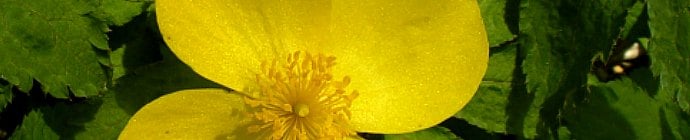
Hylomecon japonica is a special, collectors plant for the shady garden. It is rarely offered for sale, and seed from most seed exchanges will provide the wrong seed. This is a plant that is certainly worth hunting down.
In a previous post, Seed Dormancy – Are Seeds Really Dormant?, I discussed Seed Dormancy and presented a new way for gardeners to look at seed development and seed dormancy. Today I would like continue the discussion by looking at double dormancy and ask the question, does it really exist?
If you plant some peony or trillium seed in the fall you won’t see any green growth until the second spring – if you’re lucky. This is routinely described as an example of double dormancy – the seed needs two cold periods before they germinate. The two stratification (cold) periods overcome two dormancies, hence the name, double dormancy.
But is this really true? Do seeds like peony and trillium have have double dormancy? Does any seed have a double dormancy?


Phyteuma scheuchzeri is an unusual, easy to grow rock garden plant, with a bizarre flower. It is a close relative of the bellflower but does not look anything like it. I think the flowers look more like an Allium. The flower head consists of a number of flowers all opening at the same time. Each flower is quite spiky in appearance, creating a big spiky ball of rich blue color.
In my last post, Plant Seeds – Getting Started, I explained what a seed is and discussed different types of seed such as heirloom, open pollinated and hybrid. Today I’ll discuss the storing of seed and give you some suggests for getting a wide variety of seed. We’ll also look at the germination process – what is germination and what happens during germination.
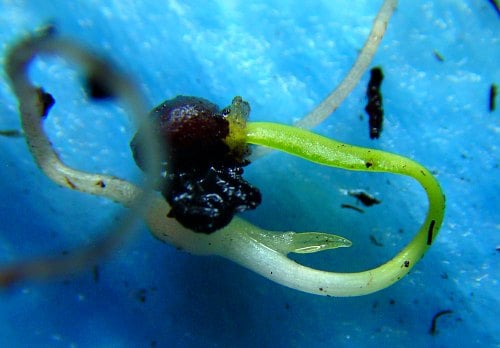
I have always been fascinated with seed germination and seed dormancy. The idea that a complete plant can be grown from a small hard nugget of cells has to be one of natures best creations. As you become familiar with seeds you soon realize that the germination process is not as straight forward as you might think. For many plants you just can’t take seed, plant them, and have germination in a few days.
Every seed seems to require its own process for germinating. Some need to be stratified, some scarified, and some need cold-warm cycles. There are many options for getting seed to germinate and I’ll discuss these in a future post.
The term ‘dormancy’ is used to describe a seeds reluctance to germinate; or more correctly seed dormancy to distinguish it from plant dormancy. The seed lies dormant until environmental conditions are favorable for it to germinate – or at least that is the impression you are left with. But is the seed really dormant? What does dormancy really mean? Good questions that I’ll try to answer in this post.

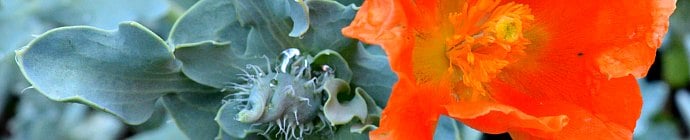
I don’t normally include biennials as a favorite plant since they are just too much trouble to keep going in a garden, but Glaucium flavum is going to be an exception. Besides large yellow or orange flowers, the horned poppy has one of the most unusual leaves I have ever seen.
Fall is coming to a close and I have been collecting plant seeds from the garden for several months. In a few cases I want the seed so that I can grow more plants, but most of the plant seed I collect will be donated to a couple organizations that operate seed exchanges. Other people around the world are doing exactly the same thing. In December, members of these organizations are allowed to order these seeds. That is where my fun starts.
I will have access to thousands of different types of seed. Anything from perennials and grasses to shrubs and trees. The groups I belong to don’t distribute vegetable seed or house plant seed, but I am sure organizations also exist for these kind of seeds.
Over the next month or two I plan to write a number of posts to tell you everything there is to know about growing plants from seed. Well, almost everything. After 40 years I am still learning.

Lots of people are looking to buy organic seeds but as a chemist this has never made any sense to me. I started asking people on social media for their reasons for selecting organic seeds over conventional seeds or heirlooms seeds. The answers clearly indicate that people don’t understand why they want organic seeds, but one valid reason did emerge.
In this post I will look at the reasons people give for buying organic seed and discuss the validity of the reasons.

In my post Fertilizer: Selecting the Right NPK Ratio, I explained that you don’t feed plants – you feed the soil. Your job as a gardener is to add missing nutrients to the soil. If the soil contains all the nutrients plants need to live – the plants will do well.
The answer to the question, what fertilizer do plants need, is very simple. They need any nutrient that is deficient in the soil. If your soil is not deficient of nutrients – you do NOT need to fertilize.
But how do we know which nutrient(s) is deficient in the soil? I’ll try to answer this question in this post. In order to do that, we need to better understand what nutrients do in the soil.

Online information about growing clematis from seed is limited. As a result, I decided to investigate clematis seed germination in more detail by running 120 test cases on a number of different types of clematis. This report summarizes known information and presents new information found as a result of this work.
