

Is climate change real? Is the Earth warming? Are humans the main cause of warming?
If you are like me, you believed all of the headlines. Global warming is mostly caused by humans burning fossil fuels. This heating phenomenon is causing huge changes in the climate. Ice caps are melting, reefs are bleaching and dying, the sea level is rising, the intensity of storms is worse, there are more forest fires, etc.
You would have to be living in a cave not to know this is all happening. It is on the news almost every night.
A few years ago, I started looking at the scientific data. In summary:
There is almost no data to support the catastrophic headlines you see.
However, there is a lot of published data to show that the climate is not changing at alarming rates.
Based on the comments, I think a lot of people did NOT read this last sentence. The Earth is warming. Climate change is happening – it is always happening. But …. climate change is not changing at an alarming rate.
What if all of the information you have been fed is wrong?
It means that most of the government efforts, using your hard-earned tax money, are a waste. It means alternative energy sources won’t solve anything. It means governments and society are doing the wrong things to make our future better.
This is so serious that we all need to start asking questions. We need to demand data to support the news claims.
The purpose of this blog post is to collect and summarize the data we do know. The post will be published shortly, but I will continually add new data as I find it. In some ways, it is a documentation of my journey towards the truth. If you find some data, for or against climate change, please let me know in the comments, and I will add it.
I am not a climate denier. I am a climate realist!
Global Warming vs Climate Change
About 8 years ago, we talked about global warming. The temperature is rising, and that would cause a number of problems. Then, suddenly, everyone was talking about climate change as if the two things were the same. They are not the same.

Global warming means that the Earth and the air above it are getting warmer. It does not mean higher intensity storms or more or less rainfall, although there is some effect on such things. It is simply a measure of the temperature.
Scientists agree that the Earth is warming. But scientists do not agree on the cause of this warming.
Headlines such as “97% of scientists agree humans are causing global warming” are completely wrong. No such survey was ever conducted.
Many top scientists are quite sure humans are not causing global warming.
What about climate change? Scientists agree that the climate is changing. It always changes and has done so for millions of years. It is also clear that we do not understand the effects of various forces on climate change. Most claims about future climate change are at best “estimated guesses” based on limited knowledge.
Here is just one example. We have very little understanding of how clouds affect climate change. More clouds mean less solar radiation reaches the ground. But they also trap heat against the surface of the Earth. More moisture in the air causes more clouds, and water vapor is just as good a greenhouse gas as CO2. Do clouds affect the heating of Earth more than CO2? What effect do more clouds have on climate change? Scientists agree that we don’t know.
Is Climate Change a Real Threat?
The majority of headlines say YES.
Melting Ice Threatens Shoelines
The Climate Crisis – A Race We Can’t Win
How Climate Change Is Causing World Hunger
Climate Change Makes Hurricanes More Destructive
Al Gore, a Nobel prize winner, said this in 2009, “There is a 75 percent chance that the entire north polar ice cap…during some of the summer months, could be completely ice-free within five to seven years.”
It is now 16 years later, and the ice cap has lots of ice even in summer.
Almost none of the predictions from climate activists have come true. Hurricanes and storms have not gotten any worse. The number of forest fires is decreasing. Increased CO2 is making plants grow better and allowing us to grow more food, not less. Sea levels are not significantly rising. Coral reefs are growing in size, not dying.
We need to understand climate change better so that we can adapt and make changes to accommodate it. There is no real evidence that our near-term lives are threatened or that our way of life will suddenly need to change.
The rest of this post will look at specific cases to investigate the reality of Climate Change.
What Does The IPCC Say?
The International Panel on Climate Change (IPCC) is the global organization tasked with evaluating climate change. It takes data from thousands of scientists and summarizes what we know.
Climate activists, news organizations, politicians, and the majority of the population have the understanding that the IPCC makes the following claims:
- Climate change is an emergency, and we need to act now.
- Extreme weather is bad and getting worse due to greenhouse gases.
What does the IPCC actually say?
You can read the full report for yourself. A summary of the current climate situation can be found in the IPCC AR6 WG1 report, chapter 12, table 12.12, section 12.5.2. You can read the details in the report, or watch a video highlighting them from a lecture given by Ross McKitrick, University of Guelph. The latter is much easier to digest and uses actual quotes.

What the IPCC actually says, in both the AR5 and AR6 reports, is the following.
There is no evidence of climate change, beyond natural variability, for the following:
- River floods
- Heavy precipitation
- Landslides
- Drought of all types
- Severe windstorms
- Tropical cyclones
- Sand and dust storms
- Heavy snowfall and hail
- Ice storms
- Coastal flooding
- Marine heat waves
- Ocean acidification
- Risk of fire
The evidence for climate change, over and above normal variability, does not exist. There is, however, evidence of global warming, which has resulted in glacier ice melt and permafrost melting.
The IPCC is in agreement with most of the points made in this post.
Reality:
- The IPCC report suggests there is no climate change.
- The IPCC confirms the existence of global warming.
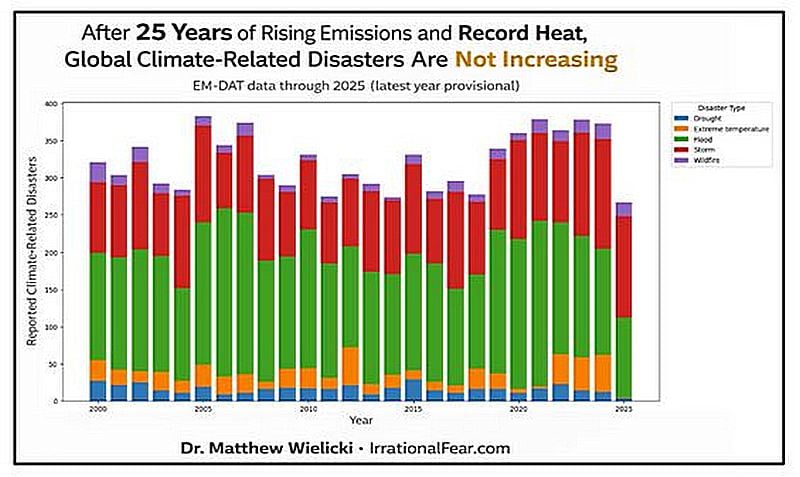
Climate-Related Disasters
If the climate were changing rapidly and causing a crisis, you would expect that climate-related disasters would also be on the rise. But …… they that is not happening.
Is the Arctic Melting?
Let’s first look at Al Gore’s prediction: the Arctic is melting.
Pictures do show less ice in the Arctic, but this is just surface ice. Most of the Arctic ice is below sea level. Here is the data from the Canadian Ice Service, Environment Canada.
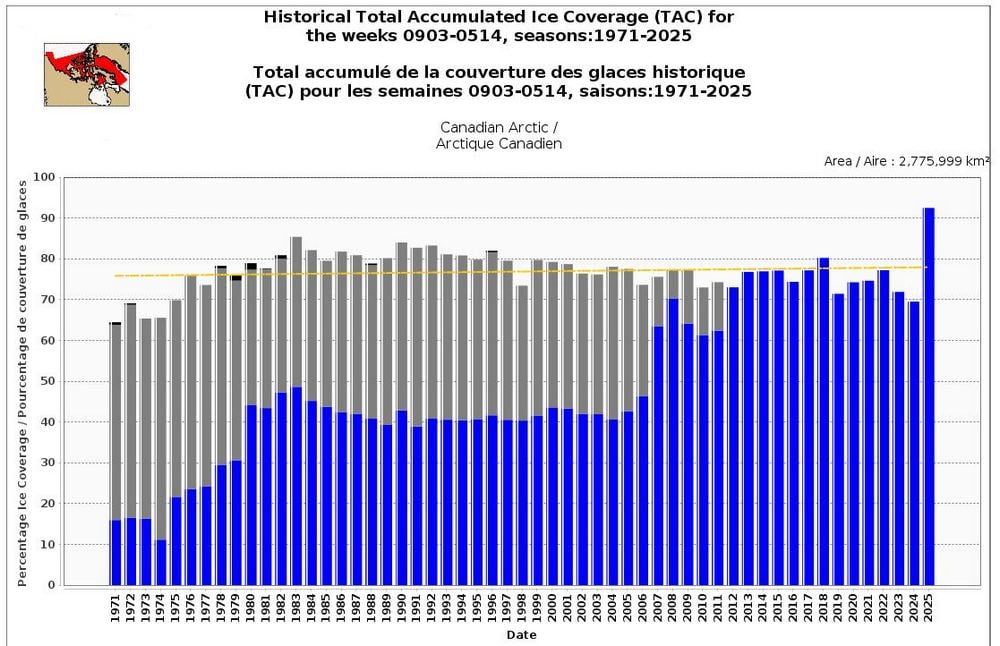
The graph shows the Historical Total Accumulated Ice Coverage (TAC), which is the total area covered by ice for the indicated time period. The blue line is the measured amount. The gray line is a corrected amount, probably due to better measurement systems like satellites in more recent years.
The data shows either a steady increase in ice or ice that is not changing much.
What about the pictures showing less ice? They are real. Global warming will cause more ice to melt in summer, but this is a very tiny amount of the total ice. The amount of ice can also increase in winter due to an increase in snowfall.
Reality:
- Some ice is melting in the summer.
- Most of the Arctic ice is stable.
- There is no ice melt catastrophe.
Ice loss in Greenland
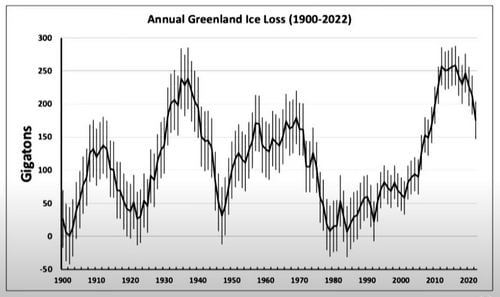
Ice has been melting at a faster rate since 2000. But if you look at 1930, a time when human activity was much less, the increase in ice melting was just as fast as in 2000. It has continually fluctuated up and down over the last 120 years.
The Earth has been warming during this whole time period, but melting has been going up and down. That indicates the two events are not as connected as many claim, and there is more to the story.
Glaciers Are Melting
Temperatures have been rising, and the mountain glaciers have been melting.
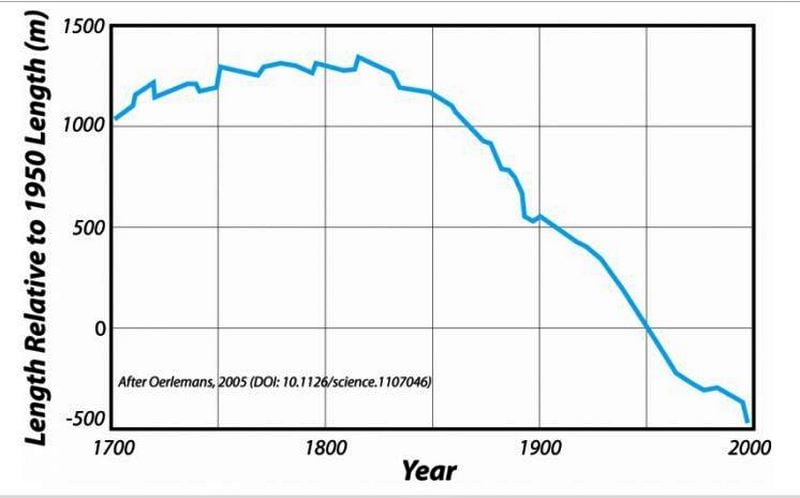
The melting has been attributed to climate warming, not climate change. The melting process does not influence climate change, although it can contribute to sea level rise, which is discussed below.
Melting started about 1850, which is about 100 years before humans started producing CO2 in any significant amount. Clearly, glacier melting can’t be blamed on anthropogenic (human-caused) global warming.
Reality:
- Glaciers are melting.
- It is not a climate change catastrophe.
Are Forest Fires Increasing?
Early last spring, Western Canada seemed to have a lot of forest fires, and the alarmists and news outlets around here were predicting another terrible year due to “climate change”.
Then there was a brief news article. Alberta had declared that every one of their approximately 150 fires was human-caused. They did not say it, but clearly, these were not due to climate change.
Why would climate change cause forest fires? The logic goes something like this. Climate change causes more severe storms, resulting in more lightning. More lightning means more forest fires because it’s the main cause of natural forest fires.

The above chart shows the historical number of forest fires in Canada, which has been declining since the mid-1990s. The data has been confirmed by the Fraser Institute.
So why does everyone think they are getting worse? This is mostly due to poor news reporting, but there is another underlying reason. The severity and cost of them are increasing. This is due to forest mismanagement as well as the fact that more and more people live in forested regions. But this increase in severity and cost is not due to climate change.
It is the summer of 2025, and based on news reports, Canada is having a lot of forest fires. Most are caused by humans.
Forest Fires in the USA
What about the USA? They seem to have a lot of fires, especially in California.
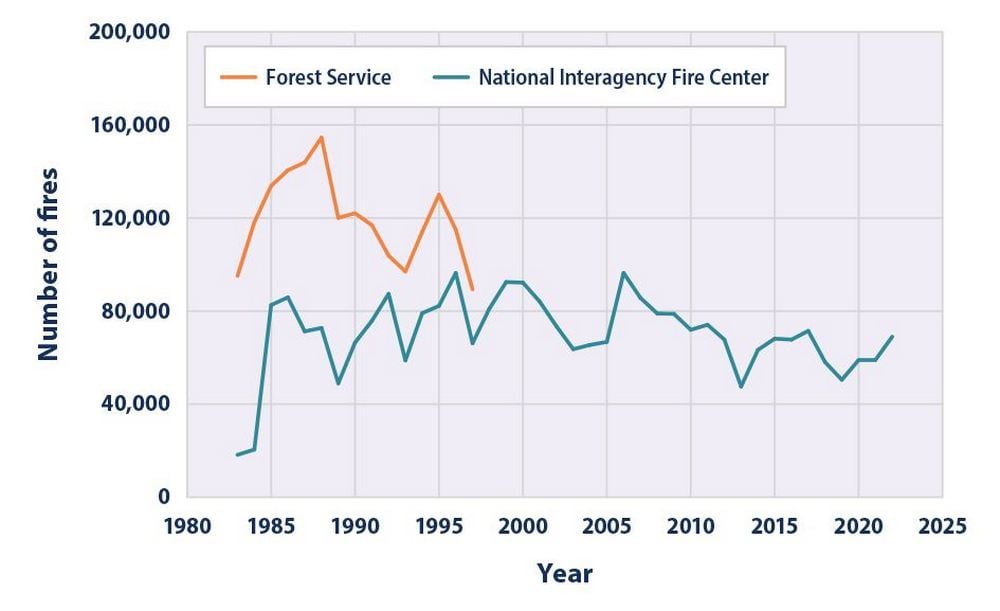
The number of forest fires is not increasing. There is a slight downward trend since 2010.
What about California? Same trend. The number of forest fires has been decreasing since the 1990s.
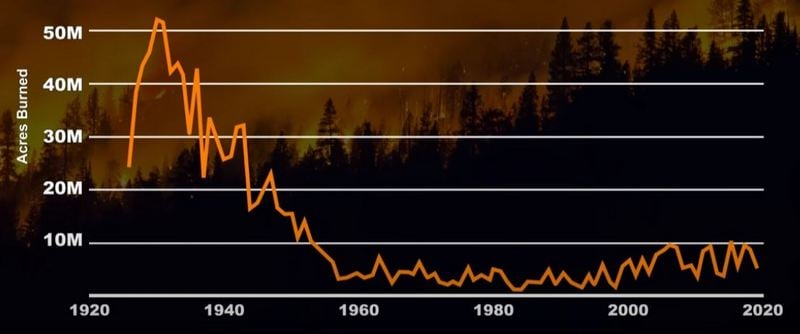
What about longer-term trends? Here is the burnt area for the US since 1926.
Global Forest Fires
A review of global fires, published in 2016, found that “the global area burned by forest fires appears to have overall declined over past decades, and there is increasing evidence that there is less fire in the global landscape today than centuries ago. “
What About the Burned Area?
Several of the comments suggested I am cherry-picking the data. Instead of focusing on the number of fires, I should be looking at the area burned. No one gave a reason why this is a better measure of climate change, and it is probably not better. Burned area depends very much on forest management, which in North America is poor, and on an area’s ability to respond to fires. It is difficult to separate these factors from weather factors.
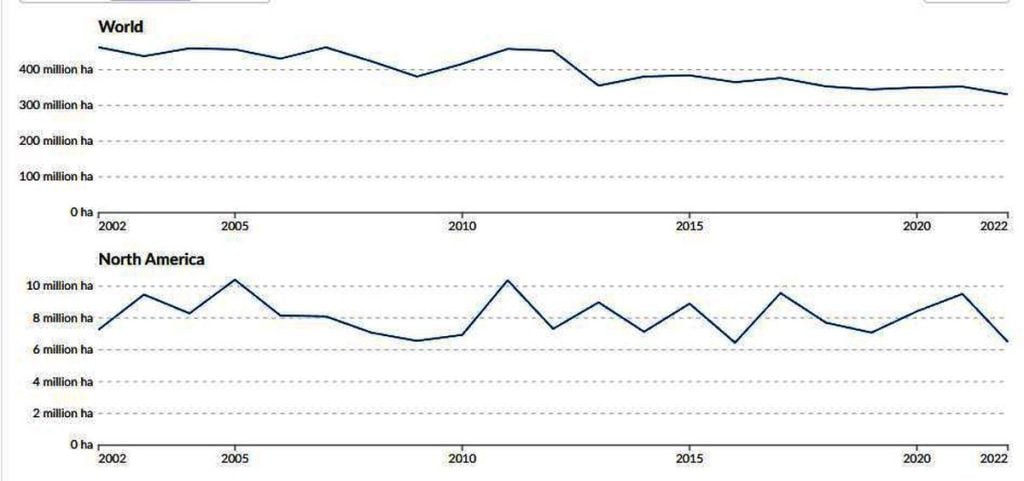
The burnt area in North America is flat, while the global burn area is trending down. The same site also has data for other regions, and they are all flat or trending down.
Reality:
- The number of forest fires is not increasing in Canada, the USA, or globally.
- The burned area from fires is not increasing in North America or globally.
News Changes Its Approach to Scare People About Climate Change
For years, news outlets have been warning about the dire consequences of “Climate Change Caused Forest Fires”. But this year, 2025, has seen a big drop in the number of forest fires, and news outlets have finally checked the facts.
The New York Times has just reported that:
“Costly and Deadly Wildfires Really Are on the Rise, New Research Finds”
Instead of being honest and letting people know that Climate Change is not causing a crisis and that it is not causing an increase in forest fires, they have decided to pivot and focus on “the cost of fire”. Even if their data was right, it only tells us that we are building more structures near forests, and these structures keep getting more expensive every year. That has nothing to do with climate change!
Record Hot Days in the US
It has been a hot summer in North America, and Europe has broken numerous heat records. Are heat waves more common now?
The Heat Wave Index in the US
The Heat Wave Index, more commonly known as the Heat Index or apparent temperature, is a measure of how hot it “feels” to the human body, combining the effects of air temperature and relative humidity. It is used to assess potential health risks during hot weather.
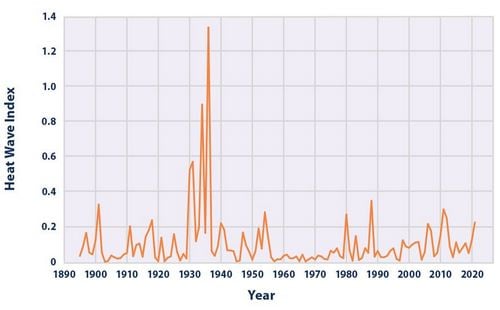
There is no significant change since 1930, and in recent years, the heat index is lower than in the 30’s, before humans produced so much CO2.
Hot Days in the US
The above data shows us how it feels, but it does not show the actual temperature. Does the US have more hot days now than in the past?
This chart shows the average number of hot days per year in the US, with a daily maximum temperature ≥95°, ≥100°, and ≥105°. It is a reconstruction by Chris Martz using official data from the United States Historical Climatology Network (USHCN).

There is clearly no upward trend during the period of 1900 and today.
Annual Average Temperatures in the US
Another way to look at temperature is to measure the average annual temperature.
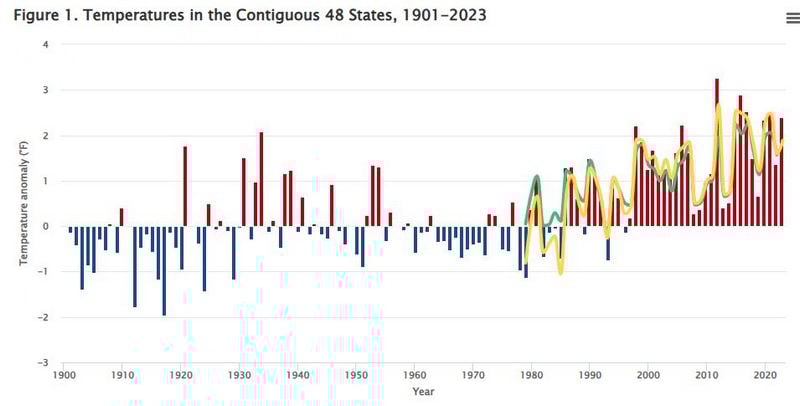
There is a clear trend upwards over the last 100 years, but even in the last 20 years, there are highs and lows, and many of the years are cooler than some years in the 1930s.
Why is the average temperature increasing when the record highs are not? This seems contradictory until you look at nighttime temperatures.
An average temperature is the average between the daily high and low. If the nighttime temperatures (the lows) are trending up and the daytime temperatures remain stationary, the daily average goes up, and that is what is happening. Nighttime lows are getting warmer more quickly than daytime highs.
From a gardener’s perspective, this is a positive trend. Hardiness zones are based on the lows. As they trend higher, cold climates can grow more warm-temperature plants.
Reality:
- Heat waves are not getting worse than in the 1930s.
- Temperatures are steadily going up. Average daily temperatures are increasing mostly due to warmer nights.
- Heat waves and record high temperature days are not as severe as reported in the media.
Are Storms Increasing?
We now have good data about global storms thanks to satellites. We know where they all are and how intense they are.

Tropical storms are not increasing. The number of hurricanes is stable or slightly decreasing. Major hurricanes are stable.
Hurricanes In The US
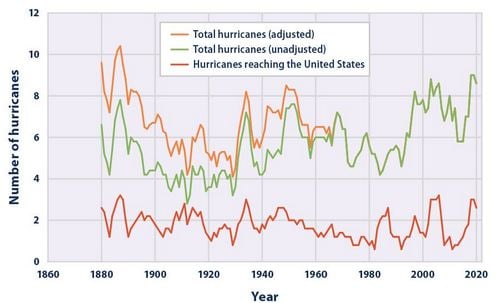
NOAA has reported on the number of major hurricanes to strike mainland USA for each decade since 1951. The average for the entire time is 5.6. The average since 2011 is only 3.5. The highest number occurred between 1941 and 1950, which had 10. Clearly, the number of major hurricanes in the US is not increasing.
Reality:
- The number and intensity of storms are stable, both in North America and globally.
Is Precipitation Increasing?
A satellite study on this concluded “No overall significant trend is noted in the global precipitation mean value, unlike that for surface temperature and atmospheric water vapor. However, there is a pattern of positive and negative trends across the planet with increases over tropical oceans and decreases over some middle latitude regions”.
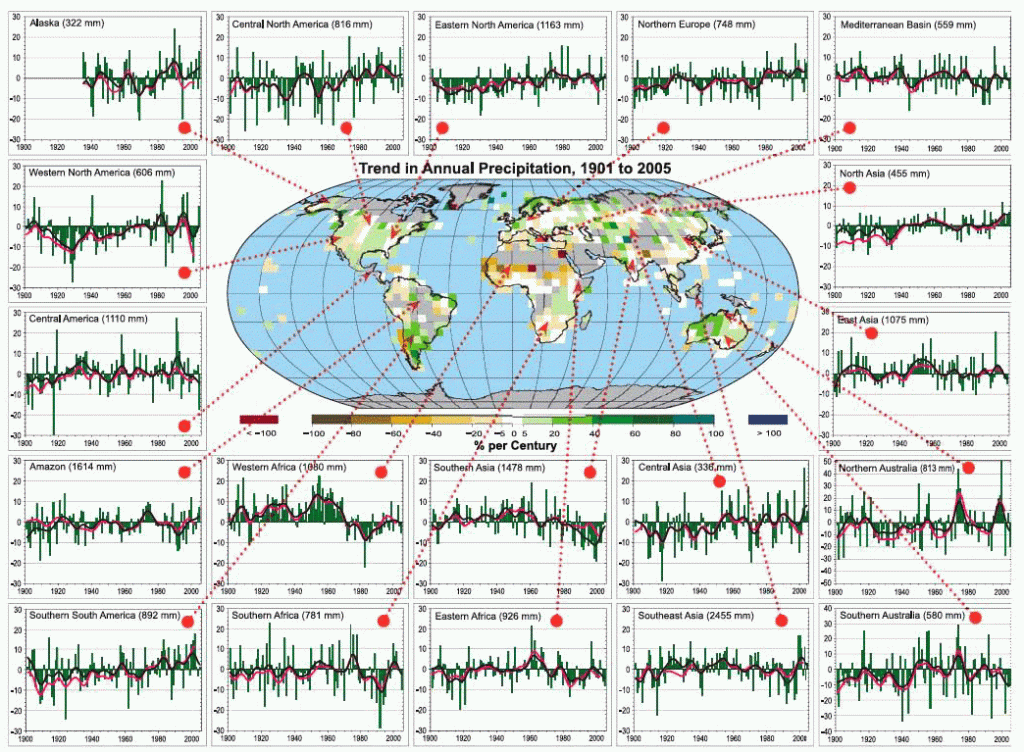

Overall, there is no clear trend in a change in precipitation; however, smaller regions can experience a change. The El Niño-Southern Oscillation (ENSO) cycle and volcanic activity also influence local rainfall.
Reality:
- The amount of precipitation falling globally or in the US has not seen a major change.
Are Sea Levels Rising?
Temperatures are rising, which causes the ice caps to melt, which causes the sea to rise. The news has predicted dire consequences from this, with many island nations being underwater in a few years.
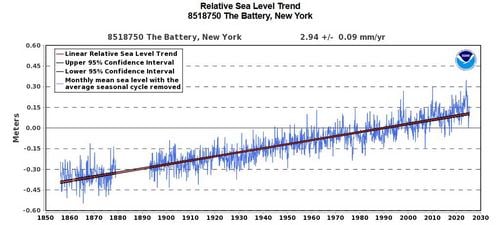
Sea levels have been rising from at least the mid-1800s, and the rise has been fairly stable in New York.
Several of the comments below disagree with this assessment. They claim it is rising at an alarming rate. We can ask the people who live in New York what they think:
- Are New Yorkers fleeing the city? Is the population dropping? No.
- Has the government stopped issuing building permits for New York? No.
- Have companies stopped building? No.
- Has the government started building flood prevention systems? No.
Clearly, the residents of New York don’t think this is a crisis. Neither do I.
A study from 2011 looked at tide-gauge data from 57 US locations and found “the records show small decelerations that are consistent with a number of earlier studies of worldwide-gauge records.”
Sea gauge data does have some issues. Gauges are mounted to land, and we don’t monitor the up or down movement of land very well. If the Earth under a gauge rises, then it will show a smaller sea level rise. And the reverse is also true. For example, New York is sinking, and taking the sea level gauge with it. So the amount of sea level rise in New York is actually less than reported.
Satellite data solves this problem, but it has only been collecting data for 30 years, not enough to determine a long-term trend.
Global Sea Level Rise
An independent analysis of global sea level gauge data was recently done by Roy Spencer, Climatologist and former NSA scientist, who showed that:
- Natural sea-level rise accounts for 1/2″ per decade (5″ per century).
- The human contribution to this is 3/10″ per decade (3″ per century).
A study (2025) that looked at global tide gauge data found that sea level rise is not accelerating in most areas. A few areas are experiencing an acceleration, but this can be explained by land disruptions that have nothing to do with climate change.
This study found that the median sea level rise is 1.5 mm/year, or 6”/ 100 years.
Sea levels are rising, but the rate is low. There is no sign of a short-term problem. The news headline “Melting Ice Threatens Shoelines” is certainly not correct.
Are Islands disappearing?
Islands are not very high, and even small rises in sea level could spell trouble.
You have probably heard of the Maldives? It’s one of the smallest countries in the world and the lowest country on Earth. On average, the ground here is only five feet above sea level. For years, news has warned of a looming catastrophe when sea levels rise.
More than 30 years ago, the AFP international news agency reported that all 1,196 islands that comprise the Maldives could be completely underwater over the next few decades (by 2015).
You would expect the islands to be shrinking as sea levels rise. However, a 2020 study showed that over the past decade, 59.1 % of Maldivian inhabited and resort islands expanded in size. Businesses are increasing the construction of new buildings and resorts. There are potential problems in the future, but for now, there is no looming crisis. All 1,196 islands are still above water.
Another example is the island of Tuvalu, a Polynesian island nation. News has frequently reported that they will sink into the ocean as sea levels rise. However, “a recent peer-reviewed study found eight of Tuvalu’s nine large coral atolls have grown in size during recent decades, and 75 percent of Tuvalu’s 101 smaller reef islands have increased as well”. The citizens are not worried. The population of Tuvalu has increased by 20 percent over the previous 30 years.
Reality:
- Sea levels are rising at a very slow rate.
- Islands are not sinking into the ocean.
Are Coral Reefs Dying
The oceans are getting warmer and more acidic as they absorb CO2. That is bleaching the coral reefs and killing them, or so it is claimed.
There are some important facts about coral that the news outlets ignore:
- Coral thrives in warm water. That is why it is found mostly in warm regions of the world.
- Almost none of the coral reefs in the world have been studied. The one that has been studied the most is the Great Barrier Reef around Australia, and due in part to its vast size, it has only been superficially studied.
- Coral bleaching can be caused by several factors, and it usually recovers in a few years.
- Coral has existed for 60 million years, surviving temperature and carbon dioxide levels significantly higher than those occurring today.
Coral reefs are very difficult to study. You can fly over them and take pictures, but that only shows you the top of shallow reefs. Most of the coral is found much deeper and requires divers to examine it. That is every expensive and why most coral is not examined.
How is the Great Barrier Reef doing? It is doing just fine. It is not dying. In fact, it is growing at both the northern and southern ends.
Growth at the southern tip may not be a surprise. The water there is warming, and that is what coral likes. So it is growing and doing well.
The surprise is that the northern end is also growing in places with warmer water. Ocean warming is not harming it.

The amount of coral in the Great Barrier Reef has decreased in the last couple of years, but it is at an all-time high since 1985.
How are coral reefs doing? It is estimated that 30% will be destroyed or seriously degraded in the next ten years, but not due to climate change.
The causes of reef degradation are many and man-caused: grounding of ships, improperly placed anchorages, destructive fishing practices, such as dynamiting or cyanide poisoning, overfishing, pollution, and sediment runoff.
Bleaching can be caused by sediment and fertilizer pollution. Even sunscreen oil can harm them. It can also be caused by heat waves and cold snaps. In most cases, they recover in a few years.
If ocean warming becomes extreme, coral will simply migrate towards the poles.
Reality:
- Coral is not impacted very much by global warming.
- Coral reefs are expanding where human activity is low.
The Indo-Pacific Warm Pool (IPWP)
The Indo-Pacific Warm Pool (IPWP) is the largest body of consistently warm ocean water on Earth. It is often referred to as the “heat engine of the world” or the “steam engine of the world” due to its immense size and its role in generating heat, moisture, and intense atmospheric convection. The defining characteristic of the Warm Pool is that its Sea Surface Temperature (SST) remains consistently above 28 °C (82.4 °F) year-round.
You would expect that such hot water would have very little coral because it is just too hot for it.
The area is known as the Coral Triangle because it contains the overwhelming majority of the Earth’s coral species and coral reefs. It is home to 76% of the world’s reef-building coral species and makes up approximately 91% of the world’s total coral reef areas.
Coral likes growing in warm water!
Are There More Floods?
A devastating flash flood impacted the Texas Hill Country, particularly along the Guadalupe River in Kerr County, on July 4, 2025, resulting in numerous fatalities and widespread destruction. It was documented by all the news outlets, who blamed it all on climate change.
Was it climate change?
The area is called “Flash Flood Alley“ for a reason. The topography lends itself to such events. For our discussion, the key question is, was this an unusual event? Are floods in his region increasing? A single event is not proof of climate change. We need to see a longer-term trend to blame climate change.
Roy Spencer, climatologist and former NSA scientist, has done a good job analysing this. The rainfall data shows that this was not an unusual event. Flood events have been trending down since the 1978 flood.
Maybe the news outlets should have reported that climate change is reducing flood events?
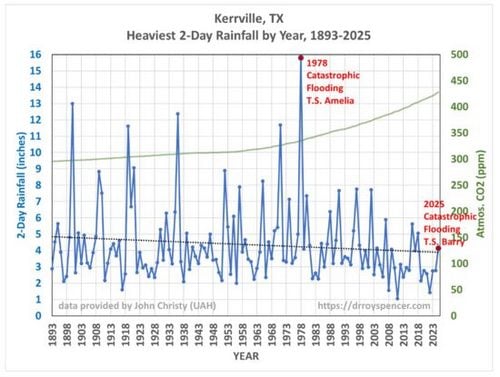
The Department of Energy’s report entitled, A Critical Review of Impacts of Greenhouse Gas Emissions on the U.S. Climate, reported that “when one looks at rainfall statistics across the U.S. extending back to the mid- to late-1800s, there is little evidence for anything that might be considered related to human-caused climate change”.
Using floods to determine climate change is tricky. A lot of the data shows financial losses, but it should be no surprise that this is going up. More people are living in more floodplains and building expensive buildings. There is also the issue that humans have moved earth to redirect flooding, which in many cases makes flooding worse in one area while protecting another. We can’t blame any of this on climate change.
Reality:
- Flood data does not show an increase in floods in the US
- Floods are largely influenced by human activity on the ground that has nothing to do with CO2 or global warming.
Is Climate Change a Threat
Climate change happens and will continue to happen. The important question is, is climate change a threat to our lives?
Based on the above data, it’s not. The data does not warrant the views of climate alarmists.
The truth is that global warming has been good for humanity. The following shows the impact since 1900. A reduction in deaths due to weather, longer life expectancy, higher GDP, and less poverty. On a global scale, it is hard to find a negative.

Several people commented that the above information is wrong, without providing evidence that it’s wrong. So I checked the data for the weather-related death rate.
It is very clear that global warming is saving lives:

As mentioned in the introduction, I am making this post public before it is complete. I will be adding many other topics in the coming weeks, months, and years.
It is important that all of us understand this topic better, so that we can influence government leaders to act more responsibly. Trying to solve a problem that does not exist costs dearly.
Number of People Killed by Climate-related Disasters
If climate-related disasters are increasing, you would expect more people to die from them. The general public and the news media certainly think so.
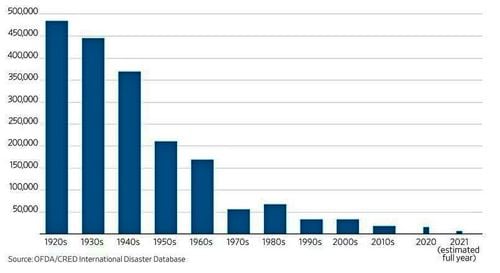
The reality is that the number of deaths from floods, droughts, storms, wildfires, and extreme temperatures has dropped dramatically. Most of this is due to human advancement in technology, but there is certainly no evidence of an increase.
Cost of Disasters
An increase in the number of disasters or the severity of disasters should result in an increase in cost.
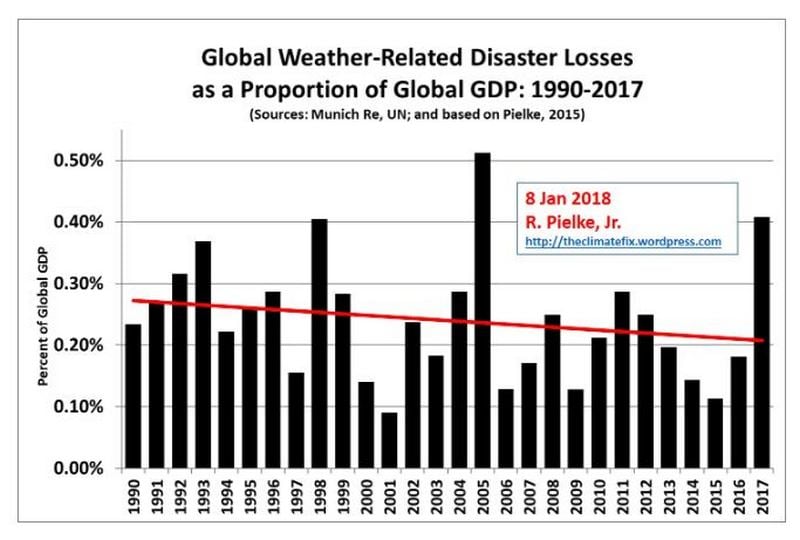
The trend between 1990 and 2017 is down, not up. The opposite if disasters are on the rise.
There are charts that show an increase in actual costs for this time period, but they don’t take into account the increasing value of human-made structures. For NOAA’s charts, they say, “A major driver of increased costs of extreme weather is the increase in population and material wealth over the last several decades”. The above chart, based on GDP, more correctly reflects those costs.


Cherry picking data is the antithesis of the scientific process. Yes, the climate has and will always change due to natural processes and inputs. The problem lies in the accelerated timeline caused by the significant increase in heat trapping emissions. There is no time for flora or fauna to adapt.
I agree with you that wide-reaching policy decisions should not be made without reliable data.
And of course your overview is incomplete – any overview would need to be, you cannot list every weather phenomenon in every place.
The problem is that you already draw conclusions based on that very limited data.
For example: To discount that climate change increases floods using just the data of rainfall of one place in the US, one recent flood and a statement about rain that you mark as a citation, but that I could not find in your linked source – that is a very incomplete picture!
Most unproven of all is your statement that “Climate change is good for humanity”. The table you present (if the values given therein are even correct) does nothing to prove it is more than correlation. You would need to control for all the other factors influencing the values given in the time period at issue: Moving from horse to tractor, inventing artificial fertilizer, advancements in medicine (vaccines, antibiotics, hygiene),… All this table does show (if we assume the values given as correct) is that at least climate change up to the dates in the table had not obliterated these gains.
I think you sum it up perfectly, Francine. It is a classic tactic to use selective data to draw far-reaching conclusions that cannot be proven, and your analysis of this is excellent. Confusing correlation with causality is one of the most common logical mistakes.
Hi Robert,
I think despite all your critical thinking you still missed the point re the cause of climate change.
The German Helmholtz Institute bothered to put together a list of the most polpular climate denier myths, which is good enough for me
https://helmholtz-klima.de/klimafakten/behauptung-schon-ueber-500-forscher-bezweifeln-den-menschengemachten-klimawandel,
just use deepl and Bobs your uncle…
Here is one quote from that list, and it seems “the science” has no doubt that the changes are caused by humans and the vast amount of fossil CO2 and other greenhouse gases
“None of my research publications has ever suggested that global warming is anything other than a consequence of man-made greenhouse gases. I consider the inclusion of my name on this list to be damaging to my reputation as an atmospheric scientist.”
Ming Cai, Associate Professor, Department of Meteorology, Florida State University, USA
(she reacts to a list of “500 critical scientists who doubt that climeate change is man-made”, most of them were not asked before being put on the list, and several fought to have their name taken from the list , just one example of fake points
I don’t agree with your position. I think you should stick with gardening articles. I wonder if all you say in your books is really true?
“I don’t agree with your position.” – that is your problem – Since you don’t agree, you assume the information I present is also wrong.
The pot calling the cattle black can’t never have been more apt saying than now.
Damned it Robert take a hard look at your own stance here. If able from the point of you being wrong. If you can’t see yourself being wrong, take help from an AI and ask it to help you with it.
Sorry – but just because you believe something does not mean I have to believe it. I am convinced by the data.
I respect your courage for publishing this article. I can’t imagine you not getting loads of flak as a result. I have thought for a long time, and still do, that it is arrogant of scientists, or anyone, to have enough understanding of all the factors that determine climate. Thus I think it is folly to make conclusions and predictions regarding climate change (except that the climate has never been static and probably never will, until the sun becomes unstable and rips the atmosphere away ).
I don’t agree nor disagree with your conclusions in this article. I am not an expert in climatology, nor are you and probably the vast majority of those that have read it. I can’t imagine carbon emissions not having an effect. Maybe good for humans, maybe bad. Hell, carbon emissions could be staving off an ice age. What I think is one huge volcanic eruption and the debate becomes academic. What I do know is climate change fears are being used to create laws and ordinances that are negatively affecting me and the community I live in. Will ruining my occupation, and kicking out people of their single family homes, really have any measurable effect on the climate? I don’t think so. But I could be wrong. And how can I trust scientists that don’t also admit they could be wrong? Any apologies for climate predictions that did not happen?
It was arrogant to go to the moon but we pulled that off.
“(except that the climate has never been static and probably never will, until the sun becomes unstable and rips the atmosphere away ).”
It is climate science and astronomy that taught us those facts.
“Thus I think it is folly to make conclusions and predictions regarding climate change”
We have gotten a lot of predictions that match observations.
https://www.politifact.com/factchecks/2022/oct/25/charlie-kirk/many-climate-predictions-do-come-true/
“I can’t imagine carbon emissions not having an effect.”
We dont have to imagine it, we can measure the effect with ground instruments and satellites.
“one huge volcanic eruption and the debate becomes academic.”
On average humans produce 60 times the amount of CO2 in a year compared to average of all volcanoes combined – and that is a conservative estimate. I suppose that could change, but we’re the biggie for now.
“And how can I trust scientists that don’t also admit they could be wrong?”
By comparing observations. Admitting one can be wrong is essential to being right.
“Any apologies for climate predictions that did not happen?”
Okay, but can you offer any credit for getting some things right? And for building the climate science that determines what is right and wrong via measurement and experiment?
Here are some things we’ve gotten right:
https://www.politifact.com/factchecks/2022/oct/25/charlie-kirk/many-climate-predictions-do-come-true/
Thank you Robert from the bottomof my heart for telling the truth about this, the most dangerous myth to talk about.
Some additional thoughts:
We have good climate data for only the past 150 years or so. That is a drop in the time the Earth has existed. Making conclusions based on data for 150 (or sometimes even 10 years) of data is pretty much meaningless, yet it happens, for example revisions to USDA climate zones.
Far away events influence climate. It’s not unusual for weather in the South Pacific (for example, El Niño and La Niña) to have a major effect on the US East coast. Then there are the air currents, for example Arctic area occasionally pushing down from the Canadian prairie provinces (for example Manitoba) and bringing unusually cold winter weather to the US East coast.
Large urban areas cause a “heat island” effect (from air conditioners in summer, heat in winter, automobiles, factories, and cement/asphalt as well as buildings absorbing the sun’s heat. As population increases, urban/suburban areas expand, more people have air conditioning, etc. the average temperature measured at a weather station will tend to increase over many years. It’s highly impractical to have a weather monitoring station out in the middle of nowhere; this was especially so in the days when checking the day’s high/lows would have required a daily physicsl visit to the monitor.
For those who believe the myths of man-made climate change and global warming, there are the myths of “clean” electricity. First, a huge chunk of electricity is produced by burning coal, which is much more polluting than gasoline. Second, electricity transmission is highly inefficient, since a good portion of electricity is lost during transmission in the form of heat. Third, solar panels are black and absorb heat instead of reflecting more of it as desert soil, or light-colored roofs would. Solar panels also cause pollution both when produced and when disposed of after their limited life. There is also a practical limit on where solar panels can be placed, i.e., on roofs, in areas not suitable to agriculture (which are far away from population centers and therefore involve transmitting powerover logn distances.) Furthermore, in the US only the southwest is really suited for solar panels. Much of the rest of the US (and all of Canada) has cloud cover or moister air, thus reducing the amount of solar radiation received.)
As to surviving climate change, people move to/from different climates and manage to survive.
But whatever logic you present, Robert, you are dealing with emotional beliefs that approach the level of religious fervor. Asmuch truth and scientific data you present, too many people are deaf and blind, by choice.
“We have good climate data for only the past 150 years or so.”
Paleoclimatologists look for clues in Earth’s natural environmental records and have many powerful tools for determine the climate for deep time. ICE core samples, ocean sediment, coral skeletons, glacial samples, tree rings, sedimentary rocks, etc. We can actually sample the CO2 in air that is 800,000 years old. In fact, Paleoclimatology is primarily how we know, with confidence, the climate is always changing.
“As to surviving climate change, people move to/from different climates and manage to survive.”
Yes, but extinctions due to changing climate is also common, historically speaking.
You’ve devoted a lot of space, and I’m sure, time, to this contrarian post. It’s you against the IPCC, I guess. I’m not calling you wrong just on that basis. I did note you avoided mention of global glacier retreat. Was that an oversight, or was it that you could not reasonably deny that it has happened much more rapidly as greenhouse gas levels have skyrocketed?
I clearly state in the post that it looks at some data and over time I will be looking at more data.
Glaciers are retreating – I don’t think anybody questions that. But what does that tell us about climate change? It shows that the Earth is warming – but nobody is questioning that anyway – I am very clear about that in the article.
What I wrote was “The purpose of this blog post is to collect and summarize the data we do know. The post will be published shortly, but I will continually add new data as I find it. In some ways, it is a documentation of my journey towards the truth. If you find some data, for or against climate change, please let me know in the comments, and I will add it.”
So the fact that glaciers are retreating is not telling us much. It is not affecting storms, precipitation, winds, fires, etc.
What it does do is give people a mental picture of rapid ice melting, which feeds into the narrative that the ice caps are melting fast and that sea levels will rise quickly. But that story and vision, which is very popular in the press, is not true, according to the data I presented. They are changing, but not quickly.
The focus of the article was not to see if climate is changing, but is it changing so fast that it is a crisis.
You still say ice caps are not melting fast. I have pointed out several times how irrelevant your chart on ice cover is, yet you haven’t removed it or defended it. Here is an actual chart of full arctic ice extent for today. (this page won’t let me insert the chart. So here is a link: https://forum.arctic-sea-ice.net/index.php/topic,4329.msg431941.html#new) This has been a relatively good year for the ice – we are only the 9th lowest in the satellite history. But note that the current extent, and average for this decade, are about 30% lower than the averages for the 1980s. That certainly seems to me to qualify as ‘rapid ice cap loss’
Daily numbers show us nothing about climate change – where you are looking for 30 year trends.
The climate has always been changing. If it didn’t the Sahara would still be a savanna. There is not one prediction made by “climate scientists” that has come true. What is true is that the solutions to mitigate this imaginary problem are causing actual harm to the environment. Take lithium batteries and windmills, for example. There is no way to properly dispose of either. It takes more fossil fuel energy to produce them than either will ever give back in its lifetime. The process used to extract lithium from the ground, pollutes land, water, and air. A windmill blade can and does kill wildlife; and can result in catastrophic consequences, like the offshore windmill blade that shattered off the coast of Nantucket, shutting down the beaches and putting all wild and ocean life in danger. They do not think that they will ever be able to fully clean that up.
Geoengineering aka. Solar Radiation Modification (SRM) refers to the deliberate, large-scale spraying of particulate matter into the atmosphere to decrease global average surface temperatures by increasing the reflection of sunlight away from the Earth. The goal is to mimic the aftereffects of a major volcanic eruption. This is happening right now on an almost worldwide scale, even in the US. What are the results and the ramifications? All living things, on earth, above and below, and in our oceans, need full spectrum sunlight to survive. It is having an adverse effect on weather, initially after spraying precipitously lowering the air temps, and then raises the heat and humidity level creating a greenhouse effect that is causing torrential downpours leading to flooding. Summers are disappearing and so are winters. The wild weather temp swings are tricking migrating animals, killing off pollinators, reducing crop yields, hurting weather dependent industries, like ski and beach resorts, and other industries that require dry days to do their work. The blanketing of the sky is so bad, you can no longer see the stars or the planets since they have been covered up, just like the sun and the moon.
What is being done in the name of saving the planet is criminal and has made a lot of people rich as a result. The only way to stop this life-threatening scam is to start holding people accountable and prosecuting them for the massive fraud they perpetrated against all life on earth. We can start with Al Gore.
Please share your sources of information on widespread geoengineering. It would surprise me if anything other than minor “cloud-seeding” has taken place.
There are plenty of articles on the practice by doing a simple web search. But you do not have to read an article to see what is going on in our skies right now. Simply, look up.
Cats kill millions compared to windmills do we deal with cats too?
But the disposal of cat carcasses does not pose an environmental threat, like the disposal of end of use renewables do.
Cats may be a plague on songbirds, but we can be thankful that those birds are still abundant. Wind turbines get the higher flying and far less numerous raptors. They’re hell on bats, too, it’s reported. There’s nothing benign about those enormous machines.
The same scientists who have proven the climate has always been changing and how are also the ones who are observing the changes today and they have made predictions that have come true. Windmills have been around for eons and used to pump water, grind grain, and are now used to generate electricity. Some of the people in the world are not corrupt.
But windmills were made with natural materials before, not materials that pose a biohazard to the environment.
All materials are “natural”. Some are hazardous.
All energy production has a downside. Did you see the footage from the LA oil refinery that blew this week?
https://www.nbcnews.com/video/louisiana-plant-explosion-prompts-evacuations-245630533686
As an aside, name the climate predictions that have come true. I have not found any.
I look forward to your future additions to this. I’ve been a fan since the glyphosate ruckus.
Robert
Your article is only an example of cherry picking data and totally missing the big picture. For years I’ve had respect for your scientific approach towards gardening however, now I’m afraid you’ve shot yourself in the foot and I will have to completely reconsider anything. I’ve read that you’ve written before. I’m sorry you’ve had to go down this road. I don’t know whether it’s politically driven or what but you’re sadly stumbling in the dark.
Gotta admit to feeling oddly saddened by this but really we should be up to the challenge of setting the record straight.
You reply is only an example of emotionally motivated denial. You vaguely accuse the author of cherry-picking data, without providing a single example or data countering his. If you can demonstrate the error if his methods, please do so. Merely calling him names is not an argument.
Agreed! I expected to see many more insubstantial comments like the one Nicholas posted. I’m pleasantly surprised to see relatively few. Perhaps that’s because Pavlis’ audience is populated by people that can tolerate having their views challenged. I’m looking forward to learning more about the topic from the independent thinkers in his audience.
Could you give us more info where you see the problem?
I agree with you John .
Totally agree. So sad to see him go down this road. It makes me question his methodology for all his other content as well.
Totally agree with John. We have lost a good fellow here, and it is so, so sad !
What data, John? Every prediction the climate alarmists have made has been wrong and not come true.
Here is one rebuttal:
https://www.science.org/content/article/even-50-year-old-climate-models-correctly-predicted-global-warming
Another:
https://www.politifact.com/factchecks/2022/oct/25/charlie-kirk/many-climate-predictions-do-come-true/
Even Exxon made accurate warming predictions:
https://www.npr.org/2023/01/12/1148376084/exxon-climate-predictions-were-accurate-decades-ago-still-it-sowed-doubt
An analysis of Al Gore’s movie:
https://science.howstuffworks.com/environmental/conservation/conservationists/inconvenient-truth-sequel-al-gore.htm
What these predictions fail to mention is that historically, the earth having warming periods is a natural phenomenon, just as the earth cooling, and even entering ice age periods, is also a natural phenomenon. Core earth samples that tracked 10K years of the earth’s evolution proved that. It also proved that CO2 levels were at times higher in the past than they are now, way before fossil fuels were ever used.
I do not know how old you are, but in the 70s scientists were trying to create hysteria that we were entering an ice age. Unfortunately for the fraudsters, it didn’t pick up steam and was dropped, but that didn’t stop them from trying to get something to stick, including ozone depletion, acid rain, fossil fuel depletion, etc. Even “Global Warming” they had to rebrand as “Climate Change” since real scientific data, like what I cited above, and historical evidence contrary to their alarmism, was not aligning with their claims that the earth was warming because of fossil fuels.
As for Al Gore, even his mentor, Roger Revelle, the man who he learned about the theory of global warming, disagreed with Al Gore. In an Omni magazine interview, he actually downplayed the significance of global warming and saw rising temperatures as good for the environment and life on earth.
Omni: What will the warming of the Earth mean to us?
Revelle: There may be lots of effects. Increased CO2 in the air acts like a fertilizer for plants. You get more plant growth. Increasing CO2 levels also affect water transpiration, causing plants to close their pores and sweat less. That means plants will be able to grow in drier climates.
Omni: Does the increase in CO2 have anything to do with people saying the weather is getting worse?
Revelle: People are always saying the weather’s getting worse. Actually, the CO2 increase is predicted to temper weather extremes.
Becoming increasingly alarmed over where the global warming agenda was going, he wrote letters to two senators cautioning them to be prudent when making decisions regarding this issue, and in 1991 he co-authored an article in the science magazine Cosmos, titled “What to do about greenhouse warming: Look before you leap.” where he again urged caution and also expressed fears that remedies could negatively impact economies, especially those of developing countries. Revelle then made a speech at the Bohemian Grove in Northern California, where he apologized that his research was misinterpreted, sending people in the wrong direction on global warming. What was Al Gore’s response to Revelle’s concerns? He denounced this brilliant man as suffering from senility and refused to debate him on the issue. To this day, Gore refuses to debate anyone on the issue and will only take interviews from a friendly media. Gore is nothing more than a scam artist who should be indicted for this crime against the environment and life on earth.
“the earth having warming periods is a natural phenomenon”
Yes. The science of climatology has proven this via evidence. The same scientists have also proven that CO2 from burning fossil fuels has increased warming above natural levels.
“Gore is nothing more than a scam artist who should be indicted for this crime against the environment and life on earth.”
Wow. Okay. How would you punish him if the indictment you advocate came to be?