

Japanese knotweed is one of the most notorious invasive plants in temperate gardens—but it’s also one of the most misunderstood. Let’s bust some myths and explain the latest science on how to control it.
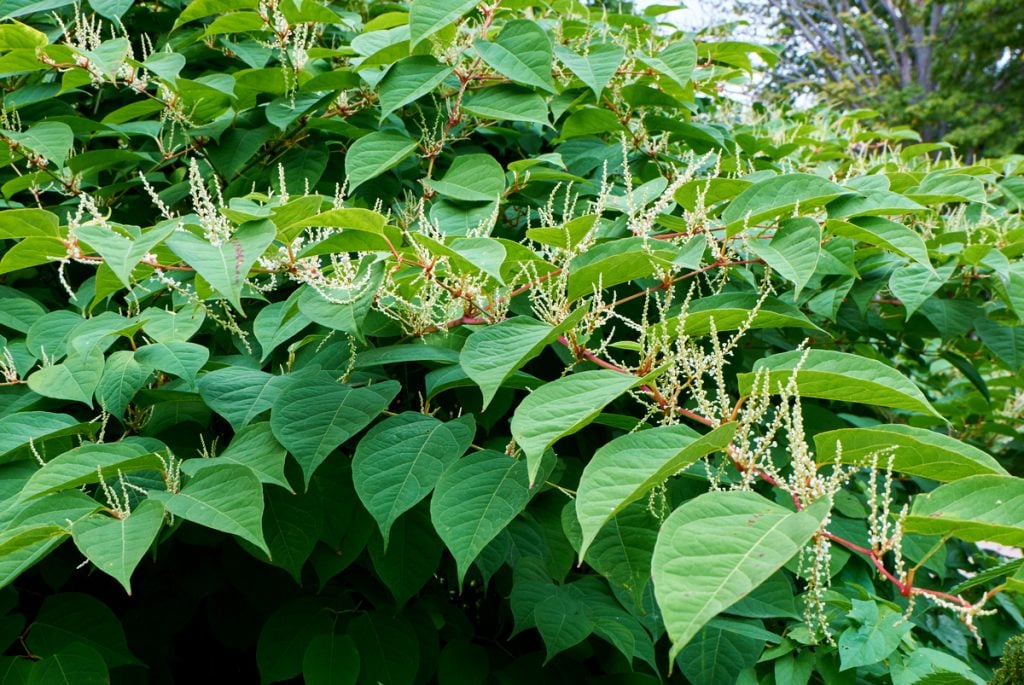
Key Takeaways
- DIY solutions do not work.
- Standard solutions used for other weeds also don’t work.
- Herbicide spray works best, but it still takes a couple of years and has to be done correctly.
Get to Know Japanese Knotweed
Japanese knotweed (Reynoutria japonica, synonyms Fallopia japonica and Polygonum cuspidatum) is native to eastern Asia and was introduced to North America and Europe as a horticultural plant in the late 19th century. It grows in a wide range of habitats, forming dense thickets of bamboo-like vegetation that aggressively outcompetes plants that are shorter than itself.
Stems are hollow up to 2.5 cm in diameter and form horizontal rhizomes that spread quickly as much as 10 m away from the parent plant.
12 Myths About Japanese Knotweed
Myth #1: Knotweed Pierces Concrete Foundations
This is a common belief that has no basis and has been debunked by studies in the UK. Roots and rhizomes will grow into cracks in the foundation and, over time, will widen them, but this does not cause the original damage.
The roots also do not grow into and damage water pipes.
Myth #2: Roots Grow 16 Feet Deep
Roots can grow up to 5 feet deep in sandy soil and are even shallower in heavy clay soil. The real problem is the rhizomes, which can travel a long way from the mother plant.
Myth #3: Excavation is Effective Control
Although the roots are not very deep, excavation is not a good control method because roots and rhizomes easily break off and start growing again.

Myth #4: Rhizomes Remain Viable for 20 Years
Rhizomes store nutrients and survive for years, but there’s no scientific support for 20-year dormancy. Most viable pieces die off in under a decade.
Myth #5: Knotweed Spreads by Seed
In North America and Europe, almost all knotweed colonies are clones from rhizome fragments, not seeds. In 1842, Phillipe von Siebold, a doctor who worked at the Dutch trading settlement in Japan, returned from his expedition to Europe and brought with him the first live samples of Japanese knotweed. It was cultivated and spread from there.
It was believed that all of these plants were female and, therefore, no seeds were produced. However, a male specimen of Japanese Knotweed was found in Southern England in 2021, and research is underway to find out how this male plant arrived. Introduced male plants could mean that the plant starts spreading by seed.
Myth #6 Japanese Knotweed is Poisonous
Japanese knotweed is not poisonous and has been used medicinally and in food and drinks for decades. It is also harmless when touched and is safe near pets.
Myth #7: Knotweed is Allelopathic
Although lab tests have found toxic compounds in the plant, they are not concentrated enough to suppress other plants. They restrict other plants from growing by being aggressive and shading them out.
Myth #8: You Can Kill It With Diesel, Bleach, or Glyphosate
It is claimed that you can cut it down and pour various concoctions into the hollow stem to kill it. Common items include diesel fuel, bleach, and salt. These do not work. Even glyphosate (Roundup) has a limited effect.
Myth #9: Mowing Eradicates It
In theory, this should work. Repeated mowing will eventually exhaust the underground tissue, but this method can take many years. It is not an effective control method.
Myth #10: Herbicides Will Work
Systemic herbicides like glyphosate can control the plant, but they rarely eliminate it unless repeated for multiple years. Biological herbicides and contact herbicides, like vinegar, don’t work.
Myth #11: Tarps Starve It Out
Long-term geomembrane covering is often ineffective. Even six-year tarping may not stop the plant, as hardy rhizomes find cracks and persist.
Myth #12: Thermo-Electric Treatment Works
Thermo-electric treatment involves applying up to 5000 volts directly to the knotweed, boiling it from the inside out, and depleting its energy reserves, making it very hard to regrow, or at least that is the claim.

Such services are now available in the UK, but I found no evidence that they are effective. One site claims that “thermo-electric treatment is not a one-off, but typically requires several visits during a 5 to 10 year plan”.
Best Way to Eradicate Japanese Knotweed
What does science say? What is the best way to get rid of this weed?
The most effective treatment is to apply herbicide to the growing plant. Spray early in the season once leaves are fully extended. This ensures maximum absorption of the herbicide. Then spray again later in the season. This must be repeated over multiple growing seasons.
Some USA extension offices recommend a single fall application after cutting the plant back in mid-summer.
Where spraying is not an option, stems can be cut back and herbicide applied into the interior of the stem, or be painted on the exterior of longer stems. But these methods are much less effective.
“Glyphosate is the herbicide of choice for controlling knotweed. It is effective, has no soil activity, is readily available, and somewhat inexpensive.” The mixed solution should have 5-8% glyphosate.


This is so interesting that the resource you cite recommends applying herbicide twice, which is not consistent with U.S. Extension articles, as you noted. I presume it’s also research-based. Also different t is the recommended percentage of glyphosate recommend (my recollection from UNH’s or Penn State’s articles is something like 2.5-3%). Whatever the nuanced differences this is a horrible plant in the wrong location and I see it all too often in clients’ yards and all over public and wild areas. It’s so sad.
Sounds like controling poison ivy, although I have found Dicamba works better than Glyphosate. Might work on JKW too
I thought another herbicide might work better – but everyone recommends glyphosate.
I had a terrible invasive problem with knotweed by a house where I once lived. It was growing on my neighbor’s property and kept creeping over to mine. My neighbor gave up and it took over his yard. I tried almost every method that you said doesn’t work, and you are right, they don’t. I only controlled it by never letting it grow beyond an inch off the ground by weed waking it with the rest of my weekly mowing and weed waking. I moved out of that house in 2011 only to move into another house where the previous owner had planted Lily of the Valley everywhere. Another invasive scourge of the garden world, which spreads by both roots and seeds. Itt’s a never ending battle.