

Insecticidal soap can be used to get rid of certain insect pests on plants, and it is one of the most non-toxic pesticides available. However, it is still a pesticide and needs to be treated as one. Many people use insecticidal soaps incorrectly, or for the wrong type of insect. In this post I will review how it works, which insects it controls and how to use it correctly. I’ll then review the problems with home made insecticidal soap.

Insecticidal Soap – What Is It?
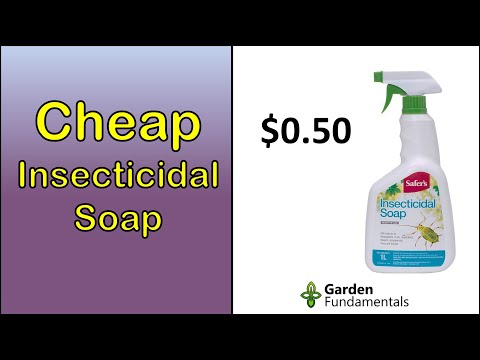
Insecticidal soap, like Safer® Brand Insect Killing Soap is a true soap. It is made by reacting potassium hydroxide with long chain fatty acids. Fatty acids are made from fats.
These soaps have been specially formulated to be effective insecticides while at the same time doing very little damage to most plants.
Organic insecticidal soap controls soft body insects such as aphids, mealybugs, spider mites, and whitefly. It also controls arthropods such as earwigs, spiders, millipedes, mites, flies, and ants. It can also be used to control caterpillars and leafhoppers, but these large insects are difficult to control with this product. It does kill soft-bodied larvae of lady beetles and lacewings – beneficial insects.
This is a general pesticide that will kill both pests and beneficials.
How Does It Work?
Insecticidal soap is a contact poison. It must come into contact with the pest in order to affect it. The soap is water based and dries fairly quickly. Once dry it has no effect on pests.
Scientists don’t fully understood how they work, but the latest information suggests that the fatty acids disrupt the insects outer cell membranes. Once disrupted, contents of the cells leak out and the insect dies. For this to work well the whole body of the insect needs to be covered.

Dry soap will not disrupt the insect membrane, so it has no effect.
The dry soap will decompose fairly quickly into harmless compounds.
How do You Apply Insecticidal Soap?
If you can’t see the pest – don’t bother spraying. A pest that flies away will not be harmed.
Here are some simple instructions for Safer Brand Insect Killing Soap . For more detailed instructions see the link below (ref 1).
- SHAKE WELL. For best results use freshly mixed solution.
- DO NOT use on new transplants, newly rooted cuttings or plants stressed by drought. Avoid application when temperature exceeds 90° F.
- Apply when insects or signs of their damage appear. Thoroughly wet all surfaces of infested foliage and branches.
Note the comment “Thoroughly wet all surfaces of infested foliage and branches”. This does not mean you should cover the whole plant. Just spray the infected areas. Remember, you need to spray the pest to be effective – spraying leaves does not work.
If you are mixing your own diluted solutions from concentrate, use soft water, like distilled water. Hard water makes the product less effective.
Keep in mind that this is a pesticide and it can harm plants. The detailed instructions for Safers says it will harm; seedlings, new transplants, cuttings, Euphorbias, delicate ferns, bleeding hearts, azaleas, sweet peas to mention a few. See the full instructions for a complete list.
Home Made Insecticidal Soap
There are many recipes on the internet for home made, DIY insecticidal soap. My post, Dish Soap Can Damage your Plants discusses the problem with these in detail. Home made solutions using soaps found in the home are chemically not the correct type of soap and are more likely to be phytotoxic (poisonous) to your plants – they might even kill them.
Dish soap is not even a soap – it is a detergent. You can’t make insecticidal soap using a detergent because they are very toxic to plants.
Is Dr. Bronner’s Castile Soaps Safe?
Castile soaps, of which Dr. Bronner’s is a popular brand, are made from vegetable oils (particularly olive, palm, and coconut) using potassium hydroxide. So they are potassium based soaps and therefore many people claim that they are the same as insecticidal soap. Most castile soaps are mixed with fragrances and essential oils for a wide range of uses but not as insecticides. This soap maybe safer than other sodium-based soap, but nobody really knows what the additives will do to plants. Since it is not labeled as a pesticide it should not be used.

Insecticidal Soap Products
Clemson University Extension office (ref 3) provides this list of available products:
- Bonide Insecticidal Soap Concentrate;
- Safer Insect Killing Soap Concentrate;
- Schultz Garden Safe Insecticidal Soap Insect Killer Concentrate;
- Natural Guard Insecticidal Soap Concentrate;
- Espoma Earth-tone Insecticidal Soap Concentrate;
- Concern Rose & Flower Insect Killer II
- Raid Earth Options Insecticidal Soap
- Lilly Miller Worry Free Insecticidal Soap
- Whitney Farms Insecticidal Soap
- Bayer Advanced Natria Insecticidal Soap
References:
- Safer Brand Insect Killing Soap; http://www.saferbrand.com/store/outdoor-insect/5118
- University of Connecticut – Insecticidal Soap;
- Clemson Extension office – Insecticidal Soaps for Garden Pest Control; http://www.clemson.edu/extension/hgic/pests/pesticide/hgic2771.html
- Photo source; Ian Wongkar


Robert, I just purchased a dwarf sunflower and overnight something has devoured its leaves and petals. I do not see any bugs on the plant. Looking for suggestions as to what it might be and how to eliminate the issue. Thank you in advance.
Probably an animal – bugs or slugs don’t work that fast.
Hi! Than you very much for this information. One question – I have a liquid castille soap made w. olive oil, potassium hydroxide and destilled water. Can I use this? And do you know what quantities? Everyone around me kept saying use dishwashing soap, I have hundreds of dead prickly pears in my homestead and want to plant them anew – but I generally try to limit my use of that, so I was very hesitant. So happy to come across this post.
castille soap is not insecticidal soap. Using has has the same risks as any other soap.
Hi Robert! Very helpful and interesting read. I am having an earwig problem with my indoor bird of paradise. I have tried repotting it but I suspect there were eggs that got transferred to the new pot, since I am now finding them again. Any tips on how to resolve this and get rid of them before they kill the plant?
Thank you in advance!
Try soaking the pot fully in water. They should float to the surface. You might need to do this a few times as eggs hatch.
Alternatively, put something on the surface of the soil so they hide under it, and pick them up manually each morning. Piece of wood might work, or even a slice of potato.
Hi, my plant has been full of what I think are gnats because they are small black and fly. I’ve been spraying with neem oil for 2 months I ran out and switched to insecticidal soap and it is just looking worse as ever. What can I do or use to fix this?
Step one – properly ID the problem.
https://www.gardenfundamentals.com/fungus-gnats-get-rid-houseplants/
How toxic is safer to humans, after you have applied? Can I prune my plants the day after application?
I don’t see how toxicity is related to pruning?
Hello! I have tiny white bugs and it seems to be in the soil. One of my plants got destroyed. Is there something I can do to treat the soil? I really don’t see them on the plant itself. Thanks.
Not until you ID the problem.
I have a mealy bug infestation outdoors in mass planting of hostas.. The bugs are on the stalks. They are spreading to other plants. Would you recommend horticultural oil or insecticidal soap? Im concerned about affecting pollinators since bees and hummingbirds frequent the hosta flowers.
either works – just spray the stalks – not the flowers. or cut the flowers off for this season.
Hi Robert. Thank you for this. I came to your site looking for a remedy for the white dust (fungus) appearing on my plants. Can I used insecticidal soap on this too (e.g. there are no insects in view, just the dusty surface on the leaves). Thank you.
Check the bottle to see if it controls that fungus.
Can I spray Safers on a recently planted tree under a summer sun without rinsing it off? I have discovered scale on my magnolia planted just a year ago. I noticed that there was alot of bug traffic on it, ants, wasps, yellow jackets and thought something was fishy. Sure enough, found the scale and have thought of spraying the Safers soap on the scale but am concerned of either getting stung by all the wasps and of the soap damaging the leaves under a very unforgiving sun(29-32°C) . Do I wait for cooler conditions to use this product? Or can i spray it after dark, then rinse the soap off the next morning?
Always follow instructions on the bottle. If it is an oil it should not be applied in hot weather or on newly transplanted plants.
I transplanted my squash and cucumbers last Monday, noticed that they have spider mites, and sprayed them with insecticidal soap before dusk that evening. Some of the leaves are now burned, discolored, and wilting. Should I cut them off and do you think that the plants will recover?
Don’t cut them off – it should recover.