

The common advice for growing streptocarpus is to plant fairly shallow. Soil should not go much higher than the top of the root ball, or the plant will rot and die.
However, you are also told that to propagate the plant vegetatively, you should take a leaf or part of a leaf and plant it an inch or two deep. I usually plant these leaves about an inch deep, and they grow just fine.
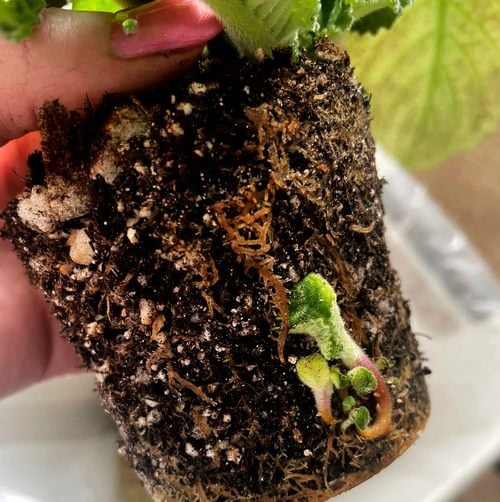
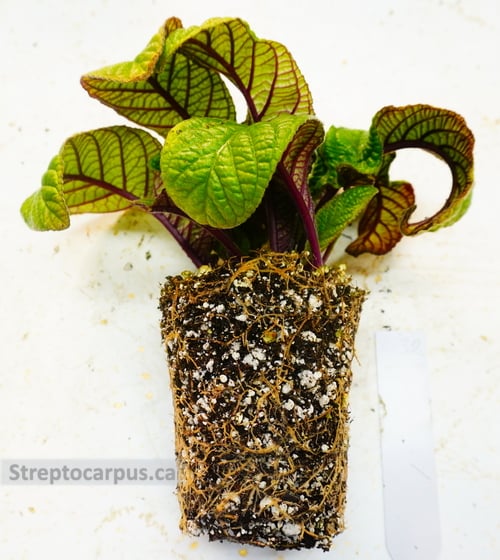
Streptocarpus are also known to form plantlets from roots, deep in the pot (see image further down in this post). These grow underground for quite a long time before the tips reach above the surface of the soil.
How can all of this conflicting information be correct? Is this another Streptocarpus myth? I decided to test the claim that planting deep will cause Streptocarpus to rot and die.
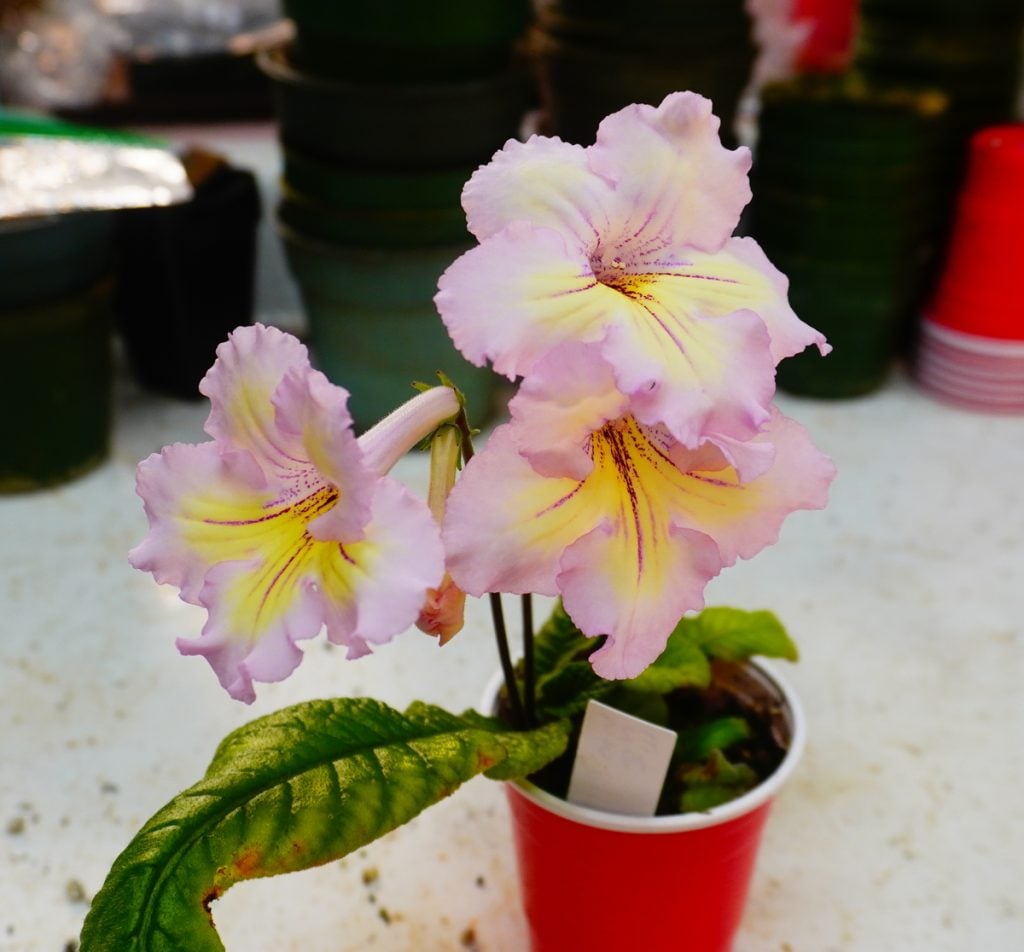
Key Takeaways
- Planting deeper will not kill a streptocarpus plant.
What Happens When You Plant Streptocarpus Too Deep?
To start with, we do have to define the term “too deep”. I think most would agree that having more than 1/2″ of soil above the top of the roots qualifies as too deep. Most growers say the crown has to be clearly visible above the soil line, and roots develop at the base of the crown.
To test the claim that plants buried too deeply rot, I started taking plants and planting them at various depths to see what happens. I have tried depths at well over 2″ deep.

The following are some of my experiments to show what happens when plants are planted too deep.
Experiment Details
All tests were done in my grow room, where I grow several hundred streptocarpus. My soil is Promix HP with about 20% to 25% perlite added. The pots are 9 oz plastic drinking cups, which are watered from above. I use synthetic fertilizer at 100 ppm nitrogen in each watering.
The test plants were kept with my regular collection and treated just like my other plants.
Experiment 25: Repot Experiment
Streptocarpus RP193 had been growing well, but it formed a very high crown. I have found that once a crown is too high, the plant stops growing well, shows poor quality leaves, and results in a loss of roots. By the time the experiment was started, the crown had almost no roots and fell apart into 3 pieces.
The pieces were planted about an inch deep, placed in a plastic bag, and left to form roots. A month later, all pieces had rooted. There was no sign of rotting, but they did lose some of the older leaves.
Experiment 31: Deep Planting
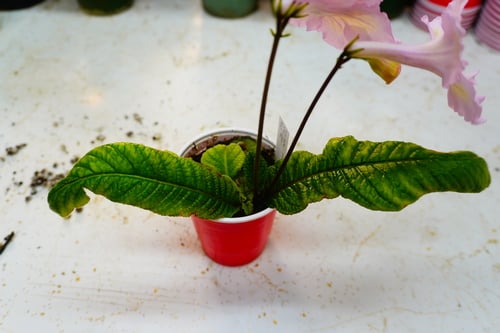
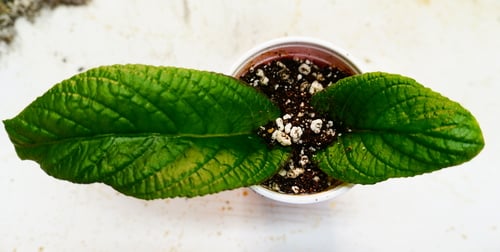
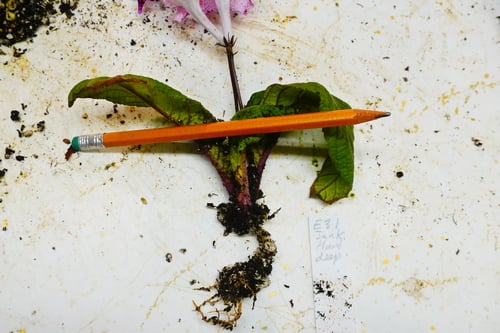
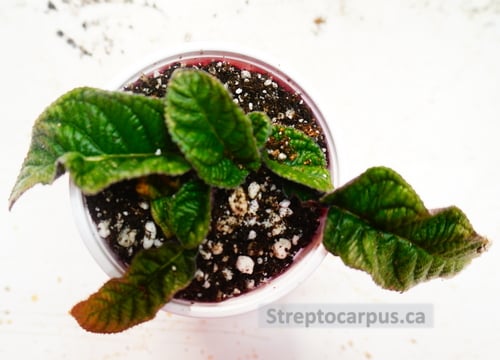
A discarded seedling was used. On Dec 31, flowers and buds were removed. The remaining plant was planted more than 2″ deep. The smallest of the three leaves was completely buried, and the other two leaves showed above the soil surface.
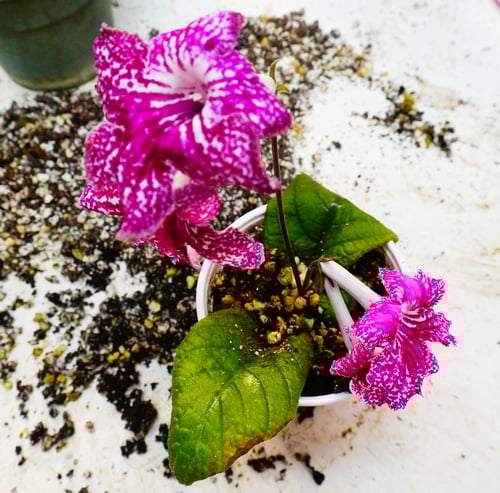
On February 19, the plant had 2 flowering stems with a total of 4 flowers. One leaf was droopy, but that might be due to a lack of watering on my part. A good root system was growing, and there were no signs of rot.
By the end of April, the plant was doing well. A couple of older leaves had died back, but rotting was not an issue.
Experiment 32: High crown
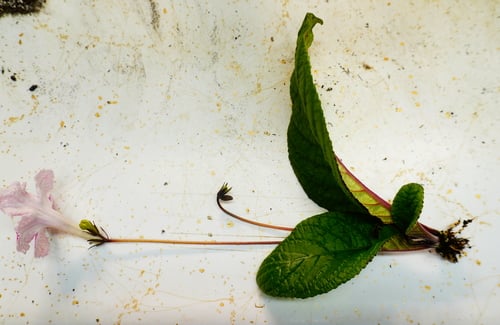
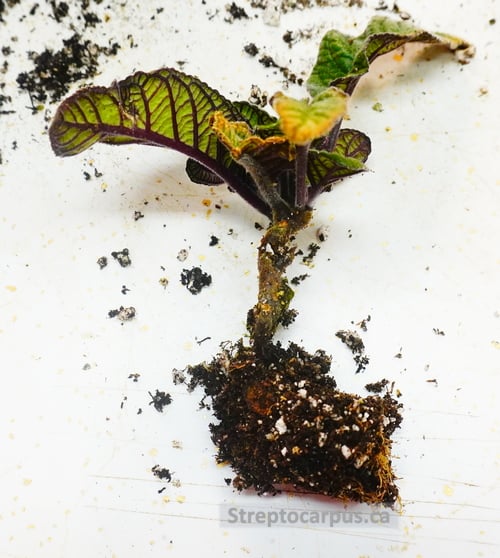
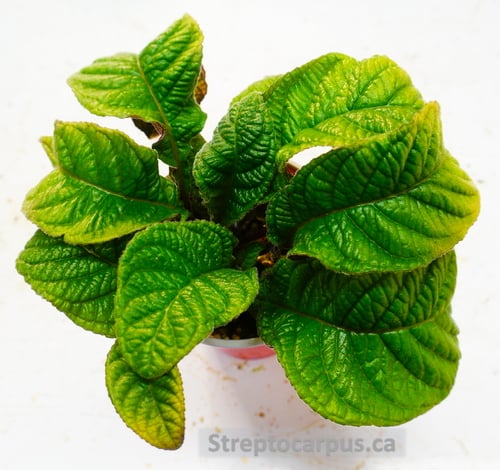
My Streptocarpus PK Samba has a tendency to form a high crown. I divided the mother plant on January 2 and removed one piece with a very high crown. It still had some roots attached, but the crown of the plant was about 2″ above the soil level and the start of the roots.
It was planted very deeply, so that even the lower part of the leaves was buried.
On April 2, the plant looked very good and had made several new leaves. It also had a very strong root system similar to other plants in my collection.
Rooting Streptocarpus Keikis
A keiki is a new plant that starts to grow on a flower stem. This form of propagation is common in orchids and also happens regularly in Streptocarpus.
Rooting streptocarpus keikis is done by inserting the new plant deeply into the soil. The flower stem will not root, but roots will form at the base of the leaves if they are touching soil. This is shown and explained in this video.

Can You Plant Streptocarpus Deeply?
I have now tested about 6 plants with extra deep planting and have had no rot. In each of the above experiments, the plant not only survived but thrived once it got used to its new depth. There was clearly an adjustment period after planting, but that is common with any plant that loses a significant amount of roots.
Deep planting puts the roots in the center of the soil, where they don’t do so well, and I suspect that they probably start dying off. New roots are made higher up in the pot where they have better access to air. Once that happens, the plants grow well.
When planting and transplanting my own collection, I do not fuss too much about planting depth and have seen no ill effects. If a crown is tending higher, the plant is transplanted deeper. If a division has a poor root system, it is planted deeper so that the soil helps support the plant.
Some growers use a wick watering system. The above experiments don’t provide any insight into how planting deep affects plants in this watering system.
I am not suggesting that deep planting is the preferred treatment of Streptocarpus. But I do believe that some of the advice and warnings about deeper planting have been exaggerated. The above experiments suggest that if a plant rots, it is not due to the planting depth.
It is always best to plant at the same height as the plant was growing before. But if there are good reasons to plant deeper, go ahead. It won’t harm the plant.


bonjour aimerai acheter des steptrocarpus .mai impossible d en trouver dans le commerce
comment faire
You can order them from me, if you are in Canada. Check out the Streptocarpus menu.
https://www.gardenmyths.com/streptocarpus-cape-primrose/