

Almost weekly I see a post in social media extolling the benefits of adding eggshells to the garden. In this post I am going to have a serious look at all of the benefits claimed for eggshells. Which advice makes sense and which is just a lot of bull?

Eggshells – What are They?
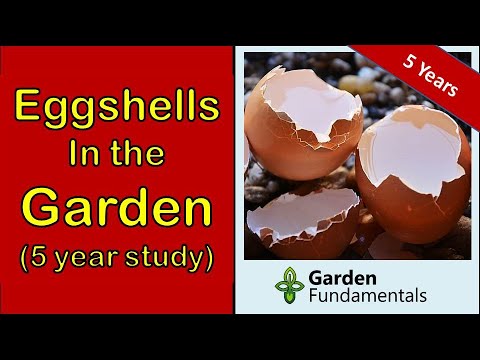
Most of the time when we are referring to eggshells we are talking about the shells from chicken eggs and that is what we are talking about here. It turns out these eggshells contain a variety of nutrients that plants can use (calcium 34%, magnesium 0.3%, phosphorus 0.04% and potassium 0.03%). They also contains 0.05% sodium and 5% organic matter.
The organic matter might be a surprise since it is not mentioned by any gardening sites. Eggshells consist of a hard outer shell, and a soft inner white skin. The inner skin contains the organic matter. The organic content can be even higher than 5% if they are not washed out. This organic matter contains nitrogen in the form of proteins, which is very useful to plants after it decomposes.
Eggshells Keep Slugs and Snails Away
Just crush the eggshells and place them on the soil around your plants. The sharp edges cut the slugs foot and so they stay away from your plants – or so I am told.
I have discussed this myth before in Eggshells Control Slugs – Do They Really Work. This post even has a cool video showing slugs crawling all over the eggshells.
The eggshells are not sharp, at least not to a slug. They don’t work.
Start Seed in Eggshells
Save eggshell halves, put some soil in them and use them to start seeds.
I am sure this works since a seed does not even need soil to get started. But what happens once the seedling has a couple of true leaves? It’s going to be too big for the eggshell and you will have to transplant it into a larger pot. Why not do that in the first place and skip the eggshell?

Some claim that you can plant the eggshell right into the garden and since the shell is organic it will decompose. It won’t decompose quickly. Unless you crack the shell before planting, or poke some holes in it, the roots are stuck inside for a couple of years. Besides, most seedlings will need to get bigger than what the shell can provide, before planting out in the garden.
You might think that the eggshell provides nutrients to the seedling. Seedlings need very few nutrients and what they do need they will get from the soil. Besides, until the eggshell decomposes it provides no nutrients.
I really can’t think of any good reason to start seeds in eggshells.

Add Eggshells to the Compost Pile
This sounds like a great idea. Why not reuse an organic waste product?
As pointed out in Eggshells – Do They Decompose in the Garden?, eggshells decompose very slowly. The only way they add any nutrients to the compost is if you grind the eggs into an extremely very fine powder before adding them.
I wanted to better understand how quickly eggshells decompose so I started an experiment to test this, called Eggshells – Decomposition Study. I’ll be taking the first test sample this summer – stay tuned.
Eggshells contain very few nutrients – mostly calcium. Most soil in North America has plenty of calcium. Unless your soil has a calcium deficiency adding more will not help grow plants. They also have a fair amount of sodium which is toxic to plants at even low levels.
Prevent Blossom End Rot
Apparently, eggshells added to soil for tomatoes and eggplants will add the necessary calcium needed to prevent blossom end rot or BER.
Blossom end rot is NOT caused by a calcium deficiency in the soil. It is a problem in the plants where they are not moving calcium to the developing fruit. You can still get BER in soil that has lots of calcium present. In most cases BER is caused by irregular watering. Eggshells won’t help that problem.
Eggshells will help BER if your soil is lacking calcium – but most is not.
For more on this see, Blossom End Rot.
Feed Eggshells to Birds
Bake the shells to sterilize them, crush them, and feed them to wild birds or chickens. As far as I can tell this is a good way to use up the eggshells. The birds seem to eat the shells which certainly contain the calcium needed for laying their own eggs.
Eggshell Mulch
I found this quote on line, “eggshells used as mulch provide a striking accent in the garden. If you gather enough, you can even apply a layer thick enough to deter weeds.”
Who can argue with the logic? This certainly will work but how many eggs do you need to eat for a 2 inch layer of mulch? More than you eat in a life time?

If you live near an egg processing plant and can get large amounts for free, this may be a very good mulch.
Eggshells as Organic Pesticide
It is claimed that crushed eggshells work just as well as diatomaceous earth in killing beetles and other insects. It is apparently a great control for Japanese beetles.
Just because crushed eggshells and diatomaceous earth both look like white powders does not mean they work the same way.
I found lots of people on Pinterest who claim it works – that does not mean much! I found no scientific references to support the idea that it works.
Sounds like a good experiment to try this summer. For once I will be happy when the Japanese beetles arrive.
References:
- Characterization of Avian eggshell waste: http://www.scielo.br/scielo.php?pid=S0366-69132006000400004&script=sci_arttext
- Main photo source: Phu Thinh Co
- Seedling photo Source: Anthony Rossos


You can add them to bread: process them with boiling water (or microwave) then dry them and crush them to a fine powder with a coffee grinder. That are tasteless in bread and a nutritional boost.
Research to support this: https://llufb.llu.lv/conference/foodbalt/2017/Bradauskiene_Montrimaite,_Moscenkova_FoodBalt2017.pdf
I grind or crush the shells and put them around milkweed, dill, fennel, and all other plants I grow for the caterpillars. Lizards hate the egg smell and don’t eat my future monarchs or swallowtails.
Birds that lay eggs need calcium, dry the shells in the sun, grind them and sprinkle in your bird feeders.
Here’s a hypothesis I’ve been growing… I have roses in zone 10 that are doing ok now for 2-3 years, blooming a few months of the year, but not really thriving, as the plants never seem to grow any bigger. Root knot nematodes are likely the culprit… they get water and compost, mulch, and pruning. They don’t have visible fungus or pests.
I have read that these nematodes lay eggs which have a lot of chitin in their tiny shells. There are gardening products you can buy that contain chitin which are supposed to attract certain fungi to the area. The fungi use the chitin as a food source.
You can also buy that fungi and inoculate the area… thereby increasing that beneficial fungi population and the fungi reduces the chitin, reducing the nematode eggs and their population over time.
This chitin + fungi strategy is known about Rose’s already. But I thought about chicken eggshells… they have chitin. Maybe this is a reason they help roses?
I’d had trouble with BER yearly, then came upon an article that says to grind egg shells into very fine powder, then mix one tablespoon of the powder with one tablespoon of vinegar, and then add that to a gallon of water. Then use that water in the holes where you’re planting your tomatoes. And then you can also water with it a couple of times a month. It worked like a charm no more blossom end rot.
And then you can also water with it a couple of times a month” – correct. BER is a watering issue. You paid more attention to the problem and watered more – and it went away.
We now know it has nothing to do with calcium.
I was just about to brings my shells when i came across this platform. So I guess i see that there’s no benefit to this process. But i wonder, in general would it help to bulk the soil a bit? Unground, of course.
It does add large particles to the soil, so will loosen it. no harm using them.
Good read indeed..
Perhaps there’s also a porosity element to consider with both eggshell and other low degrading additions to the compost/soil. How important is the physical structure of the soil?
what do you mean by physical structure?
I have 3 dozen broken eggshells in my fridge that i’ve been saving for my plants that i’m now gonna dump!
I just came across your website. Thanks for the interesting information.. I was really enjoying the experience of crushing those egg shells…it makes a lot of sense what you said. Perhaps I’ll try another food product …thanks, Isabella