

Lots of people add eggshells to the garden or compost pile. It is claimed that they add important calcium to the soil for plants. Is this true? How well do they decompose? What happens to them in a compost pile? Do they add any value to the garden?

Eggshells in The Garden
Why would eggshells be good in the garden? To limit the discussion, this post will only look at chicken eggshells. It turns out eggshells contain a variety of nutrients that plants can use (calcium 50 ppm, sulfur 39 ppm, magnesium 12 ppm and potassium 12 ppm) (ref 1). They also contain 21 ppm sodium and 5% organic matter.
The organic matter might be a surprise since it is not mentioned by any gardening sites. Eggshells consist of a hard outer shell, and a soft inner white skin. The inner skin contains the organic matter. The organic content can be even higher than 5% if they are not washed out. This organic matter contains nitrogen in the form of proteins, which is very useful to plants after it decomposes.
From a nutrient point of view, eggshells would definitely be a benefit to the garden soil if they decompose so that the nutrients are made available to the plants.
Eggshells – Do They Decompose?
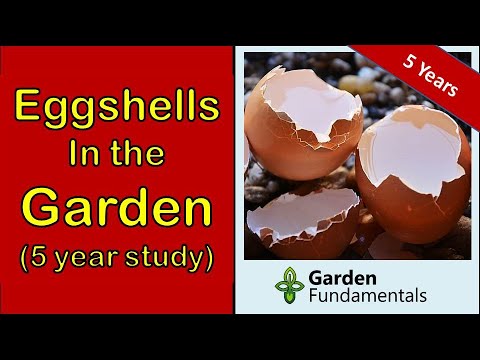
I put some kitchen scraps in the garden more than year ago and I looked at the eggshells the other day. They seemed to be completely intact – see the picture at the top of the post. Even the inner protein layer was still there.
I don’t use a compost pile very much any more, preferring the cut and drop method instead (Composting – The Cut And Drop Method). So when I emptied the compost bin the material had been there for several years. The picture below clearly shows the eggshell pieces. The pieces are quite hard and there seems to have been very little decomposition.


Eggshells Don’t Dissolve in Water
Dr. Jeff Gillman, in his book, “The Truth About Garden Remedies” (ref 2), discusses an interesting experiment. He took 1 eggshell, boiled it, and then let it sit for 24 hours. The minerals in the water were then analyzed. About 4 mg of both calcium and potassium were released into the water.
An eggshell contains about 2,000 mg of calcium. The boiling and soaking process released 0.2% of the calcium. Boiling water did not have much effect on the eggshell – why would rain and soil water have a bigger effect?
Eggshells – What Happens in Soil?
Charles C. Mitchell, Extension Agronomist-Soils at Auburn University , tested crushed eggshells in soil (ref 3). He wanted to see if eggshells add calcium to the soil, and if they change the pH of soil. If they decomposed while in the soil, you should see both changes to the soil.
The testing found that hand crushed eggshells did NOT change the soil pH, and they did NOT increase the level of calcium in the soil. This is after being in the soil for three weeks.
When the eggshells were ground very fine, they changed the soil pH and they added calcium to the soil.
The soil used for this test had a pH of 4.9, which is quite acidic. This is a very important point. Eggshells are essentially calcium carbonate which dissolves in acids, but not in alkaline solutions. Even finely ground eggshells will have a small effect on less acidic soil.
The study in (ref 4) found that eggshells stop affecting pH once the pH of the soil is around 6.8. They stop changing the pH because they stop breaking down at a pH of 6.8.
Eggshells Found in Archeological Digs
I found a report entitled “An Analysis of the Avian Fauna and Eggshell Assemblage From a 19th Century Enslaved African American Subfloor Pit, Poplar Forest, Virginia“ (ref 5). This is quite an interesting read from a historical perspective. The study looked at a property in Virginia that was at one time owned by Thomas Jefferson. It was a tobacco plantation that contained a small community of slaves from 1840 to 1860. Excavation of the site found thousands of eggshell fragments from both chickens and ducks, which had been raised by the community.
The key point for us is the fact that over the last 165 years, the eggshells in the soil did not decompose very much. In fact the researchers could still distinguish chicken eggshells from duck eggshells.
Do you still think eggshells decompose in the garden in a year or two?
5 Year Experiment Looks at Decomposing Eggshells
I wanted to see for myself what eggshells really do in the garden. I buried some and have dug some up, every year for 5 years. The inner protein layer decomposed after one year. this video shows you what I found after 5 years.
Do Eggshells Decompose in Compost or Soil!
The above information is interesting – at least to some of us.
Eggshells are extremely stable and don’t break down very fast without some help. Water alone does not seem to break down the eggshells. Acidic soil will break them down, but only if the soil is acidic enough and if the eggshells are very finely powdered. Most gardeners don’t powder the eggshells before putting them into the compost bin or spreading them in the garden.

As explained in Compost Creates Acidic Soil , compost does go through an acidic cycle during which some of the eggshell might decompose. But soon after starting the compost pile, it becomes alkaline, and during that phase very little of the eggshells will dissolve. Since the eggshells are mostly intact at the end of the composting process it seems clear that composting does little, if anything, to decompose them.
I don’t believe eggshells decompose in any reasonable period of time, either in compost or soil. If that is true – they add very little value to the garden. The exception is very finely ground eggshells (down to 60 mesh), added to acidic soil.
Where Do Eggshells Go?
If eggshells do not dissolve and they don’t decompose, where do they go? Gardeners have been adding them to soil for years and you don’t find huge piles of eggshells in their garden.
Is it possible that the microbes in soil decompose eggshells? Possible, but I could not find any reference that discussed this issue.
It is my belief that eggshells simply break up into smaller and smaller pieces while people work the soil, until you don’t see them. You think they are decomposed, but they are still there in small pieces. Pieces that are much larger than finely ground.
This conclusion is my belief, and is not proven in any way. What to do?? I know – it’s time for an experiment, which I will discuss in my next post.
References:
1) Characterization of Avian eggshell waste: http://www.scielo.br/scielo.php?pid=S0366-69132006000400004&script=sci_arttext
2) “The Truth About Garden Remedies” by Dr. Jeff Gillman
3) Crushed Eggshells in Soil: pdf of Crushed Eggshells in Soil
4) Can Crushed Eggshells Be Used as A Liming Source: http://www.agronext.iastate.edu/soilfertility/info/eggshell-lime.pdf
5) Thesis for Kathryn Elizabeth Lamzik; http://trace.tennessee.edu/utk_gradthes/1635/


WOW! How many would have thought what an interesting conversation could result from whether eggshells decompose ( especially in garden soil). I take great pleasure reading the comments of people who know so much more of the chemistry than I do . Having added egg and other seafood shells to my garden for years, there are no remnants of eggshells seen by naked eye. However, others– notably oyster shells– show signs of pinhole degradation. My addition of eggshells to garden soil ended when I started crushing them and feeding back to my ducks, who seem to prefer them to crushed ousted shell
Should be “crushed oyster shell”
I put crushed eggshells around new seedling and beans as soon as they come up. I believe it has kept the cutworms from getting my beans. l
I did not add eggshells around my beans and it seemed to keep cutworms away as well!
Without running some controls – you don’t know what happened.
Well, I’m not qualified to give opinions if they decompose or not and how fast, but I have to say that eggshells spread on top of soil will stay like that for a long time and will become quite an eye-sore. I would never use them unless grinded and then, one has to eat a lot of eggs to acquire a decent quantity.
You can easily pulverize egg shells into a fine powder with a coffee grinder, effectively increasing the surface area exposed to microbes and their enzymes and acids that they use to break down minerals in the form of rock into usable soluble forms.
Eggshells and bone are essentially biogenic rock.
I think you underestimate the power of the soil life starting with the bacteria and fungi. Nothing would break down, mineral or organic matter into soluble forms without their skills at mining and extracting.
There is no doubt that the microbes will do this – but how fast?
Very interesting. Having been adding egg shells to my garden for years, the results of your research/experimentation was rather disappointing, but truth is what it is! I do wonder if all possibilities have been exhausted. For example, when the pieces are sufficiently tiny, could they be injested by earthworms or other organisms and radically transformed; or perhaps by being invested by some plant roots. BTW, I’m also a dedicated depositer of bivalve shells (oysters, clams, mussels), and crustaceans shells like those of lobsters and shrimp. Perhaps the same egg shell results (unhappily) apply to these.
Digestion by earthworms may speed things up, but I think plants would only absorb the water soluble form of the calcium ion. I would expect shells to last longer than eggshells.
Interesting. Do you have a recommendation on how to pulverise it effectively? Or, do you experience with adding them back to chicken feed? Can they assimilate the calcium? Is it good for them?
The best way for a home owner is to use a mortar and pestle. I don,t know much about feeding chickens.
I crush them to the consistency of sand by putting them in a blender with water. I blend, pour out the extra water, and let the crushed shell dry in the sun.
I use the crushed shells in preparing litter for my composting worms. They have a gizzard like chicken and need sand like material to digest their food. Something must happen in their digestive track because I can’t find any white specks in the vermicompoat at the end of the process.
Maybe they are covered in worm poop?
I look forward to your next post Robert
Afraid ours just go in the bin. As I compost most of my material just on the soil surface shell would be a bit unsightly
As the soil is not full of undecomposed egg shells from thousands of years of not decomposing and the probability that reptile and dinosaur eggs are of a similar composition, i find it very difficult to imagine that the egg shell is not recycled within the soil. Really it comes down to what we mean by decomposition. The communition of material such as egg shell by soil animals like earth worms is a major contribution to the recycling of materials. I would argue that this is an integral component of the decomposition process. Increasing the surface area of materials such as egg shells means that they can be more easily processed by microorganisms. Calcium is a nutrient for most if not all living organisms and in a soluble form would be incorporated into the cells of many micro organisms and higher life forms so I cannot believe that egg shells would not be exploited for their calcium content. There is, however evidence of recalcitrant calcium from organic sources such as in limestone and chalk and it could be a component of complexed humus molecules. Indeed, teeth and bone composed of calcium phosphate can take a very long time to decompose. However, we use bone meal as a fertiliser.
The amount of egg shells deposited by nature is not huge compared to the amount of soil and other deposits. I am sure eventually the shells decompose – but how long does that take?
Chemically egg shells are quite similar to limestone. Limestone is converted to free calcium very slowly. Microbes may and probably do play a role in this – but their effect is very slow. It is true that most living forms need calcium but they use it in free ion form.
My understanding is that bonemeal is heat processed and then ground very fine. The references show that grnding to a fine powder speeds up the process – that is not done with eggshells, normally. Normal bone does not decompose quickly.
I dont use bonemeal – I need neither calcium nor phosphate added to my soil – and most people don,t need it.
Maybe I should have phrased the last sentence a little more carefully saying; “However, bone meal is used as a fertiliser.”
My point was, whether particular people use it or not, bone meal is a fertiliser that contains calcium phosphate which decomposes relatively slowly – not unlike egg shell containing calcium carbonate, but bone meal must decompose or it would not be a fertiliser. Whether we compost egg shells or some way else dispose of them, they will decompose, albeit relatively slowly, and add nutrients to where ever they have been added to the soil.
Why give those nutrients away to someone else when they could be used in your own soil?
What else would you do with them anyway?
To judge a compost substrate on how long it takes for it to decompose seems to be a very arbitrary way to select items for the compost. However, to base compost making on the proportions of carbon and nitrogen within micro organisms seems to be quite arbitrary as well. Deciding on what is green and what is brown not to mention whether the ratio is volume or weight seems a little ridiculous particularly when considering the rate of decomposition of different components – such as egg shell. Suberin, lignin hemicellulose and cellulose all decompose at different rates and some may remain in the soil for thousands of years before they are decomposed. So carefully working out your ratio of brown to green, whether by weight or volume, while some of that brown will not be of any use in producing nutrients for plants, seems pointless to me. However, the brown will be essential to increasing the potential CEC – compost and other organic amendments to soil, such as egg shell, do a lot more things than just add nutrients.
I am sure adding egg shells to the garden will do no harm. If I am right they might add calcium for the next generation. Can they do harm? Possibly.
If the soil is already high in calcium adding more might be a problem, but not likely given the small amount of eggs used by most families.
They can cause harm indirectly because people are using them thinking they can solve a problem. So for example, adding them to calcium deficient soil will not help blossom end rot in tomatoes. Adding a better calcium source will help – if calcium deficiency in soil is the problem. This is probably not a major issue either.
I like your comments about browns and green in compost, and agree 100%. The rule really does not make sense. Grass clippings are a green one day, and after sitting in the sun for a day, they are suddenly a brown?
As I look at more and more myths I am starting to understand that some of these myths are being created to give people simple rules. Imagine explaining composting without the brown and green rule? Who would understand? Give people a simple rule that they do understand, and can use, and they just might head in the right direction.
The comment about weight vs volume is also astute and very valid. In the last couple of weeks I have read a number of comments/articles talking about the correct organic content in soil. Almost no one specified if their number is by weight or volume – which is a 100% difference when talking about organic matter.
All due respect, if I put a pile of eggshells to the side and didn’t incorporate material for a year, there is little doubt in my mind I’d have the same results.
Our house uses 4-6 eggs/day for breakfast, other dishes and breads. (We do almost all of our own cooking.) All those shells go into compost piles/units which typically get >140 for at least a week or two. By the end of the process the only discernible shells are the ones trapped along the sides and therefore not turned during the composting process.
Some of the resulting compost is screened with a 1/4″ screen to make potting soil. Not surprisingly, some shell pieces are evident, but very few.
Everything organic decomposes (eg, rocks, uranium, metals, proteins, etc.). I can see no reason to believe eggshells defy that process.
How do you know the eggshells have been decomposed rather than just broken into smaller pieces? You will not see the difference by eye.
It is true that everything organic decomposes – but that is only true if you use the chemists definition of organic. Uranium is an element and not organic – it does not decompose since it is already an element. Rock and metals are not organic and decompose very slowly. Protein is the only one on your list that is organic and it decomposes quickly. Eggs are a combination of an inorganic outer shell and an organic inner skin. The inner skin should decompose quickly, but the outer shell is more lik rock.
I never said eggshells won’t decompose. I am suuggesting that the process is much slower than people think.
Actually, uranium decomposes into lead. Similarly, rocks do indeed have organic material – they can contain carbon, phosphorus, potassium, oil, tar, etc.
By your apparent definition, one would be purchasing a bag of rock or filling their car with stones, rather than a bag of phosphorus or gallons of gas. Once sufficiently broken into constituent pieces,
You may not have intended to say that eggshells won’t decompose, but you did say “If eggshells do not dissolve and they don’t decompose, where do they go?” Perhaps I misunderstood, but I took that to mean you feel that eggshells “don’t decompose.”
The most abundant isotope of uranium is 238 with a halflife equal to the age of the earth – according to wikipedia. From a gardeners perspective that is stable.
I don’t follow your comments about my definition about organic. You might understand the definition better by looking at my post What Does Organic Mean?
I discuss how eggs decompose in several places in the post. Keep in mind I write for gardeners. The way most gardeners use eggshells – do not seem to decompose quickly.