

I recently did a post about Cal-Mag where I described the value of getting the calcium level right. As part of that work, I found recipes for making Cal-Mag fertilizer at home using eggshells, vinegar, and Epsom salts. I’d like to use this post to have a closer look at these methods to figure out if they work and if gardeners should be using them.
What Is Water-soluble Calcium (WCA)
Calcium combines with a number of compounds to create insoluble forms of calcium, and the calcium carbonate in eggshells is a good example. Since this calcium does not dissolve in water, plants can’t use it. Some forms of calcium are soluble, which plants can use. Water-soluble calcium (WCA) is a term used in Korean Natural Farming to refer to this soluble form of calcium.
What Is Cal-Mag?
I discussed this in detail in Cal-Mag for Plants— What Is It, and Do You Need It?
In summary, plants do need calcium and magnesium in amounts around 100 ppm and 40 ppm, respectively. This can come from water, soil, commercial fertilizer, or a DIY source. Neutral or alkaline soil usually has enough, but some soils are deficient. People with hard water usually get enough in their tap water, especially for houseplants and containers. A calcium or magnesium deficiency is normally only a problem for potted plants being watered with soft tap water, rainwater, or RO water.
Homemade Magnesium for Plants
Acidic soil benefits from lime, and using dolomitic lime will not only improve the pH but also add magnesium at the same time. Soil that is not acidic and is deficient in magnesium can be amended with Epsom salts, which are 10% magnesium and 14% sulfur.
A 40 ppm solution of magnesium is made using 1.5 gm of Epsom salts per gallon or 1/3 teaspoon per gallon (1 tsp = 5 gm of Epsom salts).
Compare that to popular online recommendations for adding magnesium, which is 2 tablespoons (6 teaspoons) of Epsom salts per gallon. That is 20 times more than you need—what a waste of material, not to mention that high levels of magnesium can create an imbalance with other nutrients.

Calcium In Eggshells
Eggshells contain mostly calcium carbonate (CaCO3), and it dissolves easily in vinegar, which is acetic acid (CH3COOH). The result is calcium acetate in solution and CO₂. Calcium acetate is a soluble form of calcium. The acetate is an organic molecule that is easily decomposed by microbes, leaving the calcium free for plants. This is sound chemistry and can be used to provide calcium for plants. If you also add Epsom salts, you create a Cal-Mag mixture.
Some sites call this “fermented eggshells,” but there is no fermentation taking place.
The problem with many DIY recipes is that the authors don’t understand the chemistry and make false statements about the recipes.
- You should use brown rice vinegar.
- Use a 1 to 1,000 dilution for plants, or is it 1 to 20?
- Roast the shells in an oven to prepare them.
- The amount of shells and/or vinegar is rarely mentioned.
You Should Use Brown Rice Vinegar
Brown rice vinegar has some added color and flavor when compared to regular vinegar, but it is still acetic acid. There is no reason to specify a special kind of vinegar.
Use A 1 To 1,000 Dilution For Plants
If the original amounts of eggshells and/or vinegar are not specified, you have no idea what the final concentration of calcium is, and therefore you don’t know the correct dilution ratio. This is a problem with many DIY recipes, not just cal-mag. The only way to know the contents of a final concoction is to control the input ingredients.
I found dilution ratios ranging from 1 to 20 all the way up to 1 to 1,000. One video even said it doesn’t need to be diluted.
Roast The Shells In An Oven To Prepare Them
Many recipes include this step and claim it will “remove any organic substances that will rot and contaminate the WCA,” or “dry the shells so they absorb vinegar better,” or “burn off the inner membrane.” The inner skin is not decomposed with the vinegar and remains behind with the undissolved shells, so it is not a problem. The vinegar is mostly water, and drying the shells so you can put them in a water solution of acetic acid doesn’t make sense. Even with baking, the final solution is not sterile, but it also has very few nutrients in it that can sustain microbes. I see no benefit in baking the shells.
The Amount Of Shells And/or Vinegar Are Not Mentioned
DIY recipes that do this are just flying blind. If you follow them, you have no idea what is in the final mixture. If you use too much vinegar compared to the amount of shells, the resulting solution will still be acidic and may harm your plants.
Homemade Calcium for Plants
Even though many of the DIY recipes for making a calcium supplement for plants are poorly designed, the method does work if it’s done correctly by following this recipe.
Each calcium atom in eggshells will react with two acetate molecules. If you start with 5% vinegar (not all vinegar is 5%) and make sure the reaction goes to completion (i.e., all the vinegar is used up), you will end up with a 2.5% solution of calcium acetate. You need to know the concentration of the vinegar, which should be on the bottle, to calculate your final concentration. Use any amount you like, and then add the eggshells. Wait 48 hours for the reaction to be complete. It is done when it stops making bubbles (escaping CO₂). You can also taste the liquid. You won’t taste much vinegar at the end of the reaction.
By using an excess of eggshells, you ensure that all the vinegar is used up and that the solution is no longer acidic. At the end you should have undigested eggshells left over. If they are all gone, you did not use enough. Add more and wait another 48 hours.

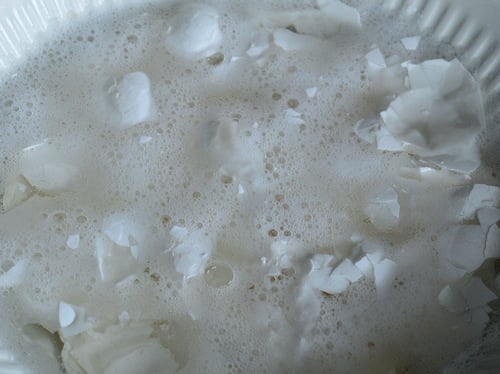
Grinding the eggshells will speed up the reaction, but it is not necessary. Some recipes dilute the vinegar before adding it to the eggshells, but there is no point in doing that because vinegar is mostly water already.
It is important to know the final concentration of the calcium so you know how much to dilute it before using it on plants.
Vinegar is about 5% acetic acid, which will produce a final solution that is 1.6% calcium.
Plants need about 100 ppm calcium. To make such a fertilizer solution, add 23 mL or about 1.5 tablespoons) to a gallon of water.
Making A Cal-Mag Solution
A cal-mag solution provides both calcium and magnesium to plants. To make such a solution, start with the diluted calcium mixture and add 1/3 teaspoon Epsom salts per gallon.
Homemade Calcium for Plants Without Vinegar
Some sites suggest that you can simply steep the eggshells in water and make a “strong calcium solution” for plants. I reviewed this in my book Garden Myths Book 1 as Myth 49. An eggshell contains about 2,000 mg of calcium, and boiling it in water releases about 0.2% of this, forming a very dilute solution, which is essentially useless.
Calcium Foliar Spray
Many sites recommend using the above DIY calcium spray as a foliar spray and usually mention that it will cure blossom end rot (BER) in tomatoes. BER is a watering issue that results in lower than ideal levels of calcium in the fruit. Calcium is a non-mobile nutrient in plants. Leaves will absorb it from a foliar spray, but it stays in the leaves. It is not transported to the fruit, and the fruit will absorb very little calcium from the spray. Bottom line: a calcium spray will not cure BER.

Should You Make Your Own DIY Cal-Mag Solution?
Provided it is made properly as described above, you will create a suitable cal-mag solution that is safe to use on plants. Vinegar is very cheap, eggshells are free, and Epsom salts probably cost less than a commercial fertilizer. I think this is one DIY mixture that makes sense.
However, make sure you need it. Adding cal-mag to soil is only beneficial if you have a deficiency. Most soil is not deficient in calcium or magnesium, in which case cal-mag should not be used. If you have hard water, check the levels in it—you may not want to add any more. Use cal-mag only in situations that require it, and don’t listen to common advice on the internet that suggests adding large amounts to everything. Too much is not good for soil or your plants.


Hello Mr. Pavlis.
Thank you for this site, I wish to have found it earlier.
I have three questions concerning this post.
1) Since using 5% vinegar creates a 2.5% solution, I assume using 10% vinegar will create a 5% solution, correct?
2) Can the undiluted solution be stored indefinitely without loss in quality, it is it better to make fresh batches regularly?
3) I am container gardening tomatoes for the first time, and am using water-soluble synthetic fertilizer once a week. Would it be okay to add the calcium solution and Epsom to the fertilizer water mix, or should I give it on a different day?
Thank-you.
Will
#1 – yes
#2 – I think it would be very stable
#3 – they can be used together
Thank you*****
Is it possible to use this homemade calcium acetate in hydroponics instead of using calcium carbonate.
Thank you. I read this because I’m going to make alcohol gel fuel. Mixing calcium acetate with alcohol.
Can industrial strength vinegar be used? Or phosphoric acid?
yes
So according to my PH meter, the breaking down of the calcium in the eggshells when ground up in white vinegar slows to a near stop at about 4.6ph. this is barely below the minimum acceptable pH for most plants at 5.0ph. if the TDS meter can be believed, this is between 9,000 and 10,000 PPM. I’m going to have to test it out, but I think it’s safe to assume depending on the level of calcium needed, somewhere around base + 200-300ppm with the correct ph would probably provide a good starting charge of calcium acetate for the plants in either a foliar or soil application. Any thoughts?
What if I start off with calcium acetate powder? How many grams of calcium acetate would I need to add to a gallon of water to make 2.5% concentration?
1 L of water weighs 1,000 g
A 2.5% solution has 25g in 1 liter (2.5% of 1,000)
That is a 2.5% calcium acetate solution. Or did you want a 2.5% calcium solution?
Yes a 2.5% calcium solution so that it matches your awesome explanation in the article. My goal is to just skip the eggshell/vinegar reaction and just add calcium acetate in water. I already have it handy in powder form.
A 2.5% solution has 25g in 1 liter (2.5% of 1,000)
Calcium acetate has a formula of C₄H₆CaO₄
Its molecular weight is 158. Of that calcium is 40, or 25%.
So 100g of calcium acetate in 1 liter would add 25g calcium in 1 liter or 2.5%
Hi! Thank you so much for your info, I am soaking egg shells now… one question: what would you recommend doing with the ground egg shells after draining the calcium solution from them? Would they be safe for my red-wiggler worm bin?
If you are soaking in vinegar – there should be no eggshells left.
If you are soaking in water – read the post again – that is a useless exercise.
Excellent post! Thank you very much for the information.
What concentration of calcium acetate do you suggest for coir buffering?
Just wondering if we could make the Ca solution, and then mix with epsom salt `til it dissolves (and have like a bottled CalMag product that`s going to have 100ppm Ca and 40 ppm Mg in every gallon) , or we have to store them separately and mix them when feeding? Happy growing!