

I know that many of you think that this question has already been settled and that 97% of scientists agree that global warming is anthropogenic, i.e., it is human-caused.
The question is far from being settled
The goal for this post is to present some of the arguments presented by both sides of the debate.
Key Takeaways
- There is clearly no consensus about climate change among scientists.
- There is no consensus about the extent of human-caused global warming.
- We know a lot less about the climate than we have been led to believe.
- Society has been misinformed by the news – no surprise there!
Climate Alarmists vs Climate Realists
Scientists and the general public tend to fall into one of two camps: Climate Alarmists and Climate Realists. I am sure some people fall in the middle, but these are the two larger and better-defined groups.
Climate Alarmists:
Climate alarmists believe in anthropogenic climate change. Humans are producing too much CO2, which in turn is the major cause of global warming.
Global warming is causing a climate crisis, and if we don’t act quickly, the Earth and future generations are doomed.
Climate Realists:
Climate realists believe that global warming is real. They also believe in climate change and the fact that the climate is always changing. Some people label this group, climate deniers, but that term is clearly wrong since they do believe in climate change.
This group also believes humans are contributing to some of the global warming, but it’s not the major cause.
They also don’t believe the Earth is in a crisis and facing imminent catastrophes. Instead, they would describe their view as, “Over the coming century, for most economic sectors, the impact of climate change will be small relative to the impacts of other drivers. Changes in population, age, income, technology, relative prices, lifestyle, regulation, governance, and many other aspects of socio-economic development will have an impact on the supply and demand of economic goods and services that is large relative to the impact of climate change”. As Ross McKitrick has pointed out, this is from the IPCC 5th Assessment Report, Working Group II, Ch 10 – a group normally viewed as climate alarmists.

What Do These Groups Agree On?
There are some fundamental facts that both groups agree on, and some of these may surprise you.
- The climate is changing and has always been changing.
- Global warming is happening. Temperatures are rising.
- CO2 levels are rising.
- CO2 is a greenhouse gas that warms the atmosphere.
- Humans have contributed significantly to CO2 levels in the last hundred years. Much of this is from burning fossil fuels.
If there is so much agreement, what do the groups disagree on?
- The degree to which CO2 is causing the current warming.
- The effect global warming has on climate parameters. The realists believe the effect is relatively minor, while the alarmists believe we are close to a crisis.
- The future trend for global warming. One group predicts minor changes while the other predicts large changes, which are more likely to cause climate catastrophes.
- The accuracy of climate models.
- The impact humans have on global warming.
The differences are significant and have profound implications for what governments and citizens do going forward. For example, the movement towards wind and solar is largely driven by alarmists.
The 97% Consensus
I am sure you have seen the headlines: “97% of scientists agree that humans are causing global warming”. Some, like this example, even extrapolate it incorrectly to “causing climate change”.

The result of a survey is very dependent on the questions asked because it is very easy to skew the results by slight variations in the language used. For example, how was the term “caused” defined? Did it ask ‘are humans mostly responsible’, or did it say ‘are humans somewhat responsible’? This is critical since even climate realists agree that humans have some contribution to global warming.
What questions were used in this survey? Surprise! There was no survey.
The 97% number stems from some work done by John Cook etal, in a letter published in ICP Science. They looked at the abstracts from 11,944 studies that used the terms ‘global climate change’ or ‘global warming’. They found that “66.4% of abstracts expressed no position on AGW (anthropogenic global warming), 32.6% endorsed AGW, 0.7% rejected AGW, and 0.3% were uncertain about the cause of global warming”.
Out of the 33% that expressed a position on AGW, 97.1% endorsed the position that humans are causing global warming. The published letter correctly states the conclusion as “Among abstracts expressing a position on AGW, 97.1% endorsed the consensus position that humans are causing global warming.”
That means 32% of the 11,944 research papers endorsed anthropogenic global warming!
Here are some key points:
- No survey was done to reach this conclusion.
- The scientists who created the studies examined in the report were never asked for their opinion.
- This work examined the belief in global warming, not climate change. The title of the work is “Quantifying the consensus on anthropogenic global warming in the scientific literature”. News outlets and reporters changed the wording from global warming to climate change to sensationalize the story.
- The data gives us no insight into what “scientists believe”.
At best, it can be claimed that 32% of research papers endorsed anthropogenic global warming!
There is NO 97% consensus!
A real survey was done in 2012 by the American Meteorological Society (AMS). It received 1,862 responses from 7,000 members. Only 52% said they think global warming over the 20th century has happened and is mostly man-made. The remaining 48% either think it happened, but natural causes explain at least half of it, or it didn’t happen, or they don’t know.
Furthermore, 53% agree that there is conflict among AMS members on the question. Clearly not a 97% majority!
S. Fred Singer (a climate realist) said in an interview with the National Association of Scholars (NAS) that “the number of skeptical qualified scientists has been growing steadily; I would guess it is about 40% now.” This is an opinion and not a survey, but it does indicate that the 97% number is far from being correct.
Climate Alarmist View:
Climate alarmists repeat the 97% number regularly, inferring it is proof of their position. Either they don’t understand how the data was analyzed, or they choose to ignore the fact and just repeat it to convert people to their side?
Climate Realist View:
They don’t dismiss the idea that many, maybe even a majority of scientists, believe in anthropogenic global warming, but they don’t accept the 97% value.
They also point out that the “number” is irrelevant in the discussion and does not indicate the correctness of either side. Many key discoveries in the past started with almost no scientific support, only to end up with a consensus. For example, the belief in the theory of continental drift.

The Hockey Stick Trick
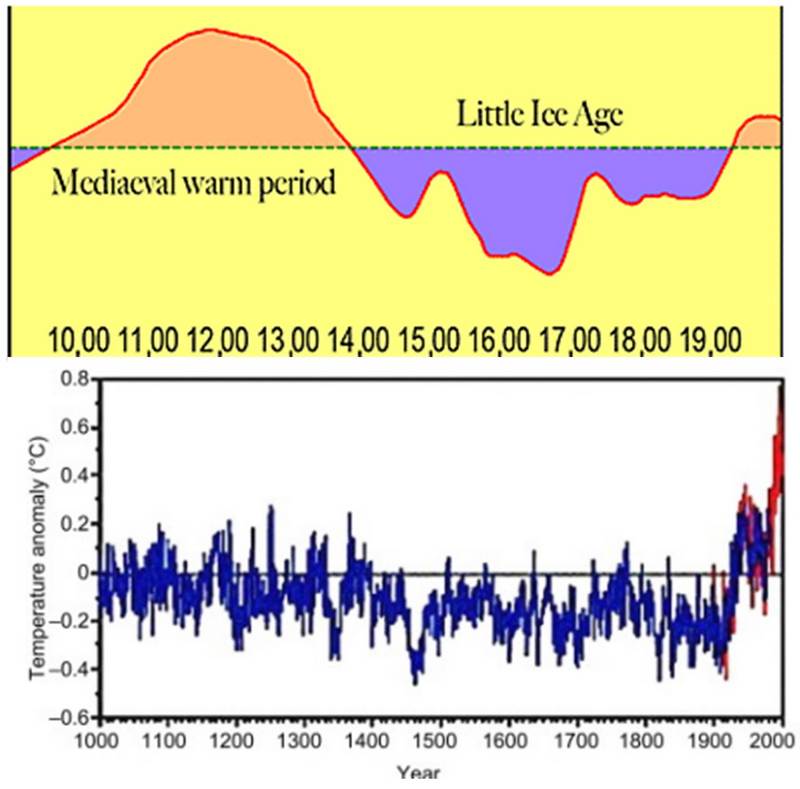
I am sure you have seen the ‘hockey stick’ graph showing sudden warming starting around 1900 (see below). This has led to claims such as:
“Temperatures are higher than they’ve ever been.”
Followed by, “it must be anthropogenic warming because it lines up perfectly with human activity and CO2 production”.
There is more to the story.
Over a period of many decades, hundreds of papers were published establishing the Medieval Warm Period from about 900 A.D. to 1300 A.D. and the Little Ice Age from about 1300 A.D. to 1915 A.D.
One way we know about this warm period is that the Vikings started settling Greenland at this time. These settlements existed in a warm climate that allowed agriculture, and they lasted for about 500 years until the start of the Little Ice Age. There are many historical papers supporting these facts, and it was accepted as fact in the IPCC-AR1 (1990) report.
Around 1998, Mann et al. published a paper declaring that all of the past work was wrong and neither the Medieval Warm Period nor the Little Ice Age happened. The evidence was based largely on tree ring data. I guess the Vikings couldn’t tell the difference between green land and snow-covered land?
This also became the official position of the 2001 Intergovernmental Panel on Climate Change (IPCC). In one simple step, the research effort of thousands of scientists was dismissed.
Mann’s study presented the data in the now-famous hockey stick graph shown below.
Climate alarmists argue that the work done by Mann corrected the past mistakes of hundreds of scientists.
On the other hand, climate realists, such a McIntyre and McKitrick (2003, 2005), have shown that the methodology used by Mann to create the hockey stick graph has several important flaws. McKitrick has commented that some are so basic that it is hard to believe they were not caught during the review process. The hockey stick graph is wrong, but the IPCC continues to use it.
It is a good graph for convincing people that we are suddenly in a warming crisis. It allowed Gore (2007) and others to claim that “Our civilization has never experienced any environmental warming similar to this”.
Why is the Medieval Warm Period so important to this discussion? Climate scientists have trouble explaining why and how it existed, creating more questions about our understanding of climate and the climate models. How can the Medieval Warm Period exist when CO2 levels were still low?
The warm period also provides a sense of comfort with the realization that even with recent warming, temperatures remain colder than what has been the case during most of the era of human civilization, in the past 6,000 years.
Bond et al. and an international team of scientists, studying this time period, claimed that the Little Ice Age and Medieval Warm Period were (1) real, (2) global, and (3) solar-induced.
What Do Climate Models Tell Us?
Climate models and weather models are large, complicated equations that have numerous parameters. Scientists and climatologists populate the values of the parameters and use the results to predict future events.
We have been using weather models to predict the weather for quite a while, and compared to climate models, they are much less complicated. They also focus on a very specific area of the globe. If you think back 20 years ago, a 5-day forecast was fairly inaccurate. Today it is quite good.
The reason for this improved accuracy is that we understand the parameters better and have fine-tuned the formulas to give more accurate information. This was possible in part because climate experts can make changes, wait 5 days, and see if the changes are correct. Then fine-tune the equations and values and repeat the process many times.
Climate models are much more complex, and they predict climate changes in the next 30 or 100 years. It is hard to wait 30 years to see if they are right and then make adjustments to improve them. There are also a lot of things we don’t understand about climate.
Take clouds, for instance. I have heard several climate alarmists agree that we don’t know enough about clouds, and yet they have a huge impact on temperature and climate. The variables and values we use for clouds in the models are only poorly understood, and that leads to errors in model predictions.
The process of predicting future climate makes use of many models because we don’t know which ones are correct. They are run using recent data to predict today’s climate. Any model that does not perform well is eliminated from the bunch, without knowing why, except that we know it is wrong. The remaining models are then used to predict the future, without knowing if any of them are correct.
Gavin Schmidt, director of the NASA Goddard Institute and a climate modeler, had this to say. The year 2023 was the hottest on record (ocean + land), and our models were completely wrong in predicting the event. “We did not understand something”. The models account for solar cycles, but mostly, it is still a mystery to predict their effects. The models are also poor at taking the effect of aerosols (dust, sea salt, human-caused particulates) into account. In fact, NASA is launching a new satellite to measure these. Aerosols have a large impact on model predictions for warming.
The models predict that global warming will cause the oceans to warm. However, the western Pacific has warmed, while the eastern Pacific has cooled. There is a 1.5 °C difference between the two sides, and this was a complete surprise to climate scientists because climate models did not predict it.
Some of you think that the idea of anthropogenic warming has been settled, but it hasn’t. A recent paper by Green & Soon compared the IPCC anthropogenic-based climate models with solar-based ones and found that models based on solar variables consistently produced more accurate forecasts across various estimation periods, suggesting that the fundamental model design used by the IPCC is flawed and that human-caused CO2 is not responsible for global warming.
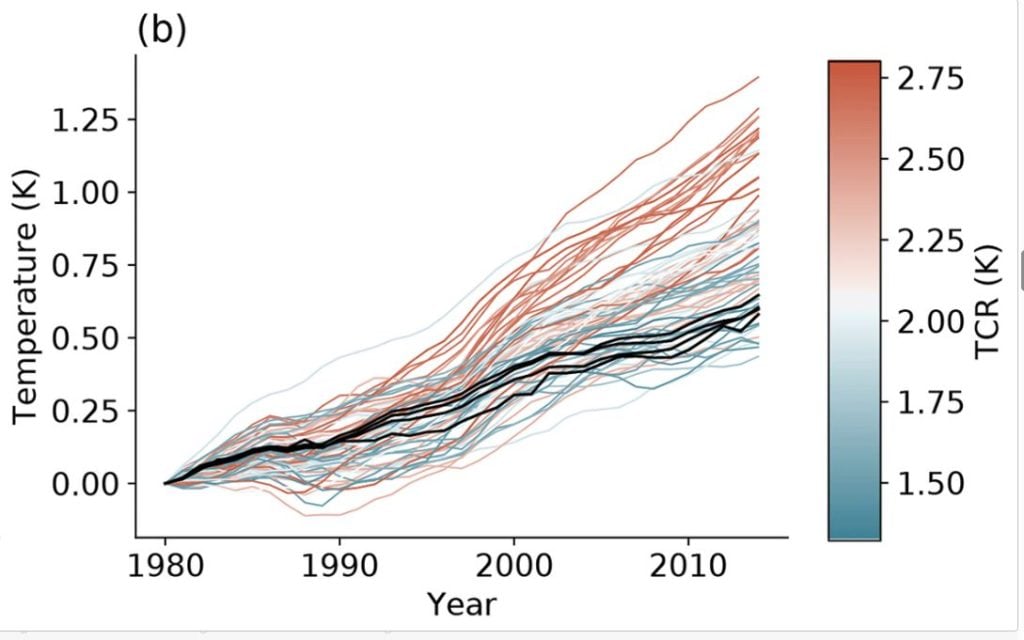
The above chart is a comparison of the CMIP6 models and actual temperatures. Some of these models are used by the IPCC. The colored lines are the predicted temperatures by the models, and the solid black lines are from 3 real data sets. The models clearly have difficulty predicting the temperatures over the last 40 years, so there is no reason to accept their values for the next 40 years.
The chart below compares 102 IPCC CMIP5 climate model data to actual measured data from air balloons and satellites. The fine lines are the predictions from climate models, and the red line is the average of the models. The circles, squares, and diamonds are actual measured data.
Why should we have confidence that the future predictions of the models are accurate?

There is another very important concept used to build the models. The process starts by making some assumptions. The models are then built on these assumptions. In the case of many climate models, especially the ones used by the IPCC, the assumption is that warming is anthropogenic. The models are then modified and tweaked to confirm the assumption is correct. This builds in an automatic bias for anthropogenic warming.
What do both sides agree on?
Both sides agree that the climate models are not perfect. They also agree that there are several key climate properties, like clouds and ocean currents, that are poorly understood and therefore are not properly reflected in the models.
Surprise events like the 2023 heating or the cooling of the Pacific Ocean indicate imperfections in the models.
Climate Alarmists:
Climate alarmists understand there are limitations in the models, but downplay their importance. They still use the models to predict the future.
Climate Realists:
Climate realists have very little faith in the models for three reasons. First is the reason stated above, that there are far too many unknowns to make them reliable. We don’t know enough to know how inaccurate they are. Secondly, scientists have found fundamental flaws in the way they are created and tested, and thirdly, they are inherently flawed because of their bias toward anthropogenic warming.
The Reality:
Climate modelling is hard, uncertain, and lacks good data. Models are getting better over time, and they may provide some insight into the future. However, they are not yet good enough to validate anthropogenic warming, and they certainly should not be used to direct government policy.
Can CO2 Cause The Warming?
Let’s start by listing things that both sides of the debate agree on.
- The Earth is warming.
- CO2 is a greenhouse gas that is responsible for some warming.
- The greenhouse effect is real.
The disagreement between the sides is mostly based on the amount of warming caused by CO2.
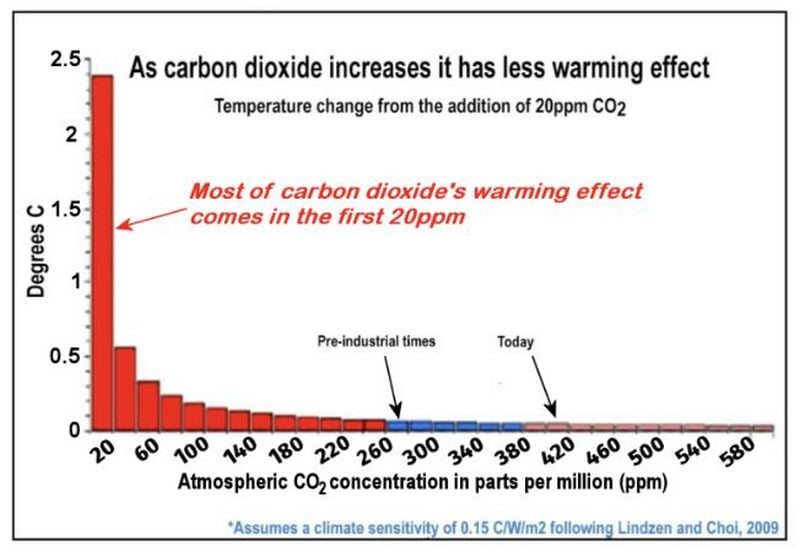
Climate realists believe that the current level of CO2 in the air is at a saturation point, and it has caused almost all the warming that it can. Doubling CO2 levels will increase temperatures very little. For this reason, human-caused CO2 can’t be responsible for the current warming trend and is certainly not going to cause any significant future warming.
Climate alarmists also seem to accept the saturation principle, but they point out that CO2 does more than just warm because of the greenhouse effect. It also activates so-called feedback loops, which also cause warming. As humans produce more CO2, they are activating these feedback drivers, which in turn cause more warming.
When confronted with the feedback narrative, climate realists argue that most of these feedback mechanisms are negative feedback loops, which cause a cooling effect. Any positive feedback loops have minimal effects on warming because they are overshadowed by the negative ones. Besides, most of these are not well understood and only show positive effects in the climate models, which are themselves incorrect.
There seem to be two important questions that need to be answered before you can discuss the effect of CO2 on global warming.
- Has CO2 reached a saturation level?
- What effect do feedback loops have on warming?
Has CO2 Reached a Saturation Point?
The saturation point has been well documented and published. Much of this work was done by Dr. Will Happer, at Princeton University, and Dr. Richard Lindzen, at MIT, two experts in atmospheric physics.
The chart below summarizes their conclusions about CO2. It does have a warming effect, but as levels rise, the subsequent effect of warming diminishes dramatically. Increases above today’s 420 ppm level have almost no effect on warming.
Dr. Will Happer claims that a doubling of atmospheric CO2 would cause a maximum of approximately 1°C of warming. At the current rate of human CO2 production, we won’t reach this level until 2100. The link for Dr. Happer explains the physics of this very well.
Climate realists argue that reducing CO2 emissions is pointless since they will have almost no effect on reducing global warming.
It is important to point out that the science behind the saturation claim is not normally in dispute by climate alarmists.
The Feedback on Feedback Loops
Feedback loops refer to natural processes that either speed up or slow down an environmental change. A positive feedback loop accelerates the environmental change, and a negative feedback loop slows it down.
An example of a positive feedback loop for CO2 warming is the melting of permafrost. The Earth warms, which causes melting of permafrost, which increases microbial activity in the soil. The microbes produce CO2, which leads to more warming, and the cycle repeats itself.
An example of a negative feedback loop is plant growth. Extra CO2 in the air causes plants to grow better and larger. This consumes more CO2, reducing CO2-caused warming. Plants growing with higher CO2 levels also need less water, which helps explain why the deserts are greening.
It is also interesting that plants growing in higher CO2 levels need to take in less air, so they grow fewer stomata. Fewer stomata result in less water loss. We can even see the difference between today’s trees and those collected 150 years ago.
Another common feedback loop deals with clouds. CO2 causes warming, which in turn increases water evaporation on the surface of the Earth. Extra moisture in the air increases cloud cover, which reduces the amount of sunlight reaching the surface of the Earth, leading to cooling. Based on this description, it is a negative feedback loop for warming caused by CO2.
However, climate models used by the IPCC assume that clouds provide a large positive feedback, greatly amplifying the small warming effect of increasing CO2. A detailed analysis of cloud behavior from satellite data by Dr. Roy Spencer of the University of Alabama shows that clouds actually provide a strong
negative feedback, the opposite of what is assumed by the climate modelers.
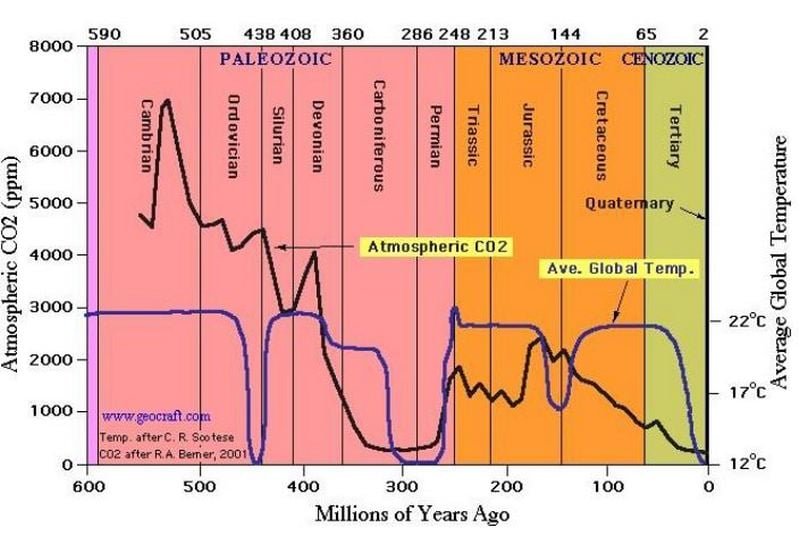
The paleodata indicates times when CO2 levels were more than 100 times higher than today. And during some of those periods, temperatures were much lower than today. At first glance, this can be taken as evidence that CO2 is not driving warming, but it is important to understand that many other factors affect the climate. Drivers of past climate change include variations in solar output, continental drift, orbital variations (known as Milankovitch cycles), volcanism, and ocean variability.
CO2 might have caused warming, but these other factors caused even more cooling. The key point here is that we don’t understand these factors very well.
The interaction between the climate and environment is very complex, and there are many such feedback loops, some negative and some positive. Most are not well understood. You will find people talking about the loops in a general way, as I have done, but I have found no assigned numbers to the effects.
The only place to find numbers for the effects is in the climate models. But the latest science strongly suggests these models may be missing key parameters. For example:
- Plants absorb 31% more CO2 than previously thought.
- Warming oceans should be outgassing CO2 due to warming, but the IPCC insists oceans are absorbing CO2, driven by biological processes and circulation patterns.
- Rivers are emitting old CO2, which can’t be distinguished from CO2 created by burning fossil fuels.
- The effect of sun radiation is more extreme than accepted by some scientists.
Climate alarmists are of the opinion that the positive feedback loops are predominant, and they make CO2 warming a lot worse. This is their main way of overcoming the saturation limitation discussed above.
One alarmist made the statement that “We (i.e. humans) are accelerating positive feedback loops. The years 2016, 2019, and 2020 are the warmest on record, and this will lead to more extreme weather events”.
The claim that these years are the hottest on record is not correct. Above, I have discussed the Medieval Warm Period, which was even warmer. Secondly, there is no evidence of “extreme weather events”, as I documented in my previous post. The evidence for the claim of “accelerating” positive feedback loops in this statement is a guess.
Climate realists claim the opposite; negative feedback loops are more common and keep temperatures low. They also point out that almost every natural event that has been studied is affected mostly by negative feedback loops. The Earth and its climate tend to be stable. It is difficult to change conditions on Earth because of positive feedback loops.
Why would warming by CO2 be any different? No one tries to explain that.
There are other mysteries that we do not understand. To understand these better, watch “Greatest Mysteries of Climate Change“.
Are Humans Causing Global Warming?
Both sides of the debate agree that the Earth is warming and that humans are contributing to the warming. It is the amount of anthropogenic warming that is in dispute. Climate alarmists claim that it is mostly anthropogenic, while climate realists believe it is only a small amount.
What accepted scientific facts do we have to determine the amount?
The science of greenhouse gases and CO2 saturation seems to be accepted by both camps. Direct anthropogenic warming from CO2 is minimal.
The contribution from CO2 feedback loops is far from settled, with both sides claiming extremes. The problem with feedback loops is that we don’t understand them well, and at best, we can estimate them using climate models. These are inaccurate, and therefore, we can not consider them as accepted facts.
Today, the scientific community does not agree on the impact of feedback loops. There is no consensus about the overall effect being negative or positive, nor is there agreement on the magnitude.
I have not found another fact-based reason that determines the extent of anthropogenic warming that is accepted by both sides of the debate.
Based on this limited consensus, we can only conclude that the currently accepted science suggests that most of the current warming is not caused by humans.
A recent (May 24) review of this topic was published by Andy May, Marcel Crok, and their conclusions are similar to my own.
Deaths Due to Temperature Extremes
It is a common belief that global warming is increasing global deaths. The opposite is true – it is saving lives.


Yikes. I’m disappointed to see you uncritically sharing climate change denial talking points that have debunked for many years, if not decades. It is quite easy to find comprehensive rebuttals to most of them, which makes me question the thoroughness and impartiality of your research (as if the “alarmist” vs. “realist” framing weren’t enough of a red flag).
You sound like a believer.
If they have been “debunked for many years” why is it that many scientists are not convinced?
Maybe only the believers think they have been debunked to help them remain believers?
Bingo
I noticed that all the comments on this article are negative, but none of them offered even an opposing article, let alone one that offers numbers and charts like this. Not even a rebuttal with OR without data on any of the claims included in the article! Just ad-hominem fallacies, or criticism on the writing style.
I’ve read your article in its entirety, and am impressed by how well-researched it is and how logical your thinking is.
Personally, I believe that because the past 45 years, or even 125 years are a very small part of the Earth’s history, they constitute a very small data set to predict climate, with its major year-to year variationsin temperatiure, precipitation, etc. over the log term.
I also believe that to the extent that climate change may be caused by human activity, some of the alternatives to the burning of fossil fuels may actually increase temperatures. Solar panels absorb both light and heat which would otherwise be reflected back, and electric power lines lose some of the power that is being transmitted, in the form of heat.
Unfortunately, many of the comments in your previous post about this issue are made up of short sound bites. For many, climate change and global warming are a tenet of faith.
One small thing … you quote the claim that “The years 1016, 1019, and 2020 are the warmest on record,” Do you mean 2016 and 2019 instead of 1016 and 1019?
“you quote the claim that “The years 1016, 1019, and 2020 are the warmest on record,” Do you mean 2016 and 2019 instead of 1016 and 1019?” – yes, thanks.
Thank you for the well-researched article Robert. The alarmists upset by the information you have uncovered may want to consider the consequences for humanity if the causes of climate change are not largely manmade. These might include the damage done to the planet extracting the materials to make batteries and solar panels and the huge waste of money associated with developing other new technologies that many not be necessary. Also, as we are seeing here in New Zealand, the damage done caused by converting productive farmland into climate-saving forests of pine. Unfortunately, fast-growing pines have a tendency to fall over today’s storms – leading to blocked rivers and more severe flood damage.
If we don’t get this science right, as I believe Robert is suggesting we do, reacting to climate change for the wrong reasons and in the wrong manner is likely to do more harm than good.
Hello Robert,
I agree with David. Your presentation created an unfair bias by labeling one group “alarmists” (an obvious pejorative) while unobjectively labeling the other “realists”. Sheesh! Could you possibly be any more biased?
Worse yet, your only response to David’s thoughtful post is “But you do not have any better suggestions?” Yes! Cease the unfairly biased name-calling.
Per your own admission, “The contribution from CO2 feedback loops is far from settled, with both sides claiming extremes.” So why pick sides now? In the meantime, please cease the premature public bias and name-calling.
We have two groups of scientists with differing views. When more data is subsequently proven, only then will we know whom is correct. Regardless, both groups are giving it their best effort. So again, lets allow them to do their professional work without premature and biased name-calling.
Also, this is a very complex issue. Hence it’s too simplistic to focus on CO2 when many other factors exist, such as methane, nitrous oxide, fluorinated gasses, and even water vapor. All factors play a role.
Thank you.
The names are not that important.
Changing the names does not change the facts in the post, which clearly validate that one group is alarmist, and the other more real.
As usual Robert, you look to the actual scientific facts to make an argument. I really like the way you have put down what the 2 different sides to the issue agree upon and what they disagree upon. I can also understand why people who have one view when presented with facts that tend to disprove their chosen view remain dogmatic in keeping that view, hence the replies you have received. I think that if you had presented more background info about the facts, people would be more inclined to accept the climate realists. Calling them realists does tend to make the other side to be the ones in the wrong and this is reinforced by calling them alarmists. But I cannot see of another word to call the alarmists. Maybe the best you could call realists to be non-alarmists to distinguish the 2 points of view without using charged language??? Thanks for this very interesting post. I did not know that plant use less water in high CO2 environments and have less stomata!
OMG. A global warming denialist. Get me outta here. Yes, I’ve had patients who were rational in their own lives – but went on about “chem trails” and the like. That’s where this is at. “Science background” ? Well, clearly not the right education and you didn’t keep up. UGH ugh ugh.
Clearly you did not read the article.
Neither the people mentioned in the post or myself are denying global warming. It says that clearly in several points in the post.
Love all the garden related posts, but I have to agree with David. In my opinion, causing confusion or skepticism is a climate denial tactic. Just as confusing the public about weather smoking as bad or not. So to me this article’s bias leans pro denial. Big oil doesn’t actually need to win the debate to win.
This has nothing to do with big oil. It amazes me that people think mentioning big oil somehow validates their belief.
Several people whose work is featured in the blog post have known links to fossil fuel companies or fossil fuel-aligned institutional funding. This includes Willie Soon and Ross McKitrick
Ross McKitrick lives in my town and is a university professor. What evidence do you have that he has links to oil?
See https://www.desmog.com/ross-mckitrick/. If you follow the links under “Affiliations”, you’ll notice that the organizations all have ties (financial and otherwise) to the fossil fuel industry.
Non of the “affiliates” are oil companies. And there is no evidence that he is getting money from oil companies???
Just because someone has ties with another group who have ties with – maybe oil companies, does not mean they are sponsored by oil companies.
The first quote in my post disappeared because it was enclosed in angle brackets. Here it is again:
***
After the article was published, three of the editors of Climate Research resigned in protest, including incoming editor-in-chief Hans von Storch. Storch declared the article was seriously flawed because “the conclusions [were] not supported by the evidence presented in the paper.” In addition to the resignations, twelve of the scientists cited in the paper published a rebuttal stating that Soon and Baliunas had misinterpreted their work.
You wrote:
| Non of the “affiliates” are oil companies. And there is no evidence that he is getting money from oil companies???
I never claimed that McKitrick was paid directly by fossil fuel companies. There are strong ties (including financial) between right-wing think tanks / climate disinformation groups and the fossil fuel industry. See https://en.wikipedia.org/wiki/Merchants_of_Doubt
There’s also this recent article about McKitrick (“A Canadian researcher was ‘indispensible’ to helping Trump dismantle climate action”): https://www.nationalobserver.com/2025/08/01/news/canadian-researcher-trump-climate-change (if you’re blocked by the paywall, you can read it via https://archive.ph/uajPR). Here’s an excerpt:
***
McKitrick has been downplaying the impacts of climate change and bolstering the fossil fuel industry for decades. As far back as 2000, he joined a briefing by the so-called “Cooler Heads Coalition,” a group with close ties to the oil industry, to criticize the IPCC’s Third Assessment Report.
“The inclusion of Ross McKitrick, whose work is widely debunked and who isn’t even American, tells you just how hard it is to find researchers who will question the overwhelming scientific consensus on carbon dioxide emissions and climate change,” said Simon Donner, a climate scientist at the University of British Columbia and a lead author on the most recent Intergovernmental Panel on Climate Change report.
Phil Newell, information integrity specialist with the Global Strategic Communications Council, wrote in an email that “there are so few deniers left that it only make sense they’d dredge the bottom of the barrel to try and overturn the overwhelming scientific consensus on climate change, via a guy with potential oil funding who knows so much about science and math that he once mixed up radians and degrees in a paper lauded by his fellow deniers, the sort of move that would earn an undergrad a failing grade.” [My note: for more information on the errors in that paper, see https://scienceblogs.com/deltoid/2004/08/26/mckitrick6 and https://crookedtimber.org/2004/08/25/mckitrick-mucks-it-up%5D
“There’s also this recent article about McKitrick (“A Canadian researcher was ‘indispensible’ to helping Trump dismantle climate action”)”
Yes – but that is a good thing. His research exposed flaws in the IPCC report and hockey stick graph. Nothing to do with Trump or oil companies. It was just bad math that should have never been accepted in the first place.
“The inclusion of Ross McKitrick, whose work is widely debunked and who isn’t even American” – his work has not been debunked. In fact the original paper about the hockey stick was partially retracted by the publisher.
Another example is Ken Gregory and “Friends of Science”, the organization he belongs to and has even been the president of (Robert linked to one of Gregory’s papers on FoS’s website). Friends of Science has an, er, interesting history: https://www.desmog.com/friends-of-science/
It website included these statements on its home page (DeSmog’s snapshot is from 2015, but I’ve verified that it remained unchanged until at least 2022):
(1) “The earth is cooling.”
(2) “The Sun causes climate change.”
This is another example of unambiguous climate change denial. The DeSmog page also documents other examples of disinformation by Friends of Science about the Covid-19 pandemic and the Capitol 2021 insurrection in the US (including some hilariously ridiculous social media posts).
Silence criticism sounds like you left science altogether behind.
You should read the post.
Robert,
I appreciate most of your posts, but I have to take issue with this one. I think that by framing the controversy as between climate alarmists (bad) and climate realists (good), you’ve used pejorative language which slants the conversation. I wish you had chosen more neutral language to discuss the issues.
But you do not have any better suggestions?
Human climate change proponents v human climate change deniers
But the human climate change deniers are not deniers. They believe in climate change and that humans are responsible for some of the change. . The word denier has given the general public the wrong impression of this group.
“Mainstream Climate Scientists vs. Contrarian Views” provides a clear, neutral, and accurate way to describe the two positions in the climate debate, widely used in academic and policy research to differentiate between mainstream consensus and critical skepticism or opposition.
The terms may be valid but not very descriptive. Contrarian views is also just as negative as climate activists.
The term “Mainstream Climate Scientists” also implies that somehow they are more correct. It also implies that most climate scientists actually believe. No real basis for that either.
I too found the terminology Robert chose a bit unlevel. But, your suggestion is just as pejorative in the other direction. So I tried to come up with two new terms, which to me proved difficult to nail to my satisfaction. My best were “Climate Alertist” and “Climate Concerned” but I don’t like them.
I spent a lot of time looking for terms as well. I even asked AI for help – but did not find better ones.
People who believe global warming is a serious problem and those who don’t. That’s the most basic and neutral way to make the distinction that I can think of.
Speaking of distinctions, I think we all understand that the contrarians who downplay the severity of global warming (now I’m using less neutral language) aren’t technically denying its existence (except when they do; e.g., some of Willie Soon’s publications).
But most people believe in global warming – even climate skeptics?