

Orchids are one of the easiest house plants to grow, but they remain a mystery for many people. In this post I will provide complete orchid care instructions that are foolproof. I have grown several thousand orchids, and this method works every time. My focus here will be on the phalaenopsis orchid, but the same orchid care methods will work on most of the orchids found in homes.

Orchid Care – Understand the Plant
Why do so many people have trouble taking care of orchids? I think the reason is that orchids are unlike other house plants, and when they are treated like regular house plants, they soon die. If you learn to understand the orchid, and treat them differently, they prosper.
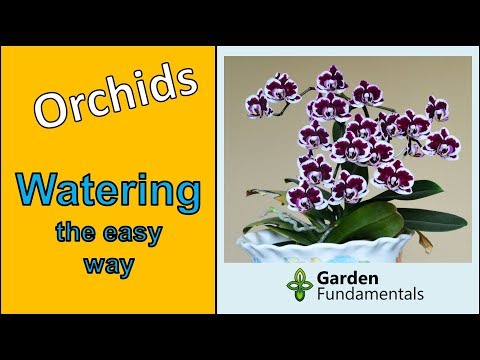
The most common orchid being sold is the moth orchid, or phalaenopsis orchid as pictured above. Since that is a bit hard to say, most people call them phals. This orchid is a great house plant. It requires little care, and will flower for 6 to 12 months a year. I have had some of the smaller cultivars flower for 2 years straight. No other house plant can compete with orchids on flower power.
Orchids are native to jungles located in warm climates. They like humidity, warmth and a fair amount of light. They like more light than most other house plants, but they can be sun burned if they get too much sun, suddenly.
The main thing you need to understand about orchids is that they grow extremely slowly compared to any other house plant. They will sit for months and look like they are not doing anything. This is important because you need to match their care to their growth rate. You also need some patients.
Temperature and Humidity
The ideal temperature for phals is 80 F (27 C) during the day and 65 F (18C) during the night. They are considered to be warm growing orchids. The good news is that they will grow just fine in most homes and you do not have to try to match these temperatures.

Orchids like to have a lot of humidity and you simply cannot provide this in a home. Good thing they grow just fine with lower humidity.
Some people have come up with ways to increase humidity. You can put the orchid pot on some pebbles sitting in water. This seems to make sense, but when the humidity is tested, it shows that the water does NOT increase the humidity around the leaves. It is a waste of time.
Some people suggest keeping the plants in a terrarium. This certainly increases the humidity levels, but in a terrarium they don’t get adequate air movement, which is also important to orchids. Before long fungus infects the plant and they die. Don’t put the plant into a contain.
Should you spray your plant regularly to increase humidity? The simple answer is NO. Spraying increases the humidity for a very short period of time so it really does not do much. However, the extra water can get into the crown of the plant and lead to rot. The spray also leaves behind a salt layer on the leaves, and orchids are very sensitive to salt.
The best thing you can do for humidity is nothing. They will live just fine in your home.
Light for Orchid Care
Orchids are high light plants. They can take a lot of light and some require quite intense light before they flower. The palaenopsis orchid is not one of them. It actually likes less light than other orchids but more than most houseplants. This is one reason why it is very suitable for the home.
It is best to keep them in a very bright window, close to the glass. They can take direct sun, but in order for them to do well in direct sun you need to slowly condition them to it. When you get the plant home it has been used to very low indoor light. It can’t just go into a sunny south window and get full direct sun.
You can condition them for a south window over a period of a week, or place them in an east or west window.
Watering Orchids
More orchids are killed from too much water than for any other reason.
Why is this? Most house plants like to remain wet, and you can water them regularly. If you treat orchids the same way you will kill them. It is that simple.
As an experiment, I took a phalaenopsis orchid out of its pot. Took all of the bark off the roots. Then sat it on my desk for 6 weeks without any water. No spraying, no watering, and no special humidity. After 6 weeks, the leaves were starting to look a bit limp. They were clearly loosing water, but other than that the plant was healthy.
I potted up the orchid and started watering it. It was fine.
Orchids are killed by kindness. Do NOT water too much.
Some web sites and even orchid labels tell you to water with ice cubes. That is just stupid. Have a look at Watering Orhicds with Ice Cubes to read more about this.

Orchid roots like to be watered, and then allowed to almost dry out, before the next watering. If roots are too wet – they rot and die. If roots die – so does the orchid.
So how should you water them? Like any plant, you should water it when the plant needs water. I know that doesn’t help you very much so I’ll give you a simple way to water properly.
Don’t water if there is any moisture in the pot. How do you know? You can stick your finger into the pot and if it feels wet – don’t water. You can also lift the pot. When the pot is dry it gets very light. It takes a bit of practice to use the lifting technique, but it works very well once you get the hang of things. Until you do – use your finger.
When the orchid is dry, set it into an outer pot that has no drainage holes and fill it with water. The orchid is now swimming in a pot full of water. Go have breakfast or a cup of coffee. When you are done, drain the water out and watering is complete.
Contrary to what is written in a lot of places, submerging the orchid roots fully in water will not harm them unless you leave them for many hours. A 1/2 hour soak works, but 10 minutes is better. I have forgotten them for several hours will no ill effect.
Try not to get water in the crown of the plant. If you do, use a paper towel to dry the leaves and the crown.
What happens to the roots when they sit in water? Orchid roots are covered by something called velamen, which is a spongy material. It soaks up water quickly and turns a greenish color. The root is actually very thin and is only a very small part of what you think is the root. The thick root-like structure you see is mostly velamen. By letting the orchid sit in water, the spongy velamen soaks up a lot of water and then roots can use this water for days.
How Often Should You Water Orchids?
Water when the orchid needs water. Following a routine of a fixed number of days does not make sense because orchids can use the humidity in the home as a water source and that changes throughout the year. In winter the air in homes tends to be dryer and you need to water more often. In summer it is more humid and you can water less often.
Where I live, it is quite humid in summer – they don’t need to be watered as much. If you live in the desert, it might be very dry in summer and you need to water more often than me.
If you forget to water for a few days, or you are away on holidays for a couple of weeks, don’t worry. Being dry for an extended period of time will encourage your plant to flower sooner.
Fertilizing Orchids
Common advice says orchids need about 1/4 as much fertilizer as other house plants. I have never given them that much. About once a month, I add a very small amount of soluble fertilizer to the pot while I am watering them. A pinch of fertilizer – as a cook would say – is all you need. Too much salt – fertilizer is a salt – kills orchids.
Do you need ‘orchid fertilizer’?
Of course not! There is no such thing as orchid fertilizer. Orchids use the same nutrients as all other plants. Orchid fertilizer only exists in the minds of marketing people selling products and in the minds of gardeners with too much money to spend. Use whatever you give other potted plants provided all three NPK numbers are about the same.
Roots Outside Of The Pot
What do you do when a root starts growing outside the pot? Nothing. That is how it grows in nature. The orchid knows what it is doing. That root is able to pull moisture out of the air.
Repotting Orchids
You can read all about it here: Repotting Orchids
Or watch the video:

If the above video does not work, try : https://youtu.be/JX4-GFdaEWM
Getting Orchids to Bloom
Fully described in my post: Blooming Orchids


My dendrobium orchid is coming to bloom stage with small node size n the centre then tat way it will stop growth.this is what happens for past one year from the time I bought it.i am in madurai, India. Little hot climate.plz advice
Suggest asking on an Orchid Facebook page.
Robert
Good afternoon
I am dr.sidhartha kiran
Pediatrician
Nice information
Learnt a lot
I live in India
Please tell me how to prepare potting medium for orchids
I use straight coconut husk with no preparation. Not sure if it is available in India but India does process coconut husk so I would assume it is available.
I wonder if you can give me some advice on a vanilla orchid. I live in the tropics, and have a vanilla orchid about 8 inches long that was doing well for many months, putting on a fair amount of new growth. Then one day I noticed that out of nowhere (seemed to me) the root/base of the plant had shriveled up and died, but the rest of the plant looked the same as ever. I hoped it would just power on with its aerial roots, and it did for a while, but now it’s lost its newest leaf, and I’m afraid this is the start of a bad trend towards death. I know people take cuttings of vanilla – should I try treating this like a cutting, cutting the base and putting it in water? Or …what? Any suggestions you can offer will be most appreciated.
Sounds like the roots rotted off – probably from too much water. If you live in the tropics this orchid probably does not even need a pot because it can get enough water from the humid air – that is how it grows in nature.
I would not put it in water. If it still has aeriel roots, cut the stem below one of these, and put the orchid in a pot with loose material like bark chunks. Keep it on the dry side until the roots grow.
Thanks so much for the reply! And you’re right, thinking back I remember I suddenly thought I was neglecting it and started giving it water – bad move, obviously, as that was when the trouble started. Your warning against over watering orchids seems to be spot on. I’m going to let the atmosphere do the work for me from now on. Thanks again!
Hello, Robert! My workplace received 4 pots of orchids as a gift for our grand opening and my boss has given me the charge of caring for them. Some pots came with the usual paper tag attached with instructions on how to care for them whilst others aren’t labeled. I’m absolutely terrified as I haven’t been able to keep an orchid alive before and I’m a total beginner. Some of the orchids come in the company of leafy plants and decorative ribbons, nets, and plastic butterflies; another is potted with an orchid of a different colour and we also had one other that came in a green floral sponge (which I’m sure my boss threw out because it looked dead).
We’ve recently removed most of the decorative nets and butterflies from one pot and I’ve been trying to identify what type of orchid it is as it doesn’t say. I’ve also been watering some of the plants and orchids using a small sauce cup. I noticed that some of the orchids (leaves) and plants have begun to split, yellow and wrinkle; buds that haven’t bloomed have also dried out and fallen off.
After reading your guide on watering orchids, I am still puzzled. Am I supposed to remove the orchid, soil and all, and place it into a different container filled with water? Do I remove the soil and submerge it? Or do I simply remove the orchid along with its pot and submerge it that way? Will the orchids still thrive if I remove all the moss and soil and left it in a pot?
As for the location and temperature for where the plants are placed, it gets quite warm during working hours and they’re positioned near the door. Sometimes, customers will leave the door open to allow cold air in.
I apologise if what I ask seems redundant and stupid. These plants are a nice addition to our workplace and raising them is a new and exciting adventure for me. I’ve looked through several guides and I’m worried that the orchids and other plants are declining in health.
To water take the pot, plus medium, plus orchid and just set it in a larger pot and add water. You do not disturb the orchid or potting mix. After 15 minutes remove it and you are done.
“the orchids (leaves) and plants have begun to split, yellow and wrinkle; buds that haven’t bloomed have also dried out and fallen off” is not a good sign. Wrinkling leaves indicate that they are not getting enough water. Probably because they have no roots. You might want to remove he orchid and have a look at the roots. This link on Repotting Orchids will help a lot to understand what a good root looks like. If the roots are not in good shape – consider repotting the orchid.
Cold drafts are not good for any plant.
Thanks for the reply! I’ve since tried watering a few of the orchids that have their own pots (they’re placed in clear/black plastic containers). I’ve also tried removing the moss that’s been crammed into the roots and trimmed some of the dry, brown roots. I’ve also tried trimming back some stems when I notice yellow parts. I’ve been worried if the orchid would be too stressed if I try to squeeze them out of their plastic containers.
The orchids with split leaves are potted with bamboos (maybe) and some other leafy plant and are in soil with small rocks/pebbles on top.
None of the orchids have wrinkled leaves at the moment but I’ll take a look at their roots. I… I just gotta dig out the ones potted in soil…
Orchids are real tough. Squeezing them out of a pot will not harm them.
Hello again, Robert! I’ve been allowed to keep the orchids since our last exchange and they seem to be doing much better in my home (most likely due to, as you’ve said, the orchids not liking cold drafts). Many of them have lost their blooms save for two: one with mini purple/white blooms and one with large off-white blooms.
I’ve only tried my hand at re-potting the mini purple/white orchid, trimming most of the roots and then submerging it. However, today when I took a look at them again, those roots had rotted. I trimmed back all the squishy roots/parts, assuming that this only happened because the roots were sitting in wet medium too long and that it wasn’t getting enough light. I’ve also tried mixing in more dry medium and crammed it into the container with the orchid, filling more space than I did last time.
For the other orchids, I just put them in a ice cream container (as a outer pot) and filled it with water. The off-white orchid, though it had mostly bare stems, still has 7 large blooms. The roots were clearly healthy (I didn’t take it out of its container) but the leaves were starting to have wrinkled spots, so I just left it to sit in the water.
Although, in hindsight, I live in an area that experiences microclimates. Today, we had cloudy skies and wind, and I put the orchids outside for a little while to soak. Starting to think it was a bad idea to water the orchids since there won’t be much sunlight for days.
Sounds like you are doing a lot of watering. Let them go completely dry before adding any water. Even if they sit a few days completely dry it will not hurt them.
Thanks for the advice, Robert. The phals have grown, and still are growing, new spikes. Two of the orchids have already bloomed with the blooms almost seeming larger than when I first brought them home. The two largest orchid plants have root heads that are peeking out of their potting mix.
The purple stemmed orchid has grown a new purple spike and an aerial root. It also has many more of its roots poking out of the potting mix. I’ve already, accidentally, broken the new flower spike when I tried to straighten it. It also has this broken leaf stub in the center. It had turned purple before but now only the bottom of the leaf is purple, the top part, however, has turned a deep green again.
The rootless orchid has grown new roots, though, they are still quite small. However, it’s also grown flower spikes twice. I cut one of them down and let the second one grow, but half of the stem has dried up. One of the smaller blooming orchids also had a dried up bud at the end of it’s spike and I’m wondering if I’ve been watering them too diligently.
The smaller blooming orchid also look to have blooms that have opened too early, blooming out of order, or are lopsided. Can this be caused by moving their position away from where they first budded or by the sudden cold weather?
Other than that, I’m terribly proud that I’ve been able to get them to bloom again. I’ve been checking if their potting mix is dry before I decide to water them to avoid over-watering.
Congratulations, you are doing a great job.
Small plants with poor root systems might abort buds because the plant can’t support the energy needed to complete them. Not so good for you, but good for the plant. Very low humidity or very sudden changes in temperature can also cause this.
Moving a plant in spike needs to be done carefully. Once buds form, they will grow towards the light, and you don’t want to change this orientation. If you do, the flowers don’t open facing the right way and the display is poor. There is no harm to the plant.
Flower spikes are quite soft when young, but they get fairly hard as they grow, and then can’t be straightened as easily. It is then common to break off a spike, but it usually regrows from the break point.
Hi, Robert! The orchid that had rotted roots isn’t growing new roots at all, only a new leaf. It’s also dropping leaves and I thought it was making room for new roots but I don’t see any evidence of one growing. Do you have any suggestions on how to encourage root growth?
Another plant had a purple stem and I thought it was dead so I trimmed it but the juices that came out was purple. The center was also still greenish.
Purple juice does not sound good.
For the one with no roots – just give it time. It will either die or make roots – nothing you can do to help it along. Once you do see roots, make sure the root gets some regular watering.
I just repotted my phal. I am brand new to orchids. I removed the sphagnum moss and potted it In coconut husk chips. The sphagnum moss was still moist at the center of the plant. The roots appeared to be in good condition, some looked shriveled and dried at the ends, most looked fine, and I didn’t see anything that looked rotted. The chips are bone dry. Should I water it now?
Water whenever it is dry.
I am brand new to orchids, glad I found your site. just repotted a friends Phal and I am puzzled about watering it. I repotted it 4 days ago, 2 days later the medium, Miracle Grow Orchid Mix Coarse Blend, felt dry so I watered it again…submerging and soaking 10 minutes. 2 days later it feels dry again when sticking my finger down into the medium. any advice? don’t want to overwater!
dj
New medium can dry out much faster than older medium. As long as it is dry you can water without fear of over watering.
So glad I found your site!
Thanks Robert for the advice about orchids, I am experimenting with them this year. Superstore had a half price sale on ones out of flower, they aren’t moth orchids, an oncidium and a dendrobium(I already got this one to rebloom! Looking forward to your next article.
Same care for oncidium and dendrobium, except they like more light. They love being outside in summer.
Okay – this seems to make growing orchards do able! Thank you.
Hi Robert Thank you so much for such useful information about Phalaenopsis orchid . I did experience with my Phals in the past same as your advice and it worked very well with beautiful flower . Cheers Abdullah
Beautiful !!!! Good site !!