

You have worked hard all spring and summer to get some fresh red tomatoes from the garden. Now you have all kinds of green tomatoes on the vine and hope that they get red before the frost hits. What can you do to speed up the ripening process? Should you remove some leaves and let more sun reach the fruit? Can you harvest them green and complete the ripening process inside?
Some people suggest putting a banana or apple in a bag with green tomatoes to ripen them – does this work?
Does fertilize or water affect ripening? Would a change in culture speed up the tomato ripening process? Let’s have a close look at the facts and help you bite into a red tomato.

Do Vine Ripened Tomatoes Taste Better?
We have all eaten store bought tomatoes and they have very little flavor – that’s why we grow our own. This lack of flavor is blamed on the fact that store bought tomatoes are picked and shipped green.
Most people now believe that in order for tomatoes to taste good, they must be ripened on the vine.
What is a ripe tomato? It is hard to define, but it should have reached it’s full size and final color. The color could be red, yellow, black, purple and even green striped. Whatever color it is, it should be as intense as possible for the selected cultivar.
The idea that vine ripened tomatoes taste better is a myth – I’ll explain why below.
You can remove fruit that has reached something called the breaker point, ripen them inside, and they will taste as good as vine ripened tomatoes. In very hot weather, ripening inside at lower temperatures can actually produce a better tasting tomato.

Do Tomatoes Need Sun Light to Ripen?
The answer is no. I think we associate the red color of tomatoes with the reddish color of the sun, and incorrectly assume that the sun plays a direct role in the ripening process. It doesn’t.

Therefore, removing leaves from the plant to expose the fruit will NOT speed up the ripening process. In fact it can slow down the process because ripening stops when temperatures get too high. Fruits exposed to direct sunlight can reach a temperature 20 degrees F higher than that of shaded fruits which is enough to stop ripening.
Direct sun exposure can also result in fruit with sun scald.
What is Mature Fruit?
The general population mostly considers a tomato mature when it is red and ready to eat. Botanists define maturity differently. A fruit is mature when the seeds have developed to a point where they will germinate. After all, the plant is producing fruit to make seeds, not to feed us.
A tomato reaches the mature stage (ie viable seeds) when it is still green.
What is the Tomato Ripening Process?
Understanding the growing and ripening process provides good insight into how we can better ripen garden tomatoes. There are several stages in this process including, pollination, reaching the mature green stage, the breaker stage and finally, full ripeness.
Pollination
Pollination needs to happen to start the process. When flowers are not pollinated, bud drop happens and I have discussed this in What Causes Blossom Drop in Tomatoes?. Most tomatoes grown in North America stop setting fruit at about 85 F, but there are cultivars that set fruit at higher temperatures.
Mature Green Stage
Once pollinated, the fruit starts to develop and enlarge in size. The seeds are also developing. Both the outside and inside of the fruit remains green and it can take 40 – 50 days to finish growing.
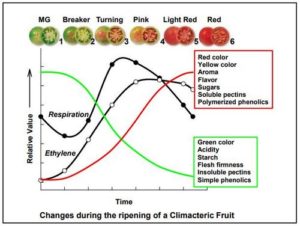
As the fruit reaches the end of this stage, it starts producing a significant amount of ethylene, a natural hormone that initiates the ripening process.
At the end of this stage, the fruit stops growing in size and the outside color turns a pale green. The fruit and seeds are now mature.
The Breaker Stage
The fruit starts the ripening process a couple of days after reaching the mature green stage,. The exact timing of this depends on the variety, but generally its correlated with fruit size where cherry types go faster and large fruited ones take longer (personal communication with Jim Giovannoni).
Recent research indicates that the ripening process is triggered by epigenetics, which is a chemical process that alters the activity of DNA genes. Certain ripening genes are turned on by this process.

You can see the changes visually both on the skin and inside the fruit, both of which start turning a pinkish color.
The breaker stage is reached when the fruit has a definite pink coloration on 10 – 30% of the fruit.
An important change takes place in the stem of the fruit when it reaches the breaker stage. “A layer of cells form across the stem of the tomato, sealing it off from the main vine. When this occurs, there is nothing that can move from the plant into the fruit. The tomato can be harvested and ripened off the vine with no loss of flavor, quality or nutrition.”
Note added Sept 2020: The above paragraph in red is not completely true. It is another myth floating around the internet and can be found on several websites. I have explained the myth in more detail in a newer post called: A Tomato Myth is Born – More About Tomato Ripening. The flow of water and nutrients is slowed down, but not shut off completely.
Fully Ripe Stage
The fruit continues to produce more ethylene, which speeds up the ripening process, until the fruit is fully ripe. The process takes 2 to 7 days.
From Green to Ripe Stage
During the process of going from green to breaker to ripe, several changes take place in the fruit. Acidity, starch and firmness go down, while aroma, sugars, flavor and color go up. The process is affected mostly by the amount of ethylene and the temperature.
Temperature Affects the Ripening Process
The ideal temperature for ripening is 68–77 F (20-25 C). Ripening slows down above and below this range. Extended periods of a few days outside of this range can stop the ripening process.
Above 85 F (30 C), the tomato will not produce lycopene and carotene, the pigments responsible for the ripe tomato color.
It is common for tomato plants to reach the mature green stage by mid-summer, when it’s very hot. When this happens, gardeners start complaining that their green fruit is just not ripening. It is all due to temperature.
Removing leaves makes the problem worse. Adding shade cloth can reduce the temperature and speed up ripening.
Refrigeration destroys the flavor.
Does Fertilizer or Water Affect the Ripening Process
Fertilizer and water affects the development process up to the mature green stage, but they don’t change the ripening process.
Harvest at Breaker Stage
When is the best time to harvest? The breaker stage.
After this point, the tomato is sealed off from the plant and no nutrients or sugars enter the fruit. There is no value in leaving it on the plant.
There are benefits for taking the fruit off. It is less likely to be damaged by insects, birds or the local chipmunk population. It also won’t split if you have a sudden heavy rain. In warm weather, taking it inside to a cooler spot can actually speed up the ripening process.
If a tomato is picked at or after the breaker stage it will ripen properly, and reach full flavor and full nutrition inside your home.
Light has no effect on the ripening process. Just keep them on your kitchen counter.
If you have too many tomatoes, store some in a cooler place to slow down the ripening process but keep the temperature above 50 F (10 C).
Recognizing the Mature Green and Breaker Stages

The breaker stage is identified by looking closely at the outside skin. When it takes on a slight pinkish coloration, usually at the bottom of the fruit, it has reached breaker stage.
There is nothing wrong with leaving the fruit on the vine an extra day or two to be sure that this color change has taken place.
The mature green stage is much more difficult to detect. The best way to do this is to cut the fruit open and look at the seeds. The jelly that surrounds the seeds will be solid before the fruit reaches mature green and becomes more jelly like once mature. The seeds are typically smaller and whiter before maturation but once they have a gray or light brown color, they have a fully developed seed coat and are mature.
Cutting fruit open is not a great idea if you want to keep and ripen the fruit so you are limited to looking at the outside of the fruit, which can be tricky.
Fruit will have reached its maximum size when mature, but the size of fruit can vary on a single plant. A day or two before reaching mature green, the color changes from green to a light green (personal communication with Jim Giovannoni). To be honest, I have trouble seeing this difference.
Breaker Stage in the ‘Purple’ GMO Tomato
The first GMO tomato available to gardeners in the USA is the ‘Purple’, which was available as seed in fall of 2023. In this picture the one in the middle is at the breaker stage and it will fully ripen inside. The top one and the one that is cut open are fully ripe, showing the dark purple, almost black on the outside, coloration.

Using Artificial Ethylene
You have probably heard about putting the green tomatoes in a box or bag along with a ripe apple or banana. The idea here is that these ripe fruits produce their own ethylene gas, which fills the container causing tomatoes to ripen quicker.
Ethylene is also used commercially to speed up ripening. Commercial tomatoes are usually picked at or before mature green and stored cool to suspend the ripening process. When they are required for market, they are warmed up and treated with ethylene, so that they are ripe by the time they reach the store.
Artificial ripening of tomatoes that have not reached the breaker stage results in poor eating-quality fruit. That is why people complain about store bought tomatoes.
Use a Banana or Apple to Ripen Tomatoes

Does this work? Should you add a banana or apple to your tomatoes to speed up ripening?
It depends.
A ripe banana or apple will produce ethylene gas which can speed up the tomato ripening process in some cases.
The best option is to pick fruit at the breaker point and not use other fruit to ripen them. The reason for this is that too much ethylene speeds up the process too much, resulting in less flavorful tomatoes.
Will green tomatoes ripen with a banana or apple? If the fruit is very young and underdeveloped, it just won’t ripen no matter what you do. Fruit that is close to being mature green will ripen. What is the cutoff for this? I don’t know. What is clear is that if immature fruit does ripen, it will lack flavor and it will take quite some time to ripen, so it might not be worth the effort.
Some reports on social media claim that a banana works, and others say it doesn’t. This discrepancy is probably due to fruit being picked at different development stages. Pick it too early and it won’t work. Pick it at a more mature stage and it does work.
Not all fruit produces ethylene as it ripens, so this trick of ripening tomatoes won’t work with all fruit. For example, grapes won’t work.
How to Ripen Green Tomatoes
Picked green, tomatoes can be stored in a cool, (55 F, 13 C) moist (90% humidity) location. When you are ready to ripen them, move them to 70 F (21 C).
When researchers tested cherry tomatoes they found the best ripening conditions to be a well-lit spot that does not get too warm. They produced the best color at 70 F (21 C), but they were sweeter when ripened at 79 F (26 C).
You can also wrap the tomatoes in paper and store them in a box. All the paper does is keep them from touching each other. The closed box will help keep ethylene levels higher. Store these cool until they show some reddening and then warm them up for a final ripening period. Only store fruit that does not have diseases, or damage that could lead to rot.
These methods only work once the fruits is reached 40% of its normal growth potential. Even the addition of ethylene will not properly ripen a green tomato that has not reached this stage.


Thanks for all the information. You do say that at the breaker stage the tomato is sealed off, then later you write that one advantage of picking tomatoes at the breaker stage, means they also won’t split if you have a sudden heavy rain. Just curious whether some water is soaked up by the tomato, or is it just the rain damaging the skin?
I did write that, and it does not make sense. I can’t explain it – but do plan to look into it.
I don’t think the skin would absorb enough water to make a difference.
I dip them in white vinegar for a around 10 seconds giving them a rub, then dry them off with a paper towel, before storing them. This is supposed to stop them going mouldy, you can also wipe them off with a anti-bacterial wet wipe before storage instead.
That might kill microbes on the fruit at the time of treatment. Once the treatment is done, microbes from the air, your hands , the box etc will still land on the toms.
A very useful article.
Thanks that was great. But do you ripen them shoulder up or down?
Does not matter. I actually turn them every few days just to make sure the bottom is not rotting.
I learn a new thing every time I come to your website. Thanks for being my teacher.
Thanks
Excellent article!
The very best article and most useful information on Tomatoes I have ever read! Thank you very much!
Here’s an article that theorizes a missing gene in store-bought tomatoes. Do you think this is credible?https://www.discovermagazine.com/planet-earth/scientists-find-genetic-reason-why-store-bought-tomatoes-taste-so-bland
Probably. Commercial tomatoes have been bred for storage and keeping qualities, not flavor. In any breeding program you have to have a goal to work towards. By setting that goal you automatically select for the genes you want. Other genes can disappear. Not because this is done on purpose, but because it is not a goal.
Work in Florida has identified the 7 or so genes most responsible for flavor and they are now testing new varieties to make sure they are included.
Maybe Robert could examine this issue. I think it’s more likely shop-bought tomatoes are tasteless because of the commercial production chain; they’re hydroponically grown, harvested green, cold stored and artificially ripened for market.
I’m not saying the article is incorrect but unless there’s a commercial disadvantage to having this flavour gene, why would anyone bother selecting against it? The idea doesn’t make sense to me!
I’m running a little test this summer. In 2022, I saved seeds from a tasteless, commercially grown, red salad tomato of unknown variety, and I’m growing the resulting seeds in my (East Midlands, England) garden soil. If my tomatoes have more flavour than the parent fruit, I can stop blaming tasteless tomatoes on the absence of a gene. If my crop tastes just as bland as or blander than the parent fruit, I can stop blaming the commercial production chain for tomato blandness.
I should add I’m not a scientist or professional plant breeder, but I do grow toms as an amateur and the subject interests me.
No one selected against the flavor genes – they just selected for other genes as a proirity. One thing you leaarn quickly in breeding is that you can only select for one or two traits at a time.
Thanks Robert; your point makes sense. I’ll pop back once my “Boring Red” tomatoes are ready to taste. Note I don’t have a hydroponic control or any means of chemically analyzing the tomatoes; it’s just a bit of fun for me!
I did find a study that compares tomatoes grown in soil with those grown hydroponically. The authors found: “Fruit grown in soil showed significantly higher sugar content, whereas tomatoes from plants under hydroponic conditions had significantly higher levels of organic acids. In contrast, aroma profiles of fruit were shaped by the tomato cultivars, rather than the cultivation method.” This was published in December 2021, long after Pat’s original comment in this thread. https://www.frontiersin.org/articles/10.3389/fpls.2021.775722/full
The study mentioned in the article Pat posted: https://www.nature.com/articles/s41588-019-0410-2 (paywalled).
The difference in sugar content is probably due ot the two different cultivation methods, however, based on a quick read, they can’t conclude the difference w2as due to the microbial community. There are too many variables here.
Thanks Robert, well I finally tasted some ripe “Boring Red” tomatoes, which I grew in soil in the same unheated polytunnel (hoop house) as my regular varieties. They had the same culture, conditions and watering regime as their housemates.
My soil-grown “Boring Red” fruits are tasty, rich, complex and tangy, unlike the parent fruit. I don’t know what that means in terms of missing flavor genes; perhaps they’re not important for flavor after all.
Anyway, as you say, there are too many variables at play. I’ve also eaten plenty of good-tasting hydroponically-grown tomatoes. It’s been a fun experiment, anyway.
I like the redesigned website layout, it’s much easier for me to read, thank you. 🙂
Thank you for such full details. I’ve been telling people this for years, and now I have more science to hand.
I pick all my toms at the end of the season and leave them in seed trays on my landing. They ripen over quite a long period so I can have a supply into the new year if I’m lucky. The advantage of this is that they aren’t all ripe at the same time so I don’t have to deal with them all at once. And I see them every day so it’s easy to keep an eye on them. I’m not fond of chutneys but I do love fried toms on toast, so no bananas necessary!
Do you find that the least mature toms still ripen, or do some stay green for ever?
Super-great blog! I just discovered it while searching for Compost Tea (woah…) and have been riveted by it since then. Thank you.
I do almost the same as Jude. The evening before an end of season forecast 27 deg F nighttime low, which will kill the tomatoes, I pick all that are on the plants and put them on the kitchen window sills. This can be in November or as late as the end of December. I simply lay a paper towel below them. I rotate them occasionally (weekly-ish) just to give exposure to all sides. They will ripen at various times, depending on whatever stage the individual fruits were at from outside. No hanging vines, no clusters, no leaves, etc., just a bunch of tomatoes on the cold windowsills. They will slowly ripen across the next two months. Some will rot (rotating them will show which ones), some will ripen even if they were hard and solid green. We ate the last of the 2021 crop, moved to the window sills in mid-November, in mid-January 2022.
Note: At 28 deg F low Temp or higher, for only one night, I’ve found that as long as I put a tarp over the toms, I believe I can prevent the formation of frost crystals. At least that’s my theory; I understand the state change below freezing but if I can keep it just above freezing under the tarp then no freezing fruits. Practice has shown that at 27 the under the tarp T goes below freezing and the fruits would be goners. Now I need to actually pick some at that temp and leave others on to see if there is a difference. Sometimes the temperature warms up for a few weeks after one of these cold snaps so keeping the fruit on the plants these extra weeks would mean eating more tomatoes even later in the winter. 🙂
I love your examination of myths and information on tomatoes!