

Ants seem to be everywhere this year, and many people want to get rid of them. A recommendation I found on social media was to place mint leaves near the hill, and the ants would quickly leave. Apparently the smell of the mint leaves is just too much for them. This seems a bit far fetched, but it is easy to test.
Why get rid of Ants?
Before I get into the main topic I would like to make a comment about ants. They are very good for the garden since they improve soil structure. Sometimes they build their nest right under a precious plant and that may cause a problem–but they rarely kill a plant. Ants are predators and eat other insects, so they keep bugs from eating your plants. For the most part, their ant hills can be tolerated.
Ants in the home is a different story. I understand why you would want to get rid of them in the home.
But if they are in the garden, try to learn to live with them and leave them alone.
How To Get Rid of Ants With Mint Leaves
I planted mint in one bed and I have been trying to pull it out for years. I always miss a piece, and it comes back. I found a few growths in spring and potted them up. This stuff spreads too fast to keep in the ground. After a month I had enough to start testing it on ants.
If ants really do hate mint, they should leave if some leaves are left near their home.
Ants, Mint and the Shed
I built a garden shed about 8 years ago. Almost from day 1, ants took up residence in the shed. There is a space between the two header beams across the main 6 foot wide door. In this space they are well protected, and unfortunately, the way I built it, I can’t easily get at them. I never really tried to get rid of them–they don’t harm anything.
I placed some leaves right at the opening, forcing the ants to crawl over the leaves to get to their home. They did not mind the mint. They just crawled over the leaves and continued on their journey.

Ants, Mint and the Patio
My patio always has ants living under the stones, and it makes a great place to test ‘how to get rid of ant’ theories. I placed some leaves near their entrance and stood back to watch them run for better digs.


As you can see from the picture, ants don’t mind mint leaves. The next day, the leaves were shriving, and the ants were still there.
Mint Does Not Bother Ants
There are a number of different mints, and many different types of ants. In this experiment I only tested one type of each, but my mint is not a good deterrent for my ants.
A previous post looked at How to Get Rid of Ants With Coffee Grounds.
Borax does work for getting rid of ants and it is the key ingredient found in many commercial ant killing products. Mix borax and sugar, 50:50, and put it where ants will find it.


I have seen what was considered professional research, filled with bias and preconceived beliefs on how things work to result in faulty conclusions. Thus, professional research often does not always tell the story. One seeking the truth about an issue, who repeats the same, with all conditions same, with all involved the same; to then get exact same results each time with several tries; most likely found what works, or how whatever the issue how it works.
Your point about different ant species behaving differently is valid. I wonder if different mint species/varieties might also elicit different responses? I have a peppermint plant that has never been bothered by ants, but I bought a chocolate mint last week and it was covered with ants within a day. Possibly the aromatic compounds that give these their different scents and flavours have different effects on the ants?
Quite possible. Take some peppermint leaves and put them on your chocolate mint and see if it chases the ants away.
I use a spray with mint essential oil as an ant and spider repellent. I must see it is very effective, but it is of course very different than using the leaves. I use 15-20 drops of the essential oil on 8 ounces of water, in case you want to try it.
I doubt it works. Do you have a reference to a study that shows it works?
No, only my own findings. I have been using this for two years now and I find it to be very effective.
Then it is just anecdotal. https://www.gardenmyths.com/anecdotal-evidence-not-worth-the-screen-its-displayed-on/
I see. Thanks for the friendly reminder. I’ll remeber to keep the anecdotes to myself.
Actually, there have been a few studies. And it works.
http://www.bioone.org/doi/full/10.1653/024.097.0215
https://www.ncbi.nlm.nih.gov/pubmed/19736768
https://www.researchgate.net/publication/269038322_THE_REPELLENCY_OF_FIVE_ESSENTIAL_OILS_AGAINST_THE_ARGENTINE_ANT_HYMENOPTERA_FORMICIDAE
Of course, it depends on the type of ant and/or peppermint, and it needs to be reapplied with some frequency, but some anecdotes are true 🙂
Thanks very much for posting these links. The middle one does not deal with ants but is still interesting.
One thing to note is that these studies use essential oils of plants, not the plants themselves. That makes a big difference in how they affect insects.
Digging up a mint bed now. It is CRAWLING ALL OVER with ants. If I remember right, ants actually ‘cultivate’ a specific fungus for food (fed and grown using the stuff they bring back to the nests). Some plants will change the soil, thus killing off the fungus they eat and forcing them to move.
Mint does not appear to be one of those plants lol. ^_^
Great post, I am glad I stumbled across this site.
We have ants that protect and relocate aphids on various plants in our garden. The aphids are damaging to the plants which is why many people try to get rid of the ants. There are many papers written on this phenomenon, although the papers often relate to root aphids some relate to the more terrestrial ones.
I have three different types of mint, each living in a separate pot. Each of the pots has a nest of ants living in the soil among the mint roots. I know that we have many different species of ant in Australia but I have found these three pots of mint housing ant colonies to be rather conclusive that the blanket statement of “mint deters ants” to be false.
I think a lot of people try to get rid of ants because of the hills them make. Aphids can certainly be a problem – I wonder how much ants contribute to an aphid outbreak? Would they occur if no ants were present? I do plan to do a series on ants at some point.
I 100% agree!!!
I have a beautiful mint growing together with ants.
For many years, the basic black ants in my garden have been sucking the life out of any younger cole crops, particularly broccoli and cabbage. Believe me, I have worked very hard on evaluating this and problem solving it. What they do is chew near the base of the stem, apparently to suck it’s juices, because they do not completely cut it down, there are NO other bugs (I know the theory about them farming aphids, but this is well before aphid season here), and the plants slowly change to a sickly yellow-purple and die. Once the plants are mature enough, the stalks must be either impervious or not taste as good, because the ants move on to other things. The best results I have had is to go out nearly daily during this time period to see if it is time again to spray the plants and surrounding soil with Bonine Eight. Diatomaceous earth doesn’t slow them down enough right at the plant, although dumping it on a hive as made them relocate. I have even tried smearing the base of the plants with vaseline once, but that seemed bad for the seedlings, too, even if the ants stayed away. Plus, the ants come up from underground as much as they come across the surface.
Can you provide some evidence that ants eat the plants? Either a report from a reliable source or a more detailed explanation of your experiment.
Ants are not known to eat live plants.
Okay, it took me a while, because I would go out and there was nothing to see except ants, and ants everywhere. They would be crawling all over the part of the stem that seemed to be chewed away. I finally figured out the ants were harvesting the root maggots underground. I wrote about it on my own blog, if you care to see: http://dailyimprovisations.com/ants-cabbage-maggots-and-broccoli/
They may be good for the garden, but when we’re talking about fireants, I’ve given up on live and let live and gone for the bait and nuke option, unfortunately. I’ve already heard often refrain, “If you maintain an organic garden, fireants are never a problem. They only show up in out of balance soils.” After years of trying to remove them from an organic garden with organic methods, I’m calling bs on that theory. Sorry, they make gardening pure misery, make it impossible to have outdoor compost bins, and cover small plants entirely with their oversized mounds.
They also will colonize inside potted mint containers! Bonus! :/
The idea that fire ants can determine that a garden is organic is ridiculous.
We don’t have fire ants – yet, but I hear they are nasty.
I have no real references for the borax and peanut butter statement except for my own experimentation. I have a jar of peanut butter i keep outside that I’ve mixed with borax, and every week or so I leave little dollops out for bait next to any colonies i find. I do see a reduction in ants, but the hives are still active. I’m in Austin, TX where fire ants are the norm. I think a new queen is just getting anointed if the current one dies. Maybe the fire ants are a little more resilient then sugar/carpenter ants.
What i find best is to just annoy them enough so that they leave the garden bed to somewhere i can use a commercial product on them. Diatomaceous earth also works really well if i just want them gone and don’t want to play games with them in my herb/veggie beds.
In any discussion of ants it is always important to realize that in North America alone, we have 1,000 ant species and we are still finding new species. They are not all going to behave the same way.
I have a few garden beds filled with mint and the ants leave these beds alone. The beds that don’t have mint always get ant infestations. I’ve tried pulling and placing mint leaves into my non mint beds, but this does not eradicate the ants. Also, your ants may prefer peanut butter (protein) over sugar. Mixing borax and sugar/peanut butter will temporarily reduce the number of ants, but won’t kill the hive.
It is quite possible that a bed of mint is more effective. It could also be something the roots exude that keeps ants away – I only tried the leaves.
Do you have some references to back up the statement “borax and sugar/peanut butter will temporarily reduce the number of ants, but won’t kill the hive”? The reason I ask is that all of the claims for borax say the ants take it back to their hive and all the ants feed on it – thereby killing them. Also, the commercial products for getting rid of ants use borax plus a food ants like. If it does not work – why would it be such a popular product? But it all could be a myth.
You know why I think they leave them alone is because they have such dense suffocating root system.
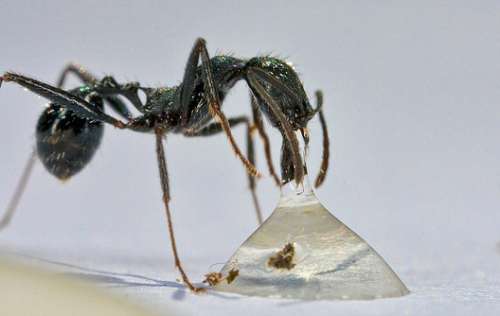
Great picture of the slurp Robert
Not sure about ants improving soil structure, I wait to be persuaded. OK I think leaf cutter ants may do some good and perhaps ant’s distribution of organic matter?
I don’t regard the crumbly breaking up of soil as improving structure – just a demonstration of it!
And I am a fan of them distributing seeds
Fascinating creatures.
Their digging also adds air to the soil. Air + organic mater = better soil structure. I do plan a post on ants where I will go into this in more detail.
I think something they might DO is deter moles. That might be a plus.
Ants have a chemical/wax on their bodies that keep them safe from bacteria/fungus. Borax melts that protection, I believe.