

Banana peels are great for your plants, or at least that is what the internet says. You should bury some peels in the bottom of the hole when planting roses. You can add them to water and let them sit for a few days to make banana peel tea, an excellent fertilizer for indoor plants. Try drying them into a black leather and then crushing them to make banana skin powder which is great for the garden. I even found one web page that makes a fertilizer spray out of them.
Eating banana peels is also a hot topic and they reportedly provide all kinds of health benefits and even whiten teeth.
Lets have a look at the reality of banana peels for plants. Are they better than just another source of organic matter?
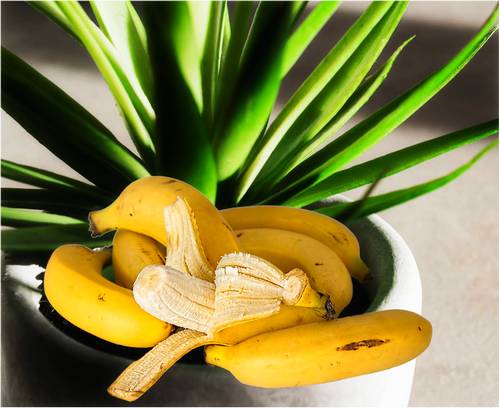
Banana Peels for Plants – The Claims
I started this post when I saw a YouTube video that claimed banana peels have an NPK of 0-25-42.
When you see claims like this it is critical that you give them a quick sniff test for reality. Does it make sense? Does it seem realistic? If not – run for the hills because the rest of the advice is now suspect.
A banana peel is part of a plant. A plant needs protein to function – all living organisms have this requirement, and protein contains nitrogen. Clearly the number zero for nitrogen is complete nonsense. No living organism, including all plant material has a nitrogen level of zero.
All living organisms contain water, and in fact they contain a lot of water. You probably know humans are mostly water and so are plants. This number is around 80%. If a banana is 80% water, how can the potassium level be 42%?

Even if you didn’t know the 80% moisture value, the above NPK number says that 67%, or 1/3 of a banana peel is phosphate and potash. Does that make any sense at all? NO!
This is not the only site that claimed a 42% potassium level, which is completely ridiculous.

The Question to Ask
All organic matter is good for soil and plants. They all provide a carbon source and plant nutrients as the organic matter decomposes.
The important question is, are banana peels significantly more nutritious than other sources of organic matter. Do they provide any unique beneficial chemicals? If they do, they might be a superfood for plants.
Vague Claims for Banana Peels
Do a bit of Googling and you quickly find all kinds of claims saying banana peels have a “high” nutritional value. Some even say the peel has higher nutrients than the banana. This sounds convincing, but you may have noticed that there are no numbers included in these statements.
What does “high’ mean? And how much higher is it compared to other organic matter? Without numbers, these are just fancy words to try and convince you to believe a story.
Dry or Wet Weight?
Even when numbers are supplied, there is still a big problem with the data. Is this based on wet weight or dry weight? When someone says a banana peel is 42% potassium, is that based on a normal wet peel or a dry peel? This is a crucial point since most of a banana peel is water.
Chemists get around this problem by reporting chemical content on a dry weight basis. But many sources take these numbers, if they even bother to look it up, and present them as a wet weight, which exaggerates the value by a huge amount.
Chemical Analysis of Banana Peels
Several nutritional experts made the claim that banana peels have not been studied for nutrients, but I had no problem finding some studies.

Note: Except for the moisture values, all percent values are based on dry weights.
Sources: Source A, Source B, Source C, Source D
The average nitrogen in protein is 16%, so the 3.5% protein in banana skins is equivalent to 0.6% nitrogen.
The above table reports values for potassium and phosphorus, but NPK uses values as potash and phosphate. The potash and phosphate in banana peels is 11.5% and 0.4%.
The NPK value for banana skins is 0.6-0.4-11.5. But this is the value for dried banana skins since all of the above values are calculated on a dry weight basis. The NPK of fresh banana peels is 1/5 of that, making an NPK of 0.1-0.1-2.3.

For comparison, purchased bagged manure is around 1-1-1.
Are Bananas High in Potassium?
Not really. Bananas have more potassium than some other food, like grains and meat, but all fruits and vegetables are higher in potassium – “there is nothing special about bananas. Tomatoes, potatoes, and beets also have potassium and often more potassium than your average banana.”
One cup of chocolate milk contains the same amount of potassium as a banana.
Magical Properties of Banana Peels
There are also some vague claims of other important chemicals in banana peels that might be beneficial to plants, but I found no specific claims that could be reviewed.
There are many more claims for our health, including things like antioxidants, but a cursory look shows that the science is not there for the benefit of these, at least not yet.
Banana peels are just another source of plant organic matter.

Banana Peel Tea
Some claim you can steep banana peels in water, either using hot water, or just letting them sit for several days in the sun.
I have reviewed the value of using left over tea before and this tea would be no different. There is limited decomposition during the process of making it, which means that most of the nutrients remain in the peels.
Potassium leaches out of organic matter more quickly since it is not chemically bound, and banana peels have a higher level of potassium, so the tea might add some potassium, but not much else.
Don’t get conned by tea claims for plants.

Banana Peels for Roses
This is a very common piece of advice. Place some banana peels in the hole before you plant roses. Some even take the time to cut them into small pieces.
Why just roses? If this was good advice, would it not be good advice for all plants? Or is just that roses love bananas – or is that garlic?
As banana peels compost, they turn into black mush. I just can’t see this being good for new tender roots?
Look at the NPK. It is very high in potassium relative to nitrogen and phosphate. That is not an ideal ratio for plants. To compensate for this some people add eggshells! We know eggshells don’t decompose in most soil, and how would adding calcium balance the problem?
This idea probably started because people believe bananas have a high potassium level, and we have the very common myth, that potassium stimulates roots – which it doesn’t. From this misinformation it naturally follows that banana peels stimulate roots and flowers on roses?
This is just a dumb idea.
Bury Them Around Plants
If you forget to add them to the planting hole you can dig up the soil around the roses, add the peels, and cover them with soil. Roots grow in the top few inches of soil – digging around the base of shrubs is never a good idea.
What Should You Do With Banana Peels?
Banana peels may contain a psychoactive substance, and smoking them may produce a “high”, or a sense of relaxation. This may be a myth associated with the 1966 song “Mellow Yellow” by Donovan.
Apparently, some people even eat them as a cooked desert or a smoothie drink, and that is OK. A vegan food blogger’s recipe uses banana peel as a ‘pulled pork substitute’ – I don’t think so!
Banana peels are just another form of plant-based organic matter. Add them to the compost pile, or spread them on the ground to decompose. They will add value to both the soil and plants but they are not a superfood.
Don’t get hooked in by all the crazy ideas on the internet.


I understand the tea is a waste of time. Based on the dry weight composition, wouldn’t drying the peels and grinding them into powder so you can dissolve in water be a good organic fertilizer for houseplants?
Even when dry and ground, most nutrients are still not decomposed into plant available nutrients.
I understand your point on making this article, the amount of “life hacks” regarding gardening is ridiculous.
However, I got here when I was searching for the npk value of dry banana skin, with the value that you presented 0.6/0.4/11.5 in mind, If I were to compost those peels, would the resulting matter have that value? if only banana peels and efficient microorganisms were used?
Thank you for your time.
Provided none of the nutrients are lost in the process – yes.
Nitrogen is usually lost during composting as microbes convert it from one form to another.
Soluble nutrients like nitrate and potassium are also lost if rain or too much water wash it out the bottom of the pile.
Does the banana tea have to be made in a glass jar
Since it does not do much – why make it at all?
When I eat a banana in the morning, I’ll still throw it in water and then water my vegetables with it the next day. It certainly can’t hurt.
Didn’t you just debunk your own “if bananas are 80% water, how are they 42% potassium” statement by posting a chart that says bananas are 81% water and 31% sugars? There’s entirely too many opinions mixed with science for this to be credible.
Valid point. The data in the table, except for % water, is based on dry weight.
Read the notes. Dry weight v wet weight percentages.
I believe in science data. However, it doesn’t quite match with the results I got from using banana peels for my plants. I used to think banana has high phosphorus because whenever I threw banana peels in the garden or buried them around the fruits producing plants there were noticeable boost in flowers and fruits production. I didn’t use any other fertilizer but just applied food scrapes directly like coffee ground, eggshell powder, banana peels around the plants and had good yields. With the low P in banana peels, I already had good yield, I could only imaging the result if I used fertilizer with high P. We have moved and have no fruit trees to test. I will be planting some tomatoes and use bone meal to see if the production will be tripled!
Banana peels make a great smoothie for my worms in my farm! It’s like a free buffet. But I did do a small experiment with banana water. Gave half my sunflower seedlings B water and most of them grew much taller. So I’m happy
Thank you for this article. As someone who used to work with scientists (although I’m not one myself) and given how a lot of sites seem to regurgitate information they find on other sites without verifying whether it’s actually true or not, I have developed a need to question everything I read and cross verify whether there is any basis in truth.
My dh found this banana tea ‘fact’ online and has diligently been making banana teas for some time and by and large I’ve just ignored it but now he wants to put it on our veg plot I was curious to know whether it actually worked. He leaves his essentially fermenting so it’s also nice and bubbly. Not something I think he actively thought about doing, more that he just doesn’t get around to using it. As I’m open to ideas on making home made fertilisers and in the interests of n=1, I am planning to test it to see if it works. I am now more skeptical having read your article!
“Don’t get conned by tea claims for plants.”
Is this also true for nettle tea and comfrey tea?
Probably. The point is that 99.99% of the plant is still in the plant. Only a bit of color goes into the water. How can that be a benefit to plants?
As a biochemist, I find it disturbing when a someone claims that the experiment doesn’t need to be done. If that was the case then scientific knowledge would stop with what we “know” now.
On the other hand science does not study everything – not nearly enough time or resources.
Given the fact that this has not been studied, and that there is no visible decomposition of the peel – what is your best guess estimate of the nutrients in the tea, based on science that we do know?