

A rooting hormone is used in plant propagation to grow new roots on cuttings. In a previous post, called Rooting Hormones – What Are They, I provided some background information. In this post I will help you understand how they should be used.

What Is a Cutting?
In plant propagation a ‘cutting’ is any piece of a plant that does not have roots. It can be part of a stem, or even just a leaf. The cutting is taken off the mother plant, treated with hormone and then planted in a rooting medium (soil). Over time the cutting will form roots.
Many plants will form roots without rooting hormone. For example you can take a piece of stem or leaf off most sedums and they will root. Most perennials will root quite easily without hormone as well. Some trees root easily, some only with rooting hormone, and some will not root at all even with rooting hormone.
Avoiding Diseases
When using rooting hormone it is best to take a bit of the hormone out of the container you bought, and place it in another small container, or flat dish. You will need very little for each cutting.
After applying the rooting hormone to your all of your cuttings, discard any that is left. This will minimize the potential for spreading diseases to future cuttings.
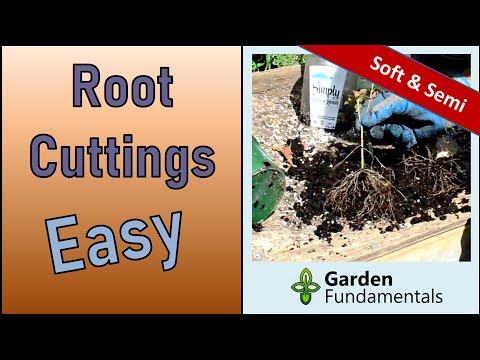
Powdered Rooting Hormones
Rooting hormones that are sold as powders normally contain something like talc – a very fine powder – along with the hormone. Dip the base of the cutting into the rooting hormone and tap it slightly on a hard surface. This will knock off excess powder leaving a very thin film of powder on the cutting. You only want a small amount of rooting hormone on the cutting. Too much can inhibit root growth.

Make a hole in the rooting medium (ie soil) with something like a pencil, and push the cutting into the hole. Firm the soil around the cutting. By making a hole first you reduce the chance removing the hormone as you push the cutting into the soil.
The above is the recommended way to apply the powder. To be honest I don’t do it this way. Instead I dip the cutting in the rooting hormone and instead of shaking the excess off, I just stick it into the soil. As the cutting is pushed into the soil, excess powder will be removed. I think that this method makes a better seal between the cutting and the soil.
Powdered forms of rooting hormone are a bit less effective than liquid forms, but they are easier to work with and are are less toxic. Powdered forms are a good choice for beginners.
Some popular powder rooting hormones include: Rootone, Fastroot, Takeroot, and Stim-root.
Liquid Rooting Hormones
Liquid forms of rooting hormone are available as a ready mixed solution or as a concentrate. If it is a concentrate you will have to dilute it, according to directions, before you use it. Once diluted it is only good for a day – discard unused liquid.
The liquids transfer hormone to the cutting more easily than powders. It is therefore important to control the amount of time the cutting stays in the liquid. Follow instructions, but it is usually no longer than a few seconds. Longer immersion may result in too much hormone getting into the cutting, which may prevent rooting. This timing issue is one reason that powders are easier to use.
Once treated, stick the cutting in the rooting medium following the procedure described above for powders.
Some popular liquid rooting hormones include: Dip’n Grow, Dip & Root, Roots, and Dyna-Grow. There are also gel formulations like Clonex, on the market. Some people really like the gel, but powdered rooting hormones are more popular.
Selecting the Right Concentration
As discussed in Rooting Hormones – What Are They , rooting hormones are available in different strengths (concentrations) to more closely match the kind of plant you are propagating. Some products come in only one strength, and some come in multiple strengths. The liquids can be diluted to the strength required, which is one of the main reasons for using liquids formulations.
If you think about how the hormone is applied to the cutting, you might realize that the amount added is quite variable. Some people will dip more or longer, and then shake off less. Some use a pencil to make a hole, some don’t – affecting how much is rubbed off. For the home gardener it does not have to be that precise.
I tend to use the higher concentrations recommended for woody plants for two reasons. I grow more woody cuttings, so I have the right one most of the time. Secondly, if I want less for herbaceous plants, I either apply less, shake harder, or stick them in soil without making a hole first. All of these steps cut down on the amount of hormone my cuttings get.
Old Rooting Hormone
For the average gardener, a bottle of rooting hormone is enough to last a lifetime. That sounds like a good deal. Unfortunately, the hormone has a expiration date. Some manufacturers suggest it should be discarded after 1 year. Some say it is good for two years. Hormex says this about their product, “As long as Hormex Products are kept at room temperature and out of direct sunlight, the shelf life is 3-4 years”. Chemical companies report that IBA is very stable suggesting it will last many years. No one seems to provide any real proof of how quickly it degrades. A lot of drugs are good well past their expiration date.

Solid chemicals (ie powders) are generally more stable than diluted chemicals, so powders probably last longer. I suspect the powder forms have a shelf life of at least 5 years and probably more than 10.
Storage of Rooting Hormones
All chemicals degrade over time. The best way to store rooting hormone is in the dark and cold. The containers are usually light proof so they are always dark. A fridge would be a perfect place for storage.


Robert has the patients of a saint lol. Thank you for the info.
Great website! I want to propagate roses from cuttings. Only 0.1% IBA products seen to be widely available in Ontario. Where can I get 0.3%? If not, is there any way to work around this? Thanks! Suja.
Use the .1% and leave a bit more on each cutting. You might not even need it for roses, but it does help.
I use a rooting powder in my azalea cutting how often should I water them
You want to keep the media moist.
I accidentally watered 3 adult plants with root hormone. Does anybody know what will happen or what i should try and do?
Do nothing – it won’t harm them.
I have a container of Shultz rooting hormone from 1993
I used the wrong root hormone strength on my rose cuttings. They are in my propagation container saying moist. I used a 1 instead of a 3. When the 3 comes in should I reapply the 3 to the cuttings and re set them?
The difference between 1 and 3 is concentration. If you only have 1, add more to the cutting.
Adding 3 later might help.
I have grafted Black Beauty Mulberry tree scionwood for the last two years and none will grow. This year I will root Black Beauty Mulberry tree cuttings that I have ordered and will use powered hormone IBA. Should the powdered form grow roots for the cuttings that I have ordered so they will make trees?
Nobody can tell you. Too many variables, but you have a better chance with rooting hormone than without.
What is the best way to dispose of liquid root stimulator that has expired? Is it bad to just pour it on the yard?
It won’t hurt the garden.
Nothing is wrong with my plants just wondering if I able to mix water and root hormone and water plants with it
You can, but it won’t do the plant any good – it is already growing roots.
Hello, I have a woodsy tropical plant that’s dying (I put it indoor during Fall months, too close to my heater vent). Anyway, I’m trying to revive it by changing the soil and apply rooting hormone. It had root from beginning but I don’t know at this point whether it’s alive or died already, hard to tell since the leaves fell off. Should I leave the root alone or scrape it and regrow using the hormone? If I leave it alone (assuming it’s alive), will hormone fortify the existing root? If it died already will hormone propagate new root development? It’s about 12 inches cutting. Your help is highly appreciated.
You should have left it alone. Changing soil will do nothing to a plant that is suffering. Rooting hormone should only be used on cuttings, not existing roots.
Would root hormone be helpful with rhizomes and cuttings such as peonies?
Not sure. I never see it recommended for use on them.