The use of wood chips for mulch is very popular but there are also many myths about it. Will it rob nitrogen from the soil? Is the dye on black mulch toxic? Do wood chips attract termites and can it ignite spontaneously?
These are just some of the myths I’ll investigate in this post.
Fish fertilizer is a common organic fertilizer that is recommended for both houseplants and the garden. It has a strong following and its proponents feel that it is better than any other type of fertilizer, but how does it really stack up against the most common organic fertilizer; compost?
Fish fertilizer – are the accolades true, or a bit fishy?
Compost vs Fish Fertilizer, by Garden Fundamentals
The popularity of indoor plants has skyrocketed in the last year and so have the myths surrounding them. I have gathered a long list of common houseplant myths to save you the trouble of making mistakes and getting into bad habits. Each myth has a brief description, and where appropriate, a link to a more detailed discussion.
Growing indoor plants is fairly easy if you take some time to research the plant you are growing and follow some basic rules. Don’t get sucked into internet hype about new ways to deal with problems. Experienced gardeners keep things simple.
Common Houseplant Myths That Save You Time and Help Plants Grow Better, photo by Proline
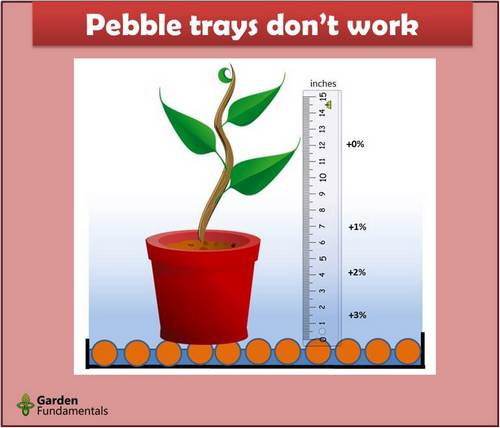
Indoor plants do better withย higher humidity and there are several recommended ways to create this increased humidity. Some of these suggestions, like misting and pebble trays, have been used for many years and are still being recommended today. But do they work? Do they increase humidity and are they good for houseplants?
The heating we use in winter dries the air in our home and this makes it more difficult for plants to grow. The same thing can happen with air conditioning in summer. Tropical houseplants are particularly vulnerable.
What is the best way to increase the humidity around your indoor plants and how high should the humidity level be?
Increasing Humidity for Indoor Plants – Pebble Trays Don’t Work
There is a lot of talk about companion planting, especially for the vegetable garden, and marigolds seem to be at the top of most plant lists. They make other plants grow better and their strong smell keeps pests away. They even stop root knot nematodes.
Much of this information is anecdotal and I suspect some of it is just made up to sell some popular books. What do marigolds actually do in the garden?
In 1992, The New York Times reported that “Crop plants sprayed with diluted methanol showed significantly greater yields while requiring less water. Cabbages doubled in size, wheat seeds doubled in weight and number, the water needs of cotton crops dropped by half, tomatoes grew faster and were significantly sweeter, roses grew faster and produced more flowers, and strawberries, eggplants and watermelons gave better yields.”
That was almost 30 years ago. What does science say today, about using methanol on plants?
If you spend any time on social media or reading popular gardening blogs you already know that hydrogen peroxide does all kinds of useful things in the garden. You will see blog headings such as, “11 Mega Reasons why Hydrogen Peroxide for Plants is a Must” and “10 Amazing Uses of Hydrogen peroxide for Plants in the Garden.”
This stuff must be fantastic! Or not.
Not every claim is a complete myth, but many of these claims are just wishful thinking. Time to look at some science and get down to the reality of using hydrogen peroxide in the garden.
The common advice is to water in the morning and not at night because watering at night keeps leaves wet all night and allows fungal spores to infect leaves. This seems to make sense, but is this really true? Do leaves stay wet a long time if watered at night?
What do farmers do? If they have to irrigate 100 acres, do they stop watering in the afternoon to reduce fungal infection?
Another common piece of advice is to water the soil only. Don’t get the leaves wet and you will have less fungal problems. I have always felt that water evaporates fairly quickly so is this really a concern?
Baking soda in the garden seems to be the next fad. Numerous videos and blog posts tout the many ways you can use baking soda, but do any of these hacks work?
It’s a pesticide, a herbicide, a fertilizer and it makes tomatoes taste sweeter. You can even use it to measure the pH of your soil. It’s a wonder product for the garden. You might think that is all nonsense, but there is some truth in some of the claims. In this post I will look at the claims and separate fact from manure.
Baking Soda in the Garden – Hacks that Work and Don’t Work
Indoor plants are not too fussy about the water they get, but certain conditions like pH, alkalinity, hardness, chlorine, and sodium levels are a concern. If the water is not suitable, plants fail to grow properly and may die. Many gardeners blame themselves for having black thumbs when, in fact, their problem is “black” water.
In this post, I will discuss things that you can do to try and correct any water issues you might have.
Hard Water Stains: Solving Problems With Your Water – For Indoor Plants, Source: Good to Grow
There are many different sources of water that can be used for plants including tap water, reverse osmosis water, softened water, and rain water. What are the differences between these and which are the best ones for plants?
When someone says, ” I just use tap water for my plants” you really have no idea what type of water they are using.ย It could be water straight from a municipal service or from a well. It could also be water that has gone through a softening process or a reverse osmosis system. It could be naturally hard or soft or it might contain a lot of sodium chloride. All of these can come out of a water tap.
In this post I will discuss the various types of water and how they affect plants. In a future post I will give some practical advice for solving problems you might have.
Tap Water, RO Water, Softened Water, Rain Water – What Are The Differences?
Alkalinity is used incorrectly by many gardeners and even garden writers. I’ll bet I’ve made this mistake. If you think alkalinity refers to a high pH, you should read this post.
What is Alkalinity – It May Not Be What You Think?